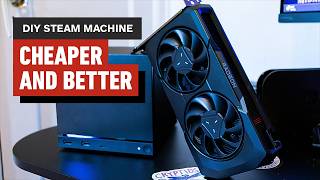

DIY Steam Machine Beats Valve's by 18%
43sShows that a custom PC can outperform an official Steam Machine for less money, appealing to budget gamers.
▶ Play Clip"Delivers on the promise of building a cheaper, better-performing Steam Machine, though some steps are glossed over."
This video compares Valve's official Steam Machine to a custom-built DIY Steam Machine using similar components but with off-the-shelf parts. The custom build outperforms the Steam Machine by up to 18% in some games while costing slightly less money, offering better upgradability and easier maintenance.
Valve's Steam Machine is a console-like PC with cute aesthetics and serious gaming capabilities, but it's expensive and hard to buy in 2026.
We attempt to build a custom Steam Machine using Valve's Steam OS, targeting comparable performance but with better value and upgradability.
MicroATX is chosen over Mini-ITX for better cooling and maintenance without the price premium.
The 7600X is cheaper than the 7600 non-X, offers 6 cores/12 threads, and boosts to 5.3 GHz, 500 MHz more than the Steam Machine's CPU.
For $10 more, the Ryzen 5 9600X offers 5-10% better performance and lower temperatures.
A budget Thermalright cooler under $20 keeps the 7600X within reasonable temperatures.
A sub-$100 B650 board with PCIe 5.0, 2.5GbE, but no Wi-Fi (can be added via USB dongle).
Single stick of PNY DDR5-5600 for $200 allows easy future upgrades but sacrifices dual-channel performance initially.
Under $300, faster than the Steam Machine's mobile 7600. Supports FSR 4.1, but not frame gen; lossless scaling can help.
A budget 500GB PCIe 3.0 SSD for under $100, adequate for indie and older games.
A 750W non-modular PSU runs efficiently and quietly, leaving room for future GPU upgrades.
A $70 microATX case with mesh front, clear side panel, and four RGB fans. Compact but lacks front dust filters.
The custom build beats the Steam Machine in most games: Death Stranding 2 (+18% at 4K), 007 First Light (+17% above 60fps), Cyberpunk (+10%). Resident Evil Reqium was slightly behind.
The RX 7600 desktop GPU's four extra compute units give the edge. At 4K FSR Performance, Death Stranding 2: Steam Machine 35 vs build 42 FPS. First Light: Steam Machine 53 vs build 63 FPS. Cyberpunk: Steam Machine 68 vs build 75 FPS.
Building your own Steam Machine with off-the-shelf parts is a viable, cost-effective alternative that outperforms Valve's official hardware in most scenarios while being easier to upgrade and maintain.
What is the CPU used in the DIY Steam Machine build?
AMD Ryzen 5 7600X
01:41
How much more does the custom build cost compared to the Steam Machine?
It costs slightly less money
00:44
Which GPU is recommended for the build and why?
AMD Radeon RX 7600, because Steam OS has poor Nvidia support and it's faster than the Steam Machine's mobile GPU.
04:33
What is the performance difference in Death Stranding 2 at 4K FSR Performance?
Custom build achieves 42 FPS vs Steam Machine's 35 FPS (18% lead).
07:52
Why does the custom build outperform the Steam Machine in most games?
The desktop RX 7600 GPU has four extra compute units compared to the mobile GPU in the Steam Machine.
07:40
What is the advantage of using a single stick of RAM initially?
It makes future upgrades easier because you can add a second stick without replacing the existing one.
04:19
18% Performance Lead
The custom build outperforms the Steam Machine by 18% in some games while costing less money.
00:44GPU Choice Constraint
Steam OS currently lacks support for Nvidia/Intel GPUs, mandating AMD and limiting options.
04:33Trade-offs in Form Factor
Valve sacrificed performance for compactness; the custom build offers better thermals and upgradability at the cost of size.
07:13Gains are Gains
Even small performance gains (10% in Cyberpunk) are worth the DIY effort for the stated goals.
08:53[00:01] system with serious gaming shops and cute aesthetics. It makes a great entry sitting on the sidelines for a while and you want a consolelike experience with some added PC functionality. But like everything else in 2026, they're a bit
[00:15] expensive and like everything Valve makes, they're hard to buy right now. Steam machine to the masses, Valve also dropped an updated version of Steam OS, which works well with AMD GPUs, making it much easier to build your own
[00:29] homebrew steam machine. Yes, Basite is an option and arguably more fleshed out. own Steam machine, let's use the real deal and make it comparable as we can. listings than we can count, and here's what we've managed to come up with for a
[00:44] DIY Steam Machine that, according to our testing, will outperform the Steam testing, will outperform the Steam Machine by as much as 18% for slightly less money. Now, while this PC will be faster, it's not as compact, but it's
[00:57] also far more upgradable, far easier to work with, and with its off-the-shelf components, far easier to fix and maintain, too.
[01:13] build to be relatively compact, but there was no way we're going to be able to compete with the Steam Machine's Supervelt design. It is using bespoke performance and cooling potential in such a small little footprint. So, we'll
[01:27] be targeting a microATX system which is smaller than a standard desktop system, but doesn't have the price, premium, or maintenance headaches of mini ITX. So, let's take a closer look at each of these components, why we chose them, and
[01:41] budget is a little lighter or has a bit more room to maneuver. The AMD Ryzen 5 7600X is a great entry-level CPU from the AMD Zen 4
[01:53] generation of CPUs, and it's actually cheaper than the 7600 nonX for some It has six cores and 12 threads like the Steam Machine, but it can boost up to
[02:05] Steam Machine, but it can boost up to 5.3 GHz, which is 500 MHz more than the Steam Machine's CPU. Pulls a lot more power, sure, but this is a desktop chip. It is bound to. If you want to boost your CPU performance a little more, the
[02:19] your CPU performance a little more, the Ryzen 5 9600X is only around $10 more. That can't be right. That has to be that has to be wrong. Okay, I looked it up. It is only about $10 more and it offers 5 to 10% additional CPU
[02:33] efficiency, which can help keep temperatures down. Thermmorite has been one of the most prominent budget cooling brands for a number of years, and it still offers some of the best coolers for absolutely
[02:46] bargain basement prices. For less than $20, you get a CPU cooler that's big and powerful and will easily keep our 7600X within reasonable temperatures. There going to find much better performance for this kind of money. Not in this
[03:01] economy. If we could spend less on a motherboard and have it do what we need it to do, we would. But at the sub $100 mark, you really lose a lot of features and we risk hamstringing the CPU with weak power delivery.
[03:14] This affordable B650 motherboard from AS Rock is the right size. Still gives us Rock is the right size. Still gives us PCIe 5 and four for fast SSDs and graphics, 2.5 GB Ethernet, and a good enough mix of USBA and USBC ports. Now,
[03:29] enough mix of USBA and USBC ports. Now, we are not using an X3D CPU, so there is no risk of burning here. And though it only has dual memory slots, we aren't planning on filling them both yet. The only feature we really wish it had was
[03:41] with that option were at least $30 more. You still have Ethernet as a high performance option, which you should use anyway, and you can always get a decent USB Wi-Fi adapter for $20. This is the
[03:54] by the time you see it. And again, by the time someone else sees it, and probably right now since I started this sentence, memory is in flux, and what's good and what's cheap is changing all the time. It's infuriating. At the time
[04:07] of writing though, you can get a single stick of PNY performance DDR5600 MTS, that's mega transfers per second, for $200.
[04:19] That does mean leaving some dual channel performance on the table, but it makes upgrades way easier in the future. You just drop in a second 16 GB stick rather than replacing the whole lot. Our biggest money sync and the one we wish
[04:33] we had more budget headroom for is the graphics card. We have less than $300 and it has to be AMD for now. With no real support for Nvidia or Intel GPUs on Steam OS, the best card for the job at the time of writing is the RX7600.
[04:49] It's faster than the 7600 mobile equivalent GPU in the Steam machine. And when you're ready, you can drop in a faster GPU and enjoy a quick and easy faster GPU and enjoy a quick and easy upgrade. It supports FSR 4.1 after the
[05:02] latest update, though unfortunately AMD's frame generation remains out of reach for now. Fortunately, that's where lossless scaling comes in. fully available within Steam on Steam OS, whatever GPU you end up putting in your
[05:14] running lossless scaling in games that don't natively give you FSR, and your frame rate should skyrocket, albeit with a latency cost. Like memory, buying
[05:26] storage in 2026 feels bad. You're going to have to go with lesserk known brands with smaller capacities than you'd like and even older technology. That was it. This PCIe3 SSD from KingSpec is not going to keep pace with a Samsung 9100
[05:41] Pro, and its limited storage space isn't ideal if you play a lot of AAA games. But for handling a number of your favorite indie and older games, this is perfectly adequate. Games and Steam OS will still load up plenty fast, and
[05:55] will still load up plenty fast, and you're getting it for well under $100. You don't want to scrimp on a PSU and overcompensating with wattage gives us scope for future upgrades. Although we could get away with a lower wattage
[06:07] power supply, this one will cover everything we're running and more. Letting it sit comfortably in the best efficiency range and run cool and quiet efficiency range and run cool and quiet during everyday use. It's not modular,
[06:19] have some wasted cables to tuck away, but we should have enough space for that. In our case, modular designs just add unnecessary cost. You can go pretty cheap and nasty on a case. Stick it in a cardboard box if you really need to. But
[06:33] if we want something that approaches the Steam Machine experience of a compactish quietish good-lookingish gaming PC for $70, the Montek Air 100 ARGB comes with
[06:45] a clear side panel, isolated PSU chamber, mesh front, and four RGB fans, so you don't need to worry about system cooling. It doesn't have front dust filters and cable management is always a bit harder in tighter case designs, but
[06:59] that's going to happen with any chassis this size. It's a lot of case for not a 20 to $30 if you go for something with fewer fans, you're going to feel the fewer fans, you're going to feel the quality difference.
[07:13] story of trade-offs. The Steam Machine is a tiny little living room PC, but in order to fit into that small chassis, Valve sacrificed some performance. You same cost. Though it won't come in nearly as small of a package. But once
[07:27] you have it set up with Steam OS, it will play anything a Steam Machine can and more with better frame rates, better thermals, better upgradability, and much, much easier maintenance. Across all four of the games we tested, this
[07:40] custom build beats the Steam Machine. But while the performance is higher, it struggles in the same places the Steam Machine does. really the four extra compute units in the desktop Radeon RX7600 make up for most of the
[07:52] difference here. For instance, in Death Stranding 2, the Steam Machine only gets 35 FPS average at 4K with FSR set to performance mode and the medium graphics preset. The RX76 build does fare better, coming in at 42 FPS. That's a pretty
[08:08] substantial 18% lead for the custom build, but it's still struggling to hit playable frame rates at those settings. However, in 007 First Light, which averages about 53 FPS on the Steam Machine, we get an average of 63 FPS on
[08:24] the RX 7600 test rig. That's another large 17% lead in our custom PC's favor. But more importantly, that jump is enough to bring First Light above 60fps. You can get First Light to hit these numbers on a Steam Machine, too, but
[08:39] you're going to have to bring the resolution way down to 1,800p. In Cyberpunk, the gap narrows a bit. When we tested the Steam Machine, it got an average of 68 FPS. That goes up to 75 FPS on the custom build, which makes for
[08:53] a 10% jump. Now, that is not as much of a difference, but gains or gains, bro. Resident Evil Reququum was a bit of a standout, though. On the Steam machine, we got an average of 86 FPS compared to 83 FPS on our custom machine. That's not
[09:07] a huge difference, but it is still a win for Valve. So, pat yourself on the back, Gabin. If you have some components lying around or an old gaming PC gathering dust, homebrew Steam machines are a fun project and a great way to build a
[09:21] living room gaming system to give you a console-like experience without the classic headaches of Windows. For more Steam Machine, make sure to check out our review of the Steam Machine. And for everything else, keep it right here on
[09:34] everything else, keep it right here on IGN.




⚡ Saved you 0h 09m reading this? Transcribe any YouTube video for free — no signup needed.