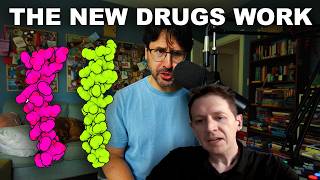

The Fat Acceptance vs. Medical Debate
45sThis segment presents a controversial and timely debate about fat acceptance and medical bias, which is highly engaging for viewers interested in body positivity and health.
▶ Play Clip"Title focuses on sulfur burps but delivers a deep dive into the science, controversy, and future of weight loss drugs – accurate and substantive."
Adam Ragusea discusses the fat acceptance movement, the 'health at every size' philosophy, and the new class of weight loss drugs (GLP-1 agonists). He explores the tension between fat acceptance advocates and medical traditionalists, and how emerging research on these drugs may vindicate the idea that weight is just one factor in metabolic health.
From the 1960s, a social movement to destigmatize fatness led to organizations like NAAFA promoting better accommodations and HAES (Health at Every Size).
Traditionalists argue that obesity is clearly linked to worse health outcomes, and being healthy at every size is impossible.
Fatness is associated with diseases like cardiovascular disease and diabetes, but is not necessarily the cause; it's part of a complex web called metabolic syndrome.
The drugs are often called GLP-1 drugs, but they also affect other hormones like GIP. 'Incretin mimetics' is more accurate but less common. They are the first truly effective weight loss drugs.
The fat acceptance crowd worries these drugs reinforce a thin ideal and are expensive, with side effects some cannot tolerate.
Clinical trials show health improvements even in people who don't lose weight, supporting the view that weight is not the sole cause of metabolic disease.
Nausea, vomiting, constipation, and diarrhea are the most common side effects. Sulfur burps also occur due to delayed gastric emptying.
Weight loss from these drugs results in about 25-35% lean mass loss, similar to crash dieting. Protein intake and resistance training can help preserve muscle.
Rapid weight loss increases risk of gallstones. Long-term safety beyond 5-10 years is still unknown.
Unlike opioids, these drugs do not seem to cause tolerance. Data from the SURPASS-CVOT trial shows sustained weight loss over 4.5 years.
New triple agonist retatrutide can achieve bariatric surgery-level weight loss (24-29% at 48-68 weeks). Adam predicts obesity as a pandemic may end in developed countries within a decade.
The conversation highlights that these new drugs are not just about weight loss; they are reshaping our understanding of metabolic health. While side effects and long-term risks remain, the potential to dramatically reduce obesity rates and associated diseases is real, and the drugs may ultimately vindicate the body positivity movement's emphasis on treating health beyond weight.
What are the 'big four' side effects of weight loss drugs?
Nausea, vomiting, constipation, diarrhea.
09:05
What is the approximate ratio of fat to lean mass loss with these drugs?
About 75% fat, 25% lean mass.
12:52
What is a triple agonist weight loss drug mentioned?
Retatrutide, which acts on GLP-1, GIP, and glucagon receptors.
23:55
What percentage weight loss did retatrutide show in phase 2 trial at 48 weeks?
24% weight loss.
24:07
What is GLP-1?
Glucagon-like peptide-1, a hormone that makes us feel full.
03:18
Why do sulfur burps occur with these drugs?
Because the drugs delay gastric emptying, leading to fermentation in the stomach.
09:42
According to Adam, what does the effectiveness of these drugs even without weight loss indicate?
That weight is only one part of the metabolic syndrome and not the sole cause of disease.
06:29
What is the longest clinical trial duration mentioned for these drugs?
About five years.
15:37
Enlightened consensus on weight and health
Shifts the debate from weight being the cause to being a proxy for deeper metabolic issues.
02:14Drugs vindicate body positivity
Shows that health improvements occur independent of weight loss, supporting HAES philosophy.
05:34No tolerance to GLP-1 drugs
Contrary to typical drug desensitization, these drugs maintain efficacy over years, supported by trial data.
17:59Prediction of obesity decline
New triple agonist drugs may achieve bariatric surgery-level weight loss, potentially ending obesity as a pandemic.
22:04[00:00] Adam:
[00:03] it's Adam Ragusea, and yes, my weight is yo-yoing
[00:12] grew a social movement to de stigmatize fatness.
[00:19] Advance Fat Acceptance, which most famously
[00:26] bigger seats for big bodied people. You also get
[00:32] which pushes this public health frame
[00:39] health at every size people observed is that
[00:45] discriminated against in the healthcare system.
[00:52] and it goes something like this. What did the
[00:56] wound? Have you tried diet and exercise? It's
[01:04] this claim that doctors tend to look at a person
[01:09] their obesity. And what obese people have
[01:16] health problems that have nothing to do with my
[01:20] Number two, even if my health problems are related
[01:29] by the study outcomes, it is nearly impossible
[01:35] off without serious medical help, so let's not
[01:41] almost impossible before you start treating me
[01:49] Over on the other side of this particular
[01:55] saying this is all hogwash, it's very well
[01:59] a lot of extra body fat have much worse health
[02:06] It is not possible to be healthy at every size.
[02:14] seen an enlightened consensus emerge where we
[02:21] of bad things, but fatness is not necessarily the
[02:29] diabetes, and kidney disease, and non-alcoholic
[02:35] in a dense web of causality that we now call
[02:42] is at most an imperfect proxy for the total
[02:48] to be fat, but they're not always fat, and the
[02:54] is murky. Anyway, I think the emergence of that
[03:01] bit between the fat acceptance crowd and the fat
[03:10] Speaking of consensus, we cannot seem to form one
[03:18] GLP-1 drugs, but that's not quite right. These
[03:26] that all our bodies produce to make us feel full
[03:32] drugs also imitate different peptides like GIP,
[03:38] and there are more things like that on
[03:42] incomplete. It's like calling all of my cups
[03:50] You could call these drugs incretin mimetics.
[03:56] regulate blood sugar and appetite are known
[04:02] imitates another thing, which is what these
[04:08] But, incretin mimetic is even harder to say out
[04:17] hasn't caught on among the general public.
[04:24] weight loss drugs because they are the only safe
[04:32] and long-lasting effects. These are the only
[04:39] to any reasonable, real world standard of what it
[04:47] them the weight loss drugs, they're the weight
[04:52] views these drugs with some amount of suspicion.
[04:59] of money selling false hope to generations of
[05:07] which seems to be the case this time, the body
[05:12] will reinforce a toxic, thin ideal in society.
[05:21] to that ideal since, hey man, all you need to
[05:27] which is still extremely expensive and
[05:34] I am, as you can tell, very sympathetic to the
[05:41] the ongoing research on these drugs points to
[05:47] should view as something of a vindication. The
[05:55] because these drugs work even if you aren't
[06:03] of fatness. In clinical trials, in people who
[06:09] to lose weight, we are still seeing dramatic
[06:15] health, brain health, addiction, substance abuse
[06:22] whys and the hows, but it sure seems like these
[06:29] weight to be essentially correct. If a drug treats
[06:36] impacting weight, if you get healthier on these
[06:42] the same, that would indicate that weight is only
[06:52] I think that body acceptance advocates should
[06:57] just about fatness. It might not even be primarily
[07:05] denominator here is the hormones that influence
[07:12] psychologically. We are evolved to live a
[07:19] the time. And so to be healthy, our bodies seem
[07:28] or when we are not getting the hormonal signal
[07:37] these very complicated biological systems
[07:43] drugs as a miracle cure, and we certainly
[07:51] I am curious about the side effects that we're
[07:57] are taking these drugs. I'm curious about how
[08:03] after decades of use. And I am curious about why
[08:13] A great expert on the internet to follow for
[08:21] practitioner. That is a nurse whose level of
[08:26] in the US system. He doesn't need to go through
[08:31] David says on my channel should be construed as
[08:38] smart guy who deals with these drugs every day in
[08:44] reading and posting about the latest research.
[08:51] his social links are in the description.
[08:55] be some ongoing conversations with Nurse David
[09:02] what kind of side effects are we seeing?
[09:05] I mean, the biggest one, and the trial data
[09:11] just informally call it the big four. So whenever
[09:17] they'll almost always have nausea,
[09:21] Adam:
[09:22] medication that I've heard can treat all four
[09:26] David:
[09:30] add is usually some form of heartburn. You'll
[09:35] my patients. You can look on Reddit, or really any
[09:42] burps, which is just the drugs delay your gastric
[09:50] forward, and so you get a little fermentation.
[09:54] Yeah.
[09:57] But even that, same thing, there are ways of
[10:04] cooking side of things, pineapple, papaya.
[10:07] The enzymes.
[10:08] Yeah, the enzymes will help. And people look
[10:13] it'll work." But yeah, that's one thing with
[10:20] manageable.
[10:21] Yeah.
[10:22] A lot of it too in the trials is their goal
[10:26] let's lose the most amount of weight as fast as we
[10:35] they're really actually quite tolerable.
[10:41] the actual absolute rate of side effects, even
[10:49] rate. And over time, because most of the drug
[10:57] you'll watch it just slowly drops away as
[11:04] Adam:
[11:06] Like the new normal where we are all expected
[11:12] real jobs. Love that, but you can make it more
[11:18] easiest way to build a website. Do you still
[11:25] I'm talking to in this video? I know who he is
[11:34] I noticed it, and now he's on my channel with
[11:39] things work. If you want to be discovered,
[11:45] a website from Squarespace does just that.
[11:51] to help the AI chatbots find your site and
[11:57] building the site yourself is just stupid easy at
[12:02] prompt and just start tweaking it until it's
[12:08] email marketing, everything that you can need
[12:12] around with a site for free. When you're ready
[12:18] name, save yourself 10% with my code RAGUSEA.
[12:24] Squarespace. Anyway, we were talking
[12:28] associated with the new weight loss drugs.
[12:33] muscle wasting, which I've understood to
[12:38] muscle loss that you would expect with
[12:42] David:
[12:44] medicine research, they will reference something
[12:52] they mean you should... If you were to just crash
[13:01] mass and about 25% lean mass.
[13:04] Yeah.
[13:04] And when you look at these drugs, it's
[13:11] lean mass loss and the rest is fat mass loss.
[13:18] definition of lean mass. It depends on, are you
[13:26] the conversation with patients like, "If you are
[13:32] in and at least do resistance training." Those are
[13:39] things that will at least preserve your functional
[13:44] Adam:
[13:47] by bodybuilders and people like that.
[13:51] Yes.
[13:52] They know that when you diet down, you're going
[13:57] the weights and if you keep getting protein,
[14:01] David:
[14:03] Adam:
[14:05] that are concerning you so far?
[14:08] There's a slightly increased risk of gallstones
[14:18] also more related to the weight loss and not
[14:24] but you lose weight rapidly and sometimes your
[14:31] patients can get their gallbladder out and then
[14:37] happened.
[14:39] And then there's the big unknown that not
[14:44] which is what happens to people when
[14:47] David:
[14:53] there is probably a reasonable subset of diabetics
[15:00] time just.
[15:01] At this point.
[15:02] Yeah. I mean, liraglutide or Victoza, that was FDA
[15:10] Adam:
[15:13] David:
[15:15] generic now. That's how long it's been around. So
[15:22] in 2017, so we're going on 10 years for that even.
[15:31] for a while. But even the clinical trials, the
[15:37] and obviously we just continue to see a benefit as
[15:44] any evidence to back this up.
[15:47] Very scientific.
[15:48] But also, I mean, it doesn't make... Just
[15:54] Adam:
[15:55] argument. There you go. Go ahead.
[15:57] Yeah. On a mechanistic argument, there shouldn't
[16:04] drug class, with statins, we know the longer
[16:11] cardiovascular diseases.
[16:12] Sure yeah.
[16:13] And so I have a feeling it's going to be the same
[16:19] 20% of your body weight and you stay on it for
[16:25] probably have less comorbid conditions. You'll
[16:33] and actually there's already starting
[16:39] Adam:
[16:41] David:
[16:47] Adam:
[16:50] quality adjusted life year. We don't just want to
[16:57] and QALY is a crude way of measuring that. It's
[17:03] you. That's a QALY. Anyway.
[17:05] The QALY data is already starting to line up that
[17:11] they do start paying for themselves, even with the
[17:21] and actuaries everywhere, that's
[17:24] Adam:
[17:26] to make a mechanistic argument, and also I suppose
[17:32] a receptor in your body and you pummel it.
[17:35] Yeah.
[17:36] With stimulus a little bit more than it would
[17:42] weird things happening among them. It's just going
[17:49] that receptor feel anything.
[17:51] Yeah.
[17:52] Are we not seeing that with these drugs? We're not
[17:56] system just equilibrates to it?
[17:59] There was a cardiovascular outcomes trial called
[18:07] last year, and it was almost five year long
[18:13] at cardiovascular outcomes. And they included
[18:21] Adam:
[18:21] David:
[18:24] was about four and a half year period and there's
[18:30] down, and if you look at the error bars and the
[18:39] 15,000 patient trial and no one is... I don't want
[18:49] regaining weight, not requiring a higher dose,
[18:58] above my pay grade in terms of understanding, but
[19:04] for some reason, there's just not that
[19:09] with cannabinoids or opioids or various other.
[19:21] GLP-1 as a receptor is so integral to just
[19:31] Adam:
[19:31] David:
[19:34] it took pharmacology to realize, oh, hey, this
[19:45] Simplistic understanding is, sure, it suppresses
[19:50] but I mean, it is-
[19:51] Tip of the iceberg.
[19:52] Yeah, half inch view. I mean, I'm working on
[20:01] infects, and I've been writing for a month and
[20:05] it down to regular, in English, but also it's
[20:11] I'm like, "Oh, wait, there's another
[20:17] I actually found an evolutionary development paper
[20:27] development of the GLP-1 class, or I guess I shape
[20:38] So you get GLP-1, which everyone knows about. You
[20:47] and you also get glucagon, and then you get a
[20:52] that family of those three hormones are so deeply
[21:04] really great paper that talks about some of the
[21:11] loss, and it had the actual amino acid sequences
[21:20] off from the primate family tree, and you could
[21:30] Even some of the bony fish glucagon is still
[21:36] human and get an effect. So clearly evolution was
[21:44] I think that's my speculation as to why you don't
[21:50] actually mission-critical to keeping you alive.
[21:55] Well, I suppose all of that is a lot of reason
[21:59] caution.
[22:00] Yes.
[22:00] If we're dealing with such a
[22:03] David:
[22:04] Adam:
[22:11] obesity as we know it would be over as a pandemic
[22:21] I've got seven more years for that admittedly
[22:31] on schedule you reckon we are. I actually
[22:37] it is preceding the way I imagined, where you're
[22:45] David:
[22:52] Adam:
[22:54] David:
[22:56] hullabaloo about how the rate of obesity in the
[23:04] it's like, is that the drugs? Is that the first
[23:11] we're starting to see a downward deflection in the
[23:20] but at the same time, I mean, some of the
[23:26] which is a triple agonist that will have phase
[23:34] I mean, it's mid-April when we're recording this,
[23:39] of June, so not too long for that. And that drug
[23:47] Adam:
[23:49] bariatric surgery, you mean?
[23:50] Yeah.
[23:51] And by triple agonist, you mean it's
[23:55] David:
[23:57] it acts on GIP, and then it acts on glucagon so
[24:07] two data showed 24% weight loss at 48 weeks. There
[24:14] weight loss at 68 weeks with patients still losing
[24:21] data published in June will have an 80-week and
[24:30] I mean, 29%, you're one point away from 30%,
[24:38] loss. 30% to 35% is usually what most bariatric
[24:47] have a drug that has that level of efficacy.
[24:56] it's pretty reasonable to expect obesity
[25:03] there are so many other drugs in development that
[25:11] loss, which again, like that's going to drive a
[25:18] and not obese anymore. So yeah, I mean, by 2035,
[25:27] obesity.
[25:28] What are you most excited about looking ahead?
[25:32] I mean, so the drug that I just mentioned,
[25:42] the mechanism alone, I mentioned it, it acts on
[25:51] field, they're like, "Oh, that's the drug we
[25:59] that in this case, when you are depressing the
[26:06] the opposite happens so it increases insulin
[26:15] as counterintuitive as that sounds, but it also
[26:24] like a starvation signal to your body and you
[26:31] trials were as ethical as they are now where
[26:38] but glucagon is the signal that comes through when
[26:43] their insulin levels drop, and it forces
[26:50] Adam:
[26:51] David:
[26:54] so GLP-1 basically reduces your intake through
[27:02] basically telling your body, "Hey, grab the
[27:08] Adam:
[27:12] decline in available calories. This is winter,
[27:17] our whole system to this new reality."
[27:19] Yeah. So you get less intake and then you are
[27:26] for weight loss. And then side benefit, because
[27:34] so you will see pretty profound, again, going
[27:42] they saw almost 25% drop in LDL cholesterol, the
[27:48] taking a statin medication. So I look at it as,
[27:54] lose weight and it drops your cholesterol like
[28:00] Adam:
[28:00] David:
[28:04] a clinician like, "Oh, hey, you can take this one
[28:12] Adam:
[28:15] you've met Nurse David and he's going to be our
[28:21] Check his blog and his socials in the description.
[28:26] to treat major depressive disorder, bipolar,
[28:32] Like the man said, these drugs work on your
[28:39] good choices with your brain and your body,


⚡ Saved you 0h 28m reading this? Transcribe any YouTube video for free — no signup needed.