
How Tennis Balls Changed the Game
57sExplains a surprising, counterintuitive shift in tennis strategy that will intrigue both casual and hardcore fans.
▶ Play Clip"Delivers exactly what the title promises: a pro tennis player answering fan questions with genuine insights."
In this WIRED Tech Support video, professional tennis player Taylor Fritz answers a variety of questions from fans about the sport, covering topics such as changes in the game, serving techniques, strategies, equipment, and mental aspects of tennis.
Fritz notes that players now mix up their second serves more in terms of location and spin, partly due to changes in tennis balls that don't bounce as high.
He agrees that court speeds haven't changed, but the softer balls used nowadays make the game slower and feel different off the racket.
Grunting is mostly an exhale and doesn't necessarily improve hitting. For serve improvement, he emphasizes a slow, relaxed motion until the point of impact.
Fritz considers Nadal vs. Federer as the greatest rivalry, potentially the greatest match in tennis history based on numbers and stats.
Confidence is an underrated factor in tennis, affecting both matches and careers. A few good points can boost a player's confidence, while a few misses can cause a downturn.
Playing against lefties is challenging because most players are right-handed and less practiced against left-handed opponents.
To counter constant lobbing, Fritz recommends developing a high flat forehand to hit winners, and if uncomfortable with lobbing, take the ball on the rise and crank it.
More spin isn't always better; sometimes you need to drive the ball flat to finish points, especially on worn-out balls that don't go through the court with spin.
Fritz thinks arguing with umpires looks stupid and is rarely productive, though video review might help release frustration.
To read serves, observe patterns and favorite spots over the course of a match, as players tend to go back to their preferred locations.
Being down 0-3 is different if you're serving (one break) versus receiving (two breaks). He suggests focusing on holding serve and possibly losing the set 6-0 to mess with the opponent's mind.
When a stroke breaks down, think back to what you were doing when it was good, and break down the mechanics to regain the feel.
As a server, Fritz picks the newest ball because it moves faster and is less fuzzy, making it harder for the returner.
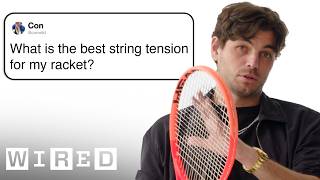
Fritz uses an 18x20 string pattern and strings around 53 pounds on the mains, adjusting tension based on conditions; looser if the ball pops off the racket.
Fritz shares a story of winning a match with a completely different racket (his girlfriend's), showing that equipment may matter less than confidence and feel.
Pressure comes when you're not confident in your shots; focusing on high-percentage targets and going for aces helps him manage pressure.
Fritz dislikes the new allowance of coaching during matches, as tennis is an individual sport and players should figure things out on their own.
Court surfaces vary: some are slow and rough, while others are fast and allow the ball to shoot through, affecting play style.
Taylor Fritz provides practical insights into modern tennis, from equipment and technique to mental strategies, emphasizing adaptability and confidence as key to success.
What does Taylor Fritz say about the change in second serves?
Players mix up location and spin more, partly due to balls that don't bounce as high.
00:15
What is Fritz's best serve improvement tip?
Keep the serve motion slow and relaxed until the point of impact.
02:06
Why is playing against lefties challenging?
Most players are right-handed and less practiced against left-handed opponents.
03:40
What does Fritz recommend against constant lobbing?
Develop a high flat forehand to hit winners, or take the ball on the rise and crank it.
04:13
Is more spin always better?
No, sometimes you need to drive the ball flat to finish points, especially on worn-out balls.
04:55
What string tension does Fritz typically use?
Around 53 pounds on the mains, adjusting based on conditions.
09:25
What is Fritz's strategy when down 0-3?
Focus on holding serve; if serving, it's only one break, and possibly lose the set 6-0 to mess with the opponent's mind.
06:35
Confidence is underrated
Highlights the psychological aspect of tennis that is often overlooked.
02:59Losing 6-0 as a strategy
A counterintuitive tactic that shows deep understanding of mental games.
06:35Winning with a different racket
Demonstrates that equipment may matter less than confidence and feel.
10:10Against coaching during matches
Provides a professional's perspective on a controversial rule change.
12:36[00:00] This is Tennis Support. [dramatic upbeat music] how tennis is played over the last 10 to 15 years?"
[00:15] I feel like people mix up their second serves and I think the reason for that is the balls. it just doesn't bounce as high
[00:28] and that we used to use more often. So for me, I think when the balls really jumped more I kind of feel like they just threw in kick second serves
[00:43] I feel like it's changed a lot. People mix up the location, the spin a lot more. that I think it's the balls that are influencing that
[00:57] with the balls that we play with now. If you bounce a basketball that's full of air, So I think the balls nowadays that we play with more often,
[01:13] which it feels great off your racket when you're hitting, a bit longer that softness. But it also makes everything a lot slower.
[01:25] I mean, I can talk about how people are constantly All the statistics say I agree, the court speeds probably haven't changed,
[01:37] than when I started playing. "Does grunting make you hit better?" and so you're just like exhaling.
[01:52] Realistically, probably not. "What's your best serve improvement tip?" the serve is a lot of different things
[02:06] And I think the keys to that are You know, I think a serve should be very slow.
[02:18] that's when everything kind of speeds up. This is something my dad told me a lot growing up. until it's time to hit it
[02:31] Austin_Aaron_Conlon asks, in tennis history?" I think Nadal-Federer is, to be honest,
[02:46] If you look at the numbers and the stats, it might be. "I don't understand why there's big
[02:59] Confidence is such an under looked factor in tennis, not just in matches but just in careers as well. One person plays a couple good points,
[03:12] They feel good about doing it. Whereas, you know, a player that's maybe been playing well, they start missing some, giving some free points away.
[03:25] It's easy for things to switch, like they'll play so much better Revolutionary-Wall42 asks,
[03:40] because when you think about it, and throughout the course of your life playing tennis, so you're gonna be much more versed
[03:56] of people aren't as practiced playing against them. "What to do when someone is constantly lobbing?" It annoyed me a lot when I was 10 or 12 years old.
[04:13] and said, "I'm gonna do it better than you." I would say really try to develop a high flat forehand. just get that [beep] outta here
[04:26] and then when they go to lob, run in the net. is if you don't feel comfortable lobbing yourself let it come up, let it come down.
[04:40] Just take it on the rise and just crank that ball. I think I might have it, that or fiddler's elbow. is not even like really caused from playing tennis.
[04:55] A Reddit user asked, "Is more spin always better?" where to finish a point, you want to drive the ball flat
[05:08] that are pretty worn out and you spin it, and it's not gonna really go through the court. if you're just over spinning.
[05:22] when it's a good time to lift and spin, and flatten it and hit it through the court. arguing with an umpire over a decision
[05:37] I feel like once they make a bad call, I think we have some video review in place, maybe lets you get some anger out
[05:53] But nothing looks stupider and they are completely wrong. KappaBETTING says, "Tips on reading opponent serves
[06:07] then I would also need the answer to this. Typically people are gonna want to go back to the spots, Over the course of playing someone,
[06:22] where their least favorite spot is. So in the moment of seeing their serve, maybe it's not easy, by just the patterns that they're looking to serve
[06:35] EnjoyMyDownvote says, "What's your go-to strategy 0-3 and 0-4 are two very different things. If you're 0-3 but serving, it's one break.
[06:51] entirely different ball game. and I'm going to try to figure out Or controversial take, lose the set 6-0,
[07:08] you're not supposed to lose 6-0 against, Like the person just, it kinda messes them up mentally. o2000 asks, he doesn't ask actually.
[07:23] A big part of it is like my forehand, but by no means is it a bad forehand, I make it work. kind of made me wanna like change it,
[07:38] so I kind of, I think in a way tinkered with it a bit, and then just lost that feel of what made it so good.
[07:50] and this is something you could do too. what were you doing when it was good? and breaking down some things,
[08:02] And you know, I feel like I kinda started to get it back, But it's easy to just kind of just lose the rhythm 'cause the littlest thing can make a big difference.
[08:17] choose the tennis balls they will serve with?" I'm looking for the newest one, if I'm the server because the balls move faster
[08:33] When you look at these, they're all brand new. As they get play, you'll notice that just the fuzz kind of comes up and out on the ball,
[08:46] Conwild asks, "What's the best string tension There's tons of different things that go into this, I've got an 18 by 20 string pattern,
[09:00] Not as popular nowadays on tour anyways. a more open pattern. I like the closed pattern
[09:12] It's easier to kind of go after the ball a bit more, So I try to generate the power myself I string depending on the conditions as well.
[09:25] I'd say I typically hover around 53 pounds on the main. That is also pretty common if you play with mixed strings. A lot of people will string the cross a little bit looser.
[09:41] then it's more common just to go same tension throughout. you might want to go a little bit you can maybe go a bit looser.
[09:54] You know, you just gotta feel it out. If you feel like the ball is, you know, pop off your racket, string it looser.
[10:10] "How easy is it for you to switch rackets? When I was a junior, Very strong, everyone in the tournament
[10:23] I wasn't a favorite by any means. so I was very average level to be playing this tournament. I noticed that I left it when I stepped out.
[10:40] for me to get my exact racket there, so I used at the time my girlfriend's racket and you couldn't get a more different racket.
[10:55] So different strings, different grip size, It was nowhere near my racket. And anyways, I took it out, played my first round.
[11:10] I've golden setted someone, which is 24 straight points, This does not happen really ever in tennis, And the guy I was playing was, you know,
[11:26] not win a set, not win a point in a set." that I wasn't even playing with my own racket. I don't think I'd underperform.
[11:41] You know, I think potentially in a tight situation, that you're not used to. I feel like I can kind of pick up any racket
[11:55] and, you know, perform to close to same level. Middle-Annual-8360 asks, "How do you deal with pressure and sometimes you don't.
[12:07] That's when the fear and the pressure really sets in. High percentage versus more difficult to return."
[12:19] I'm going for the lines, I'm always going for an ace, if I'm serving above 65%, it's a great day for me that I'm going for, I'm always going for aces.
[12:36] please explain the no coaching during matches rule? because we now do allow coaching, which I hate.
[12:50] which they're like, you know, team sports. is it's such an individual sport, of you are playing another person.
[13:02] of having to figure things out on the court for yourself. and, you know, I hope we go back to that at some point. what does this mean?"
[13:16] On a very just basic note, some courts are a lot slower, it's a lot rougher, and just stops almost.
[13:30] you ever go play at like a public park, It's like it's a fast court. and it'll shoot through.
[13:45] Until next time. [gentle upbeat music]
⚡ Saved you 0h 13m reading this? Transcribe any YouTube video for free — no signup needed.