
How Geocentrists Tricked Top Physicists
44sReveals a shocking story of deception that makes viewers want to know how the trick was pulled off.
▶ Play Clip"Delivers exactly what the title promises: the story of how physicists were tricked into a geocentric documentary."
This video dissects the 2014 documentary 'The Principle,' which used deceptive editing and framing to create the illusion that prominent physicists supported geocentrism. It exposes how the filmmakers, motivated by a blend of religious fundamentalism and pseudoscience, tricked scientists like Lawrence Krauss into appearing and then misrepresented their views.
Dan Olson found clips of a geocentric documentary on a flat Earth YouTube channel, noting its decent quality animation and Kate Mulgrew's narration, which seemed out of place among anti-science content.
Olson clarifies that Earth is not the center of the universe, citing stellar parallax, Lagrange point satellites, and the cosmic microwave background (CMB) data misinterpretation by geocentrists. Geocentrism requires rejecting relativity and universal gravity.
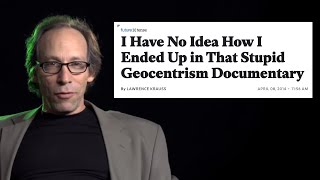
The trailer for The Principle featured famous physicists and Kate Mulgrew, leading to public denunciations by participants like Krauss and Mulgrew when they realized the film's geocentric agenda.
The film uses a 'just asking questions' approach, employing framing and juxtaposition (Kuleshov effect) to manufacture consensus without making explicit claims, making it hard to litigate.
Producer Robert Sungenis holds a fake doctorate from an unaccredited university, writer Rick DeLano is a Catholic fundamentalist and geocentrist, and Martin Selbrede of the Chalcedon Foundation advocates for dominionist theology, including support for death penalty for homosexuality.
Geocentrism serves as a wedge to promote a literalist biblical cosmology and hierarchical worldview, where Earth's special location implies divine authority for the Church.
The Principle is a cautionary tale about documentary manipulation, showing how careful editing and framing can mislead audiences. Its creators' fringe religious and pseudoscientific beliefs underpin a film designed to advance a theocratic agenda.
What is the central claim of 'The Principle'?
That the cosmic microwave background indicates Earth is the center of the universe.
03:53
What effect does the film use to manufacture consensus?
The Kuleshov effect—juxtaposing interviews to imply agreement.
30:42
Who is the executive producer of The Principle?
Robert Sungenis.
02:22
What is Robert Sungenis's doctorate in and from where?
A doctorate in Religious Studies from Calamus International University, an unaccredited diploma mill.
17:38
What is the goal of the Chalcedon Foundation?
To lobby for laws that conform to Biblical law, including the death penalty for homosexuals and elimination of church-state separation.
25:27
How did the filmmakers trick Lawrence Krauss into appearing?
By framing questions as responses to another scientist rather than asking if Earth is the center, and using a vague release form.
36:42
Earth is Not the Center
Clear and concise debunking of geocentrism using established science.
03:07The Trailer and Backlash
Shows how quickly participants distanced themselves once the true agenda was revealed.
05:38Bad-Faith Debate Tactics
Explains the subtle manipulation techniques that make the documentary deceptive yet legally defensible.
09:12The Filmmakers' Backgrounds
Reveals the extremist religious and pseudoscientific credentials of the film's creators.
14:54Why Geocentrism?
Links the pseudoscience to a broader theocratic political agenda, illustrating the stakes.
38:52[00:00] [off camera] Uh, can you just introduce yourself real quick? My name is Dan Olson, I am the writer and director of 'In Search of a Flat Earth'. I first became aware of 'The Principle' when I was working on a documentary about flat earth philosophy.
[00:15] There was this particular flat Earth channel on YouTube and I was going through all the most watched videos on the channel taking notes and one of them, this two hour video,
[00:29] had just these long long clips from some other documentary about Copernicus and Kepler and Brahe and it was actually kind of decent quality animation and Kate Mulgrew was narrating,
[00:44] and it said on screen, explicitly, used with permission such-and-such films. "The greatest astronomer of the time, Tico Brahe, developed a new geocentric model:
[00:59] the earth occupies the center, the planets orbit the Sun, and the Sun orbits the Earth." You know, YouTube culture being what it is, it's already unusual for anyone to actually ask permission,
[01:14] let alone on flat Earth YouTube. So right away that told me that something was up. Clearly the people who made this first video, which was just an anti-science screed
[01:28] on a channel full of flat Earth, anti-vax, ancient alien stuff, clearly all of these people were on the same wavelength. And that's weird. There's not usually a lot of crossover between random YouTube
[01:43] cranks and the kind of people who are able to get in touch with Kate Mulgrew's agent. So I prod a bit and it turns out there's a whole buck wild story behind that.
[01:55] It had actually made a small splash when the film first came out in, I think it was 2014. how Earth is the center of the universe, and the sun revol- like orbits the earth, and they tricked
[02:09] a bunch of astrophysicists into being in it, and and Kate Mulgrew was narrating, and there's this whole story behind that, and I just knew that it was something that I might want to talk about.
[02:22] But then as I was digging a bit deeper I realized that the executive producer, Robert Sungenis, a man with a doctorate degree from a fake university effectively interviewed himself
[02:39] in his own movie in order to make himself look like an expert. And... and it was just like that's it, that's it I- I have to talk about this now. [upbeat music]
[03:07] Okay, first things first: the Earth is not the center of the universe. I'm putting this at the front because I don't want to have to debunk every random ass claim The folks who made this film are going to make a number of claims that are just wrong.
[03:24] We have in fact demonstrated that the Earth orbits the Sun. Stellar parallax was first measured in the 1830s and has only gotten more precise since, and lagrange point satellites behave the way that they do because we accurately understand
[03:38] how gravity behaves on celestial objects; an understanding that has enabled us to, for example, detect black holes as in this 23-year time lapse of s2 orbiting the black hole Sagittarius A.
[03:53] The central claim of the film is that the cosmic microwave background radiation indicates that the Earth is the center of a universal axis, which is just not actually true. They massage the data to make it look more significant than it really is,
[04:07] giving the misleading impression that it's a very precise axis that passes right through the Earth, but in reality it's a lot more vague than that. Bottom line, geocentrism as a model of the cosmos requires a universe where a series of incredibly
[04:23] consistent physical principles apply to everything else we can see except us. Now that's exactly what they're trying to imply but as with flat Earth this creates a cascade effect where successively
[04:37] more and more functional predictive science needs to be discarded in order to make the claim work. You can't just redraw the orbits of the solar system, you need to claim the Earth is gravitationally exceptional. And if Earth is the fulcrum of the universe then the stellar
[04:54] field needs to be moving at absurd speeds in order to orbit the earth once every 24 hours, speeds that would be detectable and relativistic. And so you also need to discard relativity and
[05:07] And, again that right there is exactly what they're claiming, that they’ve found evidence that should cause us to toss out relativity and universal gravity and everything we've discovered based on those principles
[05:21] And since that isn't happening, they claim there's a conspiracy that's suppressing the evidence. And now on with the show. [light piano music]
[05:38] In the spring of 2014 a small media storm kicked up around the trailer for an upcoming documentary written by Rick DeLano, directed by Katheryne Thomas, and produced by Robert Sungenis. The trailer, narrated by Star Trek Voyager’s Kate Mulgrew and featuring
[05:52] a number of high profile physicists, including Lawrence Krassu, Max Tegmark, and Michio Kaku, seemed to be arguing against the heliocentric model of the solar system. "Everything we think we know about our universe is wrong."
[06:07] "You can go on some websites of NASA and see that they've started to take down stuff "So they set up the satellite and they find out these temperature disturbances throughout the universe were all pointing to the Earth."
[06:21] which led to several of the participants issuing public denunciations of their role in the film. “I Have No Idea How I Ended Up In That Stupid Geocentrism Documentary”
[06:37] and of course had I known of its premise I would have refused. So, either the producers used clips of me that were in the public domain, or they bought them from other production companies that I may have given some rights to distribute my interviews to, or they
[06:53] may have interviewed me under false pretenses, in which case I probably signed some release.” Following Krauss’ lead, Kate Mulgrew issued a short statement on Facebook “I understand there has been some controversy about my participation in a documentary called
[07:07] THE PRINCIPLE. Let me assure everyone that I completely agree with the eminent physicist Lawrence Krauss, who was himself misrepresented in the film, and who has written a succinct rebuttal in SLATE. I am not a geocentrist, nor am I in any way a proponent of geocentrism. More importantly,
[07:23] I do not subscribe to anything Robert Sungenis has written regarding science and history and, had I known of his involvement, would most certainly have avoided this documentary. I apologize for any confusion that my voice on this trailer may have caused.”
[07:40] The producers fired back against these by posting a YouTube video, hosted by writer/producer Rick DeLano, titled “Thoughtcrime: the conspiracy to stop The Principle” Which, you know. Jesus Christ. Thoughtcrime? Conspiracy?
[07:55] I think that alone gives you a pretty good snapshot of where these folks are at. what they consider to be discrediting evidence against Krauss and Mulgrew,
[08:07] and explicitly state that it’s not about geocentrism, it’s about cosmology. thousands and thousands and thousands of time, and there's just nothing about the geos in the film. It just isn't, it's film about cosmology, it's a film about the Copernican Principle."
[08:24] In an interview with Colin Lecher at Popular Science ""The film is not about geocentrism," DeLano told me flatly. Rather, doesn't occupy a cosmically special place in the universe. “
[08:40] Okay, first of all, those aren’t mutually exclusive? Those are nested subjects. Second, is the movie geocentric? Sooort of?
[08:52] Rick’s wishy-washy “it’s not about geocentrism, it’s about cosmology” is actually pretty accurate to the finished movie in that the film shares that wishy-washy attitude. being mostly composed of implication and innuendo rather than offering any actual claims.
[09:12] "So what I take away from this is we simply always need to keep an open mind and listen to all viewpoints and let mother nature be the one who gets the final word." "There's always a revolution coming in science because science is necessarily provisional,
[09:27] it cannot make a final statement because it doesn't know everything, it cannot examine what's "As to how many angels dance on the head of a pin, "You know I could tell you
[09:41] what the future might be, but- but it could be something different." The A plot is mostly interviews with a mix of scientists and crackpot religious zealots,
[09:53] while the B plot is a reasonably accurate animated summary of the development of the solar model from pre-history to Albert Einstein, just with the occasional curiosity of how something is framed.
[10:05] how something is framed that tosses up the odd red flag here and there. "This is the beginning of faith and the beginning of science. And that’s kinda the crux of it: there’s no screamingly absurd claims.
[10:22] This isn’t Masaru Emoto claiming you can grant water healing properties by exposing it to positive thoughts. "So I tried exposing water to written words. I thought that water might have the ability to sense vibration and give us some answers."
[10:37] Even when the film gets into theology, it does so in a really tepid, vague way, talking mostly about faith in the abstract. "Ever since the trial of Galileo there has often been tension if not outright conflict
[10:53] between faith and science. Remarkably the copernican principle seems to be the ground upon which faith and science are again at long last approaching one another."
[11:06] As a whole The Principle is an adept example of a classic form of bad-faith debate, It’s a form of debate where you advance your ideological agenda entirely in the
[11:18] form of questions in order to take the role of a non-committed bystander who doesn’t believe anything and has no opinions, but has a lot of concerns. listen to the way that Sungenis and DeLano and Thomas defend the film,
[11:33] focusing mostly on a narrative that The Principle is “exploring possibilities” and the particular idea that the preemptive critics of the film were misled by the film’s trailer.
[11:45] "Okay, so they did see the trailer and I think all these conclusions are being made..." "But when you actually watch the film Of course that’s all deliberate. The trailer is intentionally provocative.
[12:02] Like, I can’t think of a clearer example of bad-faith whinging than this. "And the trailer of course, is a trailer - it's designed to stir up controversy and, uh, you know, we just assumed that we'd get the same treatment as everybody else, which is foolish assumption."
[12:17] Rick, You made the trailer. It’s your trailer for your movie. You don’t get to complain that the trailer misled people when you’re the person who made the trailer. the movie and all the para-textual things that the creators put out.
[12:36] claims that the movie is a really even-handed examination of some cutting-edge science where everyone gets an equal say and it’s left to the audience to draw their own conclusions.
[12:50] "And another thing about it was making sure that it was balanced it's truly- you know, my- I even said when I did this, I said hey listen if we're going to make
[13:03] if we're gonna let everybody have a seat at the table and then let you know the audience figure out what they want to do, then I'm all in. And so that's-" And on the other hand, you have the second trailer for the film:
[13:23] "Science has found evidence that Earth is the center of the universe. "Science has found evidence that god exists. So why do they tell us we are insignificant?"
[13:36] Not to mention, you know, Robert Sungenis, the executive producer who has continued to be heavily involved in the promotion of the film for years following its release, including writing numerous commentary articles for the official website ThePrincipleMovie.com,
[13:52] wrote an entire book promoting geocentrism called Galileo Was Wrong; The Church Was Right. Now, you might be wondering if maybe that’s also just some provocative marketing. Maybe it’s just a way to reel people in for a discussion of some interesting oddities
[14:08] in data derived from measurements of the cosmic microwave background radiation? “Chapter 3: Evidence Earth is in the Center of the Universe” And this is the root of it: despite the superficially non-committal “just asking questions”
[14:24] tone of the film, the intended takeaway is pretty obvious and is, of course, reinforced by the evidence of how the film has been rhetorically employed since its release, with the film mostly playing for Christian faith-film audiences the same new-age spirituality crowd as other
[14:42] pseudoscience and lightly conspiratorial films like What the Bleep Do We Know and Zeitgeist. [light piano music]
[14:54] Before we go on let’s talk for a bit about the folks behind it all, because to really understand what The Principle is saying we need to understand the worldview that it comes from. So, two people we’ve already partially introduced, writer/producer Rick DeLano and
[15:07] director/editor Katheryne Thomas. They are the front line filmmakers. Thomas, a music video producer and director turned documentarian, seems to have fallen in with DeLano by happenstance, and while she claims she disagrees with Rick about a lot of stuff,
[15:22] the two of them have continued to work together since, and she vocally defends the film. "If you give an opinion where a geocentric opinion from once one subject and they go, 'oh no no no you can't say that!' you know, and if you go, oh and like The
[15:36] Principle you have multiverse ,you have string theory, you have all of this, and I'm like all of this is controversial. And and actually that's what kind of made me mad whenever I was seeing thing which was the geocentric stuff and I was like why because there's so many theories in here?!"
[15:55] DeLano is a Catholic fundamentalist and seemingly a true believer in geocentrism. For years prior to the production of The Principle, Rick maintained a personal blog titled Magisterial Fundies. From the October 2011 launch post of that blog, Magisterial Fundies: The Soft Opening, Rick states
[16:12] “The Catholic Church has, by the sovereign decision of God Almighty, been granted a charism to teach the Truth concerning faith and morals infallibly. [...] I expect to examine precisely those anomalous, unusual cases where magisterial teaching has
[16:26] either been abandoned or qualified by subsequent, lower-level teaching. 1. The question of whether the Jews enjoy a separate covenant for salvation 2. Whether the Church has reversed her condemnation of Galileo (I argue She hasn't, and
[16:46] I further argue that the utterly astounding new observations from SDSS and WMAP suggest that this is an extraordinarily powerful instance where the protection of the Church's teaching on geocentrism
[16:59] is being validated before our eyes by science itself, four hundred years after the fact).” On top of this, Rick absolutely conspiratorially minded, tossing out bizarre accusations and claims as though they’re self-evident.
[17:13] "We had no chance with The Principle against the forces that were arraigned against us. We were just... You know, we were targeted for destruction and absolute- and we had the
[17:26] highest grossing single screen opening in america the weekend that we opened, and they wouldn't even hold us over in the theater because we were the subject of a boycott by a political organization."
[17:38] Executive producer Robert Sungenis has a doctorate in Religious Studies from Calamus International University, with the hitch being that Calamus International University is a defunct,
[17:50] unaccredited distance-learning outfit that was registered in the Republic of Vanuatu but consisted entirely of a p.o. box and a secretary service in London. was overseen mainly by two people, by a physicist, Robert Bennett,
[18:08] who is also the co-author of Sungenis’ book “Galileo Was Wrong” and is in The Principle, and Dr. Morris Berg. Now Berg's an interesting guy. Dr. Berg’s has a Bachelor of Science in Psychology from the University of East London,
[18:23] and then PhD and DCH degrees in hypnotherapy from, quote, “overseas universities.” He’s also an accredited past life healer, registered metaphysician,
[18:37] and an energy EFT master practitioner certified by the Guild of Energists. "Okay so, let's just have a look at the modern energy chart. This is a pictorial representation
[18:50] of a pattern that exists at least, and I mean at least, in all social mammals." The Guild of Energists are one of those kind of really predictable self-help systems that takes a couple reasonable ideas like “happiness is good” and maps it onto
[19:07] a truly bonkers series of metaphysics, and once you scratch the surface you realize it’s just The Secret or Prosperity Gospel or The Power of Positive Thinking, including the
[19:20] same dangerous core belief that good people are successful, therefore successful people are good. And, of course, it gets a little bit culty when you get into the parts where the founder,
[19:33] Sylvia Hartmann, starts talking about “coming out of the energy closet”. This is just completely not surprising at all. It’s crank magnetism. People with fake credentials get their fake credentials from other people with fake credentials.
[19:46] There’s an entire ecosystem of these kinds of grifters, folks with questionable credentials who are adopting a fundamentally anti-science stance, but do so by claiming that they have the real science.
[20:00] They are absurdly common in self-help, dieting, and alternative medicine, but, as we see here, the more mathematical sciences are hardly immune. Okay, so those are just the folks that Robert Sungenis hangs out with.
[20:15] In addition to his fake degree, Robert is a TradCath or Traditionalist Catholic, In a casual modern use TradCath tends to just refer to a particularly conservative
[20:29] strain of Catholic thinker, but Robert is a bit more of a traditional TradCath, which means he errs a lot more towards the philosophical roots of the term, which is rooted in opposition to the Second Vatican Council, AKA Vatican II.
[20:43] Held between 1959 and 1965, this was a series of formal debates within the Catholic church in direct response to a number of internal and external pressures Women’s Liberation, declining Church attendance, the evangelical/nondenominational movement,
[21:02] It was, in short, an attempt at modernizing the church. These sessions resulted in a number of substantial changes to church operations, and official redefinition of the relationship between the church and various social groups.
[21:21] permitted for Mass to be administered in a language that wasn’t Latin, and encouraged a greater emphasis on lay-participation rather than strict clerical dispensation.
[21:36] This means, one, getting general congregants more involved in weekly services and, two, actually performing Mass in the language that the congregation speaks. This is also when the church formally changed its opinion on the death of Jesus, stating
[21:52] “True, the Jewish authorities and those who followed their lead pressed for the death of Christ; still, what happened in His passion cannot be charged against all the Jews, without distinction, then alive, nor against the Jews of today. Although the Church is the
[22:07] new people of God, the Jews should not be presented as rejected or accursed by God.” So they no longer held all Jews categorically responsible for the death of Jesus.
[22:19] Which they previously had for hundreds and hundreds and hundreds of years. The last change I want to mention was the church pivoting its view on non-Catholic Christian
[22:31] denominations, reverting the anti-Reformation Council of Trent, viewing protestants and the Eastern Orthodox tradition specifically as “separated brethren” rather than heretics.
[22:43] This is a subtle but important policy change because it effectively signaled that the various traditionalist denominations shared common political interests and it would be more important to cooperate on those fronts than hold onto old sectarian grudges,
[22:59] but in doing so the church ceded its absolute stance of supreme authority. So this is complicated. Vatican II is, in some regards, progressive, but only as progressive as
[23:11] needed to retain membership and improve political relations with other conservative organizations. So imagine the kind of person who thinks it was going too far. Now, in all fairness Sungenis has stated in a 2005 article for Catholic paper The New Oxford Review:
[23:27] “We must accept Vatican II as a legitimate ecumenical council, without dogmatic error, and designed for the good of the Church. In reality, 95 percent of its words are unproblematic. If the other five percent is interpreted in the light of tradition rather than
[23:43] liberalism and neo-Modernism, we shouldn’t have too much problem ironing out any difficulties.” So he doesn’t reject it categorically, or even have much complaint with the vast majority of the actual contents. What he does have problems with is that issue of supreme authority.
[23:59] “Just when we needed a strong hand to remind us of our moral obligations in the midst of a world gone crazy with the lust for power (e.g., World Wars I and II), and a world either contemplating or actually indulging in some of its worst sins
[24:13] (e.g., contraception, abortion, divorce, promiscuity, homosexuality), the prelates of Vatican II more or less forgot why the traditional Church, through her regimen of strong laws and purifying disciplines, insisted on keeping tight reins on her people. [...]
[24:29] This is why liberalism will never work on this Earth. Its utopian ideals ignore the fact that deep within man there is a sin problem that simply won’t go away by wishful thinking.” Keep in mind that when he says “liberalism” in this context he’s talking about, like,
[24:45] He means democracy. He’s saying democracy will never work. creating sanctioned room within the Church for liberation theology and
[24:59] thus the likes of Óscar Romero, that’s the stuff he really takes issue with. This brings me to one of Robert Sungenis’ other friends, and fellow The Principle participant, I’m gonna warn you, this guy is a huge piece of garbage with some
[25:14] truly repugnant beliefs. This does get a bit heavy. This is Martin Selbrede, a geocentrist and theologian. He has advocated for a geocentric model for years, both within fundamentalist Christian circles
[25:27] as a companion to creationism, and externally in debates with the actual scientific community. Martin is the vice president of the Chalcedon Foundation, a Christian Reconstructionist think tank dedicated to lobbying for laws that conform
[25:42] This manifests, practically, in two forms. that philosophically is opposed to large nation states but in the short term
[25:58] manifests in the push for extremely permissive homeschooling standards which, I mean, Martin here is in a documentary arguing that the Earth is the centre of the universe, so you can probably imagine what the curriculum looks like.
[26:13] Also they stand in opposition to, like, anti-descrimintion laws that prevent employers from firing people for being trans. The second is an explicit push for returning things to the “natural order”,
[26:28] enshrining Christian supremacy, and eliminating the separation of Church and State. Now, a number of people have posited that this extreme position means the Chalcedon Foundation supports policies like the death penalty as a punishment for homosexuality,
[26:42] lists the Chalcedon Foundation as a hate group for exactly that reason. In response to these accusations the Chalcedon Foundation plays a little rhetorical game where they deflect by repeatedly saying
[26:57] It’s a way of pretending to deny something without denying it, but it’s also a way of confirming something without having to actually say it out loud. Selbrede, in a 2007 article titled Answering Tough Questions About Christian Reconstruction,
[27:12] “Decade after decade, as a nation grows more Biblically consistent, and an ever-increasing percentage of its population regards the law of God as the proper standard for morality,
[27:25] it is likely the resulting social pressures (now so successfully applied via our current culture of political correctness) would gradually revert back in favor of Biblical moral expectations, causing most Biblically illicit conduct to seek more private venues
[27:40] (beyond the reach of eyewitnesses to the act) well before any such Biblical laws became transcribed into civil law. The idea of some kind of wholesale slaughter of, say, homosexuals, is a total fabrication resting on a fragmentary, piecemeal, unsystematized
[27:56] approach to Biblical law. Biblical law deals with concrete acts observed by qualified eyewitnesses.” Translated: he does support the state-sanctioned murder of homosexuals, but only as long as it's systematized. And he claims it wouldn't matter anyway,
[28:11] you wouldn't actually get that many executions, because all of the overt social hostility towards homosexuality would drive all of the gays back into the closet long before you could even make homosexuality illegal, let alone a capital offense.
[28:27] Remember that libertarianism? Yeah, they oppose large nation states like the USA because they believe that large nations will inevitably be multicultural, purely as a consequence of encompassing large numbers of people across large geographic areas,
[28:44] which provides the opportunity for the minority cultures to find common cause, unite, and push for their interests. Thus smaller, local Christian hegemons are better equipped to enforce Biblical law and keep the underclass suppressed.
[29:00] These guys are the philosophical core of The Principle, and the rest of the film is structured to make it look like all these scientists really secretly agree with them.
[29:14] [light piano music] Can I just say that this setup for Lawrence Krauss interview, with this green edge light, I get the intent, but it looks gross and no one else is lit like that.
[29:32] One of the reasons why I wanted to talk about The Principle is because the film itself isn’t entirely incompetent. It’s a pretty good example of how the narrative language of Because the entire foundation of the film
[29:45] is to make a discredited idea seem not just plausible, but supported. But to do that you need to launder a few things. So this is how you scrub the ideas. You don’t say “we’re making a movie proving that the Earth
[30:01] is the center of the universe.” You say “we’re making a movie about changes in our understanding of the Copernican principle” or “we’re making a movie about the history and future of cosmology.”
[30:14] it's a film about cosmology, it's a film about the copernican principle." You’ve just omitted a conclusion that you know participants will disagree with.
[30:30] You don’t do a total hack job where you cut up what people are saying to make them "I noticed she was sitting- on her sweet can- I grab her- sweet can- ohh"
[30:42] You use framing and juxtaposition, the Kuleshov effect, to manufacture consensus. You take two scientists, and in between them you sandwich a guy with a fake doctorate who don’t take any of the three out of context, you aren’t lifting razor thin sound bites,
[31:03] but all three are energized, excited, and, seemingly, in agreement with each other. This is a fine line, you haven’t made anyone say something they didn’t, you’ve just created the appearance that they support ideas that they don’t.
[31:18] It’s a form of misrepresentation that’s exhausting to litigate, and honestly isn’t worth it beyond, like, writing an op ed or putting out some mean tweets.
[31:30] That's why no one who was involved who spoke out against the film took it any farther than just mean tweets. What’s interesting to me is that the filmmakers have a narrative that they’re trying to work,
[31:42] One of the things the film suggests with a wink and a nudge is the outline of a conspiracy that is actively suppressing this information.
[31:54] "All they have to do to shut up geocentrist is to run this experiment upon the moon and see what's going to happen... and all of physics collapses with that experiment. I think there's a reason "Albert Einstein himself said that
[32:09] if Michelson Morley is wrong, then relativity is wrong." It implies that all these scientists really do agree that the prevailing evidence suggests a geocentric world, but they can’t speak plainly about it
[32:23] because they would be ostracized from the scientific community, lose their jobs, lose access to grant money, and generally throw a huge wrench into their own lives. "If one day god comes down from above and says look these two great theories
[32:38] relativity and the quantum theory are wrong, what would I say? First of all I would say, 'oh my god all my published works are wrong!' I mean I'll have to look for another job. This also let’s the filmmakers frame themselves as doing the interviewees a favour
[32:54] builds a sense of intrigue, that this is a view that’s so taboo we dare not even say its name. "We've clearly touched a nerve, we're clearly questioning something that some very
[33:09] Also can we talk for a moment about the absurdity of a bunch of catholics claiming that their cosmological model is being suppressed by some nebulous group?
[33:22] So, after the trailer for the film comes out a number of the participants issue statements basically saying they had no idea what the scope of the project was, they were presented out of context, they don’t remember being interviewed for a pro-geocentric documentary,
[33:35] and this is where they continue that little sleight of hand trick from earlier. In the response video they include extended clips of some interviews,
[33:47] some behind the scenes footage, and a copy of Krauss’ image release form. "Lawrence Krauss signed a release form. Here it is, yeah, there's been That last one is
[34:01] In presenting the image release forms they're submitting evidence for one thing See the signed release does prove that Krauss signed a release
[34:14] with Stellar Motion Pictures Incorporated , but it doesn't prove that the interviewers were "There's been 1500 news articles saying that it doesn't exist.
[34:27] does tell him that we're going to be seeking out controversial-" "Everybody can see this." "Your lawyers made it up, there's no multiple releases." Nothing in this bog standard release says this movie is going to be anti-copernican, anti-galilean,
[34:46] pro-geo-centric. That informed consent is merely implied. conspiratorial thinking so he just leaves it assumed as though it's self-evidently obvious
[35:00] "He had no chance with The Principle against the Funny enough, by posting all this stuff in the thought crime follow-up video they actually give us a really good insight into how you go about
[35:16] tricking a bunch of physicists into being in a geocentric documentary. In an extended clip of Max Tegmark being interviewed by DeLano they show us the kinds of questions that they were asking.
[35:28] Also keep in mind that this footage is being presented to support the argument that Rick DeLano did not disguise the subject or intent of the film.
[35:40] "and just get- and then we can move on from this particular aspect because the centrality of Earth and the customer microwave background is a fascinating yeah it could be a mistake it could be a glitch but there are other elements that are pointing in the same direction. Now...
[35:57] Krauss says, professor Krauss says, "when you look at the cmb map you see that the structure that is observed is in fact, in fact in a weird way correlated with the plane of the Earth around the Sun. Is this Copernicus coming back to haunt us? That's crazy. We're looking
[36:11] out at the whole universe, there's no way there should be a correlation of structure with our motion of the Earth around the Sun, the plane of the Earth and the Sun, the ecliptic that would say we are truly the center of the universe. Would you agree with that assessment?"
[36:26] Okay so, there's a couple things happening here. First of all, that question was 162 words long. It's a lot of rambling, it's a lot of overlapping ideas, and then the core of it is framed not as a
[36:42] question from the filmmakers but as an opportunity to respond to something professor Krauss said. See there's a big, big difference between asking someone if Earth is the center of the universe and asking them to reply to a colleague.
[36:59] The second is a lot more likely to get a much more diplomatic measured response but instead suggests that, you know, maybe they were just talking really fast and didn't word their
[37:11] ideas the best, or maybe the data has some nuance that's difficult to explain, or are there some additional controls that need to be implemented into testing. "Would you agree with that assessment?"
[37:28] "I don't think that this is telling us that Earth is in any way the center of the universe..." is how you get the kind of replies that you can use to construct consensus.
[37:40] "If you just give a listen I think it'll make it quite clear that we were very upfront Documentary operates off the assumption of good faith. We go into a documentary willing to believe that the filmmakers are communicating at the very least
[37:55] the essence of the truth. A lot of these editing techniques, or even just techniques in general, are really conventional like juxtaposing several speakers in sequence it's a very normal way to
[38:08] communicate consensus and it's not misleading if the three people agreeing with each other It's not bad form to ask participants to respond to statements made
[38:20] by other participants, it's a very normal thing to do as you're building the narrative of the documentary and is a very normal way to go about getting clear focused answers when illustrating In that regard the principle is an excellent cautionary tale,
[38:37] a reminder to always keep in the back of your head the documentary will never be the entire story. [light piano music]
[38:52] Okay so, I think the outstanding question here is: why geocentrism? Sungenis has written multiple books and tracks trying to push the geocentric model,
[39:05] Martin Cellbreed has been arguing for geocentrism since the 90s. Heck, Robert has even gone to flat Earth conferences to argue that they're wrong about the shape of the Earth
[39:17] "The topic of this debate is biblical cosmology: what does the bible have to say about the shape and nature of the Earth and its place in the cosmos?"
[39:33] be the thin end of the wedge, both in the sense of creating the appearance of wide support for their ideas and in the sense that the subsequent ideas that naturally follow from the conclusions
[39:47] presented in The Principle lead directly into their trad cath dominionist theology. mainstream biblical scholars largely agree that the biblical cosmology is neither heliocentric
[39:59] nor geocentric but is poetic with cosmological statements being metaphors meant to communicate spiritual ideas. Ancient people had stories and theater and understood the idea of myth and legend.
[40:13] Ancient audiences would have understood phrases like "the pillars of the earth" as poetic metaphor and would find it weird if you insisted that it needed to be literal. chapter one, he wrote it around 1400 bc and he was inspired by god to do so. And inspired means that
[40:34] it's inerrant and it tells us the exact truth of what went on. Ao the task for the scholar is not to undermine the text and wish it away as if it never existed. His task is to see what does this mean and
[40:49] The train of thought is that geocentrism proves not just a biblical universe but one of rigid hierarchy. A phrase that the film repeatedly fixates on is the
[41:02] idea that the Earth isn't in any specially favored or central location. after Nicholas Copernicus, states that the Earth is not in any specially favored or central location."
[41:16] "So how could we possibly be significant? But I've really completely changed my mind and "And so at the end of the day the question remains: are we
[41:29] significant or just a cosmic accident?" "Got to get away from that copernican principle and the notion that man means nothing from just a meaningless molecule to a human being that's in a special location for
[41:42] "The Earth is a very special place, no two ways about it." They really chafe against this phrase, they really don't like the idea
[41:55] that something might be abstract or relative. They're absolutists and they want to impose that Their entire idea is that Earth needs to be located somewhere special
[42:10] It's the same kind of thinking that says important people are born in important places and important places are important for metaphysical reasons. important because of the people who live there but the people are important because they come from Rome.
[42:28] To illustrate this DeLano has a very strange hypothetical that he uses to try and express "Now think about this for a second, if you believe that there is no actual
[42:42] standard by which you can say something is solid and not moving and at rest and a basis for which to make measurements... well you're going to have another kind of civilization.
[42:54] A hundred years ago, you know, if I would have said to you, Jay that's your reality dude. You would have called the psycho ward. I mean what do you mean that's your reality dude?"
[43:06] "I am sure Alex that at some point in your life you have encountered someone who has said to you at some point under some set of circumstances something along the lines of
[43:19] 'dude, that's your reality' right? You've heard that right?" "...Yeeaah, but you're not getting to the point of what i'm talking about..." This is a man who seems to fully believe that the existence of multiple
[43:33] universes would lead to a total breakdown in society, as nothing would be knowable and thus you would no longer be able to hold anyone to account for anything they did because
[43:46] like, [stoner voice] what is anything man? Of course this is all ultimately just cultural. DeLano, Sungenis, and Selbrede are terrified of The Other. They believe that they are of a superior type of person
[44:00] and are rightfully owed dominion over sinners degenerates and lesser people. If the Earth is in a fixed position dominant over the sun and stars then god put it there and gave it that prominence. And if god put the Earth in place, then god also put the church in place.
[44:16] And likewise gave it position and dominance and authority. They're a bunch of dumbasses with fake degrees they bought from their hypnotherapist friends.
[44:29] [Off camera] "The moon?" "Lesbian." [Off camera] "Venus?" "Come on, bi obvi." [Off camera] "Jupiter?" "Asked he'll say straight, but... he also sleeps with everything
[44:50] and I mean you know um you know I think it's important that we give people space." uh, except Callisto who is monogamous with Ganymede."
[45:02] [Off camera] "Saturn?" "Straight but a huge ally ever since titan came out of the closet." [Off camera] "Neptune?" "Straight trans man married to the sea." [Off camera] "Uranus?" "So ace that she doesn't understand the question
[45:17] and wishes everyone who would just stop asking."

⚡ Saved you 0h 45m reading this? Transcribe any YouTube video for free — no signup needed.