

Why $1M Isn't the Real Goal
45sChallenges a widely held belief about millionaire milestones, sparking curiosity and debate.
▶ Play Clip"Delivers on the promise of explaining key net worth milestones with concrete examples, though some padding exists."
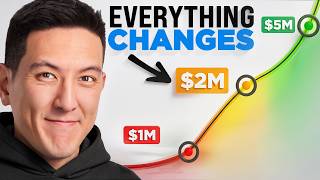
The video discusses three key net worth milestones—$10,000, $100,000, and $500,000—and explains their psychological and financial significance. It emphasizes that while $1 million is often seen as the ultimate goal, life changes at these earlier thresholds due to compounding, financial security, and increased options.
Reaching $10,000 demonstrates discipline and marks the point where compounding starts to work in your favor. With $100 monthly contributions at 8% return, it takes 6.5 years, with $7,800 from contributions and $2,200 from interest.
If you stop contributing after reaching $10k, it grows to $69,538 in 25 years with $59,000 in interest, showing the power of compounding without additional contributions.
Having $10k provides financial confidence, covers 99% of emergencies, and shatters the mental barrier, proving you can stick to a plan and move toward bigger goals.
At $100k, money starts making money. A 10% return yields $10,000 per year, which is significant compared to $10 from $100. Capital scales, making larger investments more lucrative.
The time to accumulate each $100k decreases: first takes 7.84 years, second 5.1, third 3.78, and from $900k to $1M takes only 1.35 years, illustrating the snowball effect.
Investing requires patience because results are delayed. Unlike golf, where feedback is immediate, investing shows results over years, requiring faith and consistency.
If you have $100k and stop contributing, at 8% return it grows to about $1 million in 30 years, with 90.1% of that being interest.
Invest $833/month at 7% return to hit $100k in 7.84 years. Use employer matches (e.g., 401k) and increase income through side hustles or certifications to accelerate.
At $500k, the portfolio does heavy lifting: at 8% return, it generates $40,000 per year. It's a psychological and financial inflection point, often overlooked.
With a 4.7% withdrawal rate, $500k yields $23,500 annually. Combined with average Social Security, a single person at 67 gets $48,352/year; a household gets $73,204.
At $500k, you can consider CoastFIRE, take a lower-paying job, or take time off, as the portfolio compounds in the background. It's the freedom milestone.
Getting to $500k requires the same discipline as earlier milestones—just extended over time. It's the natural result of hitting $10k, $100k, and avoiding lifestyle inflation.
The video concludes that the true milestones are $10k, $100k, and $500k, each providing psychological and financial benefits. Reaching these requires discipline and patience, but they unlock compounding and freedom, making $1 million a natural byproduct.
What is the first net worth milestone discussed?
$10,000
00:13
How long does it take to reach $10k with $100 monthly contributions at 8% return?
6.5 years
00:52
What is the second milestone?
$100,000
02:45
At $100k with a 10% return, how much do you earn per year?
$10,000
02:45
How long does it take to go from $900k to $1M?
1.35 years
04:05
What is the third milestone?
$500,000
07:26
At $500k with an 8% return, how much does it generate per year?
$40,000
07:41
What is the safe withdrawal rate mentioned?
4.7%
08:24
What is CoastFIRE?
Having enough in retirement accounts that without further contributions, it will grow to cover traditional retirement, allowing you to dial back employment.
09:43
Compounding Without Contributions
Illustrates the power of compounding: $10k grows to $69k in 25 years with no extra contributions.
01:18Acceleration of Wealth
Shows how the time to accumulate each $100k decreases dramatically, demonstrating the snowball effect.
03:51Delayed Gratification
Highlights the psychological challenge of investing due to delayed feedback, unlike immediate feedback in activities like golf.
04:20500k as Inflection Point
Positions $500k as a major psychological and financial milestone, often overlooked in favor of $1M.
07:26Freedom at 500k
Explains how $500k enables options like CoastFIRE and career changes, making it the freedom milestone.
09:30[00:01] of a million dollars. That's the number that's on a lot of personal finance books, a bunch of YouTube thumbnails, and many people are using it as the holy grail number of personal finance and investing. Now, don't get me wrong, a
[00:13] million bucks is a great goal, but it's not at $1 million where your life actually changes. In this video, I'm going to walk you through the three net and the significance of each one. So, let's start with the first milestone of
[00:26] $10,000. This is the milestone that shows me that you have discipline accomplishment. I think that if you're able to reach the 10K mark, this is when compounding begins to work in your favor if you are investing, and there are a
[00:39] lot of also psychological benefits of seeing $10,000 in your bank account as second. First though, let's pretend that you invest $100 a month into your investment account earning an average stock market return of 8%. You will hit
[00:52] the $10,000 mark after 6 and 1/2 years. But, you'll notice that even as you're earning interest on your investments, when you hit that 10K, your contributions make up $7,800 of the total $10,000, and the interest makes up
[01:05] you might say to yourself, "Well, is this even worth it? I contributed $7,800 of the initial 10,000, and this compound interest thing isn't that exciting to me. I'd rather just save my money in a bank account." Well, what if I told you
[01:18] that if you got to 10K, and then you just never contributed another penny to that account, this is what's going to happen. 10K invested for another 6 and 1/2 years will yield you interest of $6,591,
[01:30] $1,000 a year in money that you didn't have to work for. After 25 years, your have to work for. After 25 years, your balance is now $69,538 with about $59,000 in total interest earned, and that's not by contributing
[01:43] any extra dollars to that account. Another powerful concept about the 10K milestone is going to be purely psychological. Personally, I know that account, I felt more financially confident, and it was proof of my
[01:56] in a constant state of low-level financial stress or worry even if they never realize it. They're always one bad week or month away from falling behind on bills. They hesitate before making
[02:08] any purchase and money is a constant source of frustration. But if you're able to gain some peace of mind knowing that you aren't just scraping by anymore and you can start focusing on the bigger financial goals. Second, you can cover
[02:21] 99% of life's emergencies because most surprise expenses are hopefully less than 10K. And third, I feel like the mental barrier is shattered at this level because you've proven that you can stick to a plan, hit that 10K, and the
[02:33] only thing stopping you from the 100K is just time and further contributions. Which brings me to my next milestone in today's video, the second one where life really changes and that is the 100K mark. This is when your money really
[02:45] starts to make money for you and the momentum picks up. If you have $100,000 earning a 10% return in a year, that's a return of $10,000 per year on your investment. Now, contrast that to if you only had $100, but you earned 10%, that
[02:59] would earn you $10 in a single year. For most people, we can all earn at least $10 an hour doing some sort of job or task. So, in this case, you invested $100 of your hard-earned money for 1 year and you have $10 to show for it.
[03:12] That's not really super powerful, but because capital scales so well, the benefits of having more capital increase proportionally. Most people can't earn $10,000 that easily by doing some sort of job or task, especially in an hour.
[03:25] the interest that you gain from investing really starts to become quite lucrative. This is why people say it takes money to make money and although $100,000 these days is not enough to retire on, what it does do instead is
[03:39] you. This is when you can really start accelerating your net worth or your investable assets. And so, in a previous video, I mentioned that the time between the first 100,000 and the second and the
[03:51] here's an illustration. Let's say we were to invest 10k into the stock market and get a return of 7% every single year. Your first 100k will take you 7.84 years to get to. The second takes 5.1
[04:05] years, the third takes 3.78 years, and then finally from 900k to a million dollars, that 100k right there only takes 1.35 years because the money you means wealth accumulation is disproportionately a lot slower in the
[04:20] something that's often talked about, which is that when you're starting your investing and you're trying to grow your net worth. In the beginning, you could be doing all the right steps, but you have nothing to show for it, literally.
[04:33] those things where you have to show up, do the work consistently every day, and be disciplined about everything, and then maybe in two years, five years, or see the results of your progress. This can take a huge leap of faith because
[04:47] it's not like any other thing or hobby on the planet. For example, let's say we were out on the golf course together and you were about to hit your shot. Well, instant feedback on how well you just struck that ball. Your direct inputs
[05:00] those results almost immediately with a investing, you have to understand the math behind your decisions and understand that there will be a huge delay in what you were doing now versus
[05:12] what your expected dream result is going to be. For example, someone that hits a investments by the time they're 35, they might feel behind in relation to their media. But if you actually had 100k
[05:25] and you stopped contributing altogether, in 30 years, you will have around 1 million dollars assuming an 8% rate of return. 9.9% of that is going to be your original money of the hundred thousand dollars itself, and 90.1% of that would
[05:39] into the third milestone today, I do want to share with you some tips on how to get your first 100k and beyond. So, if you play with any investment frame goal to hit your first 100K is
[05:52] within 6 to 8 years, if not sooner. We know that from our example earlier, if you invest 10K per year at a 7% return, that will get you to $100,000 in 7.84 years. Now, investing 10K means that you have to invest around $833 per month, so
[06:07] we need to exceed this if we want to hit it faster. That might seem like a any company matches to your investments, this becomes a lot easier. In the US, we have employer-sponsored match programs
[06:19] for your 401K, aka your retirement plan. That means if you contribute $500 a month to your retirement fund, your employer may match $500 in addition to investments $1,000 a month. That's certainly one way to contribute more to
[06:33] your investments. In other parts of the world, there are different programs, so versions of the 401K that will often include employer contributions. And in the UK, you can pay into a pension
[06:45] contributions, too. So, if you are in one of these countries and you're contributions, I would probably start by looking there or connecting with your within your company to see if there are any programs. Another tip to hit 100K
[06:59] faster is by increasing your income. Now, this is easier said than done, but you want to be putting away as much money as possible to get the ball continuing classes for certifications, I would do that. If you can try a new side
[07:13] hustle or freelance gig that brings you an extra 50 to $100 per week, I would do that, too. Just 50 or $100 contributed to your investment accounts on a regular basis will help that compounding, especially in the beginning. The third
[07:26] milestone today, and the one most people never consider, is $500,000. talking about a million dollars, but I think at half a million or 500K, that's actually a massive psychological and financial inflection point. At 500K,
[07:41] your portfolio starts to do the heavy lifting by itself because of its sheer size. So, for example, at $500,000 earning an 8% average return, your money is generating $40,000 per year. That's not nothing. That's a full-time salary
[07:54] don't even have to lift a finger to even earn it. In addition, 500k invested with no additional contributions over 20 years will get you $2.33 million, and if still get you to at least a million dollars. The 500k milestone in America
[08:11] is also more than the average retirement savings, and according to Empower dashboard data, the average retirement savings balance is $491,000. So, I think that once you hit 500k, you are doing pretty good in my opinion. And
[08:24] at 500k, the annual amount that you can withdraw safely is $23,500 withdraw safely is $23,500 using a 4.7% withdrawal rate rule. That means if you were able to combine it with the average social security payment
[08:37] in America, your total income for a single person at the age of 67, which is the full retirement age, is going to be $48,352 per year. A household at 67 is going to receive $73,204
[08:51] per year, assuming both partners are getting the average benefit. That annual retirement, and based on when you take social security, there can be a range of how much that total amount is. The earlier you take social security, the
[09:04] less your benefit is. So, for example, on a $500,000 nest egg, your full annual on a $500,000 nest egg, your full annual income as a household is $58,292 if you start taking social security at 62 years old. It's $73,204,
[09:18] like we said, at 67 years old, and just over 85k if you start taking social security at the age of 70. Now, let's pretend you hit 500k and you're a lot younger than retirement age. So, let's say you hit 500k in investments at the
[09:30] age of 45. This is when you can actually start different types of strategies. So, So, could even quit your current job to take a lower-paying job that you might investments that you have, that gives you a lot of options and freedom because
[09:43] it's at this point you can probably move to something called CoastFIRE if you enough in your retirement account that without any further contributions, it's traditional retirement in the future,
[09:56] is more than enough. The idea with CoastFIRE then is to dial back your employment so that you only have to work to cover immediate day-to-day lifestyle 500k in investments doing the compounding in the background. Another
[10:10] option you get at the 500k milestone is that you might be able to take 6 months to a year off and not have it affect your overall finances. In other words, way more options. So, I think 500k is really that freedom milestone or the
[10:22] option milestone. Now, getting 500k requires the same discipline as the earlier milestones, just extended over time. There's really no new secret unlocked at 500k. I wish there was more to like reveal, but it's literally just
[10:35] the natural result of someone who hit 10k, kept going, they hit 100k, they kept going, and then they refused to let lifestyle inflation get in the way. So, means that you can stick to a plan and stay disciplined. And those same
[10:48] principles that got you to 10k will allow you to hit 100k and 500k and beyond. The only thing that sits between you and those target numbers is more sure to check out my video on how your net worth explodes after you hit
[11:02] $100,000. It's a deeper dive into the second milestone that we covered today. Make sure to subscribe to this channel. We're almost at 2 million subs, and I'll see you guys in the future. All right, peace.



⚡ Saved you 0h 11m reading this? Transcribe any YouTube video for free — no signup needed.