
Melatonin Drops as You Age – Protect It Tonight
60sReveals how melatonin is not just a sleep hormone but a powerful anti-aging antioxidant, while exposing blue light as its biggest enemy.
▶ Play Clip"Delivers exactly what it promises: a science-backed anti-aging sleep formula with actionable mechanisms and timing."
The video presents a science-backed anti-aging sleep routine focused on activating key longevity pathways during sleep: melatonin, growth hormone, and autophagy. It explains how modern habits disrupt these processes and provides actionable steps to optimize sleep for better recovery, hormones, and brain health.
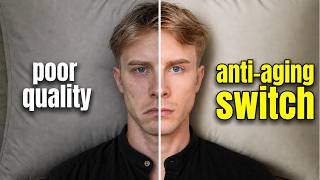
Sleep activates anti-aging pathways including melatonin, growth hormone, autophagy, and glutathione. Low-quality sleep accelerates aging and shortens life, while high-quality sleep can slow it down.
Melatonin is not only a sleep hormone but also a powerful antioxidant. It regulates inflammation, oxidative stress, and many repair processes during sleep. Its levels drop up to tenfold after puberty.
Artificial blue light has the most potent melatonin-suppressing effect. Red light, like at sunset, does not. Dimming lights and using filter apps 1–2 hours before bed preserve natural melatonin.
Morning daylight initiates circadian rhythms, and infrared light penetrates the skull to help regulate the internal clock, supporting melatonin production in the evening.
Clinical trials show 10 mg of melatonin improves cardiometabolic risk factors due to its antioxidant effects. Higher doses (up to 3 g) show no adverse effects and may support dementia, cancer, heart disease, and COVID-19 patients.
Aging-related circadian clock dysfunction can be reversed with NAD+. Increase NAD+ through submaximal aerobic exercise, calorie restriction, intermittent fasting, consistent sleep times, and dietary polyphenols.
The vast majority of growth hormone release occurs in the first hours of sleep, especially deep sleep, and is facilitated by melatonin. Eating reduces growth hormone, while fasting increases it.
The gut contains up to 400 times more melatonin than the pineal gland. Melatonin interacts with the gut microbiome to modulate short-chain fatty acids, supporting metabolic health.
Eating before bed lowers melatonin and growth hormone. A 24-hour fast can raise growth hormone by 210% on average and make it 70% more frequent. Recommended: stop eating 3–4 hours before bed, ideally 4–5.
Autophagy eliminates worn-out cellular debris and is a hallmark of aging. The vast majority occurs during deep sleep. Avoid heavy protein/amino acid intake before bed to keep autophagy active.
A meta-analysis found taking melatonin 3 hours before bed increases total sleep time more than 30 minutes before. A 4 mg dose outperforms 2 mg.
What hormone is the master coordinator of sleep architecture and recovery?
Melatonin
01:23
What has the most potent melatonin-suppressing effect?
Artificial blue light
01:38
How much does melatonin production drop after puberty?
Up to tenfold
00:55
What dose of melatonin showed cardiometabolic improvements in clinical trials?
Around 10 mg
02:56
What metabolite is key for reversing circadian dysfunction?
NAD+
04:17
Name three things that increase NAD+ production and recycling.
Submaximal aerobic exercise, calorie restriction, intermittent fasting (also circadian alignment and polyphenols).
04:31
How many times more melatonin does the gut contain than the pineal gland?
Up to 400 times more
05:47
What effect does a 24-hour fast have on growth hormone?
Rises by 210% on average and pulses 70% more frequently.
06:26
What is autophagy?
The process of cellular cleanup that eliminates worn-out debris and junk material accumulating during aging.
07:33
When is the optimal time to take melatonin for increasing total sleep time?
3 hours before bed; a 4 mg dose was superior to 2 mg.
09:29
What dose of glycine is recommended before bed?
3 g
09:55
Melatonin: Master Coordinator of Recovery
Positions melatonin as the central regulator of multiple anti-aging pathways, not just a sleep hormone.
01:23NAD+ Reverses Circadian Dysfunction
Frames circadian decline as reversible through boosting NAD+, giving a clear target for anti-aging interventions.
04:17Gut Melatonin Dominates
Reveals that the gut produces far more melatonin than the brain, linking sleep to microbiome health.
05:47Fasting Triples Growth Hormone
Quantifies the impact of a 24-hour fast on growth hormone, making the fasting-sleep connection concrete.
06:26Autophagy Happens Mostly in Deep Sleep
Shifts the focus of longevity from daytime habits to sleep as the primary window for cellular cleanup.
07:33[00:03] about it. And if you spend any less time sleeping, your life would be shorter. Good quality sleep can either make you age faster or age slower, and in the process help you also live longer. It comes down to leveraging all the
[00:16] different anti-aging pathways and mechanisms that get activated in your sleep. High melatonin levels, high growth hormone levels, autophagy activation, and high glutathione levels. The problem is that the modern world
[00:28] makes it so easy to disrupt these pathways. Over the course of years and because you're not getting the full recovery in your sleep, even if you I'm going to tell you how to build an anti-aging sleep routine. It's going to
[00:42] help you get better recovery, better hormones, better energy, better brain while you sleep. Let's start with melatonin. Melatonin levels have been seen to drop with age after puberty by up to tenfold. Your body releases the
[00:56] most melatonin in your sleep, but as you get older, the less it does so. During melatonin and significantly less after puberty. Now, the reason this is significant is because melatonin not only is a sleep hormone, but also a
[01:09] powerful antioxidant. It lowers inflammation and oxidative stress. It in fact regulates many other anti-aging and repair processes in your sleep that as the master coordinator of all your sleep architecture and recovery. So, we
[01:23] levels in our sleep as the cornerstone of an anti-aging sleep routine. You video, but if you miss the melatonin, you're wasting your time. So, how do you sleep? The biggest thing that suppresses melatonin before bed is artificial blue
[01:38] light. It has the most potent melatonin suppressing effects. What you could get exposed to in the evening is red light. The sunset has red light, but then you before bed, then it cancels out the melatonin production. So, here's the
[01:52] order of operations you have to have. 1 to 2 hours before bed, dim down the lights. Use filter apps on your smartphone to reduce the blue light. On Apple, it's f.lux, and on Android, it's Twilight. Wear blue blocking glasses if
[02:04] your computer screen isn't going to suppress melatonin when you're heading to bed. And sleep in pitch black darkness. Wear a sleep mask and use blackout curtains, so there wouldn't be any sneaking light shining into your
[02:17] eyes while you sleep. Getting exposed to infrared light during the day also helps because the infrared light penetrates the skull and regulates the circadian rhythm. The morning daylight exposure initiates the circadian rhythms that
[02:30] the evening. Taking melatonin supplements is also safe and effective. As you get older and your natural melatonin production declines, there's evening that's going to replace the melatonin that you were producing when
[02:44] producing less melatonin because you're older now. Yes, it's part of natural aging, but natural aging is bad for you in terms of living longer and slowing down aging. That's where melatonin supplementation can fill the gap.
[02:56] There's plenty of evidence from clinical trials that melatonin supplementation at a dose of around 10 mg, which is a dose much higher typically used for sleep, cardiometabolic risk factors. That's because melatonin is a potent
[03:09] antioxidant. There's also studies on taking all the way up to 3,000 mg of melatonin with no adverse reported side effects. Overall, these studies using gigadose melatonin show better sleep regulation in dementia patients and
[03:22] effects, which might be useful for neurodegenerative diseases. Melatonin combined with chemotherapy in cancer patients improved the tolerability of chemo and had possible anti-tumor effects. The patients had also less
[03:35] anorexia and fatigue. In heart disease patients, melatonin lowered blood inflammation markers. And in COVID-19 patients, melatonin had immunomodulatory might support the immune system during sickness, but there isn't enough
[03:49] So, taking larger doses of melatonin can be strategic in some situations. Can you production? Yes, there is some evidence for that. Of course, just a healthy lifestyle, being healthier, not being obese, that's going to also slow down
[04:04] production, but it's not enough. However, the part of the reason you see a decline in melatonin production is because of circadian clock dysfunction that happens with aging. This is a natural process again due to entropy and
[04:17] aging. Fortunately, it's been found that it's possible to reverse this chronic and damage to the circadian system. The key metabolite for this is NAD+ which is an enzyme with many longevity benefits, but one of its main effects is circadian
[04:31] regulation. Here are some things that increase NAD production and recycling. Exercise, especially submaximal aerobic exercise. Going to failure with your exercise actually lowers NAD production. Calorie restriction, being slightly
[04:43] under a calorie deficit, aka getting a bit leaner. Intermittent fasting, being in a fasted state helps with recycling of NAD. Circadian rhythm alignment, going to bed and waking up around the same time. And dietary polyphenols from
[04:55] and spices. Let's move on with growth hormone. Remember when you were a kid, you could just recover from everything super fast. You didn't even have to sleep. You could party all night, wake up the next day,
[05:07] to build muscle, lose fat with ease while eating anything. Well, part of the high levels of growth hormone. Unfortunately, growth hormone levels Part of the reason is because melatonin
[05:21] sleep. Growth hormone goes through several pulses during the day, but they're relatively small. The vast majority of growth hormone release happens in the first hours of sleep, especially in deep sleep. What
[05:33] facilitates this massive surge in growth hormone in your sleep is melatonin. So, help with growth hormone as well. As you can see, melatonin and growth hormone rise around the same time because melatonin is the master coordinator.
[05:47] hormone respond to nutrient intake as well. Basically, eating reduces growth hormone and not eating increases growth hormone as a way to reduce muscle loss. The gut has up to 400 times more melatonin than the pineal gland in the
[06:01] brain and 10 to 100 times more than in the blood. Melatonin mediates the interactions between your body and your microbiome by modulating the gut bacteria short-chain fatty acids. To take advantage of this, you want to go
[06:13] to bed on a slightly empty stomach, not with a full stomach. Not only is having bad for your sleep quality, but it also lowers melatonin and growth hormone levels. And as a bonus, fasting also increases growth hormone. If you fast
[06:26] for 24 hours, growth hormone has been seen to rise by 210% on average and do so 70% more frequently compared to eating regularly. So, by stopping your hormone in your sleep. Eating would reduce this process slightly, so it's
[06:41] better to go to bed slightly hungrier rather than stuffed. So, how much time stop eating at noon? I don't think you need to go that crazy with it. You don't bed and you don't need to skip your dinner entirely. In my opinion, a good
[06:55] limit is around 3 to 4 hours before bed and maybe up to money up to 4 to 5 hours. Interestingly, I get the best sleep when I stop eating around 4 to 5 slightly emptier. I know that's not applying to every people because some
[07:08] people can't fall asleep when they feel the sensation of hunger, but I actually hunger in my stomach. If you can't fall asleep with an empty stomach, then have higher in protein, maybe like cottage cheese with some berries or kiwis. Those
[07:22] have been shown to also improve sleep and they're not large portion sizes that would disrupt your sleep. The last piece of the puzzle is autophagy, which is the process of cellular cleanup. It helps to eliminate worn-out cellular debris as
[07:34] well as junk material that accumulates during aging. That's why autophagy is central to longevity. It's actually a new hallmark of aging and controls many other hallmarks. It's no coincidence that melatonin also regulates autophagy.
[07:46] Yes, you can upregulate autophagy during the day with things like exercise, calorie restriction, but the vast majority of autophagy occurs in your sleep, especially deep sleep. The body is a very efficient system. It doesn't
[07:59] want to waste energy, and for that purpose, it coordinates all of these repair and anti-aging processes into your sleep, specifically deep sleep, occurs. And this is another reason you want to stop eating a few hours before
[08:12] process. You don't need to be completely fasted, but you want to avoid high have massive amounts of food or massive amounts of amino acids and protein in your system, either, because amino acids lower autophagy. You can do additional
[08:26] evening. During the day, you can exercise and consume coffee, for example. These two increase autophagy. In the evening, you can have herbal teas like chamomile or ginger tea, two herbs that also have autophagy-regulating
[08:38] effects. Melatonin supplementation possibly also supports autophagy because there's also the amino acid glycine that's been shown to increase autophagy. What I like to do is drink chamomile tea with 3 g of glycine. That's the perfect
[08:52] All right, now that we've gone through the major components, let's put it all In the morning and during the daytime, get exposed to some sunlight. Morning light exposure starts the circadian rhythm and tells your body to produce
[09:04] melatonin at night. It also starts to support energy recycling. Infrared light melatonin. So, it's also important to get some infrared light throughout the day. During the day, do some exercise.
[09:16] fall asleep, but it also increases growth hormone and autophagy. Stop eating 4 to 5 hours before bed, at least 3 to 4 hours. This ensures you have higher growth hormone, melatonin, and autophagy before bed. Take melatonin 3
[09:29] hours before bed. A recent meta-analysis saw that this was superior to 30 minutes before bed for increasing total sleep time. A 4 mg dose was also superior to 2 mg. Many people take melatonin 30 minutes before bed, but that means your
[09:42] melatonin will rise in your bloodstream only when you're already asleep. If you take it 3 hours before bed, then you already have elevated melatonin before you fall asleep. Take glycine 3 g with either tea or just regularly. This
[09:55] promotes relaxation and helps with sleep. Glycine lowers body temperature and supports sleep, but it also increases autophagy. Block blue light 1 to 2 hours before bed to not undermine the melatonin production in your sleep.
[10:07] your body will eventually start producing melatonin, but it will do so fallen asleep. But why would you not support it by simply avoiding artificial blue light? I know this video wasn't about specific sleep hacks or sleep tips
[10:22] was about leveraging the underlying mechanisms and pathways that actually beneficial for your longevity. If you want to know how to really optimize your tips to sleep more and feel more recovered, then check out my video about
[10:37] how I increased my sleep scores from 77 to 100.



⚡ Saved you 0h 10m reading this? Transcribe any YouTube video for free — no signup needed.