
I Ate Dinner at 4 PM for 5 Years – Here's What Happened
60sPersonal transformation stories with specific biomarker improvements (sleep, heart rate) hook viewers interested in biohacking.
▶ Play Clip"The title promises a personal transformation story, and the video delivers on that with concrete changes and scientific backing, though it includes a promotional segment."
The video discusses the benefits of shifting to an earlier dinner time, based on the creator's personal experience and scientific research. It explains how eating earlier can improve sleep quality, recovery, and overall health by aligning with the body's natural circadian rhythms and hormonal processes.
The creator has practiced intermittent fasting for over 14 years, starting with a 16:8 window, then OMAD, and various other eating patterns. They wrote a book on the science of intermittent fasting and autophagy in 2019.
The most transformative change was moving dinner earlier, starting with 2 hours before bed and gradually increasing to 5-6 hours. This change improved sleep and biomarkers.
After 5 years of early time eating, deep sleep score and sleep quality improved by about 10%. Falling asleep became faster, and waking up during the night reduced.
Eating earlier allows the body to focus on digestion before sleep, leading to better overall health. Lying down with food in the stomach worsens digestion and sleep quality.
Resting heart rate during sleep is slightly lower, contributing to deeper sleep and better recovery. The creator is now leaner and carries less fat.
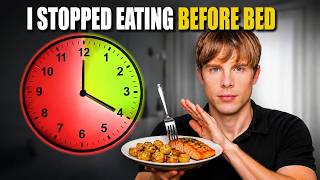
The creator's current schedule: first meal at 10:00 AM with 40g protein, workout in the afternoon, and the rest of calories at 4:00 PM. Bedtime is at 10:00 PM, allowing 5 hours for digestion.
Melatonin is a sleep and anti-aging hormone. The gut produces up to 400 times more melatonin than the pineal gland. Food intake influences melatonin production, so an empty stomach before bed is beneficial.
Going to bed in a semi-fed state reduces growth hormone. Fasting for 24 hours can increase growth hormone by 210% on average. Stopping food earlier promotes growth hormone release, which is crucial for repair.
Autophagy, the cell's cleanup system, mostly happens during deep sleep. Eating a large meal before bed forces the body to prioritize digestion over repair, reducing autophagy.
You don't need to stop eating 5-6 hours before bed; 5:00 PM dinner is a good goal. The creator personally eats at 4:00 PM and sleeps better. Habit plays a role; gradually shifting dinner earlier can make it easier.
Time-restricted eating studies show benefits for weight loss and metabolic health. A 2026 meta-analysis of 41 RCTs found early time-restricted eating (last meal before 5:00 PM) is superior to late eating, improving insulin sensitivity and blood glucose regulation.
The dinner time matters most, not breakfast timing. Eating as early as possible is better than a super late dinner. A 5:00 PM dinner is a realistic and effective compromise.
Shifting dinner earlier, ideally before 5:00 PM, can significantly improve sleep, recovery, and metabolic health by aligning with the body's natural hormonal rhythms. This simple change is supported by both personal experience and recent scientific research.
What is the recommended last meal time for early time-restricted eating?
Before 5:00 PM
06:31
How much can growth hormone increase after a 24-hour fast?
210% on average
03:24
What is the role of melatonin in the gut?
It modulates gut bacteria and short-chain fatty acids, influencing the microbiome.
02:56
What did the 2026 meta-analysis of 41 RCTs conclude?
Early time-restricted eating is superior to late time-restricted eating, with the last meal before 5:00 PM improving insulin sensitivity and blood glucose regulation.
05:51
What is the creator's current eating window?
First meal at 10:00 AM, last meal at 4:00 PM, bedtime at 10:00 PM.
02:17
10% Improvement in Deep Sleep
Quantifies the benefit of early dinner on sleep quality, making the advice concrete.
01:07Gut Melatonin Production
Highlights the gut's significant role in melatonin production, a key insight for sleep and longevity.
02:30Growth Hormone and Fasting
Connects fasting to growth hormone release, explaining a mechanism behind the benefits of early dinner.
03:09Autophagy During Deep Sleep
Explains why eating late can hinder cellular repair, a crucial concept for aging.
03:52Meta-Analysis Supports Early Dinner
Provides scientific backing for the recommendation, increasing credibility.
05:51[00:01] over 14 years now. I started with a basic 16 and 8 window after finishing high school. Then I went through phases of one meal a day or omad. I tried no breakfast, early dinner. At this point, I've basically run every eating window
[00:15] written a comprehensive book about the science of intermittent fasting and autophagy called metabolic autophagy back in 2019 before it became a mainstream topic. But here's what has been the most transformative for my own
[00:27] sleep and recovery. having an earlier dinner rather than a late dinner. I know it sounds very simple, but it has had a positive effect on many of my biomarkers and my sleep. I started finishing my dinner 2 hours before bed, then I moved
[00:40] on with three and four hours, eventually 5 6 hours. In this video, I'm going to about implementing this change and why I decided to have an earlier dinner instead. Also, if you want to discover your own health percentile to know what
[00:53] different types of biomarkers like your fitness markers, body composition, and and biggest weaknesses, then take the health assessment in our top 1% health community link in the description. Let's start with the biggest changes I've seen
[01:07] after doing five plus years of late time sugar eating and then moving on with 5 years of early time eating. My deep sleep score and sleep quality is up, not by a lot, but by about 10%. But I fall asleep faster and I don't wake up one to
[01:22] This makes sense because deep sleep happens in the first half of the night food in the stomach to digest, the body has to spend more energy digesting that maintenance and repair that happens
[01:36] health is better. This also makes more sense for the same reason. If you lay your digestion and sleep quality is going to be worsened. You might also end because your body goes to sleep. So, there's less energy dedicated to fully
[01:50] digesting what you eat. There's also a circadian rhythm element to this. Gut your sleep so that there's more energy spent on repair and maintenance. My resting heart rate is slightly lower in my sleep. Not a lot, but enough for me
[02:03] to notice. This contributes to the deeper sleep and better recovery. fat digestion and better recovery in my sleep. I'm now leaner and carry less and exercise activity. So, what's my eating window currently? I have my first
[02:17] meal around 10:00 a.m. which contains around 40 g of protein. Then, I work out in the afternoon and I have the rest of my calories at 400 p.m. I go to bed at 10:00 p.m. So, that gives me around 5 hours for digestion. So, let me share
[02:30] with you why I think an earlier eating window is better for general longevity melatonin, which is considered the sleep anti-aging longevity hormone. Naturally, melatonin gets released when we don't
[02:43] get exposed to lights, so ideally before bed. However, melatonin production is also influenced by food intake. The gut has up to 400 times more melatonin than the pineal gland and 10 to 100 times more than in the blood. Melatonin
[02:56] body and your microbiome by modulating the gut bacteria short- chain fatty acids. To take advantage of this, you emptier stomach. Not only will the massive amounts of food be bad for your
[03:09] reduce melatonin production. Another reason is that going to bed in a semi-fed state increases growth hormone. If you fast for 24 hours, growth hormone has been seen to rise by 210% on average and do so 70% more frequently compared
[03:24] to eating regularly. So, by stopping food earlier, you produce more growth reduce this process slightly. Growth hormone goes through several pulses small. The vast majority of growth hormone release happens in the first
[03:38] facilitates this massive surge in growth everything you do for melatonin will help with growth hormone. As you can around the same time because melatonin is the master coordinator. Then there's
[03:52] autophagy, your cell's cleanup system and one of the actual hallmarks of aging. Most autophagy activity happens during deep sleep, which means that if you eat a large meal right before bed, you're doing the exact opposite of what
[04:04] You're asking your body to run digestion and repair at the same time. And usually digestion is a bigger priority. It's no coincidence that melatonin also regulates autophagy. So it seems that everything is supposed to happen in your
[04:18] and everything that suppresses melatonin production is going to be bad for your sleep quality and recovery. Yes, you can increase autophagy during the day as well with exercise, saunas, coffee, etc. But the vast majority of autophagy
[04:31] processing happens in your sleep. Now, you don't need to stop eating five or 6 hours before bed. Definitely not 8 hours before bed. I personally eat my dinner at 4 p.m. because I found that it works great for me. I always sleep better with
[04:43] I'll have my dinner earlier. Some other people might not experience that. They might sleep worse if they don't have anything before bed. A lot of it can also be habitual. When I was finishing my dinner at 8:00 p.m., I definitely
[04:56] didn't like the idea that I should finish at 4 p.m. But as I gradually reduced my eating window, I started to finish my dinner at 7:00 p.m., 6 p.m., 5:00 p.m., and 4 p.m. Then over the time, I started to like it. So, in a lot
[05:08] change your habits, you don't notice the change. You actually might like the new eating window. What about research? Is there any actual research that eating timerestricted eating studies have supported the idea that having an
[05:22] sugar, metabolic health, and even weight loss. Now, the studies that do a good job at controlling the actual calorie intake, they don't find a significant blood markers between early and late time sugar eating. However, because of
[05:36] you, like the melatonin production, growth hormone, autophagy, it would make sense that an earlier dinner is better than late dinner. A recent 2026 meta analysis of 41 randomized control trials concluded that early timer eating
[05:51] appears to be still superior to late timer eating. What the meta analysis found was that the eating window of how long you fast and how small your eating window is doesn't matter that much. It doesn't matter if you have breakfast or
[06:04] how early your breakfast is. What matters the most is the dinner when you is better than a later dinner. So you can have breakfast, you can also skip it most is the dinner time and probably because of how the dinner time
[06:18] hormone, autophagy, all these things. What the meta analysis found was that early time restricted eating with your last meal being before 5:00 p.m. incident sensitivity, better waste reduction, and better blood glucose
[06:31] regulation. Surprisingly, it's not super early eating, like having your last meal before 3 p.m. or earlier than that, which makes it more realistic and dinner appears to be better. This is good news because you don't need to stop
[06:44] eating at 3 p.m. like people used to think 5 years ago. But a 5:00 p.m. dinner could be a good goal and a good compromise. If you can't eat that early, then try to eat as early as possible rather than having a super late dinner.
[06:56] right, thanks for watching. If you want to discover your health percentage and get your road map to top 1% of health, then join the community using the link then join the community using the link in the description. I'll see you there.
⚡ Saved you 0h 07m reading this? Transcribe any YouTube video for free — no signup needed.