
The Spinning Nut That Flipped in Space
44sThe mystery of the Dzhanibekov effect revealed through a real astronaut story is intriguing and science-based, perfect for curiosity-driven viewers.
▶ Play Clip"Title promises an explanation of bizarre behavior, but the transcript only covers history and setup, leaving the actual explanation for later."
This video explores the Dzhanibekov effect, also known as the tennis racket theorem or intermediate axis theorem, which describes the counterintuitive flipping behavior of rotating objects. The presenter aims to provide an intuitive explanation of this phenomenon, starting with the historical discovery by cosmonaut Vladimir Dzhanibekov during a space station rescue mission.
The video introduces the Dzhanibekov effect, also called the tennis racket theorem or intermediate axis theorem, and promises an intuitive explanation of how it works.
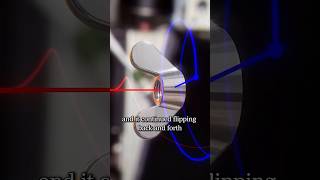
In 1985, cosmonaut Vladimir Dzhanibekov saved the Soviet space station Salyut 7. While unpacking supplies, he noticed a wing nut flipping 180 degrees at regular intervals as it spun off a bolt.
The phenomenon was kept secret by the Russians for 10 years. In 1991, a paper titled 'The Twisting Tennis Racquet' was published in the Journal of Dynamics and Differential Equations, describing the effect without mentioning the secret Dzhanibekov discovery.
The paper explains that flipping a tennis racket in the air causes it to make a half turn around an axis through its handle, so the side facing you initially faces away when caught.
The video sets up the historical context and the basic demonstration of the Dzhanibekov effect, promising a deeper intuitive explanation in the rest of the video.
What is the Dzhanibekov effect also known as?
The tennis racket theorem or intermediate axis theorem.
00:01
Who discovered the effect and in what year?
Cosmonaut Vladimir Dzhanibekov in 1985.
00:15
What did Dzhanibekov observe while unpacking supplies?
A wing nut flipping 180 degrees at regular intervals as it spun off a bolt.
00:27
How long was the effect kept secret by the Russians?
10 years.
00:55
What paper was published in 1991 and where?
The Twisting Tennis Racquet, published in the Journal of Dynamics and Differential Equations.
00:55
Historical Discovery
Provides a real-world origin story that makes the abstract physics concept relatable.
00:15Secrecy and Publication
Highlights the political context of scientific discovery during the Cold War.
00:55[00:01] Dzhanibekov effect or the tennis racket theorem [music] or the intermediate axis theorem. Now, you may have seen clips like this one before, but in this video, I will provide the best intuitive explanation of how this effect [music]
[00:15] works. So, in 1985, cosmonaut Vladimir Dzhanibekov was tasked with saving the Soviet space station Salyut 7, which had completely shut down. And after rescuing
[00:27] the space station, Dzhanibekov unpacked supplies sent up from Earth, which were supplies sent up from Earth, which were locked down with a wing nut. And as the wing nut spun off the bolt, he noticed something strange. The wing nut
[00:40] maintained its orientation [music] for a short time, and then it flipped 180° and as he kept [music] watching, it flipped back a few seconds later. And it continued flipping back and forth at regular intervals. It was a strange and
[00:55] counterintuitive phenomenon, one that the Russians kept secret for 10 years. Six years later, in 1991, a paper was published in the Journal of Dynamics and Differential Equations called The Twisting Tennis Racquet. And although it
[01:09] was related, it of course makes no mention of the secret Dzhanibekov effect. The paper says, "If you hold a tennis racket facing you and then flip it in the air like this, it not only rotates the way you intend it to, it
[01:22] also makes a half turn around an axis that passes through its handle. So, the side that was originally facing you will be facing away when you catch it."
⚡ Saved you 0h 01m reading this? Transcribe any YouTube video for free — no signup needed.