
What e^t REALLY means
43sExplains the exponential function through dynamics, making a complex concept intuitive and visually appealing.
▶ Play Clip"Delivers a clear, intuitive explanation of Euler's identity, though the title is slightly more cryptic than the content."
This video presents an intuitive, dynamics-based explanation of Euler's identity, e^(i*pi) = -1. Instead of relying on algebraic manipulation, it interprets the exponential function as describing motion, where the function's value represents position and its derivative represents velocity. This approach makes the behavior of e^t, e^(2t), e^(-t), and ultimately e^(i*t) geometrically clear, culminating in a natural understanding of why e^(i*pi) equals -1.
e^t is the unique function that is its own derivative and equals 1 at t=0. Interpreted as position over time, it starts at 1 and its velocity always equals its position, leading to growth at an ever-increasing rate.
For e^(2t), the rate of change is 2 times itself, so velocity is 2 times position, causing more rapid growth. For e^(-t), the rate of change is negative, so the function shrinks, with the rate of shrinkage proportional to its current size, characterizing exponential decay.
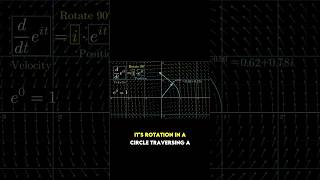
Plugging in i means the velocity is i times the position. Geometrically, multiplying by i is a 90-degree rotation. Thus, the motion is a circular rotation with a constant speed of 1 unit of arc length per second.
After pi seconds of this circular motion, you are halfway around the circle, so the position is -1. Therefore, e^(i*pi) = -1.
By viewing e^(i*pi) through the lens of dynamics, the identity emerges as a simple consequence of circular motion: after pi seconds of rotating at unit speed, you end up at -1.
What is the unique function that is its own derivative and equals 1 at t=0?
e^t
00:02
In the dynamic interpretation, what does the derivative of the position function represent?
Velocity
00:16
For e^(2t), what is the rate of change relative to the function itself?
2 times itself
00:29
What characterizes exponential decay in the dynamic interpretation?
The rate of shrinkage is proportional to the current position, so the smaller it is, the slower it shrinks.
00:57
Geometrically, what does multiplying by i represent?
A 90-degree rotation
01:10
What motion satisfies the condition that velocity is always a 90-degree rotation of the position vector?
Rotation in a circle traversing 1 unit of arc length per second
01:26
After pi seconds of this circular motion, what is the position?
-1 (halfway around the circle)
01:41
Dynamic definition of e^t
Provides a foundational, intuitive understanding of the exponential function as a self-referential growth process.
00:02Geometric meaning of i
Connects the abstract imaginary unit to a concrete geometric operation (90-degree rotation), making complex numbers tangible.
01:10Euler's identity as motion
Transforms a famous algebraic identity into a simple statement about circular motion, demystifying it.
01:41[00:02] i. Start by asking what the function e to the t really is. From the perspective of dynamics, this is the unique function which is its own derivative and also which equals zero when you plug in one. For example, let's say e to the t
[00:16] described a position over time. What this means is that it starts at the number one and at all times the velocity has to equal the numerical value of that position. So even before knowing how to compute it or anything like that, you
[00:29] get this very strong intuitive feeling for how it behaves. It describes growth at an everinccreasing rate. If you put some constant in that exponent like two, then by the chain rule, this means you have a function whose rate of change is
[00:41] exactly 2 times itself. So in the language of dynamics, the velocity would meaning that it grows all the more rapidly. If the exponent was negative, change is negative, meaning that it shrinks over time. But the rate at which
[00:57] it shrinks is proportional to that position. So the smaller it is, the smaller it shrinks, which characterizes exponential decay. But what about plugging in i, the roo<unk> of -1. Well, interpreting this once more as a
[01:10] position. This tells us that the velocity is always I * that position. And geometrically, multiplying by i looks like rotating by 90°. So, if this some kind of motion where the velocity vector is always a 90° rotation of the
[01:26] position vector. There's only one motion that satisfies this. It's rotation in a circle traversing a distance of 1 unit of arc length per second. So, after pi seconds, you would be halfway around the circle. Meaning b to the i *<unk> is
[01:41] equal to -1. [Music]



⚡ Saved you 0h 01m reading this? Transcribe any YouTube video for free — no signup needed.