
Why Boats Can't Climb Hills
42sExplains a fundamental limitation of waterways, setting up the need for innovative engineering.
▶ Play Clip"Delivers on the 'hidden engineering' promise with detailed mechanics and history, though sponsor segment slightly dilutes focus."
The Falkirk Wheel is a unique rotary boat lift in Scotland that connects the Forth and Clyde Canal with the Union Canal, overcoming a 38-meter elevation difference. Completed in 2002 as part of the Millennium Link project, it replaced a flight of 11 locks with a five-minute journey, using minimal energy and attracting tourists worldwide.
Water transport is cheap and efficient but requires level waterways; locks are the standard solution for elevation changes.
The wheel was built with Millennium Commission funding, requiring collaboration among public, private, and volunteer stakeholders.
The original 11 locks took a day to traverse, consumed large amounts of water from the Union Canal, and were eventually abandoned.
The project revitalized the canals, including The Kelpies sculpture, with the Falkirk Wheel as the flagship connection.
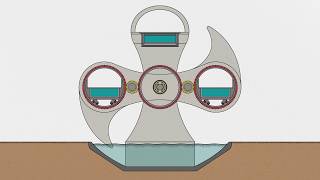
Two opposed arms with water-filled gondolas counter-rotate via hydraulic motors, maintaining balance and using only 1.5 kWh per half turn.
At top or bottom, stow pins lock the gondola, a lance connects hydraulics, U-shaped seal bridges the gap, gates open after pressure balance.
A floating boat displaces its weight in water, so the wheel remains balanced whether boats are inside or not.
Canals now host narrowboats for holidays and homes, with increasing popularity for nomadic lifestyle.
A tunnel avoids disturbing the Roman-era UNESCO site, with two locks raising boats the remaining distance.
Millions have visited; it reconnected people with infrastructure that is both functional and inspiring.
The Falkirk Wheel exemplifies how bold, aesthetically-driven engineering can revitalize infrastructure and community pride while remaining highly functional.
What is the Falkirk Wheel?
A rotary boat lift connecting the Forth and Clyde Canal to the Union Canal in Scotland.
02:17
How much elevation difference does the Falkirk Wheel overcome?
115 feet or 38 meters.
01:21
What was the original method to connect the two canals?
A flight of 11 locks.
03:01
How long did it take to navigate the original locks?
The better part of a day.
03:14
How much energy does the Falkirk Wheel use per half turn?
About 1.5 kilowatt-hours.
09:06
Why does the Falkirk Wheel remain balanced even with boats inside?
A floating boat displaces its own weight in water, so the water level and forces remain unchanged.
08:32
What is the purpose of the U-shaped seal during docking?
To bridge the gap between the gondola and the aqueduct to allow water to fill and balance pressure.
08:03
What historical structure required a tunnel for the canal relocation?
The Antonine Wall, a Roman-era UNESCO World Heritage Site.
10:51
What type of vessels now primarily use the Scottish canals?
Narrowboats, similar to RVs, used for holidays and homes.
09:38
What was the Millennium Commission?
A UK organization that funded projects to mark the year 2000 using National Lottery money.
05:14
Public infrastructure collaboration
Shows how diverse stakeholders can agree on unconventional public projects.
02:17Counter-rotating gondola mechanism
Demonstrates clever mechanical engineering using idler pinions and ring gears.
06:50Buoyancy-based balance
Explains a counterintuitive physics principle behind the wheel's efficiency.
08:32Infrastructure as inspiration
Argues that functional structures can also be aesthetically and socially valuable.
12:42[00:01] This is the Forth and Clyde Canal in central Scotland. Completed in 1790, it was the first canal to cross any part of the British Isles. There are a lot of geographical terms for coastal features where the sea indents into the land: sounds, inlets, fjords, lochs,
[00:20] coves, bays, and so on. They all have subtly different meanings that can vary by location, but in Scotland, a lot of them are called “firths,” and they’re pretty important when it comes to navigation. The Forth and Clyde Canal, as its name strongly suggests, connects the Firth of
[00:36] Forth to the Firth of Clyde. It also has a branch into the heart of Glasgow. When it was built, this canal dramatically shortened the transit times for goods in the region, and it also served as the testing waters for the very first steam-powered boats.
[00:50] Not long after the Forth and Clyde opened, another important canal was completed in Scotland. The Union Canal connected the cities of Falkirk and Edinburgh, opening up a route for coal and other minerals from the mines and quarries around Lanarkshire to
[01:04] the capital. Along the way, it passes over some pretty impressive aqueducts, including the Avon Aqueduct near Linlithgow. A connection to the Forth and Clyde Canal in Falkirk would provide a direct waterway link between the two largest cities in the country (Edinburgh and Glasgow)
[01:21] without ships needing to navigate the hazardous Firth of Forth. But there is the challenge of elevation. Union Canal sits about 115 feet or 38 meters above the level of the Forth and Clyde.
[01:35] Moving people and goods by boat has a lot of advantages: it’s cheap, it’s efficient, it usually takes less infrastructure, and it allows for connectivity across the globe. But there is a major disadvantage: the waterways that ships and boats traverse have to be pretty much
[01:50] level. Boats don’t climb hills like cars, trucks, and trains. This is the main purpose of a lock: raising or lowering a vessel to navigate elevation changes in waterways. In fact,
[02:02] locks are pretty much the only solution to this engineering challenge… except in a few rare cases. You’ve seen the title. You know where I’m headed with this. But the story of the Falkirk Wheel - the only rotary boat lift in the world - is fascinating, not just because of
[02:17] the mechanisms, but also how it came to be in the first place. It’s not easy to accomplish projects like this. The Falkirk Wheel is not the passion project of some lone eccentric billionaire.
[02:29] This is public infrastructure, which means a vast array of stakeholders had to come together and agree that this bizarre structure was worth the resources that went into building it. It’s got some very clever engineering under the hood, and a lot of lessons in its creation that, I think,
[02:46] apply to other challenges we face today. I’m Grady, and this is Practical Engineering.
[03:01] Of course, the original connection between the Forth and Clyde and Union canals did use locks. A lot of locks. This map from 1898 shows the flight of 11 locks required to get boats up
[03:14] and down between the two. You can imagine the time, resources, and effort involved in navigating this staircase. The process took the better part of a day, and not only that, it used a lot of water from the Union Canal. Even though boats can move through locks in
[03:31] both directions, water only moves through in one. Each structure always fills from the upper canal, and always drains to the lower one. That’s just gravity. But, it’s important to realize that even though most locks don’t use pumps, the energy required to raise and lower boats through
[03:48] isn’t free. Each passage through costs roughly one “lock-full” of water from the upper canal. In addition to the inconvenience and water usage, other factors eventually drove these canal systems in Scotland into disrepair and abandonment. The canals were small, and as ships got larger, the
[04:06] narrow and shallow passages became less useful for transporting materials and goods. The railroads also started competing with the canals, offering faster connections between major cities. By 1930,
[04:18] the canals were barely used, and by 1960, they were choked with vegetation and debris. Motorway construction disconnected several segments, and authorities decided to close them for good. That
[04:30] could have been the end of the story, and honestly, it wouldn’t be too surprising. It’s been the fate of many of the world's great canals and inland waterways as transportation technologies and overland shipping have passed them by.
[04:43] But then the year 2000 happened. Maybe you remember this. It was a weird time to be alive. There was this strange tension between excitement about the new century and fear that all our computer systems would crash into an
[04:59] apocalypse. The programmers and IT professionals took good care of us on the computer side, but there were people working hard on the celebrations, too. One of those organizations was the United Kingdom’s Millennium Commission. The idea was simple:
[05:14] take some of the money from the National Lottery and direct it toward interesting and impactful projects that would help mark the turn of the century. In Scotland, a large consortium of organizations - public, private, and volunteers - got together
[05:28] and applied for a grant from the Millennium Commission. In 1997, funding was awarded to cover approximately half of the cost of the Millennium Link: a massive undertaking to revitalize
[05:40] and reopen the canals that once connected Scotland from coast to coast, restore locks, build hike-and-bike trails, and rehabilitate bridges. The work included The Kelpies,
[05:52] a sculpture of two huge horse heads that serve as the gateway to the Forth and Clyde canal. That was a pretty fascinating civil engineering project in its own right. But of course, the Millennium Link’s flagship project was reconnecting the Forth and Clyde to the Union Canal.
[06:08] But rather than do it with locks, the group wanted a 21st-century landmark, or I guess, more of a watermark. A fast, efficient connection that would serve as a capstone to the canal revitalization,
[06:21] draw tourists from around the world, and serve as a symbol of the region that was once a hub of transportation and commerce in Scotland. And, in fact, a hub is a good metaphor for what they came up with. The Falkirk Wheel opened for traffic in May 2002, and now,
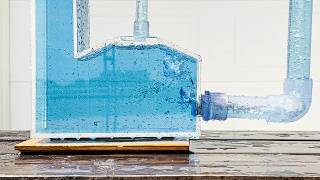
[06:38] more than two decades later, it’s pretty clear that they nailed the idea. Here’s how it works: Boats bound for the Union Canal enter a circular turning basin at the bottom. The Wheel has two
[06:50] opposed arms, each with water-filled gondolas (or caissons) spanning between them. Those gondolas are mounted on bearings that ride on circular rails. When one goes up, the other comes down,
[07:02] so traffic can move both ways. The wheel is driven at its center using hydraulic motors that keep the motion smooth and slow. Idler pinions mesh between two identical ring gears: one fixed and centered on the shaft; the other surrounding each gondola.
[07:18] This arrangement enables the gondolas to counter-rotate as the wheel moves, maintaining their perfect upright position throughout the full range of motion. The elegance of the Falkirk Wheel hides some fairly complicated systems that make
[07:33] it function. At the top and bottom, each gondola has to be able to open and close to let boats in and out. And the aqueduct at the top needs the same capability so water The docking and undocking procedure is a delicate dance.
[07:51] When a gondola reaches the top position, stow pins extend to lock it in place. Then an extendable lance connects it to a hydraulic power unit. A U-shaped seal extends
[08:03] to bridge the gap between the two structures, and pipes fill the gap between the gates with water, balancing the pressure. Finally, hydraulic rams open the gates on both sides, allowing boats to enter or leave. The whole process happens in reverse, and then the wheel is free to move again.
[08:20] Part of the engineering genius of the Falkirk Wheel is that it’s always balanced, whether there are boats inside the gondolas or not. This is one of those confusing things about buoyancy:
[08:32] a floating vessel always displaces its own weight in water. Theoretically, as long as the water level stays the same, when a boat floats over an aqueduct, there is no change in forces on the columns. The displaced water flows away, balancing the new force of the boat.
[08:50] Same thing for the gondolas. When a boat floats in, its weight in water flows out, maintaining a balance between the two sides. As a result, the Falkirk Wheel doesn’t really require a lot of power to operate. It’s about one-and-a-half kilowatt-hours for a half turn of the wheel,
[09:06] often compared to the power required to boil eight kettles of water. Where I live, that’s less than 25 cents in electricity. And unlike the day-long climb of the industrial-revolution-era locks, the Wheel moves boats between levels in about five minutes.
[09:22] The Scottish Canals see almost no commercial shipping these days. They’re still too small, and the road and rail networks are still faster. But the canals do see a lot of traffic. There’s a whole class of vessels specifically designed for navigating the unique and historic canals
[09:38] of the UK. Similar to RV culture in the US, narrowboats ply the inland waters across England, Wales, Scotland, and beyond, used for holidays, touring, and even as long-term homes. During the
[09:52] early Industrial Revolution, boats like this were pulled along canals by horses or donkeys from towpaths that ran alongside them. Modern narrowboats are self-propelled and often equipped with domestic comforts, including bathrooms, kitchens, heating,
[10:07] and internet. The number of boats has been steadily increasing over the past decade, offering the freedom and lower cost of a nomadic lifestyle on the canals. Even for those not living on narrowboats, cruises and tours along the canals offer
[10:22] something unique. It’s a totally different way to experience the landscape in some of Great Britain’s most beautiful areas, and it offers insights into the history of the region that you can’t get anywhere else. And of course, you also get to see the fascinating infrastructure,
[10:38] including a boat lift that you won’t find anywhere else in the world. But it doesn’t go all the way up. When a segment of the canal was relocated as part of the Millennium Link, it needed to cross the Antonine Wall,
[10:51] a Roman-era defensive perimeter and UNESCO World Heritage Site. Rather than disturb it, the new canal was built into a tunnel below. From the aqueduct at the top of the Wheel, two new locks
[11:04] raise boats the remaining distance once they pass underneath the wall to the top of the Union Canal. The Antonine Wall marked the far northern border of the Roman Empire. On another edge, just a handful of decades before it was built, Mount Vesuvius erupted,
[11:20] burying the city of Pompeii in ash. But there’s a twist to that story. My friends at the podcast, RadioLab, are just about to premiere a fantastic video about the survivors of Pompeii and how we
[11:32] discovered that some people actually escaped. This simultaneous release is part of a collaboration with the Independent Media Initiative to highlight some of the best educational and artistic creators
[11:44] on the internet. I’m really thankful for the award the channel won this year for my Practical Construction special, and I’m so excited to hand off to one of my favorite shows on the internet, RadioLab, for the next video in this collaboration. Go check it out after this!
[12:00] When I was a kid, my dad used to tell me, “If the only reason you want something is because it’s cool, you probably don’t need it.” You can look at me and probably tell I took that advice to heart. But there are situations where it’s worth doing something
[12:14] just because it’s going to be impressive. The Falkirk Wheel is a perfect example. Locks are a perfectly functional solution to get boats up and down to different elevations. There
[12:26] are thousands of them around the world diligently serving our inland waterways. Scotland wanted something special, something that would spark a resurgence in their canal system and revitalize the sense of pride in the communities along them. It took guts to
[12:42] try something completely different, and it paid off. Millions of people have visited to watch it turn or travel through it. The Falkirk Wheel didn’t just reconnect two canals. It reconnected people with the idea that infrastructure can be both useful and pretty cool.
[13:01] Here’s something else that’s pretty cool: a homecooked meal that’s seasonal, healthy, and didn’t require a trip to the grocery store. We’ve been using today’s sponsor, HelloFresh, for years now, even before these ones were born. And
[13:14] now they’re actually old enough to help out with dinner… kind of. “Oh, some snail shells. Put them in the pot!” pre-portioned ingredients shipped right to your door so you have dinners ready to go.
[13:30] These helpers can be a bit picky, but HelloFresh has expanded their options and even made them customizable to fit the preferences of the week.
[13:42] “Just put the pepper on momma’s croutons. I like it spicy. And in fact, HelloFresh has kid-friendly choices that are specifically curated
[13:54] for the little ones that don’t like to stray from the staples like I do. “Don’t mind the man saying ‘Oh no’ repeatedly in the background.” Even beyond the good food, using Hello Fresh is just a great way to spend time
[14:09] keeps them involved, and (I think) makes them more likely to try new foods. “I’m cooking mushrooms on the stove!”
[14:22] Give a second chance to the ‘NEW’ HelloFresh by using my code PRACTICALFM at HelloFresh dot com for 10 Free Meals + Free Breakfast for Life. This part’s verbatim:
[14:34] One free meal per box with active subscription. Free meals applied as discount on first box, new or returning subscribers only, varies by plan. Sign up today! Click the link below or use my code PRACTICALFM at HelloFresh.com. Thank you for watching and let me know what you think.
⚡ Saved you 0h 15m reading this? Transcribe any YouTube video for free — no signup needed.