
AI Summary
This video demonstrates the hydrostatic paradox through experiments with differently shaped containers and scales, showing that the force on a piston depends only on the height of water directly above it, not the total weight. The explanation relies on Stevin's law and the concept of pressure, with a nuanced discussion of how walls support extra water.
Chapters
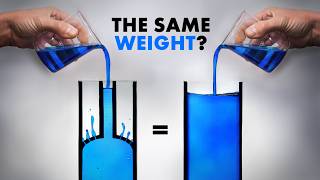
Two containers with freely moving pistons at the bottom are held by clamp stands; scales measure only the water and pistons. Adding 150 ml to one container registers only 60 ml weight due to shape.
Balancing requires 550 ml in the funnel-shaped container and 60 ml in the straight container, showing different volumes weigh the same when heights are equal.
The force on the piston is only from the water column directly above it; surrounding water can be ignored. This is Stevin's law.
An upside-down martini glass container initially seems to violate Stevin's law, but the paradox is resolved by considering pressure under the glass ceiling.
Pressure at a point depends only on vertical distance to the free surface; surrounding water does not add force because its weight is carried by container walls.
For an inverted container, the pressure under the glass ceiling equals the pressure at the bottom of the tube, so water in the tube behaves as if there is an equivalent column above.
Pressure depends on the vertical distance to the free surface via any path. The clamp stand experiences a change in weight as it supports or pulls on the container.
Pressure logic applies to pulling forces, illustrated by a ferret's fur: a distributed pull does not snap a hair, but focused force does.
The hydrostatic paradox demonstrates that the force on a submerged piston is determined solely by the height of water above it, not the total water volume, due to pressure being path-independent in a connected fluid.
Mentioned in this Video
Study Flashcards (4)
What is the hydrostatic paradox?
easy
Click to reveal answer
What is the hydrostatic paradox?
The observation that the force on a piston depends only on the weight of the water column directly above it, not the total water volume.
01:29
What does Stevin's law state?
medium
Click to reveal answer
What does Stevin's law state?
The pressure at a point in a fluid depends only on the vertical distance from that point to the free surface.
09:37
In the funnel-shaped container, why does the clamp stand get heavier when water is added?
medium
Click to reveal answer
In the funnel-shaped container, why does the clamp stand get heavier when water is added?
The sloped walls support the extra water, transferring its weight to the clamp stand.
06:23
How does pressure at a point under an inverted container relate to the water column?
hard
Click to reveal answer
How does pressure at a point under an inverted container relate to the water column?
The pressure under the glass ceiling is equal to the pressure at the bottom of the tube, as if there is a column of water above the ceiling reaching the same height.
09:09
💡 Key Takeaways
Balancing different volumes
Visually demonstrates that 550 ml and 60 ml can weigh the same due to shape, challenging intuition.
01:12Pressure vs force distinction
Clarifies a common confusion by separating pressure (point property) from force (integral).
04:43Wall supports extra weight
Explains how sloped walls carry the weight of water not directly above the piston.
06:23Refined Stevin's law
Nuanced definition that pressure depends on vertical distance via any path, resolving the paradox.
09:37Full Transcript
[00:02] into this funnel-shaped container, the scales go down on that side, as you would expect. That was 150 ml. Let's see what happens when we pour 150 ml into Before you make a guess, I'll quickly run you through the setup. Both
[00:18] containers have a freely moving piston at the bottom. The water in the container pushes down on the piston, and the piston pushes down on the scales. The two containers are being held by clamp stands. So, we're only weighing
[00:32] the water inside. Actually, we're also weighing the pistons themselves, but they're identical and have the same weight. Okay, so adding 150 ml.
[00:44] Oh. I only got 60 ml in there. That's weird, isn't it? This 60 ml is heavier than this 150 ml, or so it seems. Now, what if we wanted to balance these scales? Let's add water to this one until they
[01:00] balance. There's a little bit of friction in the pistons. So, I'm just going to vibrate the table. Yeah. Yeah. So, the needle goes almost to the
[01:12] middle. So, this is almost perfectly balanced. We've got about 550 ml in here, and still just 60 ml in here. So, how can different amounts of water weigh the same? This is the hydrostatic paradox. The hydrostatic
[01:29] paradox is the observation that the force felt by this piston is only from force felt by this piston is only from the weight of water in the column directly above that piston. You can ignore all the water around that column.
[01:46] This is Stevin's law, and it's perfectly intuitive in a straight-walled container. Like, the force felt by this area is the weight of this water. The force felt by this area is the weight of this water. The force felt by this area
[01:59] is the weight of this water, and so on. All the weight of all the water is accounted for. Like, it would be odd if one area felt more force than another. But, Stevin's law is quite surprising when the walls of the container aren't
[02:12] demonstrated it to be true here. What we seem to have shown is that the scales will balance when the height of the water is the same. Like, we know that
[02:24] the force felt by this piston is just the weight of the column of water above it. And we know from these scales that this piston is feeling the same force. In other words, this piston is feeling the force, which is just the weight of
[02:40] the column directly above this piston. So, we can ignore all the water around it. Here's the weird thing, though. I also played with a container shaped like well, this container doesn't seem to obey Stevin's law. So,
[02:55] there's something really weird going on. I'll get to that in a minute, but first, let's see if we can explain why you're supposed to just ignore the weight of all the water around that central column. To do that, we just need to all
[03:09] get on the same page about pressure. Because, really, this is about pressure. I'm sure you've heard pressure described in terms of an elephant's foot versus a stiletto heel. And that's nice, because it illustrates the fact that pressure
[03:22] really is an attempt to formalize this I'm just thinking, is the is the elephant's head confusing? Like, do I have elephant's feet, or do I have stilettos? You know, I can't have
[03:36] stiletto is nice, because it illustrates the fact that pressure really is an attempt to formalize this intuition that we all have, that when a force is
[03:48] focused on a small area, well, that's bad news. That's why pressure is force divided by area. Interestingly, these two words, pressure and force, are used
[04:00] interchangeably in everyday language. Like, it feels natural to say that a person in stiletto heels is applying a greater force to the ground. But, of weight. It's just that the pressure has
[04:14] gone up. So, to understand what we've got going on here, we really need to make sure that we've separated these two terms. And what helps me is to just remember that pressure is something that's defined at a point on a surface.
[04:29] So, you can ask the question, what is the pressure at this point? Or, what is the pressure at this point? So, to get the total force from a foot, say, you have to add up all these little packets of force. So, really, the hydrostatic
[04:43] paradox is the observation that the pressure at this point only depends on this distance. In other words, the height of the water above that point. So, why is it that all this extra water doesn't increase the force down here?
[04:59] Well, one way to think about it is that this column of water can't be compressed at the same pressure. Like, the pressure depth, the pressure inside the column is the same as the pressure outside the
[05:14] column. So, the water around the column can't push into the column. It's as if the column has a wall. So, it's like we've got one container shaped like a column, and around it, another container shaped like this. And so, all this water
[05:28] is held up by the walls of the container, not the piston. And if you could analyze the forces on a small triangular packet of water on the sloped glass wall. The horizontal force is just the pressure at that depth times this
[05:43] area. The downwards force is just the pressure times this area, which, by definition, is just the weight of this column of water. Now, if the wall wasn't there, we'd have a net unbalanced force, which is exactly what you see if you
[05:56] take away a little bit of the wall. But, this little packet of water isn't moving, because the wall is there. So, the force from the wall must be exactly canceling out the horizontal force and the vertical force on this packet. In
[06:09] other words, the vertical component of the force from the wall exactly cancels out the vertical force here, which, as we said, is just the weight of the water above it. That means every column of water above the sloped glass surface is
[06:23] held up by the glass. So, if the sloped glass is carrying that extra water, it's going to feel heavier in the hand of the clamp stand. additional weight is transferred into the clamp stand. And look, the clamp
[06:37] stand gets heavier when we add the water. Contrast that with the straight stand doesn't change when the water is added. So, that all makes sense. But, then I tested this thing. So, we said that the pressure at any point is just
[06:51] due to the height of water above that point. So, if you think about the points point. So, if you think about the points around the outside of the piston, well, points. It's only in the middle of the piston
[07:06] So, if you want to work out the total force on this piston, then we need to force on this piston, then we need to add up the forces, the the weights of all those little columns of water around the outside, plus the column of
[07:20] water in the middle there. In other words, it's just the total weight of the words, it's just the total weight of the water in there. So, this is 35 ml, so 35 Let's see what happens when we try and balance by adding water to this one.
[07:34] balance by adding water to this one. I've got 35 ml here. So, we'll pour that in first, and that doesn't seem to balance the scale. Right, let's keep adding water, then, and see when it balances.
[07:48] Okay. And so, that it's it's balanced around there. And again, we see that the heights are the same. That's weird, isn't it? Like, we know that the force on this piston is the weight of this
[08:02] on this piston is the weight of this water here, and we know that this piston is feeling the same force as this one. So, this water weighs more than there is water in there. So, what's going on? Well, the answer is that
[08:16] going on? Well, the answer is that Stevin's law is a bit more nuanced than I originally thought. To see why, let's look at some more 2D containers with holes in them. As we would expect, water sprays out the bottom of this one, just
[08:28] like it did with the martini glass. But, perhaps less intuitively, when it's flipped upside down, water sprays out upwards. And it's quite easy to see why. Like, we know that the pressure here is due to that full height of water. And
[08:42] this column here is experiencing the full pressure of that water. But, water can flow. So, if the water around that column was at lower pressure, well, this column of high-pressure water would just push outwards until the pressure was the
[08:57] same everywhere. In other words, the pressure under the glass ceiling here must be the same as the pressure at the bottom of this column of water. And again, if you wanted to be rigorous, you could analyze the forces, but here's a
[09:09] nice intuitive way of thinking about it. Let's just let the water spray out for a while and see what happens. Eventually, it reaches equilibrium, and that happens when the level of water here is the same as the level of water here. In other
[09:22] words, the force pushing down from this glass ceiling is exactly equivalent to a column of water above the glass ceiling that goes to the same height as in the tube section. So, how can we fix my previous definition of Stevin's law?
[09:37] Well, it would go something like this. The pressure felt at a point depends only upon the vertical distance from that point to the free surface of the water. Like, you can take some convoluted route to get to the surface,
[09:51] but the pressure at that point only depends on the change in height to get to the top. But, here's the really cool part. When I put 35 g of water in this part. When I put 35 g of water in this tube, it weighed more than 35 g. So,
[10:04] where did the extra weight come from? Well, just like with the funnel-shaped container, it was the clamp stand that dealt with this discrepancy. Except, this time the clamp stand had to transfer some of its weight to the
[10:18] scales instead of the other way around. And look, you can see when we pour water in, the clamp stand actually gets lighter. Interestingly, we tend to think about pressure as specifically a pushing force divided by area, but the logic
[10:32] applies just as well to pulling forces. Like, I've got this I suppose it's a ferret that my kids made. If I want to move the ferret, then I just grab a bunch of the fur and pull on the fur. And that pulling force is
[10:46] on the fur. And that pulling force is divided amongst all of those many hairs. But, if I wanted to, I could focus all of that force onto a single fine hair. And when I do that, the ferret doesn't
[10:58] And when I do that, the ferret doesn't move. Instead, that single hair snaps. between shaving with a multi-blade razor and shaving with a single-blade razor. When you shave with a multi-blade razor, the force is spread out over a large
[11:13] number of hairs that are all engaged with these many blades. And so, you end up tugging on your skin before cutting. This causes damage in various ways, like the skin can be lifted up towards the blades and get grazed or cut ends of the
[11:29] hair can actually end up below the skin. To heal the damage, your body sends more blood to those regions, and so your face goes red. But, with a single-blade razor, all the force is focused on just a few hairs at a time, and so the cut
[11:44] a few hairs at a time, and so the cut happens without your skin being tugged. actually, which is why I'm more than happy to have Henson Shaving as a sponsor for this video because they're actually doing research. Like, they've
[11:57] company, and they're getting really interesting data, which there just seems to be a lack of right now. But, the take-home is that a safety razor is healthier than a cartridge razor. So, you get less of that redness. And if
[12:11] it's well-engineered, you'll get a clean shave, too. You just need the blade to be held firmly at precisely the right angle and precisely the right clearance, which is exactly what you get with the Henson AL13 Safety Razor. Like, if you
[12:25] want to hit that kind of precision, it's helpful to have a background in aerospace engineering, which is exactly what Henson has. They've made parts for a Mars rover and the ISS, for example. The economics is that you'll pay a
[12:38] little bit more up front for the handle, but then the blades are pennies. Compare that to cartridges that cost a few dollars each, and it works out that you're making a saving after just a few months. And you get to own something
[12:51] really good. If you go to hensonshaving.com/stevemold and use promo code Stevemold at checkout, you'll get 100 free blades with your purchase of a safety razor. The link is also in the description. So,
[13:04] get your Henson AL13 today. I hope you enjoyed this video. If you did, don't forget to hit subscribe. And the algorithm thinks you'll enjoy this video algorithm thinks you'll enjoy this video next.