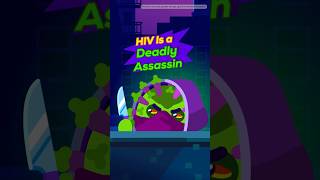

HIV's Sneaky Attack on Your Immune System
45sExplains a complex medical topic in a simple, visual way, making it highly shareable and educational.
▶ Play Clip"The title accurately reflects the content, which focuses on a new injection that prevents HIV infection."
This video explains how HIV attacks the immune system, the limitations of current daily pill treatments, and a new injection that shows promise in preventing infection. It highlights the global impact of HIV and the ongoing search for a one-shot solution.
HIV targets helper T cells, injecting its code and reprogramming them to clone the virus, weakening the immune system.
Over 40 million people live with HIV, mostly in sub-Saharan Africa.
Daily pills interrupt the copying process but cannot eliminate dormant HIV; stopping them can reactivate the virus.
A new injection twice a year forces HIV's protein shell to open at the wrong time, preventing new infections and disrupting shell formation in active cells.
The injection still requires regular healthcare visits, so researchers are seeking a one-shot solution.
Which immune system cells does HIV primarily target?
Helper T cells
00:03
How many people currently live with HIV?
Over 40 million people
00:17
Where is the majority of the HIV-affected population located?
Sub-Saharan Africa
00:17
What is the limitation of daily HIV pills?
They interrupt the copying process but cannot eliminate dormant HIV.
00:31
How does the new injection work against HIV?
It forces HIV's protective protein shell to open at the wrong time, stopping new infections and disrupting shell formation in active cells.
00:44
Global HIV Prevalence
Provides a key statistic (over 40 million) that underscores the scale of the epidemic.
00:17Limitations of Daily Pills
Explains why daily medication is not a cure, highlighting the challenge of dormant virus.
00:31Mechanism of the New Injection
Describes the novel approach of targeting the protein shell, offering a potential breakthrough.
00:44[00:03] immune systems commanders, the helper T cells. Using enzymes, it injects its code, [music] reprogramming the T cells to clone the virus. Some realize they've weakening your body's immune system. Others stay in stealth mode for years
[00:17] before activating. While it's no longer a death sentence, over 40 million people live with HIV, the majority in sub-Saharan Africa. For decades, taking daily [music] pills. These interrupt the copying process, but can't
[00:31] get rid of the HIV already stored in your body. Plus, if you stop taking them, the dormant virus can start copying itself again. But scientists have spotted a weakness. [music] An injection twice a year can now force
[00:44] HIV's protective protein shell to open at the wrong time. This stops new infections, and it messes with how the shell is built in active infected [music] cells, too. This treatment is a powerful weapon against HIV, but still
[00:56] requires regular health care visits, which can be difficult in hotspot >> So, the search for a one-shot solution continues.



⚡ Saved you 0h 01m reading this? Transcribe any YouTube video for free — no signup needed.