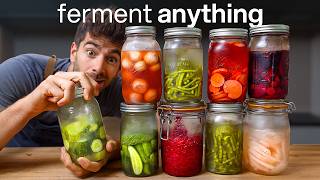

Fermentation Masterclass Intro
41sThe creator's authority (50M+ views) and promise of a simplified guide hook viewers interested in fermentation.
▶ Play Clip"The title is accurate; the video is a thorough, beginner-friendly guide to vegetable fermentation."
This video is a comprehensive master class on vegetable fermentation, focusing on simple two-ingredient ferments using vegetables, salt, and water. The host explains the science behind fermentation, the importance of salt ratios, and demonstrates the process with various vegetables from his garden.
The host has been obsessed with fermentation for a decade, with videos racking over 50 million views. He is writing a fermentation book to make the subject accessible.
The video focuses on simple vegetable ferments with just vegetable, salt, and water, covering all parts of vegetables from stalks to flowers.
Basic supplies include glass jars (preferably wide-mouth), glass weights to keep veggies submerged, and various lids including one-way airlock lids.
A good kitchen scale is essential for measuring salt percentages accurately.
Vegetables submerged in saltwater brine create an anaerobic environment where beneficial bacteria like lactobacillus thrive, converting sugars into lactic acid for sour flavor.
The ideal salt percentage is 2-5% of total weight of vegetables and water. The choice depends on timing, texture, flavor, and safety.
Higher salt preserves longer, affects texture (softer veggies need lower salt), influences flavor (lower salt builds more sourness), and increases safety for beginners.
The host demonstrates fermenting carrots and beets together at 3.5% salt, showing the process of weighing, adding water, calculating salt, and using a glass weight.
Ferments should be stored away from sunlight at 60-75°F. Lower temperatures slow fermentation and offer more control.
Garlic scapes at 4%, hakurei turnips whole at 4%, radish pods at 4%, and sauerkraut at 2.5% salt are demonstrated.
The host and Carly taste various ferments, rating them. Older ferments tend to mellow in saltiness and develop more complex flavors. Beets aged 3 months taste like roasted beets.
Fermentation is a simple and rewarding skill that enhances flavor and health benefits. Starting with basic vegetable ferments and understanding salt ratios is key to success.
What is the ideal salt percentage range for vegetable fermentation?
2% to 5% of the total weight of vegetables and water.
07:09
What bacteria are responsible for lactic acid fermentation?
Lactobacillus.
06:05
Why is it important to keep vegetables submerged under the brine?
To create an anaerobic environment and prevent mold growth.
11:04
How does higher salt percentage affect fermentation time?
Higher salt creates a more inhospitable environment for bad bacteria, allowing longer fermentation times.
07:30
What is the recommended temperature range for fermenting vegetables?
60°F to 75°F (room temperature).
12:01
Why might you choose a lower salt percentage for softer vegetables like radishes?
To preserve their crispiness and snap, as salt breaks down cell walls.
08:03
What should you do if you see mold on top of your ferment?
Throw it away, learn from mistakes, and start over.
11:17
How does fermentation change the flavor of beets over time?
Aged beets (3 months) develop a roasted beet flavor and become sweeter.
16:21
Three Ingredients of Fermentation
Simplifies fermentation to its core components: vegetable, salt, and water.
05:37Salt Percentage Range
Provides a clear, actionable range (2-5%) for successful ferments.
06:44Four Factors for Choosing Salt Level
Offers a systematic framework (timing, texture, flavor, safety) for adjusting salt.
07:28Aged Beets Transform Flavor
Demonstrates how long fermentation can dramatically change texture and taste.
16:21Curitido as a Versatile Condiment
Highlights a fermented cabbage, carrot, and jalapeno mix that works as salsa or sauerkraut.
18:35[00:00] So, as most of you know, I have been
[00:02] rather obsessed with fermentation over
[00:04] the last decade of my life. I put out
[00:06] countless videos on the subject, which
[00:08] have racked in over 50 million views.
[00:11] But over the last 6 months specifically,
[00:12] I have taken things to a whole new level
[00:15] because I am deep in the process of
[00:17] writing a fermentation book with the
[00:19] main goal of making what can be a very
[00:21] confusing and overwhelming subject as
[00:24] accessible as possible. And with every
[00:26] single bubbling jar and croc that I've
[00:29] experimented with in this kitchen over
[00:31] the last few months, I've gained a
[00:33] little bit more knowledge and a whole
[00:35] lot of inspiration that I just could not
[00:37] wait to share until the book is
[00:39] released. So, I welcome you to my master
[00:41] class in fermentation. Now, the world of
[00:44] fermentation is extremely vast. It has
[00:46] helped humans survive for thousands of
[00:48] years. So, of course, different cultures
[00:50] have adopted their own specific
[00:52] techniques, their own recipes, and the
[00:54] book covers a much broader range of all
[00:57] of these things, but today I wanted to
[00:59] specifically focus on the simple skill
[01:02] of fermenting vegetables. Because when
[01:04] you're learning any new skill, I think
[01:06] it's best to just start with the basics
[01:08] and then expand your knowledge from that
[01:11] point. which is why I think every single
[01:13] home cook should at least be somewhat
[01:15] comfortable with just simple veggie
[01:18] fermentss. So, this video won't be
[01:19] covering more of the complex recipes
[01:21] like kimchi or kombucha or even koji.
[01:24] Instead, we're going to be sticking to
[01:25] just two ingredient fermentss, just
[01:27] vegetable and salt and water if you
[01:30] consider that an ingredient. And when I
[01:31] say vegetable, that includes every part
[01:34] of the vegetable. The stalks, the pods,
[01:36] the stems, leaves, flowers, fruits, all
[01:39] of which will be demonstrated in this
[01:41] video. And what's really fun is every
[01:42] single ferment that you see in this
[01:44] video has been harvested from my garden
[01:47] over the last few weeks, which really
[01:49] ties into the core of why humans always
[01:51] fermented foods. taking that abundance
[01:53] that's available during the growing
[01:55] season and preserving it to help survive
[01:57] those colder months when fresh
[01:58] ingredients were not available. Now, of
[02:00] course, with modern technology like
[02:02] refrigeration, humans have slowly over
[02:05] time lost this very basic and natural
[02:08] ability to ferment and preserve foods.
[02:10] But even with all the available
[02:12] resources and fresh foods that we can
[02:14] now get year round in this modern world,
[02:16] people are finally starting to wake up
[02:18] about the health benefits of consuming
[02:20] food that is active, that is alive, and
[02:23] thriving with beneficial microbes that
[02:25] help create a healthy balance for our
[02:28] gut biome. Now, the great thing for all
[02:30] of you is since we are just focusing on
[02:32] the basics of fermentation today, we
[02:34] don't need any expensive gadgets or
[02:37] equipment. We just need some very basic
[02:40] supplies and by far the most important
[02:42] piece of equipment of course are your
[02:44] jars. The most classic and I think
[02:46] accessible fermenting vessel being the
[02:48] glass jar. They are reusable and most
[02:50] importantly you can see through them so
[02:53] you can actively watch your fermentss
[02:55] develop over time. These are your
[02:57] classic ball jars. Some are considered
[02:58] widemouth which have a wider opening and
[03:01] some are considered smallmouth which
[03:02] have a smaller opening. I do prefer a
[03:04] wider mouth, which is much easier to
[03:07] funnel things in and out of. Plus, this
[03:09] glass weight can fit perfectly into the
[03:11] mouth of the jar, which do come in
[03:12] different sizes, and I would highly
[03:14] suggest having a bunch of these around.
[03:16] They are a great piece of equipment to
[03:18] keep your veggies submerged safely under
[03:20] the water line, which we're going to
[03:22] need to create a proper anorobic
[03:24] environment. Now, of course, these glass
[03:25] jars come in different sizes. My
[03:27] favorite and what I would say the most
[03:29] allpurpose size is the classic 32
[03:32] ouncez, but I also ferment in these 16
[03:34] ounces and even 8 oz for like a small
[03:36] little jar of peppers or hot sauce. I
[03:39] also want to mention these lay parfait
[03:40] jars which are top of the line when it
[03:42] comes to a pop top style of jar, which
[03:44] are a great option for fermentation
[03:46] specifically because the jars can
[03:48] actually be sealed tight while still
[03:50] being able to release gas out of the top
[03:52] so you don't have to worry as much about
[03:54] an explosion in your kitchen. Although
[03:56] these jars still should be burped from
[03:58] time to time just to be safe. Which
[04:00] brings me right into the next piece of
[04:01] equipment, which are your jar lids. Now,
[04:04] there are many different types of
[04:06] fermentation lids. Different options
[04:08] that are more classic that have always
[04:09] been around, some new options that have
[04:11] hit the market as fermentation has
[04:13] started to get bigger. This is a fun
[04:14] little spring-loaded lid that keeps the
[04:16] veggies safely submerged under the water
[04:18] line without needing a weight. Right
[04:20] here is a one-way air lock lid, which
[04:22] lets that CO2 that's developed in the
[04:24] fermentation process out while keeping
[04:27] the oxygen from coming in. These things
[04:29] are great. I have a bunch of them in my
[04:31] kitchen. I use them all the time. You
[04:33] also have a more classic version that
[04:34] looks like this, which you have to add
[04:36] water to, but you get the same exact
[04:38] effect. And then of course, you just
[04:39] have your standard mason jar lids, which
[04:42] definitely do the trick, but they create
[04:44] a tight seal. So, if you do screw these
[04:46] lids on, they need to be burped from
[04:48] time to time to let out that CO2 so you
[04:51] don't have any type of glass jar
[04:52] explosion. And then outside of that, the
[04:55] only other real piece of equipment that
[04:57] you need for proper fermentation is a
[04:59] good kitchen scale. And any somewhat
[05:02] accurate scale will do the trick. All
[05:04] right, my friends, that brings me into
[05:07] the most important part of this video.
[05:09] See how we have a percentage right here
[05:12] on this jar? that comes from a specific
[05:14] fermentation equation to get the proper
[05:17] salt ratio you need to have a healthy
[05:19] fermented product. And I did a video on
[05:21] this many years back, but for this book,
[05:24] I really wanted to fine-tune this
[05:26] equation. So, it was crystal clear. It
[05:28] was very practical and it was easy to
[05:30] adjust at home. And the only way to do
[05:32] that was to experiment myself, which is
[05:35] what you see all over this kitchen. Now,
[05:37] I first want to briefly cover the basics
[05:39] of fermentation. As simple of a
[05:41] breakdown as possible. Remember, we have
[05:43] three things in this jar to unlock some
[05:47] incredible flavors and health benefits
[05:49] in this hakarai turnup. Vegetable, salt,
[05:52] and water. And when fresh vegetables are
[05:54] submerged in a saltwater solution, also
[05:57] known as a brine, it creates an anorobic
[05:59] environment, meaning no oxygen getting
[06:01] in. And in that specific environment,
[06:03] certain beneficial bacteria like
[06:05] lactobacillus, start to thrive. And
[06:07] these specific bacteria feed on the
[06:09] natural sugars in the vegetables and
[06:11] convert them into lactic acid which
[06:14] gives these fermented vegetables that
[06:15] nice sour flavor.
[06:17] All right, before we get into salt
[06:19] percentages, I just want to let you know
[06:21] that if you really are interested in
[06:23] taking your fermentation game to the
[06:25] next level, the fermentation book and
[06:27] course are coming this fall. So you can
[06:30] sign up for more information. We'll send
[06:32] you updates on the release. Just click
[06:34] the link below in the description. All
[06:35] right. So, I would say this is the most
[06:37] important thing to understand when it
[06:39] comes to vegetable fermentation, which
[06:41] is choosing the proper salt percentage.
[06:44] Now, this is something I struggled with
[06:45] for many years. There is a lot of
[06:48] conflicting information out there. And
[06:51] the reason for that is there's really no
[06:53] onesizefitsall
[06:54] answer. There's a range of salt
[06:56] percentage that's going to work well for
[06:59] fermenting vegetables. And the key is
[07:00] understanding how choosing within this
[07:02] ratio is actually going to affect your
[07:05] final product. And we have found from a
[07:07] lot of rigorous testing that anywhere
[07:09] from 2 to 5% salt of the total weight
[07:12] and vegetables is going to give you a
[07:14] great ferment. So that's the good news.
[07:16] Anywhere on this scale is going to give
[07:17] you something delicious on the other
[07:19] side. But how do you choose? All of
[07:21] these fermentss have a slightly
[07:23] different salt percentage. And there's a
[07:25] reason why. Actually, there's four main
[07:27] things to understand and keep in mind.
[07:28] Number one is timing. Salt, of course,
[07:30] is a preservative. So the higher the
[07:32] salt levels, the more of an inhospitable
[07:34] environment you're going to create for
[07:36] that bad bacteria, which is going to aid
[07:38] in longer fermentation time. So if you
[07:41] plan to ferment something for many
[07:43] months, it's better to go higher on that
[07:45] salt ratio. Whereas on the other end, if
[07:47] you plan to ferment something for a
[07:49] short period of time, a lower salt ratio
[07:51] is actually going to speed up the
[07:53] fermentation time. Number two is
[07:55] texture. Salt over time is going to
[07:57] break down the cell walls of your
[07:58] vegetable. So if you're say fermenting
[08:00] something that's a little softer like a
[08:03] radish, a lower salt percentage might be
[08:05] ideal to preserve the crispiness and
[08:07] snap of the radish. Whereas a beet or a
[08:10] carrot, those are denser, harder
[08:11] vegetables. They can handle a higher
[08:13] salt ratio while still staying crispy.
[08:15] Number three is flavor. A lot of those
[08:17] beneficial bacteria, those
[08:19] lactobacillus, actually prefer a
[08:21] slightly lower saline level. So lower on
[08:23] the salt scale can aid in building more
[08:25] of those delicious fermented flavors.
[08:27] Whereas on the other end of the scale,
[08:29] of course, a higher salt level is going
[08:31] to make your vegetables taste saltier,
[08:32] which some people prefer. But as your
[08:34] vegetables ferment and build more of
[08:36] those sour flavors, that sourness will
[08:39] end up balancing out those higher salt
[08:41] levels. And finally, number four is
[08:43] safety. Again, salt being a
[08:45] preservative, the higher the salt ratio,
[08:47] the more reduced risk you have for
[08:49] spoilage, which is going to ensure a
[08:50] more reliable ferment, which is good for
[08:53] beginners if you're just getting into
[08:55] the game, I would go a little bit higher
[08:57] on the scale and then as you get more
[08:59] comfortable, you can start lowering that
[09:00] percentage and going for more of those
[09:02] unique flavors. All right, so hopefully
[09:04] you're feeling more confident and you
[09:06] have a much better understanding of how
[09:08] fermentation works. Now, it's time to
[09:10] see it in action. And I have been
[09:12] harvesting a bunch of things over the
[09:14] last few weeks. And we're going to start
[09:16] off with carrots and beets. Two things
[09:19] that I love fermenting. I'm going to
[09:20] combine these into one jar because they
[09:22] have a very similar texture and the
[09:24] flavors together are going to be quite
[09:26] nice. Now, for this first ferment, I'm
[09:28] going to go into more detail of the
[09:30] process. And the other ones, I'm just
[09:32] going to kind of go over what I
[09:33] fermented and the salt percentage that I
[09:36] chose. and then Carly and I will do a
[09:37] nice little taste test to see where we
[09:39] ended up with these fermentss at the end
[09:41] of the video. Now, when you're
[09:42] fermenting veggies from the store, I
[09:43] would highly suggest peeling your
[09:45] vegetables because you don't know what
[09:46] they've been treated with and also if
[09:48] they've been in the ground longer, they
[09:50] might have a tougher skin. Since both of
[09:51] these are fairly small and young plants,
[09:54] the skin is very delicate. It's also
[09:56] loaded with nutrition, so it can be
[09:57] fermented. I'm just going to peel off
[09:59] and cut off any blemishes to get things
[10:01] cleaned up. And then I'm just going to
[10:02] chop up my vegetables in what I think
[10:04] will be just a nice little fermented
[10:06] bite.
[10:07] [Music]
[10:09] Now, once I'm done with the chopping,
[10:10] I'll get my scale out. I'll pop on my
[10:13] clean jar. I'll tear everything to zero.
[10:15] Then, I'm going to load in all of the
[10:17] vegetables. I'm going to cover them with
[10:19] water, which will give me the weight
[10:20] that I need to calculate my salt
[10:22] percentage. And since this is a fairly
[10:24] short ferment that I'm going to eat
[10:25] pretty quickly, I'm going to go with a
[10:26] lower percentage at 3.5%. But remember,
[10:29] since these are denser vegetables, if
[10:31] you're fermenting them for a long time,
[10:32] they could take a higher salt
[10:34] percentage. So, I'll multiply my water
[10:36] and vegetable weight times. 035 to give
[10:39] me the amount of salt I need, which I'll
[10:41] weigh out separately. I'll dump that
[10:43] into the jar. And I'm just going to
[10:44] cover it with the lid and give it a
[10:46] shake up. Generally, that's enough to
[10:47] get the dissolving process to start. And
[10:50] over time, all of that salt will just
[10:51] naturally dissolve. Then I'm going to
[10:53] pop on that glass weight to help keep
[10:55] those vegetables submerged under the
[10:57] water line, which is very important,
[10:59] especially in those early days before
[11:00] you've built up that good bacteria to
[11:02] protect things. And this will happen,
[11:04] like you can see here, a floater will
[11:06] pop up. It will break the surface of the
[11:08] water. Now, it's exposed to oxygen, and
[11:10] all of that bad bacteria can come in
[11:12] potentially leading to the growth of
[11:13] mold at the top of your jar. If that
[11:15] does happen, which things happen in the
[11:17] world of fermentation, you want to throw
[11:18] that away, learn from your mistakes, and
[11:20] start over. Now, the final step is
[11:21] popping on your lid. And what I love
[11:24] about these one-way lids is as CO2
[11:26] builds up in your jar, the CO2 will push
[11:28] out the remaining oxygen that was left
[11:31] over in the jar, meaning this empty
[11:32] space over time will have no oxygen,
[11:35] which is a much safer environment in
[11:37] your jar. And when actually fermenting
[11:39] your vegetables, there's just a few
[11:41] things to keep in mind. You want to
[11:42] store them away from sunlight. So,
[11:44] somewhere on a shelf that's not right in
[11:46] front of a window or in a basement with
[11:48] no windows. And when dealing with this
[11:50] specific type of lactic acid
[11:51] fermentation, just like the salt ratio,
[11:53] there's also a range of temperature that
[11:56] will work to properly ferment your
[11:58] vegetables. I find a range from 60° F to
[12:01] 75° F will work, which is great because
[12:04] room temperature falls right in that
[12:05] range. So for me, we've just been
[12:07] fermenting things right here at room
[12:09] temperature, and it's great. But if you
[12:10] ferment, say, in your basement at a
[12:11] lower temperature, you'll get some
[12:13] different flavors. Your vegetables will
[12:14] also ferment slower, which is a little
[12:16] easier to control. Versus at the higher
[12:18] temperature, things are going to ferment
[12:19] faster. It's a little harder to control.
[12:21] Things can kind of get away from you
[12:23] quickly at higher temperatures. Now, for
[12:25] the second thing I fermented, I had some
[12:28] garlic scapes, which emerge from the top
[12:29] of the garlic plant as they flower. But
[12:31] I'm not actually after the flour. I'm
[12:33] after these tender, garlicky, sweet, and
[12:36] delicate stocks, which I just cut into
[12:38] little pieces and fermented those at a
[12:40] 4% salt ratio. For ferment number three,
[12:43] I have my absolute favorite spring
[12:45] vegetable, which are hakarai turnups.
[12:47] These are super juicy. They're sweet.
[12:49] There's almost zero bite like you would
[12:50] get in a radish, which is why I like
[12:52] them better than radishes. And I
[12:54] actually fermented these whole at a 4%
[12:56] salt ratio. For ferment number four,
[12:58] I've been getting a ton of these radish
[13:00] pods, which actually emerged when it got
[13:02] a little hotter and the radishes bolted.
[13:04] They put out flowers at the top and then
[13:06] these pods started to develop and they
[13:08] came in the masses. This is just a few
[13:11] radishes that developed all of these
[13:13] pods. And it's a great example of how
[13:14] much more there is to ferment than just
[13:17] the actual vegetable that you're used
[13:19] to. I cleaned off all the pods, got
[13:20] everything weighed out, and again, I
[13:22] used that nice middle ground of a 4%
[13:24] salt ratio. Now, for ferment number
[13:25] five, luckily, I had some cabbage in my
[13:27] garden to show you how those ratios are
[13:29] slightly different. This cabbage was in
[13:31] the greenhouse, so it was a little hot,
[13:32] so they weren't really nice big heads,
[13:35] but hey, a few of these will turn into a
[13:37] great sauerkraut. So, I chopped up
[13:39] everything fine. I weighed out my
[13:41] sauerkraut. And since I'm relying on the
[13:42] water content in the cabbage, I lower
[13:44] that salt percentage to 2 to 3%. In this
[13:47] case, I'm going to go right in between
[13:49] at 2.5%. I weighed out the salt, dumped
[13:51] it over my cabbage, and you get to
[13:52] decide the texture of your sauerkraut.
[13:54] If you like it more broken down, just
[13:56] really massage in that salt and break
[13:58] down those cell walls. Now, I'll place
[13:59] the cabbage in the jar, and I usually
[14:01] just wait an hour to see how much
[14:02] moisture is drawn out. Now, you can see
[14:04] here, I actually didn't have enough
[14:06] water to cover all of the cabbage. So,
[14:08] I'm going to dump in some clean water,
[14:10] but to account for the ratio, I'm just
[14:12] going to sprinkle in a little bit of
[14:14] salt. And that will even everything out.
[14:15] Now, the last variable to consider is
[14:17] the time of fermentation. And what I
[14:20] would say is the first few days, things
[14:21] aren't going to taste great. If you're
[14:23] trying it, it might even taste a little
[14:25] bit off. And that's because that lactic
[14:28] acid hasn't developed yet. So, the good
[14:30] bacteria, all those health benefits, the
[14:32] sour flavor is not developed. And after
[14:35] about 5 days at room temperature, that's
[14:37] when things will start tasting better
[14:39] and they'll just continue to get better
[14:41] over time. But we're going to talk about
[14:42] the specific timings we like during the
[14:44] taste test.
[14:46] >> All right, so we have almost I don't
[14:48] know like 12 fermentss here. All
[14:50] different vegetables, all different salt
[14:52] percentages, different timings.
[14:54] >> Some things I didn't make in this video
[14:56] that have been going for multiple
[14:58] months. We're going to do a taste test.
[14:59] I want to rank them 1 to 10, 10 being
[15:02] the highest. and we'll see how it goes.
[15:05] Let's move these aside. Two hawkai
[15:07] turnups. This is the older one at 4%.
[15:11] >> This is also 4%.
[15:12] >> Okay.
[15:13] >> But this one's probably a week or two
[15:14] weeks older.
[15:15] >> Yeah. Let's try the one first.
[15:18] >> Wow.
[15:18] >> Good. Slightly salty at the 4%, but so
[15:21] good. This has been going for just a
[15:24] month.
[15:24] >> Yeah. It's salty at the beginning, but
[15:26] then it kind of passes and then you get
[15:27] that the sour flavor.
[15:29] >> Yeah. The juiciness of this still holds
[15:32] up.
[15:32] >> These look less fermented almost. Maybe
[15:34] cuz they're whole. Wow.
[15:36] >> Salt has gone down a lot.
[15:37] >> Mhm. That's from 421.
[15:39] >> Oh wow. So that is 3 months old.
[15:41] >> That is so interesting.
[15:42] >> Melloed out a little bit.
[15:43] >> A lot.
[15:44] >> The salt mellows. But it's not like a
[15:47] lot more sour.
[15:48] >> This is definitely better than that one.
[15:49] The extra time.
[15:50] >> 9 and 1/2. 8 and 1/2 for me.
[15:52] >> I would say this is like a nine and this
[15:54] is like a seven.
[15:55] >> Um
[15:56] >> let's go. Cuz we have two beats now.
[15:58] This is a 3%. What's that?
[16:00] >> 3.5%.
[16:00] >> All right. So, that's This is much
[16:02] younger than this one.
[16:03] >> Start with the young one. This one's
[16:04] beets and carrots, I think, though.
[16:06] >> This one's just beets.
[16:06] >> All right. Let's just try be the
[16:08] difference.
[16:09] >> Yeah. Because it's a lower percentage.
[16:10] Not too salty.
[16:11] >> Not too salty.
[16:12] >> Not that sweet.
[16:13] >> It still very much has like raw beet
[16:15] flavor.
[16:16] >> Yeah. I'm interested in in what's
[16:17] happening here.
[16:18] >> This is from May 23rd.
[16:19] >> Oh, wow. That tastes like a roasted
[16:21] beef.
[16:21] >> Completely different. It's amazing like
[16:23] how much the texture changes and it's
[16:25] not like, oh, this is mushy now. It's
[16:26] like, oh, this tastes cooked now. That
[16:28] tastes like a roasted beef and that's a
[16:30] 10 out of 10.
[16:30] >> And it's so sweet.
[16:31] >> Those a 10 out of 10.
[16:32] >> So good. Beets for the win.
[16:34] >> We got garlic scapes at 3% and these
[16:36] have been going for just a month.
[16:42] >> Those will get better. That's an obvious
[16:43] >> to me. That is a perfect salt level.
[16:45] >> 3%. 3%.
[16:47] >> Yeah, the 3% works. And we've been like
[16:48] blending these into salsas and relish.
[16:52] That's another note. It's not like we're
[16:53] just eating these plants. We're adding
[16:55] them to dishes, cooking them into
[16:56] things. We're blending them into things.
[16:58] It's just so good to have this around
[17:00] because you get the additional flavor
[17:02] that's built in. Like you don't need to
[17:04] add acid anymore. It's just like such a
[17:07] punch.
[17:07] >> This is incredibly soft.
[17:08] >> 8.5. Going to get better.
[17:10] >> That's like a 10 out of 10 for me.
[17:12] >> Okay, let's try these little radish pods
[17:15] that are about a month old at 4%. Oh,
[17:18] they're a little stinky. They smell like
[17:20] farts.
[17:20] >> I love that smell
[17:21] >> cuz that's the radish.
[17:22] >> That's the radish fart smell.
[17:25] >> Oh, like some have different texture.
[17:26] They have a bit of a pop.
[17:28] >> Yeah, they're like filled with juice.
[17:29] >> You know, these have gotten better cuz I
[17:30] tasted those about two weeks in. They're
[17:32] getting better. They're kind of fun. I
[17:34] would say an eight.
[17:35] >> Yeah, I'll give them an eight.
[17:36] >> Okay, so now we have four sauerkrauts.
[17:38] Classic. I don't This one doesn't have a
[17:40] date. We'll we'll guess.
[17:41] >> Yeah, we'll guess. That's That's
[17:42] interesting.
[17:44] >> Yeah, the brassica has that funkier
[17:46] farty type. That's why when you open
[17:48] like a sauerkraut, sometimes it smells
[17:50] like farts.
[17:50] >> That's how I know this is still young.
[17:52] This is a young femin that goes away at
[17:55] a certain point. probably a few weeks
[17:57] old. So, this is red cabbage with
[18:01] carowway. Our only spice in all of this
[18:03] at 4% from 2 months ago. Now, this when
[18:06] I was first tasting it, I was like, you
[18:08] got to watch out when you're adding
[18:09] spice. Any type of spice because the
[18:11] fermentation can really intensify the
[18:14] spice.
[18:14] >> Smell that. Smells like rye.
[18:16] >> Wow.
[18:17] >> I think if you didn't like carowway, it
[18:18] would be gross. But on the right
[18:20] sandwich or the right dish, like this
[18:22] would be so good on pastrami.
[18:25] >> Oh my god. or something like that.
[18:26] >> That is such a good point. Nine out of
[18:29] 10 for me.
[18:29] >> That's a nine out of 10 for me, too.
[18:31] Next time I would do less carowway.
[18:33] >> Last one of my favorite condiments of
[18:35] all time.
[18:35] >> Clearly favorite of mine.
[18:37] >> I couldn't I couldn't resist. This is I
[18:38] forgot the term.
[18:39] >> It's called cotito.
[18:40] >> Cito. This is cabbage, carrot, jalapeno.
[18:44] >> Greatest condiment of all time because
[18:45] it works as a salsa. It works as a
[18:48] sauerkraut. It works as a um sloth like
[18:51] >> but it's like a slightly fermented
[18:53] sloth.
[18:53] >> Spicy.
[18:55] M.
[18:56] >> Oh, I made this years ago on the
[18:58] channel.
[18:58] >> So good. The salt level is perfect.
[19:00] >> And then you get the sweetness from the
[19:02] carrot. 10 out of 10. I mean, the only
[19:04] thing is just like it could a continue
[19:05] to age. I would love more.
[19:07] >> Yeah. Well, this will be my next when we
[19:09] get jalapenos in. We have everything
[19:10] else.
[19:11] >> Oh, you're right.
[19:12] >> We're about to get them. They're coming.
[19:13] >> We're about to get a ton of cabbage.
[19:15] >> Oh, we got to do a video on that.
[19:16] >> That'll be a good short.
[19:17] >> We'll end on that.
[19:18] >> Oh, 10 out of 10.
[19:19] >> So fun. Hopefully, you learned a thing
[19:21] or two about
[19:22] >> pickles are good. And you should try
[19:23] making them.


⚡ Saved you 0h 19m reading this? Transcribe any YouTube video for free — no signup needed.