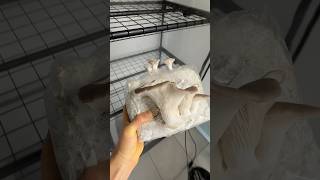

Turning Trash into Food: Mushroom Experiment
43sThe surprising concept of growing food from cardboard sparks curiosity and sustainability interest.
▶ Play Clip"Title is accurate and delivers exactly what it promises — a fun, educational experiment."
This video demonstrates a simple, low-cost method for growing gourmet mushrooms using cardboard as a substrate. The creator shows how to prepare and inoculate cardboard with a mushroom grow block, then details the colonization and fruiting process over several weeks.
Cardboard is a suitable substrate because mushrooms grow on materials with high carbon content.
Avoid glossy or heavily printed cardboard; remove tape and labels.
Sanitize cardboard to prevent contamination; place in a clean tub and dampen slightly, squeezing out excess moisture.
Use a pre-inoculated fruiting block (black king mushroom); break it into pieces and layer with moist cardboard.
One grow block can create four separate mushroom bags.
Seal the bag tightly, leaving the patch exposed; let it colonize for about 4 weeks until fully white.
Slice open the bag and move to a grow tent with consistent humidity; mushrooms appear after about 1 week.
Beautiful black king oyster mushrooms grew from all sides of the bag.
What type of cardboard should be avoided for mushroom growing?
Any glossy or heavily printed cardboard should be avoided.
00:16
What must be removed from the cardboard before use?
Tape and labels must be removed.
00:16
Why is it important to sanitize the cardboard?
To prevent contamination.
00:28
How long did it take for the bag to become fully colonized with mycelium?
About 4 weeks.
01:10
What specific mushroom variety was used in the experiment?
Black king mushroom (king oyster).
00:43
Sanitizing Cardboard
Demonstrates a critical step to prevent contamination in indoor mushroom cultivation.
00:28Efficient Use of Grow Block
Shows that one grow block can be divided into four separate bags, maximizing resources.
00:58Colonization Timeline
Provides a concrete timeline (4 weeks) for full colonization, useful for planning.
01:10Turning Trash into Food
Highlights the sustainability principle of upcycling waste into valuable food.
01:50[00:02] years, I've experimented with almost every method of growing mushrooms at mushrooms will grow on almost anything with enough carbon in it. So, I had a thought. What about all this leftover cardboard always piling up at my house?
[00:16] Now, for this experiment, it's important to avoid any glossy or heavily printed cardboard. So, I stuck with the pure brown stuff and removed any tape or my cardboard into smaller pieces and I
[00:28] sanitize it because when growing mushrooms indoors, contamination is the cardboard into a clean tub and I just want it slightly damp, so I squeezed out any excess moisture. And to grow the mushrooms, I'm using these plastic grow
[00:43] fruiting block that has already been inoculated with black king mushroom and I broke it up into pieces and layered it with the moist cardboard, And I only used about a quarter of the block with the cardboard, which means
[00:58] one grow block can actually create four separate mushroom bags. Next, I sealed up the bag tightly with some tape, making sure to keep that patch on the bag exposed. And then, I just let the bag sit and colonize. And after about 1
[01:10] week, I could start seeing little white patches of mycelium starting to appear mycelium just kept spreading and spreading. And in about 4 weeks, the entire bag was completely white and fully colonized with the mycelium, which
[01:23] meant it should be time for these mushrooms to fruit. So, I sliced the bag open and moved it into my grow tent to give it consistent humidity levels, And honestly, at this point, I still had absolutely no idea if this was going to
[01:36] work. But about 1 week later, when I opened that tent, I could see tiny cardboard. And then, just a few days after that, boom! Beautiful black king or king oyster mushrooms growing from all sides of the bag. Now, that's how
[01:50] you turn trash into food, my friends. I grew these mushrooms on cardboard. Come grew these mushrooms on cardboard. Come on.

⚡ Saved you 0h 01m reading this? Transcribe any YouTube video for free — no signup needed.