
The 13,800x Compounding Secret
60sReveals a shocking math fact about consistency that challenges viewers' perception of success.
▶ Play Clip"Delivers on the promise of seven principles with concrete examples, though some sections feel padded with motivational filler."
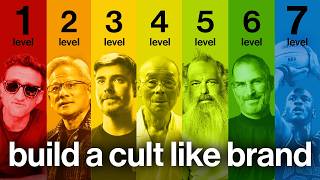
This video presents seven core principles for building an iconic personal brand, drawing on examples from successful entrepreneurs and creators like Casey Neistat, Mr. Beast, Jensen Huang, Michael Jordan, and Steve Jobs. The speaker shares personal anecdotes and emphasizes consistency, obsession, resilience, and simplicity as key drivers of long-term success.
Casey Neistat vlogged for 800 days straight. The math: 100 reps with 10% improvement each leads to being 13,800 times better. Focus on decades, not years, and don't break the chain.
Jensen Huang (NVIDIA) had low expectations, which built resilience. NVIDIA almost went bankrupt in 1995 but became the first $4 trillion company in 2025. Suffering refines character and leads to success.
Mr. Beast bets everything on each video, obsessing over the craft, not the numbers. Obsession compounds exponentially and sets you apart. The speaker grew 110,000 followers on LinkedIn in one month by obsessing over hand-drawn concepts.
Rick Rubin's principle: create what you love, not what the market wants. The audience doesn't know what they want; they only know what's come before. Ignoring the audience allows you to find your authentic self.
Michael Jordan was cut from his high school team but used that as fuel. The speaker faced a government raid on his business at 21, emailed 3,000 people, and got an exemption. Delusional self-belief helps overcome massive challenges.
Jiro Ono has made sushi for 70 years and still hasn't perfected rice. Real mastery comes from decades of practice, not years. Focus on the practice, not the metrics.
Steve Jobs obsessed over simplicity, reducing the iPhone to one button and then none. The speaker focuses on three core tasks per day. Simplicity means saying no to 97% of things to say yes to the 3% that matter.
Iconic brands are built on principles of consistency, resilience, obsession, authenticity, self-belief, mastery, and simplicity. By applying these seven principles, anyone can start building their own iconic brand today.
How much better are you after 100 reps with 10% improvement each?
13,800 times better.
01:21
What was NVIDIA's market cap milestone in 2025?
First $4 trillion company in the world.
02:43
What principle does Rick Rubin teach about building iconic brands?
Create what you love, not what the market wants. The audience comes last.
07:02
What did Michael Jordan do after being cut from his high school team?
He used it as fuel to come back 10 times stronger.
09:55
How long has Jiro Ono been making sushi?
70 years.
11:02
What did Steve Jobs say about the iPhone's buttons?
He kept saying 'too many buttons' until they came back with a buttonless interface.
12:52
What is the speaker's daily focus technique?
Reflect on the three things you can get done today, not 30 or 100.
13:51
Compounding Math
Provides a concrete, surprising number that illustrates the power of consistent improvement.
01:21NVIDIA's Resilience
Shows a real-world example of a company overcoming near-bankruptcy to become the most valuable in the world.
02:43Audience Comes Last
Challenges conventional marketing wisdom, advocating for creator-centric authenticity.
07:02Delusional Self-Belief
Highlights the psychological fuel needed to overcome seemingly insurmountable obstacles.
09:02Insanely Simple Focus
Offers a practical, actionable technique (three tasks per day) for cutting through noise.
12:38[00:00] To everyone who's ever told anyone with a dream they can't, this video is for you. Every iconic brand started with a founder that focused on a key principle to create something legendary.
[00:14] You're not in it for the money? I don't think anyone of the company is in it for the money. If today were the last day of my life, would I want to do what I am about to do today? Anyone working on a big vision is going to get called crazy, even if you end up right.
[00:27] I've studied these principles for the last 15 years to build a business and brand that's created more wealth, influence, and freedom than I ever could have imagined. In this video, I'm going to break down the seven core principles so you can stop playing small and start building your empire.
[00:41] The first and most important principle of building an iconic personal brand? Consistency. Casey Neistat went and filmed a vlog for 800 days straight.
[00:56] filming, editing, putting the storytelling together every single day in the same 24 hours that you and I have. That is insane levels of consistency. And here's the math behind it all. If you go and you
[01:09] put in a hundred reps and with each one of those reps, you get 10% better. By the hundredth rep, how much better do you think you are? No, not a thousand times better. Not even 5,000 times better.
[01:21] You're 13,800 times better by that hundredth rep. This is the magic of compounding. And this is a mask you sign up for when you're consistent. I know when I first got started building my personal brand,
[01:34] I just focused on creating writing that I was proud of 1,000 times. Now, fast forward, I created a brand that has over 3 million people around it. Truthfully, this is not even what I was after day one.
[01:47] I just wanted to be ruthlessly consistent every single day for years. And I knew that at the end of the day, the score would take care of itself. And so when you go and you're building your iconic brand, focus on decades, not years.
[02:02] Pick a craft that you genuinely would be excited to do for the next 10 years and then just stick to it. Every day, do the thing and don't break the chain. And the three of us decide to start the company.
[02:16] Frankly, I had no idea how to do it. And nor did they. None of us knew how to do anything. I think one of my great advantages is that I have very low expectations. Jensen Blaine was sitting down with some Stanford students,
[02:29] and he said this about suffering. Most of the Stanford graduates have very high expectations. People with very high expectations have very low resilience. And unfortunately, resilience matters in success.
[02:43] In 1995, NVIDIA almost went out of business. Now, fast forward to 2025, and it was the first $4 trillion company in the world. It was this level of sticking with it, even when no one believed in the company.
[02:58] Hell, it was a video game software company. You know, very few saw the potential for this to become the most valuable company in the world. But Jensen's plan, you know, stuck with it. Through thick and thin, even mortgaging his house,
[03:12] And it was this level of suffering that led to the resilience necessary to become this successful. You know, I've experienced this in my own life. You know, looking back over 14 years ago, I was working 80 hours a week in my first business.
[03:26] It hurt like hell. But it was all this pain building my first company that forced me to go and find a better way. Because I knew how I was building, it wasn't sustainable.
[03:38] because in those deepest challenges in life are the kernels of genius. And this is the pain and suffering that necessary to go and build your iconic brand To this day I use the phrase pain and suffering inside our company with great glee Boy this is going to cause a lot of pain and suffering
[03:55] And I mean that in a happy way, because you want to refine the character of your company. It's currently October 4th, 2015. By the time I'm recording this video, I have 8,000 subscribers.
[04:07] So whenever you see this, compare these numbers to whatever I have when you watch this. Mr. Beast is notorious for thinking insanely long term about any project he takes.
[04:22] Every single video that Jimmy puts out, he bets the farm each and every time. People think he's nuts, a borderline addicted gambler. But it's this level of obsession around the craft, not the results, not the numbers, not the money,
[04:39] but the craft itself that separates Jimmy from every other YouTuber. because I think one of my greatest superpowers is my obsession, and I think some people would view that as a weakness, but if you just think about solving problems three times more than everyone else,
[04:53] you're bound to come up with different solutions. Jimmy had 20 selves in 2012 and 15,000 selves in 2015. These are humble numbers. You can just imagine how obsessed Mr. Beast was.
[05:07] That obsession, it didn't compound linearly. It compounds exponentially. With each rep, he's getting 50% better, 20% better, betting all the trips, going all in every time.
[05:21] And the reality is that obsession is contagious. In the world of building iconic personal brands, every single day there's thousands of people starting on the different platforms. And a level of obsession will set you apart.
[05:35] And you can imagine going and choosing to either build on X, LinkedIn, YouTube, or Instagram. And if you just approach this as some side hobby, a thing you're just going to dabble in, you'll probably just get lost in the noise.
[05:48] That said, if you really go and obsess around a single format on a single platform and making it the best in the world, this is how you set yourself apart. And you don't need to think about something insane.
[06:02] Just a few years back, after being in nature, I thought of, I'm going to go and start handwriting different images around concepts that I think will be helpful for founders. I just started obsessing around drawing out these different concepts and then sharing them on platforms like LinkedIn.
[06:17] Sure enough, almost overnight, these concepts were shared thousands and thousands of times. In one month, I grew by over 110,000 followers on LinkedIn. And not because I was seeking to do that, but because I was just obsessed around making these images that I thought would be really useful.
[06:36] And so, what's your obsession? What's that thing that, you know, many people would think is weird, but that you're really into? And how do you go to the nth degree to become the best at it in the world?
[06:48] This insatiable drive, this obsession around your craft, is it's going to help you separate your iconic personal brand from everything else out there.
[07:02] Rick Rubin teaches us that iconic brands aren't built by guessing the market. They're built by creating what you love. Rick Rubin threw his albums from everyone from Johnny Cash to Kanye West.
[07:15] It's all with this one principle. The audience comes last. I'm helping out you. Now, for a lot of people, that sounds like creativity suicide. You know, aren't you building for an audience? Well, the answer, sure, is they're part of the equation.
[07:29] But the most important part of the equation is you. It your taste your intuition your judgment And inevitably when you get too caught up in what people think you lose the true essence of what you trying to build And if you looking to create an iconic brand it in that
[07:45] essence, the depth, that the beauty and the originality exist. And so when you're looking to be creative, you got to block out the audience and you got to focus on the craft and the product
[07:57] at hand. You know, I know when I was first starting to build, you know, my own brand online, I was obsessed around building this more soulful approach to entrepreneurship. And some people told me, you know, Matt, this stuff's too woo-woo. I don't even think anyone cares about this.
[08:10] But I ignored every single one of those people because I knew that this stuff was true to me. These are the practices that have helped me separate myself over the previous decade. And it was stuff that I didn't see anyone else talking about online. You know, you don't need to sell
[08:24] your soul. You don't need to go and burn out. You can lean into you, your unique advantage, and separate yourself from the pack. When you ignore the audience, you give yourself an ability to sort through your own weirdness.
[08:37] And oftentimes, it's in that search that you find who you truly are. As we all know, one of the most important parts of any brand that we've come to know and love that's iconic is that it's authentic, right?
[08:50] It's truly you. This is what comes from the weirdness, from that exploration, and from actually ignoring the end audience. Well, the audience doesn't know what they want.
[09:02] The audience only knows what's come before. Now, you may know Michael Jordan as the superstar he became and the founder of what's now a $6 billion brand empire.
[09:16] But he was cut from his high school basketball team. Cut. You can imagine the heartbreak there. When he went and accepted the Hall of Fame award from the NBA, he went and gave this speech.
[09:28] If that means I have to do whatever I have to do, I'm going to win, no matter how you look at it. Michael Jordan had an instinctual competitiveness. He used the fuel of other competitors going in, chirping him, or telling him he couldn't do it,
[09:42] and he took that personally. That's all I needed. That's all I needed for him to do that, and it became personal with me. And he didn't take it personally and just let it go and demotivate him.
[09:55] He actually used that as fuel to come back 10 times stronger. Now, when you look at your own career, when I look at mine, right, there's been so many times where I've had to go and apply this delusional self-belief to get over massive
[10:08] challenges. I was 21. My first business was raided by the government. I had no idea what I was going to do. I could be fined up to a million dollars and put in jail for a year.
[10:20] I had enough delusional self-belief in myself to go, you know what, I'm going to go and email 3,000 people over 48 hours. And if I let enough people know about this situation, something's got to give.
[10:33] After three days of this trending on Twitter in Canada, and one week later, we got the only exemption of its kind to operate a business like Bitmaker. 26 times I've been trusted to take a gang-winning shot.
[10:47] And this... have failed over and over and over again in my life. And that is why I succeed.
[11:02] Jiro Ono has been making sushi in a subway station for 70 years. And after all those years of seeking out the best ingredients and practicing every day of the week,
[11:14] he tells people that he still hasn't perfected rice. Now, people could think this is crazy. But this is the delusional belief in mastery that creates iconic brands. Most people think because they done something for three or five years that they become great But real mastery comes from doing things for 20 years 40 years And what I think about with all of this
[11:37] is this idea of everyday retirement, of focusing on something that's really in your calling. Oftentimes in life, you know, the success that you're looking for doesn't come from becoming obsessed around the metric. It comes from being obsessed around the practice. When I went and got
[11:54] started on YouTube as an example, I wasn't focused on views, engagement, or getting to 100,000 subscribers. I was focused on mastering the craft of cinematography, of writing, of sound, of becoming
[12:07] confident on camera. Because Lord knows in those early days, I had no idea what I was doing. It was from this dedication to the mastery and the love of just becoming a little bit better every single time that's allowed me to go and stand out on this platform. And so, you know, that mastery, right,
[12:24] is what's going to separate you from the rest. Because when a bunch of amateurs are just going and bragging about the six months they've spent doing something, you're going to build up decades of experience and still consider yourself a student again.
[12:38] Technology is there. What's curious to me is it's the most remarkable tool. Today, Apple is going to reinvent the phone. When Steve Jobs was showing different prototypes of the first iPhone from Joni Ives,
[12:52] it had three buttons on it. And Steve said it needed to be a lot more simple. And so they went back to the drawing board and came back with a phone with one button on it. And Steve said, still, too many buttons.
[13:05] Sure enough, they went back to the drawing board and came back with a buttonless interface. And these were in the days of BlackBerry and, you know, Razer flip phones. But Steve was obsessed with simplicity.
[13:17] This didn't just translate through their product, right? It was in their hours as well. Simply drawing, you know, different kind of comparisons between Apple being this new and cool company and then Microsoft being this nerdy old school thing that was stale, right?
[13:32] Just simple comparisons that people could remember. You know, Steve was obsessed around simplicity. And insanely simple is something that's also benefited me in my own life. At the end of the day, I find when I'm going into any week, there are thousands of things I can get done across the portfolio of online companies that I run.
[13:51] But each day I reflect on what are the three things I can get done today? Not 30, not 100, three. And then every single day I wake up and go from top to bottom to those core three tasks.
[14:03] And simplicity isn't just about what you're saying yes to. It's being comfortable saying no to 97% of things so you can say hell yes to the 3% that are actually going to move the needle forward for you.
[14:15] Insanely Simple Focus is also about honing in the signal and then cutting out the noise. Steve Jobs was notorious for ignoring customer feedback, surveys, and focus groups.
[14:28] He preferred much more to lean into his own product intuition, relying on that quote from Henry Ford, which is, if you'd asked what people had wanted, they would have said a faster horse. Sometimes when you just rely on everyone else's opinion, you get clouded.
[14:43] But when you listen to that inner voice that you have and trust that signal, you're able to just slow things down to one simple thing. We have a chance if we stay focused and choose wisely to really continue to impact people's lives in some small way for the better.
[15:03] So real iconic brands go deep, not just wide. Icons aren't born, they're built. And with these seven core principles, you can build your iconic brand today. Now, if you like this video, be sure to like and subscribe and go and check out this video
[15:18] on how you can go and build a profitable personal brand.
⚡ Saved you 0h 15m reading this? Transcribe any YouTube video for free — no signup needed.
