
Why Loud Speakers Are Actually Insecure
60sChallenges common perception about confidence, offering a counterintuitive insight that resonates with viewers.
▶ Play Clip"Delivers on the promise of discussing clear thinking and confusion, with deep insights, though some parts are conversational and could be more concise."
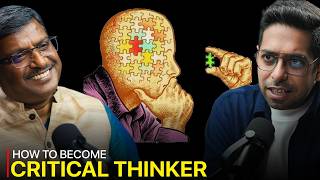
In this podcast, Vijender Chauhan, an educator with over 25 years of experience, discusses the psychology behind clear thinking, confidence, and decision-making. He critiques the education system and social structures that shape aspirations, and introduces the 'three Cs' (Choice, Critical thinking, and avoiding Comparison) as a framework for maintaining personal agency in the digital age.
The conversation begins with a light-hearted observation about sitting posture, leading to a deeper question about the motivation to change people's thinking.
Chauhan introduces the concept of 'fight or flight' using the example of dirty tap water: instead of fighting for clean water for all, people install RO systems (flight), avoiding the systemic issue.
The education system rewards conformity with stars and goodies, while punishing non-conformists as 'dirty children', leading to a lack of critical thinking.
Chauhan introduces the 'three Cs' as a framework for maintaining agency: Choice (search instead of scroll), Critical thinking (question what you consume), and avoiding Comparison (your life is unique).
Confidence is often misunderstood as speaking loudly or fast. True confidence is the courage to admit mistakes and rethink oneself, not bluffing.
Chauhan's motivation stems from his background in public-funded education, feeling indebted to give back and counter attempts to mislead the youth.
Aspirations are not purely individual; they are framed by a social ecosystem that sows certain dreams and suppresses others. Education should make people aware of this.
The pattern of choosing flight over fight is seen in education (private schools) and health (private hospitals), leading to a lack of systemic change.
To unlearn conformity, start asking 'why' about your own aspirations. For example, asking why you want to become an IAS often reveals implanted dreams, not genuine ones.
The desire for government jobs is often driven by the need to avoid humiliation in a society where anyone can insult a common man. This is a systemic issue, not just individual aspiration.
India's caste-based stratification of labor (e.g., manual scavenging) prevented innovation, unlike London's sewerage system which was developed due to fair wages and pressure.
Career choices are unclear because society offers only a few canonical dreams (engineer, doctor, IAS), leading to overcrowding and unhappiness. Choosing a career should not be a multiple-choice question.
The aspiration gap is the difference between the dream you want and the dream you reasonably believe is achievable. This gap is exploited by the coaching and mentoring industry.
The education system adopted the colonial structure without decolonizing it and ignored manual skills, leading to a hierarchy where thinkers are above workers.
The biggest concern for Gen Z is that algorithms are deciding what they consume, what they dream, and even who they vote for, leading to a loss of agency.
Despite concerns, Chauhan sees hope in Gen Z's willingness to fight for causes (pet rights, environment) and their flexibility in changing careers, which is a positive shift.
The podcast emphasizes the need to reclaim personal agency from algorithms and social structures, and to foster critical thinking and diverse aspirations. It highlights the importance of public-funded education and the potential of the younger generation to drive change.
What is the 'three Cs' framework mentioned by Vijender Chauhan?
Choice, Critical thinking, and avoiding Comparison.
01:50
According to Chauhan, what is the true test of self-confidence?
The courage to admit mistakes and the ability to rethink oneself.
06:08
What is the 'aspiration gap'?
The difference between the dream you want and the dream you reasonably believe is achievable.
35:46
How many people were selected for civil service this year according to the podcast?
958 people.
36:38
What are the two main mistakes in the education system according to Chauhan?
Adopting the colonial education structure without decolonizing it, and ignoring manual skills.
38:37
What does Chauhan suggest to unlearn conformity?
Start asking 'why' about your own aspirations.
18:03
What is the main concern for Gen Z according to Chauhan?
Algorithms are deciding what they consume, dream, and even who they vote for, leading to a loss of agency.
43:44
What is the 'fight or flight' example used by Chauhan regarding tap water?
Instead of fighting for clean water for all, people install RO systems (flight), avoiding the systemic issue.
00:16
Real Confidence
Challenges the common misconception that confidence is about speaking loudly, offering a deeper definition.
03:04Government Jobs and Dignity
Explains the systemic reason behind the obsession with government jobs, linking it to the need to avoid humiliation.
20:01Stratification and Innovation
Draws a parallel between London's sewerage system and India's caste-based labor division to explain innovation lag.
23:25Aspiration Gap
Introduces a key concept that explains the coaching industry's exploitation of aspirants.
35:46Gen Z and Algorithms
Highlights a critical modern issue: the loss of personal agency to algorithms.
43:44[00:03] entry is good but the way of sitting is also very casual. very casual. What's the right way to sit [laughs]? What is the reason that you really want to change people's thinking?
[00:16] When we found out that the tap water had become dirty, we had two options. We could either fight or we could flight. And interestingly system like did the
[00:28] flight go? You have been in the education system for more than 25 years. If you enter the room you should not first. So what do you think is the main flaw in our education system? In school, you constantly get the good kid, the
[00:43] star on your hand, the goodies, all these things where you are a conformist. What is the matter. perfect. And where you are What is the matter. perfect. And where you are not a conformist, you will immediately find
[00:56] yourself considered a dirty child. Sometimes you are failed. In simple terms, go out. Why is it not clear in career choice? not happy in their career later. We work in an office where no
[01:11] one notices even a single special thing about us. We have three or four dreams given in some canonical way. We have three or four dreams given in some canonical way. What does it mean? This means that in a country of 140 crore people and four dreams, those people are
[01:24] continuously dreaming of something else. They are not deciding what they will consume and what they will not. Algorithms are deciding for them
[01:38] should consume and what they should not. That is not a distraction, it is our world. How do we ensure that we have the agency to decide? Whereas we cannot leave everything. Usually I talk about three Cs.
[01:50] In this podcast, we sit down with someone who has interviewed thousands of people. And now he can read the person in front of him in 1 minute. His confidence, critical thinking, smart speaking, command over these subjects for years
[02:05] , expertise [music]. With their feedback, people clear exams like IAS. Our guest today is Masijivi i.e. Vijendra Chauhan ji. We understood from him how one can become a smart and critical thinker.
[02:19] How can we make our confidence and communication impressive? He told the three Cs through which anyone can become a sharp decision maker. We learned why a person does what they do. Meaning how is a career choice made? How relationship decisions are
[02:34] how is a career choice made? How relationship decisions are taken and how many systems work against us rather than in our favor. One thing I can say with certainty is that after reading this podcast as deep as we went and grasping the roots,
[02:49] you will definitely become a smart speaker, critical thinker and a powerful decision maker. According to you, what creates real confidence because this is such a word that when
[03:04] I ask my audience on Instagram what are the challenges of life, two things come up the most, one is overthinking and the other is confidence, these are very common words. True, look, confidence is a word that's been
[03:20] played around with a lot. It has been played too much. It has been used. It has been It has been used. It has been abused and because of this, long ago Agyeya wrote a poem in which when he talks about symbols, he
[03:35] says that the metaphors have now become dirty. Meaning, some poems start in such a way that it is said that I do not call you the star of the evening's moon. So it is not that my mind is not that my mind is shallow or deep. These metaphors have now become dirty. The
[03:48] shallow or deep. These metaphors have now become dirty. The gods have done something with these symbols. For the audience who could understand this kind of Hindi. What is being said here is that it is not that I do not call you the moon at all. So that doesn't mean
[04:00] I'm a shallow person. I am a shallow person. The truth is that the meaning of this word has become so worn out that for the last thousand years every lover has been calling his girlfriend as beautiful as the moon.
[04:15] not come. The Same Has Happen With Words Like Confidence and Self-Confidence. It's been so used, and Self-Confidence. It's been so used, so overused that it no longer provokes any
[04:28] real emotion. Hmm. Because it has become a very easy way that the one who is speaking fast, is speaking loudly. It is assumed that he is a confident person. Whereas the truth is that only a person who is scared speaks loudly.
[04:42] Which lacks self-confidence. One who fears that his words have no weight. So when he speaks easily with a low [throat clearing sound] voice, it will be heard. Therefore, he has to increase the amplitude and loudness inside it
[04:56] increase the amplitude and loudness inside it instead of increasing the content inside it. I mean this is one example which means the external aspect which is expressing confidence which is shown in many ways.
[05:10] I think they should be trusted a little less because a lot of times they are tutored. candidate should clearly see that the coaching centres have told him to
[05:24] sit like this, speak like this, act like this and he is just replaying the same. So in this it is about confidence, for example, we normally say that your hand Because hand movement shows that you have less confidence but
[05:39] someone who is sitting like this. This time he gave 10 mock interviews and in eight of them he was told to keep his hands like this. He has placed his hand like this. Due to this you understand? This means that not being able to move your hand means that you don't have confidence, which means that it is
[05:53] no longer a sign of confidence. Because it is true and natural, it might have happened. So in my opinion confidence means just that. According to me, the test of self-confidence is that a that. According to me, the test of self-confidence is that a person has the
[06:08] courage to admit his mistakes. showed the ability to rethink himself. According to me that person is confident. You asked a question
[06:23] and this happens very often. The candidate said, Sir, I know this part of it. The Other Thing I Don't Know. I should have been knowing but I don't know. I believe this is a person who is confident. Rather than a person who is bluffing. I don't know and
[06:36] despite that I am just mumbling and telling about this. He is telling about that place. He is not telling what is being asked. Same applies to the life as well. You will We are such a person who says I have
[06:49] all the solutions for you or I have all the solutions for my life. He is not a This is not a sign of a confident person. This is a sign of a person who is bluffing. confident. This is a purse sign of a person who is very very cunning
[07:05] and trying to be cunning. In fact, it does not work. It becomes known upfront. So according to me, the ability to rethink yourself , the ability to evaluate your personality yourself , the ability to accept mistakes and the ability to feel like another person.
[07:21] These are the things that mark a good confident person. I see it this way. Whenever I consume your content, I see one thing and that is the intention within you
[07:36] , the desire within you. I will not use the word change to describe your thinking. Probably want to evolve. You want to work on people's thinking. What is the trigger behind it? What is the reason that you really want to change people's thinking?
[07:50] that you really want to change people's thinking? thing is that I don't know whether you will be able to relate to it that much or not. Although you have faced crises in life, you come from a relatively stable family
[08:06] background and circumstances. I was or whatever you want to call it, so being
[08:20] born in these places and gradually moving ahead, I realised that public funded education, that is, the municipal school of my locality, later the government school of Sarai Rohilla
[08:33] and then Delhi University which is a public funded university, funded university, because of going through these institutions, I reached that thinking and that because of going through these institutions, I reached that thinking and that position after which Himesh
[08:47] or other people believe that no, this is a notable position. Because of that it meant public funded Because of that it meant public funded education and I have always thought about
[08:59] studying in these institutions because otherwise I could not afford it. We are in a way indebted to me and when you feel this debt you try to pay it off. And whenever I see the youth,
[09:16] meet them, observe their paths or see the attempts to mislead them, I am constantly worried about this and hence I feel that my way of giving back would be to I feel that my way of giving back would be to
[09:32] You are doing very important work. No not no doubt. But I feel that this is not just an individual issue. A person's dreams, a person's desires, a person person's dreams, a person's desires, a person 's progress. All this is. We are
[09:46] not telling anyone that one should not dream big. understand. I have proper papers on this aspirations are not just individual. We say it is
[09:59] framed by a certain ecosystem and I don't know why people talk less about that ecosystem which sows a particular kind of dreams in you or suppresses other kinds of dreams.
[10:12] As a teacher, as a publicly funded university teacher, I believe it is my responsibility to make people aware about this ecosystem. people aware about this ecosystem. But this means if there is an
[10:26] individual and he is thinking about his goals, it does not come to his mind, you have seen some situations, circumstances which become your trigger, if it does not come to someone's mind but he is doing good work for his life, then should he develop it, should he develop that which is
[10:41] good work for his life, then should he develop it, should he develop that which is not, I have to think socially also, yes this is a good question, actually this is what I believe and we will talk about it, it may be in the course of next few minutes.
[10:54] of next few minutes. But I believe that saying this does not come to their mind. They do n't come naturally. [nasal sound] Social concerns or collective thinking
[11:06] or social determination of their dreams of their aspirations and all. Ah this I think is not the whole truth. There are forces, there are ways, why, which that There are forces, there are ways, why, which that collective part is some how
[11:21] As many things will come. For example, I do a basic thing. Let's start from there. Whenever you counter a situation [sound of clearing throat] is not new. Many people have said thousands of times
[11:35] that you have only two options. You either fight or you fight. Okay, right? You either run into it or you find a way to avoid it. Understand it in such a way that perhaps you will understand it through an incident. My daughter
[11:51] studies abroad. We were with him recently and like any selfish parent, I wanted him to come back to India. With all the children around, I asked her by name,
[12:04] We are doing everything right. We will see. She opened the tap, filled the glass with water and while taking a sip from it, said that the day
[12:16] I will be able to open the tap and fill drinking water in your city and country, please let me know that the day it will be possible at your place, I will come. I started evaluating this thing as to when this would happen. You
[12:28] know it, I know it, it will never happen. You will never face such a situation in Faridabad, Gurgaon or Delhi that you will open your mobile phone. But then I asked myself why this would not happen? Why is it that this will happen in Melbourne,
[12:43] this will happen in Netherlands and this will not happen in Delhi. The we will have ROs. Hum I hope you are getting what I am saying.
[12:58] dirty, we had two options. We could either fight or we could flight. If we fight, we force our governments , we force our ecosystem to ensure , we force our ecosystem to ensure that everyone has clean water in their taps. Do
[13:13] [nasal sound] We took the easy route. What was the easiest way that we could afford? So we made a call and within 4 hours we had an Aro installed in our house. and within 4 hours we had an Aro installed in our house. Now the entire city is getting dirty water.
[13:26] This is no longer my problem. I chose flight rather than fight. It happened in public education. We came to know that good education was not being provided in the school. happens with health. We came to know that good treatment is not available in government hospitals.
[13:43] We said that we take insurance and go to private hospitals. It happened with every aspect of our life. That we chose flight rather than fight. And interestingly, the system wants you to
[14:00] choose the flight when they escape, then those who survive do not have a voice. They will never be able to force drinking water to come out of the taps in Delhi. are
[14:16] able to force drinking water to come out of the taps in Delhi. are You cannot name a single city in the entire country where you will open a tap and where you will open a tap and drink water from it, whereas it is legally mandatory
[14:29] that the drinking water being supplied should be potable. Drinking water is just an example. We choose flights everywhere. I'm sometimes like those crazy people I urge. I am not saying that I can do it myself.
[14:43] But I urge the students to fight with all the things and see if this fight and flight situation is instilled in them since childhood ? A lot of it has to do with the socialization
[14:57] that the classroom includes. starts with the family. But the family soon finds a great ally in this work soon finds a great ally in this work and that ally is education.
[15:12] told not to ask questions. He is elder, you should not ask him any questions. Whether he is a father or a husband, there is no need to ask him questions. And this is how you incorporate subordination. But the child starts going to school very early
[15:26] going to school very early and in school you constantly get the good child with a star in his hand, the goodies mixed in, all these things where We and where you are not conformists where you
[15:39] and where you are not conformists where you ask questions. Where you dissert. ask questions. Where you dissert. Immediately you will find that you are considered a dirty child. Your grades drop. You start getting punishments.
[15:51] Sometimes you are failed. And yes. So education is the conspirator in this entire game.
[16:04] Right. And what other beliefs do you think are instilled through parents or through the education system, I will not say that it is the fault of the parents, that too conscious parenting is coming now, I did not know the concept earlier, that too
[16:19] in my life, think about it, this human being is also a living being after all ultimately survives for only two things. One thing is reproduction
[16:34] survival and parents know this very well at the subconscious level that the better way to survive in the system is to bow your head, walk
[16:47] quietly, ignore, comply, walk by being a conformist. This is critical thinking, once the worm of which starts biting you in your mind, you start asking questions and if you have not got such teachers, such institutions
[17:02] which make you a conformist, that is, which teach you to ask these questions, then chances are that you will spend your entire life is fine, why is this person facing problems,
[17:18] until you have not got that worm of critical thinking. Galgotias do not come like this, they do not come from the air, they are the conformist institutions, they are those institutions which constantly say that no fair in the so called love and war, war and everything is War
[17:33] that is not the case right at the mass level, I understand as you said, it is a very big battle if we think about it at the level of the whole country, but if someone is listening to the podcast here and he feels that he does
[17:51] unlearn this thing which he has been taught for years, which has made him a conformist and somewhere on his death bed he regrets that he never thought beyond his limits, what can be some steps which he can take now? See there there are some
[18:03] definitely there are some steps. One of them is that start asking why and about yourself. Like I am giving a basic one which maybe you will be able to relate to and I am sure the audience will also be able to relate to it. That is, for example,
[18:19] that I want to become an IAS. Okay, right? I want to get into a government job. And it's a valid kind of an expectation. I always say please ask why do you want to become one?
[18:34] And You Will Realize Most Aspirants Do Not Have a Valid Answer to It. give answers but what are their answers really ? One of the most dangerous and I would say vulgar answers is this. I wanted to
[18:48] become an IAS since childhood. Just think, imagine that there is a child of 10 or 12 years. My children, you have grown up but just imagine how a small child of 8 years, 10 years can have this dream in his mind that he will
[19:03] become an officer, that is, he will be sitting behind a big table in which that white towel will be kept. If you have seen a senior officer you understand. How can this be a child's dream ? There is no action in it. A
[19:17] becoming a sportsman, a child may dream of flying a kite. Evan will become the bus driver. Okay, right? Even Police Inspector I understand because it shows action. that he will become an officer? This does not mean that it is his dream.
[19:31] dream. Somebody Else I am not saying person may be system but mostly person implanted this dream in this person. Right? This is what happens to That happens because of the appearance. It could be because he couldn't become a father. It may be
[19:46] because he couldn't become a father. It may be because God will come in the relationship. Or here comes that systemic thing again. here comes that systemic thing again.
[20:01] This is exactly the same thing as RO. The RO. The situation in our country is such that anyone can insult or humiliate a common man at any time. situation in our country is such that anyone can insult or humiliate a common man at any time.
[20:16] this if you have ever been to Tier 2 Tier 3 City then you know that anyone can insult you while walking. A police constable, a village Patwari, some powerful person is
[20:29] riding a motorcycle. I am walking on foot. Just this much can humiliate you. Just this much can humiliate you. In this country, most people live in constant fear of being humiliated. They are breathing. And
[20:44] anybody getting into government service if possible SDM, DM, SP, Inspector, ensure that not only the child who gets the uniform , who gets the post, no one will be able to insult him generally but
[20:59] no one will be able to insult his family. Do you understand what is happening? In a society where like in foreign countries, water is available by opening a tap and that water is drinkable.
[21:14] That was the right of any citizen in this country. But we stripped them of this dignity. Now the only way to achieve this dignity for the family, for the entire
[21:26] kinship and to the entire street locality is you get into IAS. You get into good service. You are not getting there for your individual career. Actually you are only exposing yourself and your family to this insult which anyone can do to you at any time. You are going into
[21:43] insult which anyone can do to you at any time. You are going into And this hype is then glorified to the point where we now have a person Why shouldn't this happen to every citizen so that he is not insulted? Then those are his
[22:00] not that I am talking about any collected dreams. In because you were constantly insulted by your father, your uncle or the women in your family
[22:12] or you were afraid that you might be insulted and you wanted to have some authority under which no one would dare to insult you. And This Is the One of the Greatest Hype
[22:26] Behind All the Government Jobs in the Power of Authority and Becoming a Creator and Becoming Something Notable. Is the reason for this also that something which is in excess does not have any value? Our population is so large that
[22:40] Our population is so large that unfortunately, even when our population was not that large, this problem existed. So population is an easy punching bag. A very very easy punching bag to see what you will do? It is 140 crores. If there are so many people then
[22:53] why will there be respect? The truth is that you actually feel that it is a very innocent process in which people are not respected. The system of our country has been running on this basis because here respect was a controlled or controlled
[23:09] How? Our country has consistently run on the basis of stratified stratification. Talking about our division, division has been continuously classified here.
[23:25] system was necessary for the survival of the country. In this Brahmin also, this will be the Sarvapan Brahmin Brahmin. This must be God.
[23:38] This will happen and in this way you just have to look at your status from top to bottom. You have to see your position on the basis of your social status and then you are given the right that and then you are given the right that
[23:54] people above you can insult you and you continuously remain in this trade off and this system continues. I always explain this with a story. Understand that at a time when the Industrial Revolution was at its peak, London was developing very rapidly. Just like
[24:11] Delhi is developing these days. Yamuna is getting polluted today. The reason was that there too, the filth that came out from people's houses was that there too, the filth that came out from people's houses was filth. Then the which
[24:25] you can understand because there was no sewerage system there then. I'm talking about the initial fuzz, of course. There also, a person used to come to people's houses at night. The toilets were built in such a way that he used to come from outside and
[24:38] collect your waste from there. There was manual scavenging and carrying of the filth and after that it finally ended up in the debts. The in the debts. The work we are talking about, please understand that this work of
[24:51] going to people's houses and cleaning their garbage was the most expensive wage job in London. You can understand why because obviously it was a dirty work nobody wanted to do it obviously it was a dirty work nobody wanted to do it
[25:05] he used to take up to one pound a day. It was so prohibitively costly that the whole of London put pressure on its government and its local government that we cannot afford it, hence find a scientific solution to it and hence the sewerage
[25:22] solution to it and hence the sewerage system of London was designed so that the sewage does not fall into the Thames River. There was the same problem in our country too, but what solution did our country find? Our country has created a caste
[25:36] whose job is to do this only. Whether he wants it or not, he will not ask for fair wages for it. The same thing was happening in London. He was getting fair wages in London. made such technological development that no one would have to do this work. Our country did
[25:51] not need this. Our country had created an entire caste. Whoever wants to do this work, whether he wants to or not, will have to do it. Do you understand? That's why all the innovation you that it will happen with laundry. This would be with leather working. All those jobs
[26:06] which we used to call dirty work. That is why we had created some entire castes and told them that you do this work and you will have to do it. You will have to work but you will not get respect or wages. That was our system. So this idea that rather than
[26:20] fighting the system, finding innovations and solving it, we actually stratified the society. And in this we decided that
[26:33] decide who will get it and who will not and hence every person will live in constant fear of being insulted by someone who is above him. In this stratification, there is no talk of just caste. In this stratification of all things, whatever is above this can
[26:46] insult you. And you will also enjoy insulting people below you in this stratification , not giving them dignity, not giving them respect. And this is how the system has evolved. Until we work against this
[27:01] system. We women will continue to be insulted, the poor will continue to be insulted, the common man will continue to be insulted. In fact, if you go out on the road and no one recognizes you , then it is fine and you will definitely get
[27:13] respect. But if he doesn't recognize you, then you too will be constantly going through the debate that he might insult you. working. There can be several other ways. But through this reflection, I never thought about the
[27:29] example of themes you gave and its version here and that is the root cause of why we are lagging behind in innovation. That's why because we actually divided labor in such a way that some people were given this work and they have to do it. For
[27:42] tell you this in the classroom. The women of this country could not progress for a long time. The simple reason for this is that we men had to eat hot round unleavened bread. Do
[27:54] you understand? There is a huge section of North India in our country where it is considered a virtue whether the men of the family get hot puffed phulkas or not. If you don't get it then what is the benefit of earning?
[28:09] Yeast bread is eaten all over the world. Yeast bread means rye bread which means that you can eat that bread for a week. You buy it from the market and eat it. But it will always be necessary to have a woman in your kitchen
[28:23] keep hot round puris in front of you for all your three meals and will not come in front of you. If you get stale bread, we call it stale. If no one in the world calls him stale, then they say how long will the poor man 's life be. Can you realize that today it is good that you have a house help. Other methods
[28:36] came up. But can you realise that for and what did they get in return that yes, she gives hot roti to her husband or son. The
[28:48] price for this is that she has to stay in the kitchen all day long. And that's been the case. R. Social Systems. Are Social Structures Are Responsible. For the kind of aspirations we have, for the kind of life we have, for the kind of
[29:02] dignity we have. This is a big thing I observe. I would This is a big thing I observe. I would like your thoughts on why career choices are not clear? Due to which majority of people are not happy in their career later.
[29:15] majority of people are not happy in their career later. We thank you for asking it. There are several reasons. But the biggest reason reasons. But the biggest reason for this in the country at present is that there is a
[29:27] for this in the country at present is that there is a We have three or four dreams given in some canonical way. A
[29:42] sixth, the preparation for JEE and NEET will start. But by the time he reaches eighth or ninth grade, he is completely in the clutches of JE NEET. This means either become an engineer or a doctor. Once you become an engineer or a doctor, then
[29:55] you can join the civil service , become an IAS or go abroad De De Are Handful of Dreams Hum is the one the whole country is trying to follow. said, this is not happening just because of career choice. The
[30:12] question of social reputation, a question of social status which includes avoiding insult and adds up and seems sorted so
[30:26] and four dreams, so you can understand what the situation will be? There are two problems with that. First of all, there was overcrowding in these dreams. not going there anymore because you wanted to be a doctor. You were going because there were only
[30:39] four options. Choosing your career cannot be a multiple choice question. Choosing your career cannot be a multiple choice question. You should have a dream that answers if someone asks you what your dream is. So in its answer
[30:53] you should write a paragraph of 150 words instead of ticking 'I will become a doctor' in the multiple choice question. instead of ticking 'I will become a doctor' in the multiple choice question. That is not happening. So we as a society have failed to nurture the diversity of
[31:07] ? Go back to the same stratification again. How many stratification again. How many beautiful careers have we already Like like leather working
[31:21] like I mean I'm just giving plumbing like and doing any hand work. that manual skills should be a part of your education. There should be no
[31:34] looked down on all those things. So no one dreams that I will become a plumber. No one dreams that I, a person who does manual work, I mean a good leather worker, will mean a good leather worker, will
[31:47] you will not only get a respectable job as a shoe maker but you will also And this may be possible in many countries, it may not be possible in your country, I remember in my childhood, seeing the work of shoes, that stitching
[32:02] work, I used to find it satisfying [laughs], the thread would come out and go, then I found a needle from somewhere, so I used to do it like this and I used to be praised for it, what work are you doing, aren't you
[32:16] ashamed, you are such a brilliant, such an intelligent student, what are you trying to do, you realize this, we looked down on many dreams which could have been good dreams, dignified dreams, in
[32:30] and we brought in people who honestly do not have that dream. You ended up having bad engineers. engineering institute, whenever we go there, stand up and ask someone
[32:43] how many people wanted to become mechanical engineers. They are in mechanical branch. engineers. How strange is that? We are in IIT. You are in NIT. But you have no passion for the engineering branch you are in.
[32:56] But you have no passion for the engineering branch you are in. that not everyone wants to become only an engineer. He wants to become an IIT engineer. If want to become a CS engineer.
[33:13] How many IITs can you lose? Despite that, there will be limited people in the CS branch. What does it mean? This stratification of dreams for you has
[33:26] actually canonized your dreams, the dreams of this country, so much, so limited that most of the people in this country are limited that most of the people in this country are not happy with the work they are doing.
[33:40] engaged in work which they do not enjoy. You and I are creators. If we stop enjoying this work today , will we be able to do justice to it? Will not be able to do it. Those people are continuously doing something and dreaming of something else.
[33:54] It's like mental infidelity. You're in a relationship with somebody else [laughs] and you're married to somebody if somebody else. This is this is so unfair to both of
[34:06] them. We are talking at the social level. But perhaps a big change should come at the parental level that parents are perhaps imposing their unfulfilled desires or their aspirations on the children, as you said, why is a seven-year-old or eight-year-old child creating an aspiration about
[34:19] which he does not even have knowledge. But the primary role is probably not that of the parents to sit with the children and discuss that career guidance. They should be made to explore what options may be available. Sea Parent is a very important part of this whole machine.
[34:33] Sea Parent is a very important part of this whole machine. But one of its important parts is the parent. Two of my papers are on the aspiration gap. Aspiration gap means how are
[34:47] created? Was it that you suddenly fell asleep overnight and [nasal sound] then there's a whole social structure, a social system that decides what kind of dreams you can have and what kind of dreams you can only have.
[35:03] are right and all the research around the world shows that your dreams are a product of your social structure. The time, Gujaratis never dreamt of getting a government job.
[35:18] Gujarat did not have an important dream. Because the social structure was such that it did not look at this dream with respect. He is serving the government, right? But he is serving the government. He is not doing his work, his business, is he? So you can understand that this means every
[35:31] dream is determined by the social structure. This is aspiration. But the difference between aspiration and aspiration gap is that aspiration gap is one thing, you have a dream and that is one thing. But that dream which you reasonably believe is worth fulfilling. There is a
[35:46] dream which you reasonably believe is worth fulfilling. There is a call this the aspiration gap. The Actual Dream You Want to Have and the Dream You Reasonably Consider Achievable. The difference between them is the aspiration
[36:00] difference between them is the aspiration gap. This aspiration gap is an industry today that includes you and me. We tell people, look, this should be your dream. Aspiration is still at this level. Come to us. We will give you some things
[36:12] after which your dream will reach here. Ok? Coaching industry, mentoring industry, everything. Ok? So this aspiration gap is also has become a product and a commodity that is being sold that is being made big and that is why the whole industry around it is
[36:26] and that is why the whole industry around it is flourishing which wants people to keep having the same kind of dreams, for that they come to us, to fulfill that dream they come to they come to us, to fulfill that dream they come to Kota, to Rajendra Nagar and to
[36:38] many places, we will sell them the medicine to fulfill those dreams, okay and the fulfilled for the same number of people as were being fulfilled earlier, this year 958 people got selected for civil service. The result came yesterday as 958. Being such a big industry, can it
[36:54] also go from 958 to 959? No. That means there will be only 958 people in the country whose dream has been fulfilled this year. And how many of these are out of this, around 10 lakh people fill the form. So you can imagine that the dream of 958 out of 10 lakh people will be fulfilled
[37:07] and this number is going to remain the same. When you give so much coaching and mentoring, what more can happen than that person A will replace person B. That's it. His name will appear in 958. Someone's will be removed. The
[37:23] Now let me see this in the picture. Out of the remaining 10 lakh, after the 958 who left, there are about 10,000 left. Did these 10 lakh people not have any right to their dreams? Or were their dreams lesser dreams? Were the efforts of his dreams
[37:37] less dreams? Were not there. I sit here and take interviews every day. I know , their efforts, their dedication, their strategy, there was no lack in any of them, there were many people. Despite that it did not happen. There can be several
[37:52] you can't change statistics. You wo n't change the figures, will you? Out of 10 lakh, it will be only 958. Meaning this year it was 958. Tomorrow it may figure will be around that. What this means is that the gap in aspirations is going to continue to exist.
[38:07] What this means is that the gap in aspirations is going to continue to exist. I believe this number should go down from 10 lax. That is Morant. Rather than making it 20 laks. Currently it happens in 958 out of 10 lakh. Then it will be 958 out of 20 lakh.
[38:23] Then you will have more scope. You can do it by Right? You have been in the education system for more than 25 years. So what do you think is the main flaw in our education system ? What are the main problems?
[38:37] I think one is going to be hard to find. But we made two big mistakes. Yes. First of all, we adopted the colonial education structure almost as it was. education structure almost as it was.
[38:56] We didn't decolonize him that period. And secondly, we ignored what we And secondly, we ignored what we call talent, what we call skills, and instead, we
[39:16] coming to us from the caste hierarchy was that the person who thinks is on top. We have also adopted the one who works with his hands at the bottom and the ruler is at the top and the people are at the bottom. adopted and both of them were married. These two were combined and the system that was
[39:32] created from it was the education system. Despite this, this system worked very well for the last 60-70 years in the sense that we have grown as a nation. Meaning, we cannot ignore the fact that after independence we became a developing country
[39:49] and at least there were such visionaries sitting at the top who were continuously changing this system. We come to the 196 Menthari Commission. One begins to see in a new way. In 1991,
[40:01] teach people to think. Teach people critical thinking and teach them manual work. But now in the system that we have, this legacy is still continuing. I think we should
[40:15] continuing. I think we should we should democratize our system. It is possible only if rather than flight we
[40:31] If you think that the private education system can do this. He has no incentive to do so. Only a publicly funded education system can do this. Because in an obvious sense, the private funded education system is
[40:46] obvious sense, the private funded education system is run on the basis that most of the people think that they are better than others. Ok? We can afford more. So that is why our vehicle, our school bus, should be air conditioned.
[40:59] We have English speaking teachers because we can buy it. As long as you keep thinking this, you will never think why anyone has to go to school by bus. Someone has to travel 12 km. 15 km Why do I have to
[41:14] ? Because actually there is a school in the neighborhood but it is not worth going to. also know that you cannot send your child to that school safely. You will be worried about the child. There will be concern about security. There will be concern about what he will learn. The
[41:28] worry whether the class is being held or not. There is no cleanliness. This will remain a concern. 50 The second concern will be this. So that is a problem, we need to improve our public funded education and you will see that you do this in schools,
[41:41] see that you do this in schools, even today in universities, despite the conditions being so bad, despite continuous funding cuts, public funded despite continuous funding cuts, public funded universities, IITs, AIIMS, medical
[41:53] government medical colleges, government universities are better than mostly private universities. In the AI Impact Summit that recently took place,
[42:06] AI Impact Summit that recently took place, you gave a big pavilion to Galgotia and made him face disgrace in the whole world, a smaller pavilion was given to all the IITs together. IITs are the crown of our country. You
[42:19] spend crores of rupees on them. You respect them and they earn your respect. She respect them and they earn your respect. She you need to understand your country, you need to overhaul these systems. Not just IITs
[42:36] but also schools and colleges of the public and please understand that education is a public good. It is not a commodity on the basis of which you can say that if you invest this much in it today, then how much return will you get next year.
[42:49] When will private universities do all this work? You should extend her gestation period a little. You say that you have 10 years, 20 years. Later the returns you will get will be multiple times. Look today, how
[43:03] many private colleges aspire. They wait for the admissions to IITs to be closed first, then we will pitch to the remaining students that you should come to first choice of people. There is
[43:16] Delhi University, JNU, Jamia, and IITs, NITs. Publicly and IITs, NITs. Publicly funded education is the key. It is still left. The opportunity has not yet completely slipped out of our hands. We can still strengthen it further.
[43:30] We talked about the education system. Now the main thread of the education system is main thread of the education system is student rights? You interact with so many people , take interviews. What worries you most about the next generation?
[43:44] See how do we define Jain ji? Jain ji's definition is that this was the generation when there was internet. We do n't know what the pre-internet world is like. You still have an idea of what the pre-internet world was like. I have
[43:58] lived in that world but for today's generation, which does not know the pre-internet world, the internet is a reality. It is part of their reality. We call it Janji. And [nasal sound] here's where my slightly worrying part begins.
[44:11] Because when you are continuously consuming products from the internet. There comes a situation, there comes a situation after which it
[44:24] situation, there comes a situation after which it seems like the product starts consuming you. The part of my concern is when you part of my concern is when you
[44:37] Sometimes we see this apprehension in Jain ji. There is a fear in this generation that they are
[44:49] what they will consume and what they will not. Algorithms are deciding for them what they should consume and what they should not. I have been talking against this in almost any platform available. Whenever I go to any university, any
[45:02] go there many times. So whenever we go, I keep saying this again and again. agency to decide for you should stay with you. Don't let algorithms decide where you eat.
[45:17] Where will we drink? What dreams will you take? What would you like? What would you dislike? Because if you look carefully, realize the algorithm is deciding now days. Okay, right? So much so that who will be your moment partner? Who will you vote for?
[45:31] All these things are being decided by algorithms and the pervasive technology that is in action right now. Your agency to decide for yourself should stay with you. My concern is that many times in the new generations, under the
[45:44] pressure of algorithms, under the pressure of internet algorithms, under the pressure of social media pressure of internet algorithms, under the pressure of social media algorithms, this generation is giving up algorithms, this generation is giving up its right to take decisions.
[45:57] If you give up the right to make decisions, then these algorithms, these products will consume you. then these algorithms, these products will consume you. Sometimes I see this happening. So, in the area where I am, in terms of dreams, it is
[46:11] constantly visible there. What dreams will you take? What dreams would you have? Those reels and buckets are deciding that look, this is what is in his bucket, so this thing should be in my bucket too. This comparison anxiety, being people like
[46:23] others, being like Vijendra Chauhan, being like Hemesh, it is very important to control these things. Right right right right. So when you advise students that the agency to decide should remain with you. A very natural
[46:36] question might arise that there is so much information overload. If you hold the phone, you will be influenced. If you take information, overload will come along with it. How do we ensure that we have the agency to cannot leave everything. That's one of those useful things I talk about, three Cs,
[46:51] which means, one, it should be your choice. Ok? What does it mean? I am not saying that you should leave the internet or not saying that you should leave the internet or not consume it. But don't let the internet dictate what
[47:03] you consume. What does it mean? This means that instead of browsing or scrolling, you should search. You do it, I mean whatever it is, you do like the tattoo artist. You should search for a tattoo artist that I want to see a tattoo artist.
[47:19] Then you see a tattoo artist. Then search for another tattoo artist. Meaning its agency should live with you. It should be your choice whether you will be seeing it, watching it, We then that is one see which is very variant. The
[47:35] other sew generally I talk about is that the critical thing. critical thing. What we mean is that as much as you are accepting things, What we mean is that as much as you are accepting things,
[47:48] You should search for that. You say that this is not what I am seeing. I will not watch this. I will not consume this. I will not go into this this this this thing. And thirdly I generally talk about avoiding comparison. We
[48:01] see that your life is yours and it is unique. That life cannot be compared with any other life. Your life is
[48:13] made up of your privileges and your deprivations. If another person has different privileges and deprivations, it will be completely different. deprivations, it will be completely different.
[48:26] podcast, this is visible on his wall. Don't compare him. Don't do that. Ok? Neither compare life nor compare background. Both in physical sense but I am saying more in metaphorical sense, right, you should not compare it, do
[48:41] not make this comparison, if you understand only these three Cs, that is, I am just Jain ji, that is why I am saying it in sutras, rather I would like you to think deeply about it and derive your own theories, but please keep it yours, it
[48:56] Chauhan that my future generation is deciding their life, no one else is deciding it for them because there is a problem, please realize it, these algorithms are beyond our controls, these are
[49:12] beyond the control of this society, these are beyond the control of this government, somebody else is deciding these algorithms, if somebody else is going to decide what you should like and what you should not like, then one day he can also decide whether
[49:27] you should like the family or not, whether you should like many other things or not They can make you hate, hate your own nation, they can make you hate yourself, and algorithms have become that powerful now it's and unfortunately our
[49:43] control over these algorithms is minimal, we are just up to it, we are the ones who are deciding what the algorithms should do, and those who are in control of them are all
[49:57] absolutists, they have no morals, they will not decide, those who are in control of the algorithms will not decide in your best interest. They are
[50:09] decide the better they will decide what is useful to them. Right? And hen's your agency to decide your life all everything. I mean, nowadays people are
[50:21] algorithms are throwing in front of him that this would be better for you. And they ended up accepting it. and And Everything Else That Includes Whom You Will Vote. This is a concern we discussed with the judge.
[50:36] when we talk about the future of India and what This Several Things If you look carefully, in the Fight and Fight I talked about you will find that you should charge Genji for 50 charges.
[50:51] But you cannot accuse him of not fighting. And that's the fighting. And that's the biggest positive for me. People of my generation had to be mobilized with a lot of force saying, brother, some injustice is happening,
[51:04] go there and fight. If you look at today's generation, from pet rights to environmental rights, they are on the edge of it. They realize that it is there. It's not like that, why not. And country after country you see that crazy
[51:19] revolutions happen. It means that is the biggest hope I have. I know that it can be an unguided missile. I understand that it will need a leadership. I understand that you cannot just keep quiet that if something is happening then it will
[51:33] always turn out to be positive. But then energy is there and this energy is something easily satisfied. Hum Which is again a positive. He has hunger. I am hungry. This is the hunger that I can
[51:47] achieve this, I can achieve that. And also, he does And also, he does in our times, stability was a very important value,
[52:04] a single life long career, thankfully in today's generation, this is not their captivity. like careers. But this does not mean that they make their career their prison.
[52:16] willing to change careers. They are willing to move from A to B. That is one thing which is really good. Also other people say this with hatred, in a bad way. I say this with great
[52:29] love and affection that the family and other structures that existed here are very binding structures. These have less effect on the janji. It happens but less often. Meaning, they are not bound in such a way that the family will
[52:44] okay you did it. Now we are grateful to that. Sometimes they are not even grateful. But we have our own life. positive. I understand that many people of my generation complain about this.
[52:58] But this means that when things bind you less, you have more scope to fly. you have more scope to fly. Of course a little negative gets added.
[53:12] females used to be oppressed in the olden times. But the question of leaving this guy did not arise. I will endure all kinds of oppression but will stay with this man. Now they take a stand that how is this possible brother, I am also human, I am also equal, the only
[53:26] negative is that sometimes the thing that patience is required from both the sides one should take a stand but when there is a fight and not a taboo now, so it is okay, let it happen and then when there is a
[53:42] fluid situation in flux, then such phases come a new equilibrium comes, what was your top learning from this podcast, do tell in the comments below. And do let us know which guests you would like to see on our podcast.
[53:55] I have been on the same mission for the last several years to make your life better. We can help you move forward. We will continue to make videos, reels, training programs and podcasts related to the same. And if you
[54:08] your confusion into clarity into action and your fear into confidence then you can read my book The Manifestation Blueprint. You will get it online,
[54:21] on Amazon and also in book stores. See you again in the next video. Till then stay happy and keep sharing happiness. I love you all.




⚡ Saved you 0h 54m reading this? Transcribe any YouTube video for free — no signup needed.