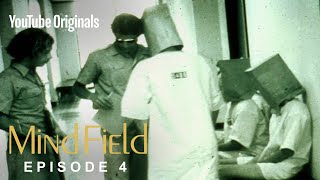

The Stanford Prison Experiment: What You Weren't Told
40sChallenges the widely accepted narrative of the experiment, sparking curiosity and debate.
▶ Play Clip"The video delivers exactly what the title promises: a critical reexamination of the Stanford Prison Experiment."
This video critically reexamines the Stanford Prison Experiment, challenging its widely accepted conclusion that ordinary people become evil simply due to situational forces. Through interviews with a former guard, a journalist, and a psychologist, and by conducting a redesigned experiment, the video reveals that demand characteristics and participant predispositions played a larger role than previously acknowledged.
The experiment is often cited to show that ordinary people become evil when given power over others in a prison-like environment, but this narrative is being questioned.
Blum's cousin Alex, a U.S. Army Ranger, was involved in a bank robbery. Zimbardo argued that Alex was a victim of situational forces, leading to a lenient sentence, but the family later saw this as shirking personal responsibility.
Participants were explicitly told to act tough and that the study was about prison life, which likely influenced their behavior. This is known as demand characteristics.
Dave Eshelman, one of the most aggressive guards, admits he was acting and trying to be the worst guard possible to help the experiment. He enjoyed the power and did not follow a script entirely.
Psychologist Jared Bartels and the host design a new experiment to eliminate demand characteristics and test whether anonymity and power alone lead to cruelty.
Participants are placed in a dark room, solving puzzles, with the ability to blast noise at another team. They are not told it's a prison study, and instructions are minimal to avoid demand characteristics.
Participants are screened using the Personality Assessment Inventory to select those low in aggression and high in conscientiousness.
The first group, with no instructions to be aggressive, buzzed the other team only 23 times, never above level 5, showing little cruelty.
When told that operating the distractor was their task, participants buzzed more frequently, similar to the Stanford Prison Experiment guards following orders.
One participant (number two) buzzed 37 out of 44 times, often at high levels, suggesting individual differences matter.
The host and Jared conclude that personality plays a significant role; even in a situation designed to elicit cruelty, most participants did not become sadistic.
Zimbardo argues that the new study selected participants who were too conscientious, thus breaking the power of the situation. He maintains that the original experiment's lesson about situational power is still valid.
The video suggests that both situation and personality matter, and that the Stanford Prison Experiment's lesson may be more about obedience to authority than inherent evil.
The Stanford Prison Experiment's narrative that ordinary people become evil solely due to situational forces is oversimplified; personality and demand characteristics also play crucial roles. Questioning established interpretations is essential for scientific progress.
What are demand characteristics in psychological experiments?
Demand characteristics occur when participants act differently because they feel a certain behavior is being demanded by the experimenter.
06:09
How did Dave Eshelman describe his role as a guard?
He said he was acting and trying to be the worst guard possible to help the experiment, and he enjoyed the power.
09:45
What was the key flaw in the Stanford Prison Experiment according to the video?
The experiment had strong demand characteristics; guards were told to act tough, and the study was framed as a prison simulation, influencing behavior.
05:54
What was the cover story in the redesigned experiment?
Participants were told they were studying how people solve puzzles in the dark.
16:37
How did the first group in the redesigned experiment behave?
They buzzed the other team only 23 times, never above level 5, and showed little aggression.
21:37
What did the second group do when told operating the distractor was their task?
They buzzed more frequently, similar to the Stanford guards following orders.
22:27
What was Zimbardo's criticism of the redesigned experiment?
He argued that the participants were selected to be too conscientious, thus breaking the power of the situation.
31:20
What is the final conclusion of the video regarding the Stanford Prison Experiment?
Both situation and personality matter; the experiment's lesson may be more about obedience to authority than inherent evil.
32:52
Demand characteristics revealed
Challenges the validity of the original experiment by highlighting how instructions influenced guard behavior.
05:54Guard admits acting
Key participant confesses he was not naturally evil but performing a role, undermining the 'ordinary people become evil' narrative.
09:45Low aggression in first group
Shows that without demand characteristics, people do not automatically become cruel.
21:37Personality matters
Supports the idea that individual differences play a significant role in behavior, countering pure situationalism.
29:38Revised lesson
Suggests a more nuanced interpretation of the experiment, emphasizing obedience to authority over inherent evil.
32:52[00:04] was the Stanford Prison Experiment. They tend to focus on how unethical it was,
[00:17] and are less critical of its supposed conclusion. Palo Alto, California. Twelve young men are rounded up from their homes by police,
[00:29] in the basement of Stanford University. led by Stanford psychology professor Dr. Philip Zimbardo.
[00:41] 12 guards and 12 prisoners. recreating life in a correctional facility.
[00:54] The prisoners are booked and stripped nude. forced to wear smocks, stocking caps and shackles. Identified only by their prisoner numbers.
[01:13] Given anonymity by their mirrored sunglasses, restrict prisoners' bathroom use. so do their cruel methods.
[01:36] conditions are so bad [man] The study makes international headlines.
[01:51] and his conclusions are taught to students worldwide, and are even submitted to Congress The study brings up a question
[02:04] is evil caused by the environment, Zimbardo's shocking conclusion and have power over depersonalized others,
[02:18] And it occurs more often than we'd like to admit. during the Stanford Prison Experiment, wasn't what we've always been told?
[02:53] has always had its controversies. have pushed it back into the spotlight Today, I'm going to speak with journalist Ben Blum,
[03:05] of the experiment to a larger audience How did you get involved in the Stanford Prison Experiment Well, my involvement was quite personal.
[03:18] the basic lesson of the experiment And then my cousin Alex was arrested for bank robbery. This was a team of mostly military guys with AK-47s.
[03:33] He was a 19-year-old U.S. Army Ranger. that organized and led the bank robbery. He was just so brainwashed in this intense Ranger training
[03:49] that when a superior proposed this bank robbery, he took it as just one more kind of tactical thought experiment. in his legal defense.
[04:04] Zimbardo submits a letter to the court, that Alex, my cousin, had been so transformed by the social environment of the Ranger battalion
[04:18] without exercising his own free will. He received an extraordinarily lenient sentence of 16 months.
[04:30] So Zimbardo was a family hero. you know what, I knew this was a bank robbery by the end, Alex, myself and our whole family
[04:46] came to view the Zimbardo argument as a way to shirk personal culpability, and to put all the blame on the situation.
[04:59] at the Stanford Prison Experiment in particular. as well as some of those who participated. I learned, to my deep surprise,
[05:13] had stories of their experience that completely contradicted Which is, look, these regular people,
[05:25] and because of the situation, became evil. Zimbardo has claimed that the guards and then the kind of hidden wellspring of sadism
[05:39] unfolded organically. [Zimbardo]
[05:54] They had been told quite explicitly That falls under the heading of what psychologists call Experimental subjects tend to be motivated
[06:09] [Michael] Demand characteristics occur act differently than they normally would and feel that a certain kind of behavior is being demanded.
[06:25] who wasn't being tough enough.
[06:58] from the Stanford Prison Experiment they'll do it if you tell them I think the study stands still as a fascinating spur
[07:16] as a demonstration that should make anyone curious in such a short time. but it might need to be reinterpreted.
[07:31] than the one that we've been telling for so many decades. The flaws in the experiment call into question large portions of the narrative
[07:45] So I want to hear from someone who was actually there.
[07:59] agreed to tell me his side of the story. You're a living, walking piece of psychology history.
[08:11] although I still get some hate mail. Well, what do you say to them when they react that way? I say, well, there's probably a lot about that
[08:24] Well, Dave, before we go too far, so we can kind of talk about what we see.
[08:36] So how did you get involved with a Stanford Prison Experiment? and I was home for summer, looking for a summer job.
[08:49] $15 a day. The way it was introduced to the guards, we were never led to believe
[09:03] We were led to believe that our job that they were the ones the researchers are really studying.
[09:17] And we all knew they were filming. commenting on the action from the other side of the wall. Here. Make sure you get a close-up of that."
[09:30] Okay? So if they want to show that prison is a bad experience, Didn't you feel bad? but 18-year-old boys are not the most sensitive creatures.
[09:45] the worst guard I could possibly be. -And it's pretty serious. -Mm-hmm.
[09:57] This is my favorite part of all the footage we have It's you and a prisoner confronting each other I remember the guy saying, "I hate you, man."
[10:10] -Yeah. -"I hate you."
[10:38] Each day I said, well, what can we do to ramp up Why did you want to ramp things up? I was helping the researchers with some better understanding
[10:55] it was personally interesting to me. You know, I cannot say that I did not enjoy what I was doing. Maybe, you know, having so much power
[11:08] you know, maybe you kind of get off on that a little bit. You weren't entirely following a script from a director. But you also felt like
[11:23] -Yes. -And you gave that to him. I was going to do a better job than anybody there But does that excuse me from what I was doing?
[11:36] So the question is, was there a point where I stopped acting and I started living, so to speak?
[11:49] The standard narrative is that Dave Eshelman did what he did it's easier than we think for abuse to happen. but how predisposed to aggression was Dave?
[12:03] a "prison study," after all. and helped the experiment, may have affected his behavior.
[12:16] in the absence of outside influence, can anonymity, power, and depersonalization alone I'd like to design
[12:29] So I'm meeting with Dr. Jared Bartels about the Stanford Prison Experiment I would love to do the Stanford Prison Experiment again.
[12:46] but still find the same conclusions. It's important. It's interesting. is eliminate as best as possible the demand characteristics
[13:01] Why do we even need to call one group "guards" Oh, I'm a guard? The cover story is really important,
[13:16] and you want to hide the true purpose of the experiment. and personality traits. asked for participants for a study of prison life.
[13:31] that were more kind of disposed to aggression. -"I want to be a part of that." -Exactly. of kind of authoritarian-minded individuals together,
[13:47] an authoritarian regime and environment. of the individuals. to be as evil as they can?
[14:04] that were assumed to be influential You have to have the depersonalization. You have to have some power differences.
[14:19] in just a number of hours? there wasn't anything dramatic that happened when the guards started to assert their authority.
[14:35] That came about because of prisoners testing [Michael] Yeah, and that led to fear. That, like, wait a second, these prisoners need to be
[14:47] So I think you still need that provocation. Something that's going to increase Right. All right, so, Jared,
[15:01] brainstorming a new design -Absolutely. -Awesome.
[15:15] to begin the planning process. Will a person, without any expectations or pushes in a certain direction still be abusive or not?
[15:28] we want to eliminate all outside variables of the Stanford Prison Experiment. Subjects need to believe that no matter how they behave,
[15:42] This is where people will be coming in in the morning. That's important, because we don't want them to ever meet their teammates face-to-face.
[15:55] by providing mirrored sunglasses and uniforms. Our study will take place in a room that is pitch-black. [Michael] Ah. I would love to see how dark
[16:10] -You ready? -I'm ready. [Michael] This is uncomfortable. thanks to infrared cameras.
[16:24] The second element is depersonalization. they will only be identified by number, not name.
[16:37] we don't want our subjects to know what we're studying. All they'll be told is that we are studying how they solve puzzles in the dark.
[16:52] -who is also solving a puzzle. -Okay. suggest certain expected behaviors, and will simply give our participants an unseen,
[17:07] We will measure the cruelty predicted by giving our participants What I'm going to show you next is the system
[17:21] We've armed the teams with a "distractor button" jarring noise into the other team's room.
[17:33] and they'll be told that anything below a 7 And each person has their own control. -You can't see what they're doing. -Okay.
[17:48] as well as the frequency with which they push the button, the participants become in this situation. Well, I'll give you a demonstration.
[18:03] Hey, Derek, could you play level 3 for me? So that's a 3. Perfect.
[18:16] or a member of their team pushes a distractor button, will be determined by the highest level selected This is to increase the feeling of diffused responsibility.
[18:30] take advantage of these factors and act sadistically? to actually be harmed in our experiments, Instead, Jared and I will be the ones
[18:46] at a safe level, no higher than a 3. we selected participants We screened our participants
[19:00] "The Personality Assessment Inventory," like honesty and conscientiousness. But it's pitch-dark.
[19:15] Thank you, and once I leave the room you may begin. Okay, here we go. [man 2]
[19:29] [man 1]
[19:41] of the control panel at this point. [man 1]
[19:55] [man 2] [laughter] We picked people who were most likely
[20:10] [man 1] [woman]
[20:25] [woman] [all] -[high-pitched squeal] -[woman] Did somebody do it already?
[20:38] -We should retaliate. -Yeah, retaliate now. [loud, discordant horn] [all laugh]
[20:53] [horn blares] against that most recent buzz.
[21:09] Shall we try again? [loud, discordant horn] this team doesn't appear to be turning evil.
[21:22] Just ignore it and keep working together. They're not interested in retaliating. [discordant horn blares]
[21:37] we blasted them with noise 23 times. and never above a level 5.
[21:51] Puzzle pieces down. that encouraged them to act aggressively?
[22:03] Although the other team your team will not. Your only task is to operate the distractors.
[22:15] without their knowledge. You will not hear any sounds if they buzz back at you. where there's a little bit of power differential.
[22:27] [Michael] By now saying that the buzzer is their "task," Similar to how instructing prison guards may have encouraged more use of force.
[22:42] [woman] Even though they were given instructions just started chatting with one another.
[22:55] No. Oh. Okay. [woman]
[23:08] [high-pitched squeal] this group only pushed the button three times. in blasting the other team?
[23:23] with that predisposition, right? who shouldn't be interested in retaliating. on what we were actually studying.
[23:37] Here I am. I'm Michael, and this is Jared. There are no other people. There was never another team doing anything.
[23:52] This is a study related to the Stanford Prison Experiment. The standard narrative we hear about that experiment So, yeah, we're trying to see if we get the nicest people we can,
[24:08] and the ability to be cruel, but never encourage them to, Did you have any suspicions about what we were studying
[24:22] or what was going on? that what we're really looking at
[24:36] That's really what we're looking at. who, like the first group, were screened to be individuals Anything up to 7 should be safe.
[24:54] you can go ahead and get started. [laughs]
[25:12] [high-pitched squeal] Yeah. [high-pitched squeal]
[25:27] [discordant horn blares] Okay, here comes number two. Number two is still at a volume 3.
[25:44] Let's see what will happen if we continue buzzing them. Derek, let's blast them again. Number 3. Okay, let's...
[26:00] But she's not touching the dial. [Jared] She's not. [loud, discordant horn]
[26:13] [woman 2] It's just annoying. [blaring horn]
[26:27] [high-pitched squeal] [all laugh]
[26:40] was really the only one hitting the distractor button, So we decided to see what would happen [man 1]
[26:56] and we have not blasted them with the noise, and they haven't played one either. they would never touch the distractor button.
[27:12] In the end, we buzzed this group a total of 44 times, 37 of which came from number two All right, guys. Puzzle pieces down.
[27:31] to make this group sadistic. [woman 1] -Oh, she... -[high-pitch squeal]
[27:46] -Wow. -Yeah, she's-- She's going nuts. At a 7.
[27:59] That might explain why she was just going nuts on the button, Okay, they're all pushing the button a lot more. that it was their only task.
[28:19] [all laugh] Just like in the Stanford Prison Experiment. that they have a certain task to do, they'll do it,
[28:32] The thing is, they never hit upon what we really cared about, Yeah. [Michael] Hello, everyone. I'm going to turn the lights on in this room.
[28:46] -And slowly... -Ah, it hurts. So, hello. I'll give you time to adjust your eyes.
[29:00] Today, you've been part of a study where all we wanted and gave them that feeling of anonymity if I crank my dial up really high,
[29:12] So you have this opportunity to be cruel. Like, when the other person was pressing-- Sure, but that's-- that's just in-kind retribution.
[29:25] As it turns out, so far, everyone stays in that "below 7 or under" range. trying to ramp up the demand characteristics.
[29:38] And I believe number one, right, you did say at one point, So I loved that phrase, because it says but I'm doing it because I believe it was expected of me."
[29:51] Jared and I sat down to discuss our results. We brought in people who had very different personalities We put them in a situation that did not demand things from them.
[30:07] I think we have some intriguing support for the idea that it's more than just the situation.
[30:19] We really saw personality kind of shine through. -of where that line is... -Yeah. None of them did.
[30:34] Dr. Philip Zimbardo, "How to Make a Hero." For years, Dr. Zimbardo has responded to criticisms
[30:48] always maintaining that they aren't valid. of demands from authority, I then told him about the study we ran to get his reaction.
[31:02] I wanted to know what the sufficient conditions might be And we struggled to get that to happen. Just giving them anonymity, and a dehumanized other,
[31:20] Well, I mean, maybe the problem was, who were extremely conscientious, by selecting people who are high on compassion,
[31:34] you broke the power of the situation. we had, I presume, We gave them six personality scales.
[31:50] who were mostly in the mid-range. some people behave cruelly, evilly. Not everybody, but more of the guards than not.
[32:04] So, again, I think that your study is a demonstration -Ah. -Where the personalities are-- The personalities are special.
[32:21] the disposition, the personality, No, that's the big-- Where is, you know, how much of one
[32:35] Right. played little role in his subject's behavior. that what happened was what was asked for.
[32:52] then the Stanford Prison Experiment, like the classic Milgram study, still has an important lesson. if an authority figure suggests that doing so
[33:04] In our test, we made sure that such influences didn't exist. Personality rose above the situation.
[33:18] if we want to improve conditions where power is involved. And look, questioning methods and interpretations It's how we improve our confidence in what we know.
[33:34] So stay curious, never stop asking questions, and, as always, thanks for watching.
[34:12] There is so much more to satisfy your hunger Click below to check out more episodes.

⚡ Saved you 0h 34m reading this? Transcribe any YouTube video for free — no signup needed.