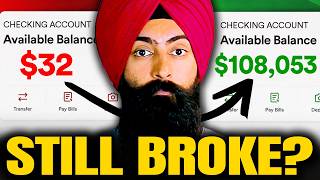

Money Taboos Are Keeping You Broke
38sA blunt reframe of why avoiding money talk leads to financial slavery is instantly relatable and highly shareable.
▶ Play Clip"Delivers on its promise with genuinely useful money principles, but pads runtime with sponsor reads and book plugs."
The video explains why most people remain financially broke and how to fix it. It covers the psychological traps of net-zero thinking, money traps like 0% APR financing, the importance of owning assets rather than liabilities, and how inflation and Fed policy favor the wealthy. The speaker shares a five-step wealth formula and practical investing strategies such as automating small contributions and using the 'Rule of Five.'
If you don't understand money, you end up working just to make debt payments. Understanding and growing money lets you support yourself, your family, and your community.
The speaker tells of a woman buying $150 of lottery tickets with a rejected credit card. Gambling or financing lottery tickets is a straight path to financial ruin.
To stop being broke you must: stop net-zero living, avoid money traps, learn to grow money faster, stop the fake flex, and understand the five things covered in the video.
Many people think having $100 means they can spend $100. But if you spend every dollar, you're broke regardless of income. Wealth is determined by what you do with money, not how much you make.
If you cannot buy five of something, you can't afford one. With $100, you can only afford a $20 item — this leaves room for emergencies and investing.
People confuse 'affording monthly payments' with 'affording the item'. Financing a phone, laptop, or sofa at 0% APR removes the pain of spending and causes you to buy more than you can afford.
Assets put money in your pocket; liabilities take money out. Liabilities like fancy cars, shoes, and umbrellas make you look rich but keep you broke. Wealthy people buy assets first.
Instead of buying a BMW, the speaker bought a small condo, rented it out for $600/month, and netted $250/month of passive profit after expenses.
Build wealth by consistently buying investments in any market. The speaker's book 'ABB: Always Be Buying' explains the strategy, and he offers a free digital copy to viewers.
The Fed doesn't print physical money; it increases the money supply in a database. When more dollars enter without new wealth being produced, each dollar's value drops and prices rise.
Inflation silently taxes everyone, but disproportionately hurts the poor and financially uneducated. Wages often don't keep up, making people poorer even after a raise.
Income minus expenses equals investments plus savings. Keep a margin by spending less than you earn, then invest the difference in stocks, real estate, a business, or other assets.
You can start investing with $10 using modern brokerages. Automate investing a fixed amount (e.g., $100) every payday into something like an S&P 500 ETF and let compounding work.
After making $1M in a year, the speaker still drove a $500 car and chose to put $150,000 into real estate, stocks, and business rather than buying a luxury car.
1) Earn money. 2) Don't spend all of it. 3) Invest the rest. 4) Reinvest returns. 5) Repeat. The cycle builds wealth because you stop making everyone else rich.
The root cause of being broke is a mix of poor money mindset, uncontrolled spending on liabilities, and a lack of investing. By shifting to an abundance mindset, avoiding money traps, and consistently investing in assets, anyone can begin building real wealth over time.
What is the Rule of Five?
If you can't buy five of an item, you can't afford one. With $100, you can only afford a $20 item.
05:43
What is the definition of an asset?
Something that puts money in your pocket, such as a business, stocks, or real estate.
09:00
Why is 0% APR financing a money trap?
It removes the pain of spending, so people buy more than they can afford and end up with monthly payments forever.
08:24
How did the speaker's first real estate investment perform?
He bought a condo, rented it for $600/month, and had $250/month of passive profit after expenses.
11:09
What does ABB stand for in the stock strategy?
Always Be Buying — consistently buying investments in any market condition.
11:51
What is the hidden tax described in the video?
Inflation — it's a silent tax that disproportionately hurts the poor and financially uneducated.
19:44
What is the wealth formula presented?
Income - Expenses = Investments + Savings.
25:32
What did the Federal Reserve do in 2020 for the first time in history?
It bought corporate bond ETFs, directly giving money to corporations.
18:34
What was the speaker's first stock purchase amount and company?
$2 of Ford stock, because that was the trading price when he couldn't buy a Mustang.
29:11
According to the speaker, what is the difference between making money and building wealth?
Making money is earning income; building wealth is about time and freedom, achieved by not spending everything and investing the rest.
45:04
Net-zero thinking is a wealth killer
It reframes affordability from 'I have the money' to 'I can afford to lose it' — a core mental shift for building savings.
03:06Inflation is a hidden tax on the poor
Explains why wage raises often leave people poorer and why asset owners benefit from Fed policy.
19:30Start small, automate, and stay consistent
Shows that investing with $10 or $100 automatically every payday can outperform waiting for a big lump sum.
29:40Invest your money, don't flex with it
The example of driving a $500 car after a $1M year demonstrates that wealth is built by reinvesting, not spending.
37:00The five-step wealth formula
A simple, repeatable framework — earn, don't spend it all, invest, reinvest, repeat — that anyone can implement.
46:55[00:01] up the smoke screen and they say things like, "Oh, you shouldn't talk about money like that. Then you shouldn't worry about money." When in reality, we all use money every single day. If money really didn't matter, then why are you
[00:14] going to work every single day to get a paycheck? Now, I get it. There's a lot just one small aspect of our life. But if you don't understand money and if you don't have money, you become a slave to money because now you're drowning in
[00:27] that you can't afford. So you're going to work every single day not to enjoy fulfilling, but just so you can make your back payments. But if you understand money and you know how to use money and you can grow your money, now
[00:40] take care of yourself and your family financially and you have more money to help other people and to help your community because you have the resources have the resources to help other people.
[00:52] debt, the only person that you're helping is your bank because you're paying these insane rates on money that you borrowed to buy things that you didn't even need. So many Americans put a lot of weight on luck when it comes to
[01:04] financial success right now. They see somebody who's become wealthy or rich become wealthy. They must have inherited the wealth or they must have just got investments or whatever." luck is the reason why they're successful. If that
[01:19] millionaires are self-made? That means these are people who did not have millionaire parents. These are people who created their millions themselves. that are millionaires made it themselves. This is where you can say,
[01:33] "Oh, they had an advantage or they had this or they had that." We can spend the that other people had as to why they could become successful. or you can to use your money the right way. That way you can build your wealth because
[01:48] use your money. The first thing you got to do is get your mindset right. I YouTube, but I was at Speedway getting gas and Speedway actually had this video on their screen that was talking about how they let you buy lottery tickets
[02:02] with credit cards. And I went in because I needed to get a pack of gum. And there was a lady there who was frantic, who was freaking out because her credit card got rejected when she was trying to buy like $150 worth of lottery tickets. She
[02:15] was buying dozens and dozens of lottery tickets because this was her kind of hope of becoming successful. Spending all your money on lottery tickets or financing this lottery tickets is gambling and it's a straight path to
[02:27] win, but now you're going to be spending all your future paychecks paying off long-term game. And if you really want to know the secrets to not being broke there's five things that you need to understand. These are the five things
[02:41] you have to understand. First, you got to stop living in a net zero life. Second, you got to avoid the money traps that are out there. Third, you need to know how to grow your money and grow your wealth faster. Fourth, you got to
[02:53] stop living in this game of the fake flex. And five, you need to understand the five things I'm going to be going over in this video. So, make sure you let's talk about living this net zero lifestyle because this net zero
[03:06] lifestyle is keeping the majority of people broke and it is holding you back is like this. The majority of people think, okay, I have $100 in my bank account right now. And if I have $100 in my bank account, that means I can go out
[03:21] and I can spend $100 on a pair of shoes because I have $100 in my bank account. If I have $100, I should be able to spend $100. This is net zero thinking because if you have $100, you can spend $100. This mindset kills people's wealth
[03:37] because if you have $100, you cannot afford to spend $100. This is why I keep determines if you're going to become wealthy or not. And your income is now going to live broke or not. It's what you do with your money. If you make
[03:52] $100,000 and then you spend $100,000, guess what? You're broke. If you make $20,000 a year and you spend $20,000, guess what? You're still broke. The very you are not allowed to spend every dollar that you have because some of
[04:07] you from emergencies and some of your money needs to be invested to help build your wealth. Okay? If you have $100 in your bank account, you cannot afford to spend $100. This becomes even more true if this money that's in your bank
[04:21] account is not yours. So, when I was in law school, I had this friend or acquaintance rather that was in my law school with me and I was talking to him one day about what his plans were for the evening. And then he told me that he
[04:33] umbrella. I thought it was kind of funny that his like evening activity was to because, you know, we're in a rainy area and it's not fun to go walk around when bought my umbrella from Home Depot and I paid like $5 from it. And he told me,
[04:49] now remember this is when we were in law school, okay? He did not have a job. He told me that he wanted to go out and buy this really fancy $400 umbrella. He showed it to me on his phone and I was like, " $400 for an umbrella? Who spends
[05:02] $400 on an umbrella?" And he told me that he had this extra cash from his student loans in his bank account. So, he wanted to use this money to buy and invest in this umbrella. So, when he goes to these attorney interviews, he's
[05:14] going to look really fancy with his $400 umbrella in his hand. That is net zero thinking on steroids. Now you assume, oh, I have $400 in my bank account, even money from the bank, and you feel like you need to spend this money because
[05:30] this cash is in your bank. When you live this lifestyle of spending every dollar you have in your bank, whether it's your money or someone else's money, it's even money. But when you have this need to spend every dollar you have on things
[05:43] that don't make you money like an umbrella, you are going to be broke. The solution to this net zero thinking is to create a system where you are not You have to create the system where you
[05:56] means. This is where a rule of five comes into play. A rule of five says if you cannot buy five of them, you cannot afford one of them. So if you have $100 about things you don't need to survive. If you have a $100 in your bank account
[06:10] can only afford to buy something that costs $20. Because if you have $100 in your bank account, this $20 thing is what you can afford to buy five times times, you can't afford to buy it one time. Second, let's talk about money
[06:26] traps to avoid because the majority of Americans are broke and will never build they don't have on things they don't need, which will never make them any money. Sometimes this is obvious like I just gave you that example of that
[06:39] person I knew in law school who had money from student loans. This money was not his. This is the bank's money that he spent to buy an umbrella. Right? But obvious. When the majority of people say that they can afford something, what
[06:52] they actually mean is I can make the monthly payments. But that's very something. The simplest example of this is your cell phone. Okay? Your thousand cell phone that you have in your pocket. So many people are financing this phone
[07:06] on 20, 30, $40, $50 monthly payments because they cannot afford to pay $1,000 for a phone. So they think, "Oh, I can afford this phone because I can pay $50 afford this phone because I can pay $50 a month with 0% APR financing, so I'm
[07:19] not paying any extra money and interest, and I can afford this phone, right?" But this is a money trap. What happens when you finance something that you can't afford, that you don't have the cash to buy up front? Well, now you're going to
[07:31] be paying this 20, 30, $40, $50 a month for the rest of your life because every year you're going to get into this trap of buying a brand new phone. And then this money leaving your wallet. You think that you just bought $1,000 phone,
[07:44] but you never had the pain of $1,000 leaving your wallet. All you saw was $50 leaving your account every single month. And so you think now, oh, I bought this $1,000 phone and it's only costing me $50 a month. So, let me go and buy this
[07:57] $2,000 laptop that you can't afford, but it's only $85 a month. So, now you buy that. And then you buy the sofa that you can't afford because that's only $75 a things that you can afford because you think you can live way up here, but you
[08:11] can actually afford down here. You thought you were being financially smart by paying 0% APR, but you just got played because now you're spending more because you never had the pain of money leaving your pocket in the first place.
[08:24] leaving your pocket in the first place. The reason 0% APR is so profitable for businesses is because when you buy things with 0% APR, you never have the pain of money leaving your bank. And so now you can buy a whole bunch of things
[08:36] that you didn't know that you can afford because you can't actually afford it. monthly payments. There's a difference between being able to afford a smartphone and being able to make the monthly payments. There's a difference
[08:48] between being able to afford a brand new car and being able to make the payments. the things you buy, not just making the monthly payments. The goal with the first two things that I talked about, not living net zero and avoiding money
[09:00] traps is all so you can grow your money and your wealth faster. If you follow the first two things that I just talked about, you avoid that zero, you avoid see happen is all of a sudden you're going to find extra money in your bank
[09:13] account out of nowhere. Now, what you want to do with this extra money is you want to put some of it to work. That way you can grow your wealth faster. There's and liabilities. I've talked about this before. So, if you haven't subscribed to
[09:25] our YouTube channel yet, make sure you do that. But what you need to understand are assets are things that put money in your pocket. Liabilities are things that take money away from your pocket. Your $400 umbrella, your shoes, your lottery
[09:39] liabilities. If you're spending money on something and it's not putting money in your pocket, or if you're not buying it for the sole purpose of making money, it's a liability. The interesting thing about liabilities though is liabilities
[09:52] make you look rich, right? When you go out and you buy a fancy new wardrobe, you buy a new shoes, you buy a new purse, you buy a new cell phone, you buy a new watch, all this stuff makes you look rich. And so this is what broke
[10:04] people do. Broke people spend all their money on liabilities. That way they can look rich, but they're actually just product rich. You look rich, but you're assets. If you want to become wealthy, you got to flip this around. you need to
[10:18] start spending more money on assets which are things that pay you for owning them. And then once you have more money coming in, then you can afford to buy these liabilities. The first time I really understood this concept of assets
[10:30] and liabilities was when I first started investing in real estate. I was running this event planning business and I had money in my bank account and I really wanted to buy this BMW. It was a 3 series and I really wanted to buy a 3
[10:42] would look really cool with my image. But then for some reason I was reading books and every book talked about how wealthy people owned real estate. I had I didn't grow up with real estate investing family members. But I decided,
[10:56] you know, I wanted to try this out. So instead of using my money to buy a car, I ended up buying a small little condo. This condo, as soon as I bought it, about a month later after renovating it, I rented it out for $600 a month. And
[11:09] after paying all expenses, I was left with $250 a month in profit every single month. And I didn't have to physically do any work to get this $250 a month. This was passive income I was getting because I spent my money buying an asset
[11:23] instead of using my money to buy a liability, which was a car. Assets are pocket. These are the things you need to buy if you want to build wealth. Liabilities are things that make you look rich, but they keep you broke. So
[11:37] now, if your goal is to become wealthier faster, you got to spend less money here way you build wealth in the stock market is not by chasing hot stocks. It's through what I call ABB, always be buying. And I just wrote a brand new
[11:51] book called ABB, Always Be Buying, How You Can Build Wealth in Any Market, where I break down the exact strategy of how you can build wealth in the stock market and turn your extra money into income or more wealth. That way, you can
[12:03] wealth. And because you're watching my video, I'm going to give you a digital copy of my book completely free. I have that link for you if you want to below. And when you sign up for the book, you're also going to get access to
[12:16] Market Briefs, which is my newsletter for investors completely free, where my in things like the economy, housing, stocks, crypto, and global markets. It's investors every single morning. So, if you want to get my ebook and market
[12:29] briefs, all for free. All you have to do is sign up, and I have that link for you government wants trillions and trillions of dollars, if there's not enough people government and they keep wanting to spend more money, you still got to make
[12:42] up this cost. So what do they do? They call up their friends at the Federal Reserve Bank and they say, "Hey, we need a $2 trillion loan." And then the Fed's remember what I said. They're not a reserve. They don't have a cash pile
[12:55] anywhere. So what do they do? They go to the money printer. And now they can print out $2 trillion. They loan this cash to the government. And now the Federal Reserve printed it out of nothing. The government can now take
[13:08] this $2 trillion and spend it in whatever way that they want. It can be inefficient. They can try to create efficient products, but their goal is to hopefully help people. Now, whether they're inefficient or not is a
[13:20] political debate. However, you know that that is what they do. Now, is the part that people need to understand about why the rich get guy, I'm like, "Oh, I'm going to get richer." Like what? Great.
[13:33] >> I never understood how. >> So now what happens? You just printed >> which you don't actually print, by the way. You just increase a database >> Yep. >> And now this money enters our economic
[13:47] circulation. Well, what happens now when more dollars enter without actual wealth being created? Because we saw this happen in textbook form in 2020 and 2021 where nothing was being produced except money. Well, when more money gets
[14:01] produced, it effectively reduces the value of each individual dollar. This is comes from the word inflate. What are you inflating? The monetary supply. So, you're increasing the monetary supply causing the value of each individual
[14:15] dollar to go down, which effectively causes the price of things to go up. [snorts] And so, in 2020, 2021, no one's producing. However, the government is spending money like crazy. Where are they getting this money? The Fed. So,
[14:28] spending it like crazy. Now, people are getting money. It's people, it's businesses, it's corporations. Um, and this money is being spent. And now home and I'm rich." You have some people who are getting big unemployment checks.
[14:43] millions of dollars and everything is running smooth, but and people are spending money like crazy, buying things, but nothing is being produced. have a supply chain mess because everyone's buying all the stuff in
[14:57] stores. However, no business is able to produce anything because the economy shut down. So, the supply chain issue then you start to see is a byproduct of the inflation because everyone's trying to blame, oh, the inflation is happening
[15:10] have to look at what is the real root cause. The inflation is what causes the supply chain issues and now we're trying to go backwards. But this is where rich as the value of the dollars drop, what happens for regular people? Your salary
[15:27] doesn't stretch as far. Your savings don't buy you as much. And so you're effectively becoming poorer each and every day because for most of us, we're taught to save our money. That's what I was told to do growing up. Uh you know
[15:39] that traditional Indian house is save, save, save. And so I was told to save my money. And your savings are becoming less valuable each and every day. Well, what wealthy people do is they're not storing cash. They're buying assets. And
[15:53] economic system, >> can you explain what an asset is? >> This we're now getting to the root of how the rich actually get richer, time to understand. But now that I get it, one, it doesn't need to be the rich
[16:07] >> Yeah. >> But they have to understand what assets right? >> Because this is how the government pumps the money into the system. And this was a part like I'm grateful sometimes that
[16:20] I'm kind of dumb for real. [laughter] But and and this really I had a breakthrough moment back at Quest. We were dealing with nutritional science so I would have to keep asking, keep asking, keep asking, keep asking.
[16:33] got rid of my embarrassment over not knowing >> and I kept asking until I understood it so well that I could explain it to other >> that ended up propelling me forward because I was no longer just nodding and
[16:45] "No, no, I don't get that. I don't understand. I don't understand." understand. I don't understand." >> And so, by that, then I actually began understand what ingredients made sense and all that.
[16:57] stupid. >> And so, now because I've been willing to look stupid for so long in the world of finance, I finally asked the magic actually thought they were printing money. I thought that $100 bills were
[17:11] coming off of a printing machine. That's not how it's done. At least not to the in a database. >> And when they create that money, I was are they actually going into rich people's like accounts and giving the
[17:25] money? No. What they do is they buy often times government assets. I don't stuff, but like they're buying assets from the government, >> but the question is where did those assets get purchased in the first place?
[17:40] And they got purchased by people who are effectively trying to park their money as they call it. >> Yeah. So I for years was parking my government guarantees it. Yeah. >> And so the way that the government
[17:54] your tax is they put bonds out into the world that then people buy. So when they're pumping money into the system, they just go buy those bonds. So now because rich people were the ones that were educated enough and had the capital
[18:08] >> That's correct. And it goes actually a pandemic we saw something that we've never seen happen before. So the Fed has the ability to work with interest rates. I'll talk about that in just a second.
[18:22] And then they can print money and give it to the government. And then when you have an emergency time, we saw this happen in 2008. We saw it happen in happen in 2008. We saw it happen in 2020. They can do weird things. So what
[18:34] they did in 2020, this is the first time it's ever happened in history, is they it's ever happened in history, is they directly gave money to corporations in the form of purchasing corporate bond ETFs. So think of it this way. The
[18:46] ETFs. So think of it this way. The biggest corporations in America can go out and raise money from a bank. They can go out and raise investment dollars or they can put out this loan. Say if you are a regular person, you want to
[18:58] loan money to us, you can do that. And so there's ETFs, which is a group of corporations that are looking to raise money. Um, and it's it's a way to kind of track those debt investments. Well, in 2020, because a lot of corporations
[19:13] they're like, "Oh, we can't sell products. We're going to go under." The done. And they started buying corporate bond ETFs in the first time in history. And this is where things got really dicey because now how do you decide who
[19:30] printing money. Somebody's got to pay for that. Who pay who's paying for it? Regular people, average people. Because now it's a hidden tax because the government can't just spend money without somebody paying for it. They
[19:44] they don't pay it through tax dollars, somebody's still going to have to pay a tax. And inflation now is a hidden tax. It's a silent tax. It affects the people disproportionately affects the poor and the financially uneducated. And this is
[19:59] why financial education is so important is because if you don't understand this, you are going to get screwed over by the system because now guess what? Your gas groceries are going to be more expensive. Your home cost is going to be
[20:11] more expensive. The cost to do anything is going to cost you so much more today, next year, the year after that. Well, your salary, hey, you got a raise, but you're actually broker now than you were before the raise because your raise
[20:23] isn't keeping up with inflation. And so what's happening now, this money gets printed and it enters our economic circulation. And now you can own the the assets or what happens, let's say you own stocks, you own real estate. Well,
[20:37] the Fed can also manipulate interest rates. So when interest rates go down, it makes borrowing money cheaper. Well, when you make borrowing money cheaper, to go out and borrow money. This also creates more inflation because now when
[20:53] you go to the bank and you borrow a million dollars or $100,000, the bank is money and that's how it gets injected into the economy. So, lower interest into the economy. So, lower interest rates create more inflation. And if you
[21:05] are somebody who's financially educated, you own assets. And we didn't explicitly answer what is an asset. It is something that gives you equity. And at at the that puts money in your pocket. A liability is something that takes money
[21:19] away from your pocket. What's an example of an asset? This could be owning a business, investing in stocks, investing in real estate, anything that you buy for the purpose of making money, right? And so when interest rates go down,
[21:31] because now the Fed working with the government want to create more enter economic circulation. More people are going to want to buy a home. Well, if you have more demand to buy a home, where do home prices go? Up. who owns
[21:43] homes? Well, yeah, if you're a homeowner, but if you are a real estate investor, now the value of your assets have just because now you own multiple real estate investments. Your rents have gone up. Your stock investments have
[21:56] gone up because now businesses can borrow money for effectively nothing. borrow money for effectively nothing. You borrow money for three, four, 5% and of dollars to grow the company. And if
[22:08] you just made a profit off of the free debt. And so now corporations become wealthier because of asset prices go up. And what does this do? The reason why it makes rich people richer and poor people poorer is because not only is your cost
[22:23] of living higher, but now if you want to go and invest your money, well, asset prices are more difficult to attain. It's harder to buy the same level of level of real estate because now the people who own these have already seen
[22:37] wealthy and you understand this and you're buying these assets and you've real gains and you start to see this divide between the rich and the poor. And this is where inflation disproportionately hurts the financially
[22:51] disproportionately benefits the wealthy and that's why the middle class gets wiped out. And the crazy thing is none of us are taught this. I didn't grow up learning about financial education. I didn't grow up learning about investing.
[23:04] I didn't grow up learning about any sort of wealth. My parents are immigrants from a state in India called Punjab like I was saying before and in my household success meant go to school get good grades get a good job and and for me uh
[23:19] doctor I was actually given two options become a doctor become a failure I could >> and they let you choose >> and they let me choose right and uh so I saw how hard they worked u for my dad if he had a Saturday and a Sunday off that
[23:33] was considered a long weekend and So, you know, I wanted to give back to my successful. They wanted me to become successful. And uh so I kind of followed that path like doing what everybody says, following the system, trusting the
[23:47] system, right? >> And it just didn't make sense to me because on one hand in my house, uh money was a taboo topic. You don't talk about money. You don't worry about money. You don't it's it's a bad thing.
[24:01] But at the same time, I see how hard my parents are working to get paid, you know, to to pay for our our lives. Now, we were fortunate. I never had to worry about my next meal. I never we were never poor or anything like that. We uh
[24:13] but I saw how hard they worked. One of the things that I've learned in life is pay attention to end up mattering the most. And that's why I want to talk to sponsor, Policy Genius. Because if you don't have the assets to live off of
[24:28] yet, something tragically happened to you. The last thing you want is now your struggle to survive financially. And that's where term life insurance can come into play. Now, I'm talking about term life insurance here, not whole life
[24:42] insurance is it's life insurance for a period of time, 10 years, 20 years, 30 years. That way you can work to build your assets. It is a lot cheaper than whole life insurance because the whole
[24:54] idea is you're not here trying to get rich off your life insurance. It's just there as a bridge until you can build your assets. This is one of those things where the earlier you start, the cheaper it is. Because if you're a healthy
[25:06] get a half a million dollar term life a day. So, if you have any questions, you want to learn more about term life term life insurance policy would actually cost you, I'll put a link to
[25:20] description. It only takes a few minutes to complete, and it'll give you an actual quote on how much term life insurance will actually cost you. And I have that link for you down in the description. You can own a business
[25:32] now, this is the question of what are you doing with your salary? What are you doing with your income? You can either build the equity by starting a company yourself or by building a home or you can buy the equity. Now, how do you do
[25:46] that? Well, you have to understand the wealth formula. The [snorts] wealth formula that I come up that I've come up with is you take your income minus your expenses and that equals your investments plus your savings. So, if
[26:02] subtract all the things that you buy, your rent, your mortgage, your car payment, your groceries, your gas, you take away all of your expenses, and if you have a margin, well, now you have extra cash. Now, you can save all or
[26:15] save some of it, then that money can be put to work in your investments. These investments, like I've been hinting at, is what makes wealthy people wealthy, and it's what keep wealthy people wealthy. These investments can be in the
[26:28] stock market because anytime you buy a share of any company, if you go out and buy a share of say Amazon, you become one of the owners of the Amazon corporation. You get to share in the profits. If the Amazon valuation goes
[26:41] up, your stock price goes up. The second way would be through real estate. Not estate investment. Buying a rental property that you're buying for the sole purpose of making money. This is something they can pay you every week or
[26:54] every year, every month. uh then it can be through your own business or if you you can invest in startups. It's much more accessible now. You can own cryptocurrency if that's something that you believe in. So, there's a lot of
[27:09] this is where now you need to be putting your money to work to actually buy and own and build this equity. Yeah, those are I mean I first of all I just want to say I love how structured your thinking is and it's so great to break things
[27:24] or watching so far, make sure you go back and ask yourself which of those habits you're struggling with. Are you someone who's in the 2 S's choosing to either spend or save? Are you someone who's being slowed down by systemic
[27:37] thinking and like being controlled about where that goes? like really take a moment to reflect in this episode while you're listening which part you want to work on because I know right now some of you may be tempted to just turn this off
[27:49] hear about this. I'm scared about my money already. I don't want to talk about it. But I'm hoping that this is creating space for you to really sit down, introspect and reflect going into that. I think one of the biggest issues
[28:01] that people have when they hear this, and I know that I had a long time ago when I first heard this, was I don't have enough to do anything with. And so I remember when I started hearing about crypto specifically, like very early on,
[28:17] maybe like >> 13 years ago, probably the first time. Yeah. I was very early heard about cryptocurrencies about 12 13 years ago. And I had just come out of the monastery. So I didn't have any money.
[28:31] Like I didn't I didn't have anything to invest. And probably in about a year I invest. In my head I go, that's not Right? And I think a lot of people have that mindset. They're like, I only have
[28:44] $500. I only have $1,000. Like what can I do with that? I might as well spend it on whatever it is because or I'm going to save it because I need it for a rainy that mindset when they're like, I don't have enough. How how do you approach
[28:57] >> So, when I was in high school, I really wanted a Ford Mustang, but my dad was like, "No, you can't buy a Ford Mustang. I wasn't going to get that car." Um, but this is again when stock prices had crashed and the next best thing if I
[29:11] couldn't buy a Ford Mustang, this and I started reading the business books then stock? Again, I didn't have a lot of money. My first investment in the Ford stock was $2 because that's how much the stock was trading for. Now it's much
[29:25] higher. But what I'm trying to get at is, you know, you can start with very little amount of money. I mean nowadays with the new age of stock brokerages, if you have $10, [clears throat] you can start buying this type of
[29:40] equity. You can start building this type of equity. But the key now is the of equity. But the key now is the consistency and how often like doing it consistency, people say, "Oh, anytime I have $100." Well, okay. Okay, what you
[29:54] want to do by consistency is make it automatic. Anytime you get paid, take a portion of that money and automatically invest it. Now, the next question is probably where do I put this money? Do I just throw it into Tesla or Amazon?
[30:08] Well, if you're not willing to do that level of research where you don't want don't want to invest in real estate, you don't want to get into the more, you know, let's say the more advanced type of stuff, you want to just put your
[30:20] you can do is look at something called an ETF, which is an exchange traded fund, which gives you exposure not to one company, but many companies, maybe hundreds of companies. For example, there's something called the S&P 500,
[30:35] which is a group of the 500 biggest companies on the stock market. Essentially, the 500 biggest companies in America. You can invest in the S&P 500 by investing in just one symbol. So, you invest in this one thing, and you're
[30:48] companies. Now, you don't have to worry about what each of these 500 companies essentially in America, the future of the American economy. If that's every time you get paid, put in $100. And now you just do this for the long
[31:02] term. Whether the market is up or down, does not matter. It should not change your strategy. You just keep passively investing your money. Make it automatic. have to even worry about it. And now you just keep building it up because now
[31:15] it's the whole idea of compounding. You don't want to just throw your money in money and let that grow. Put more money in. Let that grow. Put more money in it. Let that grow. I made a couple videos where I talked about two people. One was
[31:27] a janitor, one worked in a school. Both of them made very little income, yet of them made very little income, yet both of them retired very wealthy. And millions of dollars. And the reason why they've been able to retire with a
[31:42] took a little bit of money every time that money. It did not matter, you know, what else was going on in the world. They always paid themselves first. They always invested in assets before they
[31:55] started going out and buying things that made them look rich every single time. And when you put that little bit of money to work, whether you're starting with $25 or $250 or $1,000, when you put that money to work and you do that
[32:07] that money to work and you do that consistently over time, you can build real wealth. I mean, if you look at a compound calculator, a [snorts] few hundred a month compounded from the age of 21 to 65, getting an average rate
[32:22] of return. I mean, we're talking about millions. But it just starts with making that small investment first and being consistent with it and always be willing up because I think the other option, so as I was saying there is the issue is I
[32:35] don't have enough, it's not going to matter, right? Like that's one mindset. The other mindset is and it's almost the opposite. It's the idea of like, but I >> Right. And I feel like it's like, oh no, but I want it now. And I think there's
[32:47] saying about the how the lifestyle's been portrayed >> that we almost feel like people just change their lives overnight and that portfolio of rental properties or they all of a sudden have
[33:00] whatever it may be and all of a sudden we're wondering, well, how does it get stuck in a get-rich quick scheme or we get stuck in like some >> quick win. How do it sounds like to me that one of the biggest trainings is in
[33:14] the discipline of being able to postpone pleasure. >> Because what you're saying in any mark is it's going to take time. Like you had to save up four 4 to 8,000 >> for your first condo that you bought.
[33:28] First of all, you had to work for that money. You had to save that money so that you could invest it. Then you were able to buy this 8,000 condo which which >> has had great, you know, growth, I'm sure. But there was a lot that took to
[33:42] people are like, "Oh, well, I'd rather spend the $100 on this." Right? >> It's it's it's a real decade of sacrifice. And there's really no way way. Now, the best investment you can make if you want the better returns, the
[33:56] bigger returns is by investing your money in yourself. And the the tough part is you got to be willing to go through that time and the effort because you're right, it takes time. I you know unless you have that experience already
[34:09] there you have the mentors you have you know parents people who can guide you through it maybe you can shorten it but I didn't have that so for me it took me a solid decade to figure it out to go from business idea to business idea to
[34:22] business idea to get go through failure over failure to get scammed after scam to those things are what teach you and when you're going through it sucks you a lesson you just feel like dang I just got screwed over
[34:34] >> you know what I mean true >> but it's It's you got to keep the goal, >> but it's It's you got to keep the goal, you know, in mind and it's understanding because you're right, the last thing that you want to do also is get into
[34:47] this idea of just pinching pennies because at the end of the day, a penny saved is just a penny and the the thing that I can best do to illustrate that is if you make $40,000 a year and you're like, "Okay, I'm going to put aside a
[35:01] quarter of my income. I'm going to put aside $10,000 to save and invest." And work and you're like, "Oh my god, I love this. I want to do more. I want to get better results." So now you're like, "Well, I'm going to try to put aside 30%
[35:14] of my income, 35% of my income." And you keep trying to squeeze this limited pie. building that growth mindset. And this is what wealthy people are able to do where they say, "Okay, sure, I can try to squeeze more pennies out of the pie,
[35:28] I'm going to try to grow the pie. How do I go from $40,000 to $400,000?" thinking, how in the world am I going to go from 40 to 400 like it just sounds
[35:41] impossible and so far away and at that point, yeah, it might seem the way, but the first step, like you said, it's that mindset. That's why I call minority mindset, minority mindset, because all success starts with your mindset. You
[35:53] be wealthy in your bank account. And you have to understand how your mindset tell yourself you can't do it, you can't. then the next thing you're going to do is you're going to say, "How do I go
[36:05] >> 50 to 100. [snorts] You're going to start watching YouTube videos. You're going to start putting in work. And as you start to make more money, now you're of what do I want to do with this money? Do I want to go out and buy a new Beamer
[36:19] >> or do I want to go out and invest in my business? Do I want to go out and buy a invest in stocks? Do I want to go out and invest in a startup? And now you can that financial education. And this is why, you know, anytime I talk about the
[36:33] hows of, you know, things that I say you should do to become wealthy, I always talk about how you uh invest and grow your money last. Because if you don't know how to save that money, if you don't know how to invest that money,
[36:47] good until you know how to do that. Because now earning more money has the most impact because now you know how to put that money to work. You have the >> And I'll give you a quick example. Like the first time I made a million dollar
[37:00] the first time I made a million dollar in a year, my car was worth $500 that I was driving. I still drive today, that $500 car. Just last week before I came out here to California, my homeowner association called me and they said,
[37:12] "Hey, Jasper, uh, we have a number of complaints about a junk car sitting in true story. They said it's been sitting there because I was in California for a long time. They said, "It's been sitting there." And uh people say that you
[37:25] should take these junk cars and put them in storage. And I was like, "Well, for your information, it's not a junk car. That is my car that I take to and from work every single day. It doesn't have a bumper on it. Um but it works." And they
[37:38] higher further in the driveway so people don't see it." And I was just like, "Oh know, and it's not that I can't go out and buy another car. I I the way I look at it is, well, if I want to go out and buy $150,000 car, which I can, I can go
[37:53] ahead and take this cash and buy a car, or I can take this $150,000 and put it back either into real estate or into stocks or into my business. You grow up being told, "We can't have this. We can't afford nice things. We don't have
[38:05] them. Rich people are evil." When you grow up hearing this, you grow up living >> believing it. >> You believe it. And why wouldn't you?
[38:17] That's what you were told. Everybody around you said that. People in your school probably said the same thing. You lived this life thinking that, you know, money is limited. It is taboo. It is bad. And we can't have nice things
[38:29] because we're not rich. Okay, no big deal. That's what's normal. Now, you grow older, you get a job, maybe you're making some decent money, but you're going to have those same money beliefs. And then maybe you start having kids. I
[38:43] know your kids want to have the nice PS4, 5, 6, whatever we're on. And what do you say? Oh, we can't afford that. We can't afford the nice things. We don't have money for that. That's for rich people. We're not rich.
[38:56] >> And so now this starts to get passed down. And this is where now the first times. The first step to building wealth is to start with the money mindset, the beliefs that you have around money and understand number one that you can
[39:12] become wealthy. Not just that you can become wealthy, you will become wealthy and that money is abundant. There's a lot of money in the world. Right? When people start to enter this financial education space, we start to assume that
[39:25] if you're rich, I can't be rich. M if you have money, I can't have money. So, it starts to create that jealousy or just this negative association with, oh business idea because what if you steal and take my money? Well, both of us can
[39:40] money in the world. If you look at it from a financial perspective, the trillions and trillions of dollars. There's a lot of money out there. You can have millions and live a life of true financial freedom. And not just
[39:53] that, understanding that money is a tool because the reason why we put these smoke screens around money that money is bad, it's taboo, it's evil, is because many times people are insecure about their own money. And so when I
[40:08] can't go out and buy that nice vacation for my kids, I can't buy my husband that thing that he wants. I can't buy my wife that YSL or Gucci purse that she wants. I can't go on the nice vacations. Well, you know, money is bad. We shouldn't
[40:22] stress about money. It's it's these stupid vacations. We don't need those. scam to go out there and sit on an all-inclusive beach and have food start to create these smoke screens where oh, why would why would anybody
[40:37] Why would anybody want to have these nice and expensive things? >> And so now it's, you know what, if you don't want it, that's completely fine, but make sure you can afford it. and
[40:50] make you a good person. >> It's also not going to make you a bad person. It's just a piece of paper. It's fuel. It amplifies who you are. When you have more of that money, you can do more of the things that money can buy. One of
[41:04] those things is have freedom. Have options. Options to choose what you want to buy. Options to choose where you want to eat. Options to choose when you want to go on vacation. Not just can you go on vacation. And options to choose how
[41:17] that. unfortunately or fortunately depending on how you look at it. It also you can get, what type of health care your parents can get, what type of of college your kids can go to, what type of education your kids can go to.
[41:33] It it matters. And so now at the end of the day, you can hate it or you can >> And so we create these smoke screens without really understanding how money plays a part in our life. Because at the end of the day, money talks. And the
[41:47] people who have money will get to be able to live their freedom. And the people who don't, you become subservient to the people who have money. this to be factual. >> They're facts. Yeah. What I'm hearing
[42:00] >> They're facts. Yeah. What I'm hearing you say is if every individual watching or listening does not take 100% responsibility for their beliefs around money, they will pass on generational money traumas to their
[42:17] children or the people around them because they'll be speaking beliefs that are limiting in instead of abundant. >> Absolutely. And so, how does someone who has been conditioned for decades around
[42:31] has been conditioned for decades around certain money beliefs all of a sudden educate themselves, get the tools, get the information and say, "No, everything I've been taught for the last 20, 30 years of my life is a lie around money."
[42:44] >> And therefore, you know, have I been living a lie around that have been telling me this, can I trust them? my parents like your >> It does. >> It blows up. And so how does someone
[43:00] navigate the emotions of oh all these things my parents who I love who are well intended have taught me around money have kind of been holding me back and I understand they try to protect me but it's really limited me. How do we
[43:14] deal with that? And then start educating ourselves to break free of money limits. insecurity
[43:26] so that we can have more financial peace and emotional peace around money. >> I think you got to start with this understanding if somebody doesn't have what it is that you want, you probably shouldn't listen to them on how to get
[43:40] where you want to go. >> And your parents might have the best intentions, your family might have the best intentions, but they might not know Right? The common saying is don't listen
[43:52] Take that for whatever it's worth. >> Or a broke person on how to personal >> You know my parents and a lot of traditional Indian immigrants. You come to a new country like America with very little. You work very hard. Now you want
[44:07] little. You work very hard. Now you want your kids to have a better life. And if you don't have financial education, you're going to say that the best way to do that is go and become a doctor. That's why you see so many Indian people
[44:20] beat it into you since the day you're one. I'm speaking from 100% experience here because since I was young, my parents said that I need to go and become a doctor because if you become a doctor, you're going to number one have
[44:34] have the status. Someone's going to want to marry you and you're going to be able to make a lot of money and be rich. But what I learned was there's a disconnect between being a doctor and being financially wealthy.
[44:49] we assume that if you go to school, get good grades, you make more money and you become more wealthy. But there's also a difference between making more money and >> What's the difference between making money and building wealth?
[45:04] >> Well, some people who have made millions and millions of dollars died with nothing in their name. died being broke and lived broke. Building wealth is really a matter of time and freedom. And what I mean by that is I can make a
[45:18] million dollars a year and be broke, which a lot of people actually are. We're out here not far from Beverly Hills and a lot of people are making a lot of money but are broke. And I see this all the time because I work in this
[45:31] financial education space where I have met countless doctors because I talk about this a lot. people who are making three, four, five, $600,000 a year that have no savings, no investments, and no idea where to start. Because when you
[45:45] start to make more money, you first think, if I [snorts] had an additional so many things. We because we think in terms of spending. If I had $10,000 a month, what would I do? Well, I would first go to Cancun. I'd buy myself a
[46:00] nicer car. I'd go on a nicer, you know, whatever. And that's how we consume. That's how we think. We're we're conditioned to think that way. That America is a consumer nation. We are the largest consumers of things in the
[46:14] world. I like to say that Americans make a dollar to spend $2. Traditional Indian >> right? >> Because you're conditioned to save. Not saying either one of these is right. They're both wrong. But
[46:27] >> when most people are conditioned to consume and spend, you make more and you how can you spend a million dollars a year? is very easy. It is very easy to start buying some nice homes. You start going on some expensive vacations. You
[46:41] there goes your million dollars a year. >> Gone. people. So, we talk about the difference between building wealth and making a lot of money. You got to take the money that you earn and not spend it. And you got
[46:55] to put this to work. And so, let me let me break this down this way. Becoming wealthy comes down to five steps. And you know, I've talked about it in many different forms, but I'm going to break down into the simplest root thing you
[47:09] got to earn money. And then people say, "How do I earn money?" It doesn't matter. It could be a side hustle, could be a business, it could be a job. You you make some money. Number two is you don't spend all of your money. And that
[47:22] means when you make $1,000, you don't spend all,000. How much do you spend? yet. Just don't spend all of your money. >> Well, most people make $1,000 and they >> Yeah. They they use their credit card to spend more than what they have because
[47:35] this off next month because I have another thousand coming in." debt because they're over consuming. >> You'll never build wealth. You'll never get rich. You'll never have any freedom. And so, you can't spend all your money.
[47:48] Which is why number three is you take the money you don't spend and you go out and you buy an investment. We'll call it the middleman. And you'll see why I call this money, don't spend it, and you want to essentially throw it into this thing
[48:00] on the side that will hopefully make you some more money in the long term. >> Then number four, when your investment makes money, take the money that your investments make and dump it back into your investments.
[48:16] >> And then number five is where to make more money. And the reason why you're have more investments. Now, let me explain why this is so difficult because [clears throat] You're never going to become wealthy if
[48:31] it to somebody else. >> If you want to become wealthy, you have to keep more money for yourself. The way that our economic system works is the more money you spend, the richer somebody else gets. It's, you know,
[48:44] When you go to Chipotle and you buy that extra guac, Chipotle is making more money. When you go to Amazon, you spend more money. Amazon's making money. Now, this can make some people extremely wealthy, but it also keeps the majority
[48:56] of people broke financially. >> And so, this is where if you want to make yourself rich, you got to stop making everybody else rich right now. You got to first make yourself rich. And that means stop giving other people your
[49:09] money. And there are so many extremes to how you can do this, right? I mean, you could go to that that one extreme where I am not going to spend anything. think I'm going to live in a shoe box and I'm going to eat nothing but rice and beans
[49:21] and I'm going to stack all my money. Fine. Other people will find a more >> Yeah. Yeah. I'll spend a certain amount on the things I like, but I'm not going to overspend. Or I like it where you just say, "I'm going to reinvest a
[49:35] certain amount of my money every single month." Yes. Of the money that's coming in, whether it's a paycheck or your business. I'm going to take that money. this much is going every month into my investments, whatever that might be.
[49:47] >> And then if I want to spend the rest on a vacation or, you know, extra guacamole or whatever it is, cool. Enjoy your life as well. Like you don't have to live >> the most frugal life as well. You don't have to be so extreme. But I think first
[50:01] >> Yeah. >> Then spend on some activities and events >> And you got to find your balance. For me, I was on an extreme. When I first learned about this, I went extreme because I first when I was making money
[50:15] first, I was running an event planning company. I didn't know anything about money. I took my money and I bought nice watches and I dumped it back into my car. I mean, that's what I thought was normal. But as you start to learn, you
[50:27] financially educated, you realize that that doesn't do anything for your >> right? There's there's no wealth built into tricking out your car. There's no wealth built into just spending money on nice things. It looks nice and it's
[50:41] But that's not going to make you wealthy and you got to decide what's more President Trump's plan to abolish the IRS is progressing. Why? Over the last IRS is progressing. Why? Over the last few days, he has renewed or increased
[50:55] tariffs on dozens of countries around the world. And he says that this is his way to potentially replace the IRS or at least the income tax with the

⚡ Saved you 0h 51m reading this? Transcribe any YouTube video for free — no signup needed.