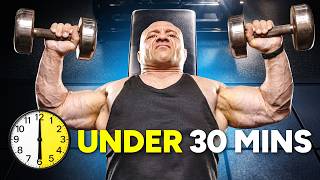
[00:01]
illustrating how to put together and execute a super short, super effective workout for overall general adult fitness. If you are a busy person and we're going to do it. Since I'm both lazy and scared to lift weights, Varqas
[00:16]
Patel will be doing all the lifting. Best of luck to you. That was I think I might actually need to puke. Oh, no way. If back out. You know, I'm busy, but I'm not so busy
[00:31]
that I need to do this workout. >> [laughter] plenty of time to train. We train all the time. But most people, people who
[00:43]
have children, people who have family, people who have friends, uh, me, people who have jobs and tons of other stuff to do, they cannot be in the gym forever. And so, it is a really big deal
[00:57]
to ask and answer the question of how do we get the biggest bang for the buck in we get the biggest bang for the buck in the gym to get fit? You're done. Damn. [laughter] We say get fit, what do we mean? There
[01:10]
are distinct needs that we have to accomplish in the gym for a holistic fitness approach to be tenable. These needs include putting on muscle enhancing strength, improving cardio,
[01:25]
increasing our tissue resiliency to make us less likely to to get hurt, not just in the training space, but also everywhere else. And in addition to that, we have to consider doing all of this for the full body. That's a lot of
[01:39]
needs. How the heck do we get that whole thing accomplished in the minimum amount of time that we can spend? Why are we doing this, by the way? Seems like we have a lot of needs, not a lot
[01:51]
having all these strength and all this other stuff? Well, there are major, major advantages. One advantage, let's be real, is aesthetics. You want to look amazing in clothes and possibly with very few clothes on, as well. In
[02:06]
addition to that, this kind of working out can enhance health. Muscle mass and strength and cardio all do that directly. If you enhance your health in a sustainable way, you're also enhancing your longevity, which is enormous, and
[02:20]
this kind of working out can do a huge dividend for you. When you're working out and your muscles are eating up the food that comes out of your digestive tract, anytime you have a little bit extra BS, you're on the road, doing
[02:32]
with your kids, you know that by working out this way, that food is more likely to go to fueling your muscles, rather having to burn off the calories. That confidence of being able to eat some BS
[02:45]
workout just completely run through it is a huge, huge deal. And lastly, this kind of working out trains capability. You'll be able to do any other fitness friends. You'll be able to have energy at work, and you'll be able to play with
[03:00]
your children with a minimum probability of injury and a maximum ability to not lose your hair and have enough muscle strength and everything you need to be That's all really good news, and this workout can give it to you, but remember
[03:14]
that we have constraints. The first kind of constraint is the number of sessions you can have per week. The number of times you get to go to the gym and work out may be limited. Many people can work out 6 days a week. Way more people can
[03:29]
only work out 3 days a week or a week, and a bunch of people on many weeks can only work out twice. Is it possible to have a two-time-a-week workout that checks all these boxes? It sure is, but we got to get real creative.
[03:42]
The next limiting factor we have, the next constraint, is one of session duration. Sure, some people can work out for 2 hours at a time. That might not be you. You may only have 20 to 30 minutes on several days a week to work out. So,
[03:56]
our sessions can't be long, and we can't have too many sessions. And lastly, is a limitation on equipment diversity. Yeah, you might have access to the world's best gym, or you might have access just to an incline bench and a pair of
[04:10]
Equipment diversity can be quite high, and we have to make sure this kind of workout can accommodate almost everyone, and [music] good news, it does. And it does so by attacking the problem through several different modalities. The first
[04:24]
core way we're going to approach this is to use mostly what are called distributed compound lifts for our exercises. Focused compounds are compound lifts like a wide-grip bench press, which are technically multi-joint
[04:37]
and multi-muscle, but really only stress one muscle to its limit. In the case of the wide-grip bench, it's the chest. Distributed compounds are compound [music] lifts that include multiple muscles and joints, but because all the
[04:50]
muscles get roughly the same difficulty of training, all of them benefit. A which trains your front delts, your chest, and your triceps, kind of all with the same difficulty. The more we use distributed compounds, the fewer
[05:05]
>> [music] >> in order to check off the boxes of training most of our body. That's a huge, huge big deal. Next, we are going to use non-overlapping supersets. We're trying to condense as much of the
[05:19]
workout down to as little time as possible. Resting for 2 minutes between sets is a non-starter. We want to rest, ideally, like 5 to 10 seconds between each set. How could we possibly do that? You're resting in order to recover so
[05:32]
you don't rest, then you don't recover, then you can't do a productive set. Sort of. But if you're using completely unrelated muscles in one exercise and completely unrelated muscles in another exercise, or mostly unrelated ones,
[05:45]
even, your ability to recover extends to your actual set. For example, you can do some push-ups and superset them to bent-over dumbbell rows. Almost push-ups have nothing to do with the muscles involved in bent-over dumbbell
[06:01]
the muscles you just toasted with dumbbell rows are resting, to some extent. And then when you're doing dumbbell rows, the muscles used to do push-ups are also resting. And thus, you can just do dumbbell rows and push-ups
[06:14]
seconds break between sets. The only thing you really need that break for is to reset up that next exercise, and you're good to go. This is going to save so much time, it's just absolutely wild and a huge unlock. For as much as
[06:29]
possible, we are going to do lifts that are training the whole body. We're going hinging, we're going to be doing squatting. So, when you're designing of programs from the hypertrophy app, you're going to want to make sure that
[06:43]
you're hitting mostly the whole body. Talk about in a little bit about do that, but overall, whole body training is the way to go if you have a few sessions a week to do and you're really, really short on time. All right,
[06:56]
this, but the pain begins now. Just two rules. One is always good technique. Rule two is push. Good. Three more like that, and then we go to the knees. that, and then we go to the knees. One.
[07:12]
Big push. Knees. [clears throat] Knees. Knees. Oh, keep going. Oh, yeah. We're also going to take advantage of reps. In most of these cases, we want sets of 15 to 20 reps on a first set. So, when you're
[07:24]
able to do it about 15 to 20 times. That's a very rough estimate. 12 is That's a very rough estimate. 12 is okay, 22 is okay. Why? Because we want a okay, 22 is okay. Why? Because we want a combination of cardiovascular challenge
[07:37]
and resistance challenge, and we want to make sure that we grow muscle. We know that anywhere between sets of 5 to 30 repetitions are going to grow us the middle of that range, that's perfect. But 15 to 20 blasts you to the
[07:51]
cardio moon like sets of 5 to 10 can't. And sets of 5 to 10 are pretty heavy, doing them, so the superset situation with almost no rest probably doesn't work that well for sets of 5 to 10. Perfect. No critiques, these are
[08:05]
flawless. It works great for sets of 15 to 20, however, and it's okay that as you do more and more sets, you end up doing sets of 5 to 10. The real critical factor is picking a weight light enough to do 15 to 20 on your first sets. If
[08:19]
you do that, you get amazing combination of cardio and muscle growth and a really awesome amount of strength enhancement, as well. Good stuff. Feeling good so day in my life. >> [laughter]
[08:32]
stance, so shoulder-width apart with your feet slightly pointed out with the toes. Your chest stays up. Keep your heels on the ground and squat all the way down, back and down to the ground. Up.
[08:44]
Two more. One of our core modalities, something that never leaves us, is always good technique. You are not in the gym to survive the experience. >> You are in the gym to be a superlative, to thrive, to conquer. And the way you
[08:58]
do that is only on your terms. Every single set, every single rep is controlled on the eccentric and powerfully executed on the concentric with a full range of motion, and every rep that are like damn near the same as
[09:11]
flailing around, you are doing meaningful work. Two. Yeah, yeah, Varqas, where the was all that power the whole time? Do more. shoulders. Put that to work. Let's go. Up.
[09:24]
go. Up. Yeah, my man. More of that Up. Yes. Again. Up. Yes. Again. We're here to work today. As you get working out in this style,
[09:37]
you're going to get stronger. My recommendation is generally not to increase the weight week to week to week, but try to add a rep week to week Hypertrophy app, if you're tracking this, what you might just want to do is
[09:51]
do one extra rep at the end of every set every time you come in. It will be deal. Just lock in and do what you did last week. Adding [music] a rep, adding a rep, adding a rep for about 1 to 2 months, take a week off, when you come
[10:06]
back, add some weight potentially. Instead of the 15-lb dumbbells, try the 20s or the 17.5s. So, like that, altering the weight month to month to month or every 2 months, altering the reps every week, continues to progress
[10:20]
that challenge, so your fitness continues to improve. Halfway done. I think I might actually need to puke. Oh, no way. If you don't puke within 30 seconds, come back out. We got work to
[10:34]
seconds, come back out. We got work to do.
[10:48]
you can make for your own journey in this workout style. First, order doesn't matter as long as you're pairing the non-overlapping exercises. So, if you wanted to do squats and shoulder stuff first, or you wanted to do stiff-legged
[11:02]
deadlifts and curls first, any way you slice it, no big deal. This is a huge commercial gyms. Look, your pieces of equipment might be taken. Switch to the next part of your workout, come back and do the other part later. No big deal
[11:15]
whatsoever. Slow, slow, rack. Last set, last set, quickly, right away, right away, right away. Breaks are for some other time. If an exercise gets stale, your kind of
[11:27]
it as you've been doing it for months and months, or if you get to the gym and a machine is taken, feel free to swap that exercise for its close cousin analog. So, if you're used to doing incline bench with a close grip, try
[11:41]
flat bench with a close grip or dips or close grip push-ups. That kind of awesome, and if you want to keep it in for the long term, by all means, it's a great idea. You don't have to do the same exercises all the time. Locking in
[11:54]
for 1 or 2 months to do pretty much the same exercises is a really good idea. trade out some or even all of your exercises, that's an awesome, awesome thing to do. Seven, last one coming up. Big stretch,
[12:06]
Seven, last one coming up. Big stretch, big stretch, up fast. Rack. Curls. 10 curls. If you want to do more, you can do more. You can go up to three times per week
[12:20]
with a whole body split. If you go four or five times per week, I highly recommend you take alternate sessions, every other session do only upper body lifts, and every other session only lower body lifts. Or, every
[12:33]
pull, and every other session exercises that push. Exercises that push would be all upper body pushing chest tricep moves, and all lower body quad dominant lunges,
[12:46]
Pulling moves are everything like deadlifts and hamstrings and good mornings, as well as upper body pulling upright rows, curls, every kind of row, and every kind of pull-up and pull-down variation. That, once you hit 4 days or
[12:59]
more, it's good to alternate upper and lower, so you don't toast any joints or aren't crazy long. It really, really helps. But, up to three times a week, you can do whole body, whole body, whole body. That was Up fast.
[13:13]
>> [groaning] >> Good, down slow. >> [screaming] >> YES, DOWN SLOW. TWO MORE AND YOU'RE two good ones. Two good ones, this is not a negotiation. THIS IS A COMMAND.
[13:29]
SLOW. One last good one. Move, god damn it. Yes. Slow, as if another, as if another, as if another. Rack. Beautiful. Beautiful. Beautiful. One last exercise
[13:42]
pairing left. We're almost here. You could also do potentially more sets. plan, start just one set of every gym. It'll take 20-30 minutes. It'll be a bit challenging. Next time, you can go
[13:58]
stay at two. [music] The time after that, you can go to three. Two main points here. Point one, you have time to spend in the gym, you can >> [music] >> which means if you're pairing dumbbell
[14:11]
rows and push-ups, you can do five sets of push-ups, five sets of rows. And eight that you'll do that day. God bless you. You'll get better results in every dimension if you do more, if you have the time for it, and if you can recover
[14:24]
from it. But, if you don't have the time, don't worry. Just six total exercises, three pairings, twice a week, with just two to three sets per exercise, can get you a phenomenal state fitness in perpetuity. As long as you're
[14:40]
every now and again using more weight, getting slightly stronger over time, just 2 days a week for 20 minutes at a time, two to three sets for just six exercises is going to cook that ass. Keep your rest breaks as short as
[14:53]
possible, push as hard as you can, and you will have phenomenal benefits with a big deal because some people say, "Listen, I don't even have a whole hour for the week to work out." Cool. You can get amazing workouts in two 20-minute
[15:09]
sessions per week exactly like this. And with a pair of dumbbells at home and if you have a gym, the world is your oyster, even better. >> [music] >> Up.
[15:23]
And one last one. Up. Good, come all the way up. Right away to crunches. Lastly, let's talk about synergies. Working out doesn't occur in a vacuum
[15:36]
unless you're literally in space. But, seriously, the main synergist to getting amazing results is a good diet, and it doesn't have to be rocket coach app to guide you along. Yes, you
[15:49]
videos that we have, but I'm going to sum it up for you super quick. Three to five meals a day, roughly evenly spaced, with a core of protein at every meal, and as often as you can, keep them healthy, which means plenty of veggies,
[16:03]
Does that mean you grab a protein bar and a shake every now and again? Of every now and again? Of course. But, on average, if you try to stick to high protein, about a gram per pound of body weight per day consumption, split
[16:17]
you are going to be doing a massive service. [music] Your ability to increase muscularity, your ability to drop body fat, to have your weight do whatever is going to be massively, massively enhanced by good
[16:30]
about good nutrition is calorie balance. If you want to lose weight, eat fewer calories than you're typically used to till you lose about a pound a week over If you want to gain weight, increase the calories a bit, make sure your protein
[16:44]
pound per week over some time. And if you want to maintain weight and body composition, just keep your calories plus or minus in that range that you know has you stepping on the scale week to week at roughly the same body weight.
[16:56]
the RP diet coach app can make all of those adjustments for you completely. Do tool for your enhancement. [music] Can you do this by yourself? Absolutely, you can. Next up, 8,000 or more daily steps. You might be busy, you might be working
[17:12]
in a lab somewhere or in a research center, or in a school, or in any other job, you might be driving delivery stuff. You can't just can get a trillion steps. 8,000 steps a day is not that many, but if you get them, it radically
[17:25]
boosts your health, your longevity, your quality of life, and burns a bunch of fat, which is really, really good news. If you want to do more cardio on top of this kind of plan, here's the big deal. Just doing those two or three sessions
[17:37]
for 20 to 40 minutes at a time with minimal rest, that's at 15 to 20 reps, that's already cardio. What an awesome start. If you want more cardio, you can add anywhere between two sessions to six sessions a week, anywhere between 20 to
[17:52]
40 minutes in length per session for average, general, very high quality fitness. Here's the big kicker. Whatever it is you call cardio, we're not talking about steps, this is separate, this is on top, must make you out of breath and
[18:04]
>> [music] >> that you're doing it. If you can chat cardio, that's not cardio as to how we're counting it here. And if you can >> [music] >> your health gets enhanced, and your
[18:17]
overall fitness is going to skyrocket. Is it tough? Yes. Is it mandatory? No. Just with a good diet, enough daily [music] steps, 8,000 or more per day, and with lifting two to four times a week, just 20 minutes at a time, you're
[18:30]
if you want extra cardio, it had better be hard and pretty god damn frequent as well. Lastly, sleep and rest and relaxation. have too much stress in your life, none of this is going to save you. So,
[18:44]
as possible. Some of the stress you can't pick, some you can. So, if you're going to go arguing online on Twitter for 5 hours, that's not really good for recovery. I highly recommend that you avoid that. Good relaxation practice is
[18:57]
not let them take over you too much during the course of the day, let the anger flow out instead of just direct it at yourself or other people, and take, you know, an hour or two pretty much every night
[19:10]
to de-stress, chill with family, watch some TV, read a nice book, stay the away from social media. Something that really relaxes you is a huge deal for composition. If you want to put on more muscle and lose more fat, stress is the
[19:24]
great killer to that process. Have as little of it as you can. And lastly, good sleep. 7 to 9 hours of restful sleep a night is better than every getting enough sleep. So, make sure you're getting high quality sleep, make
[19:38]
managing your stress, you're getting a bit of extra steps and cardio in, and we types of workouts, just remember two things. Maintain good technique and well, you're going to see amazing results. And if you see amazing results,
[19:53]
results. And if you see amazing results, just send five easy payments of $999.99 just send five easy payments of $999.99 to mikeisraetel.gov.
[20:06]
what do you think about today's workout? Uh it's a workout. I'm in the gym an hour, hour and a half, >> and I'm just gabbing with my friends. This is good to remind you that like
[20:19]
30 minutes with Mike will absolutely demolish you And outside the other website we're not allowed to if you want extra services. Um
[20:31]
channel. Uh go back to the San Francisco tech bubble and tell tell them about us. Tell them we hurt you, but you survived. I will do so. Thanks for having me on, Mike. I'm a big fan.
[20:46]
Mike. I'm a big fan. See you guys next time.