
AI Summary
The video takes viewers inside the Dallas InfoMart, one of the most interconnected data centers on Earth, operated by Equinix. It explores the physical security layers, cooling systems, power redundancy, and the concept of carrier-neutral interconnection, highlighting how Equinix Fabric enables virtual cross-connects to major cloud providers. The tour emphasizes the human element behind the internet's infrastructure.
Chapters
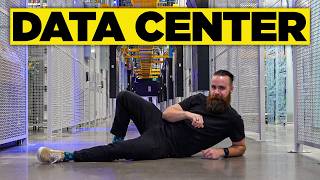
1.5 million square feet of data center space with 8,700 strands of fiber, multiple internet exchanges, and over 140 networks peering at terabit speeds.
Access requires ID, key card, thumbprint, and passing through a man trap to prevent tailgating. Multiple layers of authentication are used.
A customer (Grock, an AI company) was wheeling in fully loaded racks of LPUs, indicating high-density AI workloads.
Blue lights are used for aesthetics and to make it harder to identify specific equipment in cages, adding a subtle security layer.
Customers have exclusive access to their cages via fingerprint and badge. Some cages are fully enclosed for top-secret clients.
The facility uses slab floors and side air handlers, cooling like a gaming PC with liquid cooling. Generators can run for 36 hours on diesel.
Equinix allows customers to bypass the public internet by directly connecting to other networks within the building, reducing latency and improving reliability.
Equinix pioneered carrier-neutral data centers, allowing multiple networks to interconnect on a level playing field, increasing the building's value.
Fabric allows virtual cross-connects to multiple providers (AWS, Azure, GCP, etc.) through a single port, with speeds from 10 Mbps to 50 Gbps, managed via a portal.
Every floor acts as a meet me room, facilitating direct connections between customers, unlike traditional data centers with a single meet me room.
The video concludes that the internet's physical infrastructure is built on interconnection and human expertise. Equinix's data centers provide secure, high-speed connectivity, but the passion and tenure of the people behind it are what truly make the internet run.
Mentioned in this Video
Study Flashcards (7)
What is the Dallas InfoMart?
easy
Click to reveal answer
What is the Dallas InfoMart?
A 1.5 million square foot data center with 8,700 strands of fiber and over 140 networks peering at terabit speeds.
00:01
What is a man trap?
easy
Click to reveal answer
What is a man trap?
A security mechanism with two interlocking doors where both must close before the other opens, preventing tailgating.
01:35
Why are lights blue in the data center?
medium
Click to reveal answer
Why are lights blue in the data center?
For aesthetics and to make it harder to identify specific equipment, adding a subtle security layer.
04:08
How long can Equinix run on diesel generators?
easy
Click to reveal answer
How long can Equinix run on diesel generators?
36 hours.
09:25
What is Equinix Fabric?
medium
Click to reveal answer
What is Equinix Fabric?
A software-defined networking solution that allows virtual cross-connects to multiple providers through a single port.
13:59
What speeds does Equinix Fabric support?
medium
Click to reveal answer
What speeds does Equinix Fabric support?
From 10 megabits up to 50 gigabits.
14:38
What is a carrier-neutral data center?
medium
Click to reveal answer
What is a carrier-neutral data center?
A facility where multiple networks can interconnect on a level playing field, pioneered by Equinix.
12:00
💡 Key Takeaways
Man Trap Security
Illustrates a practical physical security measure against tailgating.
01:35Blue Lights as Security
Shows an unconventional security tactic that also serves aesthetics.
04:08Bypassing the Internet
Explains the core value proposition of interconnection hubs.
09:50Equinix Fabric
Demonstrates how software-defined networking simplifies connectivity.
13:59People Behind the Internet
Emphasizes the human element and passion in infrastructure.
17:05Full Transcript
[00:01] you and I do? They have a direct connection to each other. They're neighbors bypassing the big bad wild internet. And they do that here. This is where the internet lives. This is the Dallas info Mart. 1.5 million square ft
[00:15] of data center goodness. 8,700 strands of fiber. Multiple internet exchanges. Over 140 networks peering at terabit speeds. It's one of the most connected watching this video from here, your
[00:28] building right now. So, let's try and get in there. Get your copy ready. We're today. It's going to be kind of crazy. Look at all these timestamps. We covered a lot. Let's go. Yeah. Go into the Infomars. Now, getting inside a data
[00:43] center is hard. Security is intense. They got multiple layers of protection, protecting billions of dollars worth of equipment and a large chunk of the reception without A being a customer or B being invited. Thankfully, we didn't
[00:56] there. Putting on a hard hat and a vest and pretending we're important. actually. Ethically, of course. But today, we're invited. Or I use my YouTube powers to ethically hack with my influence. Go with that. That sounds way
[01:09] us out and made this video possible. Thank you, Equinex. So, this is actually one of their people, S. >> Hi, I'm Sal Gonzalez, senior manager of global technical sales. Been with Equinex 24 years here in Dallas, Texas.
[01:23] into the data center. Now, after me and my team signed in at the first checkpoint, supplying our IDs, getting a fancy name tag, we then encountered the man trap. >> Not just anyone can go into a data
[01:35] center, you have to have access, key card, thumbrint, and go into a man trap or person trap. This is the fanciest one I've ever seen. Come on in. It's a trap because once you arrive inside, both doors have to be closed before the other
[01:50] one opens. Then you have to authenticate on this side too to open the door and this prevents a very popular form of physical security hacking known as tailgating or just following someone in, grabbing the door before it fully
[02:02] following Sal in, but he let me. But normally that does curtail this quite a next to someone waiting for them to open the second door. Becomes a bit obvious most you'll encounter, is a security measure ensuring only authorized
[02:17] once in, we're being watched at all times, not just cameras, but we had to couldn't even go to the bathroom without S. I also couldn't get coffee without to the break room, which is actually kind of fancy. They had fancy seltzer
[02:31] water. Coffee was just okay. I should probably help them with that. Why don't got to write that idea down, actually. Now, at this point, we're still not in sweet, sweet sound of worring servers, but we're about to be. But first, we
[02:44] encountered yet another door that required another badge and fingerprint. door? We already authenticated, right? Yes, but there's layers. You see, as a only given access to your stuff, the floor your stuff is on, and the cage
[02:58] your stuff lives in. Yes, there's another area that requires another badge But then we saw this. As we were walking through those doors, I saw a customer wheeling in a massive rack of servers. >> And here's an example of a customer that
[03:13] is bringing in a fully loaded rack. >> That's an AI customer, isn't it? >> Do you recognize that customer? It's Gro or Grock. I'm not sure how to say it. They are an AI company and those racks were dripping with LPUs. Oh, I was kind
[03:29] smiling. And we actually had to ask permission to even mention that we saw being in this data center. Major companies, companies that we rely on for core services, they're here. This is where they put their stuff. This is the
[03:41] question, it's answering it right there. When we like a video on YouTube, like button. Watch. You're going to make that server smile. Ready? See, there it went. This is the internet. I need to calm down. Little coffee break. Now,
[03:55] lot of server racks as we walked by cuz I'm always curious what people have. But what I didn't see was any indication of what company these servers belong to. And that's by design. Just walking past these racks, if you happen to notice a
[04:08] company you're familiar with and seeing what servers and and networking harbor And then Equinex takes it a step further. Notice the lights in this place. They're blue. Why is almost every light in the Equinex data center blue?
[04:21] not true. There's two reasons they have that. One, it's just fun. RGB. We do it data centers too. The theater was supposed to be kind of a nightclub. You got black walls, blue lights, video games in the conference rooms. The
[04:35] secure, or at least it used to be. Having blue lights made it harder to equipment in the cages. If you happen to know that a customer used F5 and you're a competitor, hey, I might want to use F5. They're using Cisco, I want to use
[04:49] edge. And I kind of like that. Just another subtle form of security. And if you're new to security, stuff like this is key. multiple layers, defense and depth. Don't rely on one solution, one method to secure your stuff. Use
[05:02] to point out that company Grock, which by the way is not X AI Grock, it's this servers. Back in my day when I was a networking systems engineer, we would be we'd have to bring all of our stuff with us to that rack and then rack it and
[05:17] stack it ourselves. I still have scars from the cage nuts. Look. But when to have all your stuff preconfigured and they do the rest. Now, look at these to. When I would walk into a data center, I would just see rows and rows
[05:31] of server cabinets that I could just walk up to and open. Most of them what Equinex does here better. When a customer puts their stuff into a cage, usually only that customer has access to this cage. Fingerprint badge. Unless you
[05:44] And look at these cages. Not all of them are the same. And I thought this was so interesting because some have an open top. So in theory, I could climb that asked them if I could do that or if anyone would catch me if they weren't
[05:57] looking and we would catch you within 5 seconds." >> Security's watching. So if you want to get tackled by someone, have a closed top and some I couldn't even see. They were in enclosed areas.
[06:11] >> Some customer are also not additionally just to the deck there. They actually And it's fully enclosed. >> Top secret. I wasn't allowed in there. there are some crazy top secret companies in this data center. There's
[06:25] need top secret stuff, Equinex will give you what you need. Customers can also unless there's some kind of crazy security issue, Equinex will not even go into your cage. This is your cage. >> Here, I'll flap it here. It's going to
[06:38] this cage. >> Now, speaking of security, what about there? I actually learned that becoming an Equinex technician is no joke. This years ago. >> I've been with Equinex 24 years going on
[06:53] 25 years in July. I'm a sales engineer. Started as a tech for 8 years here at the data center DA1. Uh site engineer. I was on sales team. U sales engineer for >> And this is part of their interview process. They took me to this other
[07:09] you had to actually go through a test building cables running fiber splicing. >> Because a lot of people in the interview can talk. I got my CCNA. I promises it's like they get here and they're light. You I can't even do an RJ45.
[07:24] So So what I'll do is break the fiber, unplug it somewhere, and break that that >> Now, something had me wondering. I saw all these Grock racks being wheeled in. in. >> How in the world do they power all this?
[07:38] even keep my gaming machine here in my keep it in a cool server room. Imagine an entire rack of GPUs. And not just a rack, a data center full of GPUs. And then I saw this. Look at the floors.
[07:52] something weird? They're not raised floors. In a typical data center, you have a raised floor. And they actually pump cool air in from the ground because, you know, hot air rises. This place didn't have that. How are they How
[08:05] are they cooling this stuff? This facility we've evolved to pushing air >> and the hot air is actually pushed up and out through ventilation. So typical >> This is the air handler pushing it to the side goes up to the top. It still
[08:19] The room being flooded to the side. >> Now as s which is better, the raised from the side. >> We can argue to where blue are those all said and done. >> They use slab floors because it can hold
[08:33] heavy. Now, on every floor, they have air handlers at the end of the hall that is on the roof. And the way they cool this data center is kind of like a gaming computer. Hear me out. It's like liquid cooling. On the top, you have
[08:46] normally mount your radiator and the fans to the top. You'll have your water or your liquid go to your radiator, get cooled off by the fans, and they get to cool it off. And as the water gets hot, it goes back up and gets cooled off
[08:59] again. That's what's happening here. All these things are doing that. And what's containers is self-contained, meaning when they want to add another one, they just airlift it in there. Boom. All in one go. They also have giant water
[09:11] something fails, they got some backup water to go in and cool things off. But what if the power fails? They got a backup for that. Their generator yard is >> Right. We're able to run on diesel generators for a total of 36 hours at
[09:25] >> Everything here 36 hours. >> Yes. >> Wow. And if for some reason we're not at full time >> back on the roof. It was kind of funny.
[09:37] heights, but he went up there for us. Didn't get anywhere near the edge, but and cooling and all that. Like, that's fun. And you can go watch this guy cuz talk about bypassing the internet. Let's go there right now. Get your coffee
[09:50] today. Now, this part is actually kind of crazy and it has everything to do street. You'll see. But first, I want to talk about the problem this data center and this dystopian mall are solving. Most people and businesses connect to
[10:02] AWS, GCP, Azure for stuff, the stuff we use on the internet cuz that's where the especially for businesses because they'll often host their infrastructure might have some stuff back in their data center doing a hybrid cloud situation.
[10:15] crappy. But often it kind of is. We're usually connecting through the big bad wild internet, hopping between routers, connections with potentially bad latency going on a road trip. You can't guarantee the quality of the roads. You
[10:28] know when there's going to be traffic. That's the internet. That's why things flip the script on this. They help people skip the internet. And it's Remember, this is the most well-connected building on Earth. And
[10:41] just one. The main data center is known as DA11. It's flashy, it's fresh, it's workloads. Across the street is something a bit older. This is the InfoMart, the most interconnected data center in the Southwest.
[10:55] Let's go. That's DA1, known as the Infomart. It's kind of pretty though. Got that retrofuturistic feel. It's kind of my vibe. It was built in the 1980s Crystal Palace and it was supposed to be something like Tony Stark would think
[11:07] of. A technology mall where companies like IBM and Kodak would have off their cool stuff. But it was kind of ahead of its time and it didn't take off. So now we're left with this big, large, gorgeous building that happens to
[11:20] internet superighway. This is one of the most critical items and pieces of the network fibers that come in here and dark fibers that come in here, right? This is ultimately what makes Equinex Equinex, which is a network connection
[11:33] >> Like, I'm not even kidding. Location, location, location. This thing is sitting pretty. It literally is a fiber highway because in the US, long haul existing rights of way, primarily railway lines and existing highways. The
[11:46] Infomart is sitting right there at a major convergence of some fiber optic highways. grand central station for the internet. But this actually kind of points, these internet exchange points were often controlled by a single large
[12:00] shots dictating who could connect and at what price. But Equinex, they weren't about that. They actually pioneered the idea of a carrier neutral data center level playing field. We don't care who you are." So it kind of works like this.
[12:13] info mark. They put a network node in there. Makes total sense. It's prime connections, but you know what? Verizon wants in too and they can. They jump in because they realize how valuable this real estate is. So now they all have
[12:27] snowballed from there. The more networks that joined, the more valuable this most network dense buildings on the planet. And that sentence just felt good have to do with our story though? Well, Equinex bought that building like it's
[12:41] come in. This happened back in 2018. And then they have another building right highway underneath between the two buildings. So, if you want to connect to right here. It's just a cross connect away. Okay, cool. Lots of connections,
[12:55] here. To see the next part, we needed secret access to one of Equinex's own cages. Now, I said a word before that you may have not caught. Crossconnect. do in a data center. So, let's say you and I, we start a company, Networkchuck.
[13:07] servers in a data center. But then we're like, hey, we want an internet connection. And let's say we go with AT&T. AT&T will have their network another cage somewhere in that data center. We have to somehow get a
[13:19] internet. So we'll order one. We'll order a physical cable that will connect our stuff, our router, our switch, whatever it is to AT&T's cage. That normally have to do this for whatever thing you want to connect to. So maybe
[13:32] connection to AWS. You can do that because Equinex has everybody in there. You can order a cross connect, get a cable, go straight to AWS, Azure, GCP, whatever you want. But these are expensive and they take time. You have
[13:45] is money. But now back to our cage right here is housing something that I thought was the coolest idea ever. It's called fabric. Instead of getting a million connection. >> So this is Equinex Fabric. This is
[13:59] something we designed over 10 years ago. We were founded with uh internet exchange or that's how we got started where people would literally do crossconnect. So it was a onetoone connection where they connect from one
[14:11] customer over to another customer and then we'd have everyone together like in a data center. So they'd be in close proximity. So we developed fabric in a way. So now you can just get that one port and you can create multiple virtual
[14:23] connections. So now you can have all your cloud connections. You can connect to other service providers with us, other network service providers, uh other people like Zoom, etc. They're on our fabric. Over 3,000 other customers
[14:38] within seconds now. You don't have to go and talk to someone else to get a cable connected over. You can just go connect to them virtually and you could go anywhere from 10 megabits up to 50
[14:51] home real quick. Imagine you order a 10 gig connection from Equinex Fabric. You however you want. Let's say you want 1 gig to AWS straight to their cage. How about one gig to Azure, one gig to GCP? Let's use two gigs for AT&T internet,
[15:06] maybe one gig for Verizon for backup. This is all happening at a portal. You're just clicking. You're not running cable. How cool is that? Now, the way called softwaredefined networking. A fancy buzzword that means you can do a
[15:18] lot of what we used to do physically inside software, making it super easy all that's happening. Notice a lot of Juniper equipment. I'm a massive fan of oversimplify it, but it's kind of like connecting to a switch along with every
[15:31] fast low latency connection with security, obviously. But just sit back the racks of equipment you see here, Equinex is giving you access to all the it's not just the companies connected to the hauntingly retro building across the
[15:45] street, Infomark. Major players also run fiber directly from the street from a manhole, Dark Fiber, into DA11. And major companies might have a presence on rooms where Dark Fiber comes in. Look at all that fiber. They were kind of
[15:58] did me a solid. >> Let me just check. I think I have extras. Let's see. Look at that. >> And that's the theme here. Connection. centers, they have one room in the data center called a meet me room where all
[16:11] they're all just sitting there in a closet huddled together saying connect over here. Equinex doesn't play like that. Like every floor is a meet me thinking. You're thinking about fabric and how sure they give us a direct
[16:23] connection to AWS, GCP or Azure right there in that data center. But what if you're trying to access AWS from another location? Like AWS and GCP and all these data centers. What if your stuff lives in Virginia or Washington or New York or
[16:37] across the internet anyway? Actually, no. You're on Equinex's stuff now. everywhere. Look at all this. Look at all these data centers. Look at this network, you're on their network, the Equinex internet, and you're taking that
[16:52] special HOV lane. VIPs only. Now, me and my team spent all day at this data learned like how they work, what makes them tick. But you know what? It's not the security or the power or even the insane amount of connections that stuck
[17:05] is the people. These people that were walking us around. They were humble and awesome. They've also been there forever. Some of them for over 20 years. the way, if you want to know if a company's good, look at the tenure of
[17:18] walking around and seeing all the amazing things and geeking out, what was know these people, the people that make the internet run. Because when you get all the things we do, there's people behind it. And normally how awesome a
[17:32] product is correlates how much passion the people pour into it. So when you're surfing the internet today, when you ask AI a certain question, just pause for a moment, think about S. Thank you, S, for making this possible. Manny, Brad, Ed,
[17:45] and also say thanks to Ed and Jordan like right now. They were the ones who waited forever for me to make this video and were so patient. So, if you could "Thanks, Ed and Jordan." It might convince them to show us something
[17:58] that's all I got. I'll catch you guys next time.