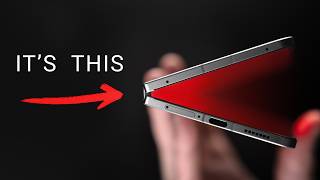

The Foldable Crease Problem Solved?
45sDirectly compares the crease of the Oppo Find N6 with Samsung and Pixel folds, creating a visually striking and controversial claim.
▶ Play Clip"The title accurately reflects the video's claim that Oppo achieved a crease-free screen that Samsung couldn't."
The Oppo Find N6 features a nearly invisible crease, achieved through advanced hinge and glass technology, setting it apart from competitors like Samsung and Google.
The screen and hinge of the Oppo Find N6 are unlike anything seen before.
Samsung Fold 5, Pixel 10 Pro Fold, and Samsung Fold 7 all have visible and feelable creases.
Find N6's crease is faintly visible but almost imperceptible to touch, feeling like smooth glass.
OPPO laser scans each hinge with 0.3 micron precision and applies photopolymer droplets (5 picoliters) layer by layer, reducing height variation from 0.2-0.3 mm to 0.05 mm.
The hinge is 75% smoother than typical hinges, resulting in a nearly flat surface for the OLED.
Adhesive shifting between OLED layers causes creases to deepen; physical stress points can lead to screen breakage.
A wider, gentler bend (11% wider) reduces mechanical pressure on the panel during folding.
Thicker, more elastic glass springs back when opened, realigning shifted adhesives; claims 82% reduction in crease depth over time.
Titanium hinge casing and wings, carbon fiber support plates; triple IP ratings (56, 58, 59) for water and dust resistance.
Rated for 1 million fold cycles (vs. 500,000 for Fold 7); claims screen remains flat at 600,000 cycles.
The Oppo Find N6 uses innovative 3D-printed hinge smoothing and auto-smoothing glass to virtually eliminate the crease, addressing both visual and durability issues that have plagued foldable phones.
What is the 'zero feel crease'?
A crease that is faintly visible but almost imperceptible to touch, feeling like smooth glass.
01:30
What technology does Oppo use to smooth the hinge?
3D liquid printing: laser scanning with 0.3 micron precision, applying photopolymer droplets (5 picoliters) and curing with UV light, repeated 20 times.
02:00
How much does Oppo reduce hinge height variation?
From 0.2-0.3 mm to 0.05 mm.
02:00
What is the fold rating of the Oppo Find N6?
1 million fold cycles.
06:00
What causes creases to worsen over time on foldable phones?
Adhesive between OLED layers shifts due to shearing forces from folding.
04:00
What is the water drop design?
A wider, gentler bend (11% wider) that reduces mechanical pressure on the panel during folding.
04:30
How does auto-smoothing flex glass work?
It is thicker and more elastic, springing back when opened to realign shifted adhesives.
05:00
What is the claimed reduction in crease depth over time?
Up to 82% compared to the previous generation.
05:00
What IP ratings does the Find N6 have?
IP56, IP58, and IP59.
05:30
How does the Find N6's fold rating compare to the Samsung Fold 7?
Find N6: 1 million cycles; Fold 7: 500,000 cycles.
06:00
Zero feel crease revealed
The moment the host demonstrates the smoothness of the Find N6's screen, contrasting it with the noticeable creases of other foldables.
01:30Secret sauce: 3D liquid printing
The explanation of how Oppo uses 3D printing to smooth the hinge is a surprising and innovative solution.
02:001 million fold cycles
The claim of 1 million fold cycles (double the Samsung Fold 7) is a jaw-dropping durability stat.
06:00[00:00] I got this phone in a couple weeks ago and I immediately noticed that the screen and the hinge were just unlike anything I've seen before. I reached out to OPPO and I asked them if they could sponsor a video so I could show you guys this tech a little bit earlier than usual. So, this is the Oppo Find N6. Uh, and okay, to appreciate what's going on here, I got to show you some of the other
[00:25] folds I have here. This is the last one that I purchased, the Samsung Fold 5. This is a couple years old at this point, but this was a great device. The crease was very noticeable. You can see it very clearly here. And when you run your finger across it, it's like super obvious that you're going over like like a speed bump in the middle of the screen. Uh this is the latest Pixel product or foldable Pixel
[00:50] product. This is the Pixel 10 Pro Fold. This same deal, right? Very visible crease. Now, this over here is the Samsung Fold 7. This is actually broken unfortunately, but same idea. You can see the uh it's a very visible crease and again when you run your finger across it, it's very obvious when you're when you go over it. Okay, it's a problem that the entire foldable market has had since the inception of foldable phones. But this
[01:15] is quite different. So, the Find N6 has what they call the zero feel crease that hides the crease visibly, but is an almost imperceptible crease when you run your finger across it. It's faintly visible. So, I'll turn it off. It's kind of most obvious when you have the screen off. You tilt it at just the right angle, you can kind of see it. Yeah, it's there, but you can't feel it at all. It actually feels like
[01:40] a smooth, continuous piece of glass. So, how did they do it? How did they do something that Samsung couldn't do? So, part of it is the hinge. This is their second generation titanium flexion hinge. So, if you look at this thing really close up, you can see that there's this like blue tinted material on the central plate. And this is the secret sauce. This is their 3D liquid printing. So, usually hinges have these tiny microscopic variations
[02:05] in height right along the spine of the phone. And it's like 0.2 0.3 mm difference in height. It seems insignificant, right? Like what are we talking about 2 millimeters? But when you take a really thin flexible OLED and you put it on top of something like that, those height variations translate into a pretty noticeable crease on the screens. So to solve this, OPPO laser scans each individual hinge with.3 micron precision. And then they apply these little
[02:29] droplets of photopolymer, like tiny amounts. I think it's like five pico liters, like incredibly small amounts. And then they cure it with a UV light. And they do it over and over 20 times until they build it up layer by layer until it's smooth. So it goes from like the height variation of 2 mm down to 0.05 mm. It's a massive reduction in like bumpiness. And the result is something that's 75% smoother than a typical hinge.
[02:54] And now when you put a flexible OLED on top of something like that, it's almost perfectly smooth. And if you compare this to like the Fold 7, like right, it's just that valley is super obvious on this one in comparison to the Find N6. But there's a second issue that foldable phones have. It's that the crease gets worse over time. Like when you get them new, the creases look great, but as it ages, 6 8 months
[03:19] in, the creases get deeper and more visibly obvious. And even sometimes they can you can feel them in a more obvious manner. And it's simply because the adhesive between the different layers of the OLED start to shift over time. And that's the importance of removing creases. Like the visual imperfections are one thing, but if you can feel a crease, it means there's a physical stress point. And every time you fold it up, you create these shearing
[03:44] forces that cause the older layers to shift. And that's how most foldable screens break. So OPPO addresses this in two ways. First, they do a water drop design with the fold mechanism. So as you fold the device up, instead of like a sharp acute bend on the screen, they make something that's a little more gentle. So it's like a kind of wider kind of curved bend and it just puts much less mechanical pressure on the panel
[04:09] itself as the device folds up and it's an 11% wider water drop this generation. Now the second thing that OPPO does is their new glass. They have this new material called auto smoothing flex glass. And it's a glass that is thicker and more elastic than the typical ultra thin glass on foldables. And because it's thicker and more elastic, every time you open it up, this top surface acts as like a it almost like springs back open
[04:34] and pulls those OLED layers back open and realign all the adhesives that have shifted around from being folded up. It seems like it'd be very effective at maintaining the durability and just longevity of the screen. They're claiming up to an 82% reduction in crease depth over time compared to the previous generation. And this hinge is extremely durable. It's got a titanium hinge casing and titanium wings. It's got carbon fiber support plates. And the phone is triple
[04:59] certified. It has IP 56, 58, and 59 ratings. And I was super confused by this. I was like, why all three? Like, isn't it cumulative? And it's not. By having all three, you have it that it can be submerged. It can also withstand high pressure and can also withstand high temperature water jets. It's like it's a very at least seemingly durable hinge and phone. But the spec that was most impressive to me is the fold rating.
[05:24] So this device is rated for 1 million fold cycles. Like you open and close, that's one cycle. A million of them. The Fold 7 is rated for like 500,000. And the older phones are all significantly lower than that. A million. And they're claiming that at 600,000 this screen should still open up to be exceptionally flat. So, the OPPO Find N6. This is super cool screen tech. Super cool hinge tech. I'm glad I was able to share
[05:49] it with you. I never thought that the solution to like creases on screens would be 3D printing stuff on the hinge to be able to like flatten it out like that. It's so neat. All right. Hope you guys enjoyed this video.
⚡ Saved you 0h 06m reading this? Transcribe any YouTube video for free — no signup needed.