
This Deep Sea Worm is a Silent Killer
45sThe description of a seemingly fragile worm that is actually a fearsome predator evokes curiosity and fear, perfect for engagement.
▶ Play Clip"The title promises 'creepiest forms of life' and delivers a solid list, but the content is more informative than truly scary, with some padding from sponsor plugs."
This video from WatchMojo counts down the top 10 creepiest life forms discovered in the 2020s, showcasing a range of bizarre and unsettling deep-sea creatures, insects, and arachnids. From carnivorous sponges to a spider with split male-female anatomy, the list highlights the strange and often terrifying diversity of life on Earth.
Unus cyphon insidiator, a 7-inch iridescent worm, uses glass sponges as a home base to ambush brittle stars and barnacles in the deep Pacific Ocean.
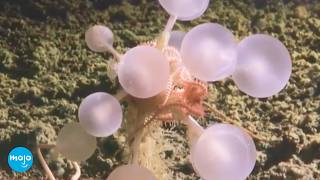
Chondrocladia, found 2 miles deep off Montague Island, traps small crustaceans with tiny hooks and slowly absorbs them, unlike filter-feeding sponges.
Caraproctus heliculi, discovered in the eastern Pacific and described in 2025, has 24 rows of teeth and a predator's smile, making it both cute and horrifying.
Chimera Supape, found in Thailand's Andaman Sea at 2,533 feet, has large eyes and eerie features. Only one specimen has been found, limiting knowledge about it.
Ketostema, discovered in Peru's Alto Mayo Protection Forest in 2022, has a bulbous fatty extension on its head. Its function remains a mystery.
Mobula ureae, the third manta ray species identified in 2025, can reach 20 feet across. Its late discovery highlights how unexplored the ocean is.
Etmopterus westralienus, a 16-inch shark with bioluminescence and large eyes, was found off northwestern Australia. Its light organs are used for communication or camouflage.
Acrophylla alta, found in Queensland's rainforest, weighs over 1 ounce (like a golf ball), making it Australia's heaviest insect. Its size is linked to cooler, higher altitudes.
Pesalia mikazuki, found near Gamow Beach, Japan, in 2025, is venomous and may have been carried north by currents affected by climate change, posing a risk to humans.
Demarcus Inazuma, described in 2025, displays extreme gynandromorphism: one side is male (gray) and the other female (orange), resembling two spider halves stitched together.
The video underscores the vast, largely unexplored biodiversity of our planet, revealing that many bizarre and potentially dangerous species remain undiscovered. It serves as a reminder of the importance of marine and terrestrial exploration.
What is the common name for Unus cyphon insidiator?
The sponge ambusher worm.
00:29
How does the Chondrocladia sponge capture its prey?
It uses tiny hooks on its surface to snare small crustaceans and then slowly absorbs them.
01:47
How many rows of teeth does the bumpy snailfish have?
24 rows of teeth.
03:14
At what depth was the ghost shark Chimera Supape found?
Around 2,533 feet below the waves.
03:42
What is the function of the blob-headed catfish's bulbous nose?
It is still unknown; researchers are trying to understand its function.
04:40
What is the maximum width of the Atlantic manta ray (Mobula ureae)?
Up to 20 feet across.
05:35
What is the significance of the West Australian lantern shark's bioluminescence?
It has light organs down its sides, which are used for communication or camouflage.
07:03
Why is Acrophylla alta considered Australia's heaviest insect?
It weighs over 1 ounce, about the same as a golf ball, and no heavier insect has been found.
08:00
What is the hypothesis for the appearance of Pesalia mikazuki near Japan?
It may have been carried by currents impacted by increasing temperatures due to climate change.
08:43
What is gynandromorphism, as seen in Demarcus Inazuma?
A condition where one side of the animal develops as male and the other as female.
10:06
Carnivorous Sponge
Challenges the common perception of sponges as passive filter feeders, showing they can be active predators.
01:47Ocean Unexplored
The late discovery of a 20-foot manta ray underscores how little we know about the deep sea.
05:49Adaptation to Altitude
The stick insect's size is linked to cooler, higher altitudes, illustrating evolutionary adaptation.
08:00Climate Change Displacement
A venomous jellyfish appearing in new waters due to climate change poses a direct risk to humans.
08:43Extreme Gynandromorphism
A rare biological phenomenon where an organism has both male and female characteristics, split down the middle.
10:06[00:00] The announcement of this discovery was made today by Australia's James Cook University. Welcome to WatchMojo, and today we're counting down our picks for the creepiest forms of life that have been discovered in the 2020s. It looks simple and fragile, yet it kills silently.
[00:17] Number 10, Unis Siphon Insidiator. It may be easy to think of worms as a peaceful form of marine life, but a 2025 discovery proved that isn't always the case.
[00:30] Unus siphonansidiae, also known as the sponge ambusher worm, was found within glass sea sponges amongst sea mounts located deep in the Pacific Ocean. The iridescent species is just under 7 inches long, but that hasn't stopped it from being
[00:45] a fearsome predator like its relative, the bobbit worm. By using the glass sponges as a home base, they're able to hunt down unlucky brittle stars and barnacles that happen to float into their path. While there's no reason a human would
[00:59] end up on their menu, it's an uncomfortable reminder that carnivores come in all shapes and sizes. Number nine, Chondrocladia. Something chilling. A carnivorous death ball sponge in
[01:12] the depths of the southern ocean. If the carnivorous worm from the last century freaked you out, then you may want to sit down for this one. This sponge was found more than two miles below the surface off of Montague Island.
[01:26] Scientists learn soon after how it managed to survive at such depths. The new species of Chondrocladia has already been recognized as a fearsome carnivore. The sponge lies in wait, a silent killer in the deep.
[01:39] Any small crustacean or passing organism that brushes against its surface is immediately snared. Though it looks harmless, it's covered in tiny hooks that are believed to trap its prey
[01:52] before slowly absorbing it. This is drastically different from most sponges which filter feed, making it truly unusual. Its appetite has earned it the eerie nickname, Death Ball Sponge.
[02:04] And given its methods, it's clear to see why. We have found a species that has a peduncle, and from that peduncle come several, several branches, like 10 or 12 branches.
[02:16] And at the tip of each of those branches, there are some balls. Number eight, Chiropractus colliculi. Researchers say it's more than just a pretty face. It's offering new insights into life in the deep sea.
[02:29] Although not as traditionally scary looking as some of its deep sea companions, this fish unsettling appearance is still enough to give some the shivers The bumpy snailfish known to experts as Caraproctus caliculi
[02:43] was discovered deep in the eastern Pacific Ocean. It's the newest deep-sea darling to capture the Internet's heart. It's exciting to see people connecting with the deep-sea species. Many deep-sea organisms like this one are very beautiful, very relatable, are deep-sea neighbors.
[02:58] It was finally described in 2025, giving a name to this peculiar-looking creature. Like others in its family, it's likely to be a predator, meaning that unnerving smile is the last thing its prey sees before meeting an untimely fate.
[03:14] Considering it's been found to have 24 rows of teeth, we can't think of a more horrifying, yet somehow cute, way of going out. While there's still more to be learned, it's already clear they shouldn't be underestimated.
[03:28] And they're thriving in an environment that we might think of as harsh, but to them it's just home. Number 7. Chimera Supape We may not know much about it, but one thing's for sure. There's a good chance it'll haunt your nightmares.
[03:42] Also known as a ghost shark, Chimera Supape is notable for its eerie features and its large eyes. It was found in Thailand's Andaman Sea at around 2,533 feet below the waves.
[03:55] Despite it first being described in 2024, not much has been learned about this elusive creature. Only one specimen has been discovered so far, making it all but impossible to learn more about its habitat and behavior.
[04:09] There's no telling how many more of this specific disturbing species are lurking within the depths, or if we'll be jump-scared by another one anytime soon. Number 6. Ketostema Probably my favorite of the new species' discoveries is the blob-headed fish.
[04:24] We wouldn't blame you if seeing this caused you to do a double take. With its bulbous nose, the blob-headed catfish certainly isn't winning any beauty pageants anytime soon. It was uncovered during a search of Peru's Alto Mayo Protection Forest in 2022,
[04:40] and researchers are still trying to understand the function behind its odd anatomy. Although they've been able to deduce that it belongs to the same family as other armored catfish, The species varies so much in appearance that one would never be able to guess they were related.
[04:57] Unlike its close relatives, on the end of its head it has this really huge sort of fatty and just like blob-like extension. With so much being left unknown, all we have are its looks.
[05:10] And it hard to look at it without feeling disturbed Really it a complete mystery Number 5 Mobula ureae It may seem unsathomable that a creature as large as this
[05:22] could find a way to stay hidden for so long. Yet that was exactly the case for Mobula ureae, also known as the Atlantic manta ray. The third species of manta ray, it was properly identified in 2025.
[05:35] Although manta rays are known for being docile, this one gets up to 20 feet across, so it's hard not to be wary of it. However, even scarier than the unnerving creature itself is the knowledge that despite its size,
[05:49] it and others like it have existed for so long without being previously identified. It's a horrifying reminder of how big and unexplored the ocean truly is. Number 4. Ectomotorus Westralienus
[06:03] Australia has a new species, Oshdark. It was found in the deep sea of northwestern Australia during a voyage by the CSIRO research vessel Investigator. If large species are hard to find in the ocean, then imagine how hard it must be to identify smaller ones.
[06:19] One recent discovery made that concept all the more evident. At just 16 inches long, the West Australian lantern shark might not seem like much. However, its natural bioluminescence and eerily large eyes easily make up for its diminutive size.
[06:35] It also has a longer mouth than some other members of its family, which is enough to make exophobes wonder just how far their jaws open while eating. And why did you call it a lantern shark? Is it because of the lights?
[06:49] Yeah, there's a whole group. There's actually about over 30 species of lantern sharks around the world. So we tend to stick to that sort of part of the common name and then we tend to add on to that. But yeah, the lantern relates to these different light organs they have down their side.
[07:03] In fact, even if you don't have a fear of fish, the mere thought of looking down into the water and seeing a glowing light making its way towards you is scary enough on its own. And we've still got a new ghost shark species to work on, and that's just the shark.
[07:17] Number three, Acrocylla alta. Look away if you're freaked out by mega insects. Bodies of water aren't the only place where new disturbing species can be discovered. Unfortunately, some can be found on land.
[07:30] One recently unknown creepy crawler sharing space with us is Acrophylla alta, also known as one of the world's heaviest insects. A new species of stick insect has been discovered in a remote Australian rainforest.
[07:44] This huge specimen called Acrophylla alta was found in the tree canopies of the mountainous wet tropics region far north of Queensland You heard that right At over 1 ounces it the least to weigh even more than a giant burrowing cockroach
[08:00] In non-animal terms, that puts it about the same weight as a golf ball. Its immense size is credited to its habitat in north Queensland, which is at a higher and cooler altitude. Researchers have suggested that it adapted to be this size in order to survive,
[08:15] leaving us to wonder if any other terrifying creatures up there have evolved to do the same. I'm pretty sure it's Australia's heaviest insect. Well, from the research that we've done so far, we can't find anything heavier.
[08:31] Number two, Cessalia Nikazuki. As the earth and the creatures living on it adapt to the ever-changing climate, some species are bound to end up in areas we've never seen them in before.
[08:43] One of the most alarming instances of this was in 2025, when a previously unseen kind of Portuguese man-of-war appeared near Garmo Beach in Japan. It was further north than it should have been, leading those studying it to hypothesize that it could have been carried there by currents impacted by increasing temperatures.
[09:02] Although the jellyfish, later named Pesalia mikazuki, isn't physically imposing, it is as venomous as its relatives. If more start to appear in new waters, they could harm those who aren't aware, making it one of the most dangerous discoveries in recent years.
[09:19] Before we continue, be sure to check out WatchMojo's 24-hour livestream. All of your favorite videos in one place, 24-7. Always on, always live. Ladies and gentlemen, it's your turn! Number 1. Demarcus inazuma
[09:33] There are some species that look so odd that it's hard to even fathom that they truly exist. Tyran's Demarcus Inazuma is the perfect example. It was first described in 2025.
[09:46] And the weird thing is that one side is larger and orange, and the other is smaller and gray. If you happen to stumble across one, you might even think someone stitched two spider halves together.
[09:59] In reality, the arachnid displays extreme ginodromorphism, meaning that one side developed as male and the other as female. It's no wonder why it was named after the similarly colored One Piece character.
[10:13] But if we had to choose to be in a room with either the spider or Inazuma, then we'd choose the latter in a heartbeat. Which of these species scares you the most? Let us know in the comments below.




⚡ Saved you 0h 10m reading this? Transcribe any YouTube video for free — no signup needed.