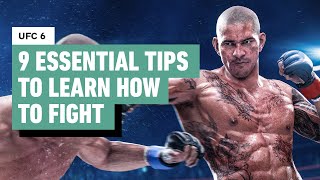

9 Tips to Master UFC 6
37sOpens with high energy and promises essential tips, hooking viewers who want to improve.
▶ Play Clip"The title accurately promises nine essential tips, and the video delivers exactly that with clear, actionable advice."
This video provides nine essential tips for mastering UFC 6, covering fighter uniqueness, stamina management, stand-up and ground techniques, and strategic unpredictability.
Each fighter has unique perks and flow states. Study their move list and flow boosts to maximize advantages.
Blitzing opponents wastes stamina and makes you predictable. Manage stamina and vary your attacks.
Holding forward while striking is slower. Release the left stick when in close range for faster attacks.
Combos in your move set are faster and consume less stamina. Practice jab-jab-hook and body-head combos.
Every attack has a counter: head movement counters jabs, ducks counter hooks, uppercuts counter ducks, etc.
Body shots reduce opponent's stamina and speed; leg kicks limit mobility. Mix up targets to avoid predictability.
Know bad positions (mount, side control, back). Use head movement and post to drain opponent's grapple advantage.
Choose between escaping, defending the finish, or preventing transition. Don't be predictable in your defense.
Move in and out of range to bait attacks. Use training mode to practice combos, transitions, and frame data.
Mastering UFC 6 requires understanding each fighter's unique abilities, managing stamina, mixing up attacks, and using counters effectively. Practice in training mode to refine your skills.
What is a flow state in UFC 6?
A temporary power-up that differs per fighter, e.g., Unbreakable reduces damage for 12 seconds.
1:09
How many perks and flow boosts does each fighter have?
Five perks and five flow boosts.
1:33
What happens when you hold forward and press attack in stand-up?
It is a slower attack meant for closing distance; faster attacks are done without holding forward.
3:24
What is the counter for a jab?
Head movement (left or right) to slip and punish with a hook.
4:49
What counters a hook?
Sways or ducks.
4:56
What counters uppercuts and knees?
Ducks; they also counter takedown shots.
5:04
How do you defend against body kicks?
Catch with a well-timed body guard.
5:10
How do you check leg kicks?
Check them to deal damage to the attacker's legs.
5:14
What are the three worst ground positions?
Being mounted, in side control, or having someone on your back.
6:43
How do you reverse a position from mount?
Use head movement and post to fill grapple advantage meter, then press R2.
7:00
What are the three options when defending a submission?
Escape (move stick left/right), defend finish (RT+up), or prevent transition (RT+down).
7:21
Flow State Power-Ups
Introduces a game-changing mechanic that makes each fighter feel unique and strategic.
1:09Everything Has a Hard Counter
Emphasizes the depth of the combat system, rewarding knowledge and prediction.
4:35Attack the Body to Open the Head
A key fighting principle that applies both in-game and in real life, highlighting strategic depth.
5:32[00:00] Ladies and gentlemen, this is the main
[00:04] event of the evening.
[00:07] There is a lot that UFC 6 throws at you.
[00:10] Punches kicks elbows knees clinches
[00:12] submissions, transitions, the list goes
[00:14] on and on. And if you don't know about
[00:17] each of these things, you're probably
[00:19] going to lose to them.
[00:22] So, in the interest of making you a more
[00:24] complete mixed martial artist, here are
[00:26] nine tips that you need to know in UFC
[00:28] 6.
[00:37] While previous UFC games have had small
[00:39] differences in each fighter stats along
[00:41] with their own unique mixture of
[00:43] techniques, stats, and perks, you could
[00:45] generally adapt one of a few game plans
[00:47] and apply it to nearly every character.
[00:49] In UFC 6 though, an effort was made to
[00:52] make every fighter feel much more
[00:54] unique. And as such, it has become much
[00:56] more important to really learn how your
[00:58] fighter can best play the game. So when
[01:01] you decide on what fighter you want to
[01:02] use, take some time to dig into their
[01:04] perks and move list and especially learn
[01:07] what their flow state perk is. Flow
[01:09] states are potentially fightanging
[01:11] power-ups that differ from fighter to
[01:12] fighter. The unbreakable perk, for
[01:14] example, lets fighters who activate flow
[01:16] state to take less damage for 12
[01:18] seconds, encouraging them to be a little
[01:20] more reckless with their strikes. In
[01:23] order to get your flow state as often as
[01:24] possible, you'll also want to know your
[01:26] flow boosts, which will give you an
[01:28] extra bonus to your flow meter if you
[01:30] perform specific actions. Each fighter
[01:33] has five perks and five flow boosts. So,
[01:35] craft your game plan around them to make
[01:37] sure that you're squeezing out every
[01:39] advantage that your fighter gets. When
[01:41] you're looking through your move list,
[01:43] make a mental note of what moves have
[01:44] four and five stars and consider those
[01:46] your go-to special techniques that
[01:48] you'll want to prioritize over others.
[01:51] You could also look through and remember
[01:52] some of the more unique and situational
[01:54] techniques that each character has like
[01:56] spinning kicks, flying submissions, etc.
[02:01] >> Submission, it's starting to get tight.
[02:04] >> At lower levels of play, it can be
[02:06] tempting to just absolutely blitz an
[02:08] opponent, overwhelming them with offense
[02:10] to the point where their defense just
[02:12] gets overloaded. And you may even find a
[02:14] bit of success early on if you play like
[02:16] this. But don't let that fool you into
[02:18] thinking that this is a viable strategy
[02:20] against anyone that knows this game on
[02:22] anything beyond a casual level. Because
[02:24] once the opponent weathers the storm,
[02:26] you'll be in a terrible position as the
[02:29] fight goes on due to you blowing a bunch
[02:31] of your stamina early on in the match.
[02:33] Not to mention the fact that if you're
[02:34] being predictable with your spam, you're
[02:36] also more likely to get counter hit,
[02:38] which will be really bad for you. This
[02:40] goes for the ground game, too. Don't
[02:42] just spam the obvious direction to
[02:44] escape when you get taken down. Instead
[02:46] of just immediately going for the get up
[02:48] option, wait for a beat. Try to block
[02:50] their transition if they go for it to
[02:52] reduce their stamina. And if all they're
[02:54] doing is just waiting, land some punches
[02:56] from below to increase your grapple
[02:57] advantage before going for the
[02:59] transition. Above all else, being
[03:02] predictable will get you knocked out and
[03:04] submitted in UFC 6. So, even if it means
[03:07] making a choice that isn't the most
[03:08] optimal in a situation, make sure that
[03:10] you're not being easy to read.
[03:13] A big mistake that newcomers to the UFC
[03:15] series make when it comes to the
[03:17] stand-up game is that they'll just hold
[03:19] forward regardless of their distance and
[03:21] start swinging flurries of punches. What
[03:23] they might not know is that holding
[03:24] forward and pressing a button is a
[03:26] different attack than just pressing the
[03:28] button by itself. Holding forward and
[03:30] pressing attack is meant for when you're
[03:32] at a far distance and looking to close
[03:34] that gap while also letting loose a
[03:36] strike. As such, it's much slower than
[03:38] just pressing the button. So, if you're
[03:40] already in the pocket and you're looking
[03:42] to exchange strikes or just let loose a
[03:44] flurry, let go of the left stick and
[03:46] just press the buttons. Your attacks
[03:48] will come out much faster and you're
[03:50] more likely to get the better of the
[03:51] exchange. UFC 6 is not like a
[03:54] traditional fighting game where you need
[03:55] to know combos to be able to do
[03:57] substantial damage, but knowing a
[03:59] handful definitely will help you level
[04:00] up your standup game, especially if
[04:02] you're playing as a fighter with very
[04:04] good standup. UFC's stand-up system is a
[04:06] little more free form than before. So,
[04:08] every character should be able to throw
[04:10] any combination of punches, but if they
[04:12] have the combo in their move set,
[04:14] meaning it's part of their repertoire of
[04:16] techniques, that combo will be faster
[04:18] and will consume less stamina.
[04:20] Definitely lean on your basic jab, jab,
[04:22] hook combinations, but also take a look
[04:24] deeper into the move list and try to
[04:26] commit some of the more advanced combos
[04:28] to memory that alternate between hitting
[04:30] the body and the head so you keep your
[04:32] opponent guessing as to where you're
[04:33] going to hit next.
[04:35] The reason why becoming predictable is
[04:37] so dangerous in UFC 6 is that everything
[04:40] has a hard counter. And if you're
[04:42] playing against someone who knows how to
[04:43] counter your offense, you're going to
[04:45] whiff and eat a lot of shots to the
[04:47] face. So if you're up against someone
[04:49] who is constantly peppering your face
[04:50] with a fast jab, throw some left and
[04:52] right head movement in there and punish
[04:54] with a hook when you slip their punch.
[04:56] Hooks are countered by sways or ducks,
[04:58] so either dodge away or dodge towards
[05:00] them when you feel a hook coming to make
[05:02] them pay. Welltimed uppercuts and knees
[05:05] will call out ducks and will also deal
[05:07] big damage if you manage to catch a
[05:08] fighter shooting for a takedown. Body
[05:10] kicks can be caught with a welltimed
[05:12] bodyguard.
[05:14] Leg kicks can be checked and will end up
[05:16] doing big damage to the attacker's legs.
[05:18] Takedown attempts can be stuffed early
[05:19] to give you an advantageous position,
[05:22] etc. If there's ever anything that
[05:24] you're unsure of the counterplay to,
[05:26] spend some time looking through the
[05:27] game's manual and you'll definitely find
[05:29] some sort of answer. This is again
[05:32] covered by the golden rule of don't be
[05:34] predictable, but it deserves some extra
[05:36] mention because it's really tempting to
[05:38] focus 90% of your offense on the
[05:40] opponent's head. It's the quickest way
[05:41] to end a fight. It'll lead to a
[05:43] satisfying knockout, and it's the part
[05:45] of the body where the damage is most
[05:47] easily visible. That said, if you're
[05:49] only or mostly only going for the head,
[05:53] you're basically cutting the amount of
[05:54] things that your opponent has to be on
[05:55] the lookout for by half, which makes you
[05:58] much easier to defend against. Just like
[06:00] in real fighting, the body is what opens
[06:02] up the head. By attacking the body, you
[06:05] force your opponent to either switch
[06:06] their guard or continue eating shots
[06:08] that will dramatically slow down their
[06:10] own strikes and reduce their max stamina
[06:12] over the course of the fight. If you
[06:14] target the legs, you limit their ability
[06:16] to move. Consider body shots an
[06:18] investment that will pay off handsomely
[06:20] over time.
[06:24] >> This is of course UFC and not Fight
[06:27] Night. And as such, the ground game is a
[06:29] core part of the experience. Even if
[06:31] your fighter isn't very good on the
[06:33] ground, you need to know the basics of
[06:34] how the system works so that you don't
[06:36] just get taken down and submitted for
[06:38] free. You don't need to know every
[06:40] single ground position, but you should
[06:42] know what the really bad ones to be in
[06:43] are. Being mounted in side control, and
[06:46] having someone on your back are by far
[06:48] the worst places to be. When you're
[06:50] mounted, you're opened up to a multitude
[06:52] of submissions. And if the opponent
[06:54] postures up, you're looking to take
[06:56] significant head damage. You do have
[06:58] some defensive options here, though. You
[07:00] can use the right stick to move your
[07:01] head left and right to dodge straight
[07:02] punches, or hold the left bumper and
[07:05] move the right stick to try and post the
[07:07] incoming hook. Successfully doing either
[07:09] of these things will substantially drain
[07:11] the attacker's offense, filling your
[07:12] grapple advantage meter. Once that's
[07:14] full, you can press R2 to reverse the
[07:16] position and move to a more advantageous
[07:19] one. When it comes to defending against
[07:21] submissions, you basically need to
[07:22] decide whether you want to try to escape
[07:24] the submission by moving the stick to
[07:26] the left or right, defend against the
[07:27] opponent's attempt to finish the
[07:29] submission by holding the right trigger
[07:30] and pressing up, or defend their attempt
[07:32] to use the submission as a way to
[07:34] transition into a dominant position by
[07:36] holding the right trigger and pressing
[07:37] down. Every undefended submission finish
[07:40] drains your submission resilience and
[07:42] can often leave you with an injury as
[07:44] you do an automatic desperate escape.
[07:46] Once your submission resilience is
[07:47] depleted, you tap out.
[07:50] Once again, try not to be predictable.
[07:53] If you get put in a submission, you can
[07:55] kind of chill until you see your
[07:56] opponent start to go for something. Just
[07:58] like how you'd check the move list for
[07:59] stand-up fighters to know what your best
[08:01] options are, you should also check out
[08:03] the move list for ground specialists to
[08:04] see what kind of unique options they
[08:06] have on the ground. They might have a
[08:08] really strong position reversal in a
[08:09] specific position or submission chains
[08:11] that are harder to read and enhance the
[08:14] strength of the next submission. Between
[08:17] high attacks, low attacks, linear
[08:19] straits hooks takedowns clinches
[08:21] etc., there's a lot to defend against in
[08:24] UFC 6. So much so that really the best
[08:27] defense is to simply not be there when
[08:29] the attack is thrown. In this way, UFC 6
[08:32] is a lot like a traditional fighting
[08:33] game where you want to move in and out
[08:35] of your opponent's range to try and bait
[08:37] them into throwing out a move that
[08:38] they're not in the proper range for,
[08:40] giving you an opportunity to punish
[08:42] their recovery. On the flip side of
[08:44] that, make sure you know the ranges of
[08:46] your attacks as well. Don't use
[08:48] uppercuts when you're at any distance
[08:49] other than right in front of your
[08:51] opponent. Don't whiff your body or head
[08:53] kicks, and don't just autopilot throwing
[08:55] a bunch of hooks when the opponent has
[08:57] already disengaged. Missing punches is
[09:00] very detrimental to your stamina and
[09:02] will be a quick way to become exhausted
[09:03] as the fight goes on. Finally, make sure
[09:06] that you're making use of the game's
[09:08] training mode. Work on your
[09:09] combinations. Learn what the various
[09:11] transitions look like so that you know
[09:12] which direction to press when you're
[09:14] trying to deny them. Turn on the frame
[09:15] meter and get a sense for how fast your
[09:17] moves are, how wide the punishment
[09:19] windows are, etc. And those are nine
[09:22] tips to help you master the octagon in
[09:24] UFC 6. Thanks for watching and for more
[09:26] UFC 6, keep it here on IGN.




⚡ Saved you 0h 09m reading this? Transcribe any YouTube video for free — no signup needed.