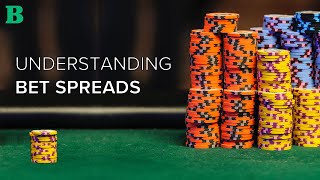

What is a Bet Spread?
34sClearly explains the core concept of bet spreading in blackjack, which is both educational and intriguing for viewers interested in card counting.
▶ Play Clip"Title accurately reflects content; video delivers a clear overview of bet spreads in blackjack."
This video explains the fundamentals of bet spreads in blackjack card counting, covering when to increase bets based on the true count, the concept of betting units, and how to balance maximizing expected value (EV) with minimizing risk and casino heat.
Bet less when the casino has the advantage, bet more when the player has the advantage. Limited by bankroll size.
Around a true count of 1, the player gains the advantage. Exact point depends on rules (e.g., S17 vs H17).
Player advantage increases by about 0.5% per true count starting at true 1.
A betting unit is a fixed dollar amount (e.g., $10). Bankroll in units = bankroll / unit size. A 1-to-10 spread means top bet is 10x the minimum.
Units are a communication tool, not a magic formula. The real goal is to maximize EV and minimize risk.
Larger bet spreads generate more EV, but also more heat from casinos. Example: from $5 to seven spots of $200.
Bigger spreads attract attention. Decide if you want to maximize EV (and get backed off) or minimize heat (smaller spread).
Rarely beneficial to raise bets beyond a true count of 6; max bet is usually reached by true 6.
Effective bet spreading is about betting more when you have the advantage and less when the casino does, while managing risk and heat. The key is to find a balance that suits your bankroll and goals.
What is the goal of a bet spread in blackjack?
To bet less when the casino has the advantage and bet more when the player has the advantage.
00:58
Around what true count does the player typically gain the advantage?
Around a true count of 1.
01:24
How much does the player advantage increase per true count starting at true 1?
About half a percent (0.5%) per true count.
02:31
What is a betting unit?
A fixed dollar amount used to standardize bet sizes; e.g., a $10 unit means each increment is $10.
02:56
What does a 1-to-10 bet spread mean?
The top bet is 10 times the minimum bet.
03:11
Why might a card counter use a smaller bet spread?
To minimize heat and avoid being backed off by the casino.
06:16
At what true count is the max bet usually reached?
By a true count of 6.
07:11
What are the three main goals of a card counter's bet spread?
Maximize EV, minimize risk, and get to the long run.
04:56
Core Principle of Bet Spreads
Fundamental concept that underpins all card counting betting strategies.
00:58The Glorious True One
Key threshold where the player gains the advantage, central to timing bet increases.
01:24Advantage per True Count
Quantifies how much more the player can bet as the count rises.
02:31Maximizing EV with Big Spreads
Illustrates the trade-off between EV and heat, a critical decision for counters.
05:10Max Bet at True Six
Practical rule of thumb to cap bet increases, balancing risk and reward.
07:11[00:01] Apprenticeship. I recently recorded and added to our paid video course an entire section dedicated to bet spreads and bankroll management. And I'm not going here on YouTube, but I thought I would share one of those videos with you now,
[00:15] which is kind of an intro to understanding bet spreads and some of know to effectively be betting and Here you go. All right, let's dive into understanding bet spreads.
[00:34] just figuring out your bet spread. And, you know, I can give you a chart for basic strategy, there's a chart for deviations, and, you know, Hi-Lo can show you all that stuff. Betting is more complex cuz there's a lot of variables,
[00:46] give you a high-level overview and understand some of the important things you're going to need to know to really understand betting and bet spreads. The first is just the most basic sense of the goal of a bet spread. The goal of a
[00:58] bet spread is to bet less when the casino has the advantage, and to bet more when we have the advantage. If you had an infinite bankroll, you would bet as little as humanly possible when the casino had the advantage and as much as
[01:11] humanly possible when you have the advantage and just let all the math work bankroll, so we have to come up with a bet spread that fits for our bankroll. But, before we get to that, let's just talk about, well, when do we gain the
[01:24] more because we have the advantage? And this is what I call the glorious true one. So, we sit down at a blackjack table where we start back counting a blackjack table, and we count plus and minus, and we wait, we wait, and we're
[01:37] waiting for this glorious true one to occur because it's in this range that we start to get the advantage where everything that we're here for, it becomes profitable. Unfortunately, it's not quite as simple as exactly at a true
[01:50] one that we gain the advantage. It really depends on the rules, but for an example, in a S17 game with decent rules, you might gain the advantage below a true one. For an H17 game with not that good of rules, you might want
[02:03] your bet, but it's around a true one. And we've got our house edge calculator betting software will help you figure out really if and when you should raise your bet right at true one, but that's the range at which the edge changes from
[02:18] the casino to the player. So, do we just throw our entire bankroll out there once we get to the glorious true one? No, we can't afford to do that. Remember, we start to get the advantage around a true one, and if you can remember, our
[02:31] advantage goes up by about half a percent per true count starting at true one. So, the higher the true count, the more we can afford to bet, but we still need to bet in proportion to how much of an advantage we have and how big our
[02:43] take a few minutes and talk about betting units. You've probably heard this said on forums or on on the internet, well, how many betting units do you have? How many betting units is your bankroll in? What this means is,
[02:56] let's say you have a $10,000 bankroll, and you were to bet in $10 increments, units. A thousand $10 betting units makes $10,000. Talking in terms of betting units can be a really easy way to discuss your bet spread and your
[03:11] bankroll size. So, let's say that you're betting $10 increments, and you're betting from $10 up to $100, well, we would call that a one to 10 bet spread because your top bet of $100 is 10 times your initial bet of $10. Well, if I'm
[03:25] betting from 100 to a thousand dollars, I'm also using a one to 10 bet spread. It's just with a larger betting unit, a $100 betting unit rather than a $10 betting unit. And a lot of the predetermined bet spreads that we have
[03:38] in our bankroll management app are based on this kind of idea of betting units, not because it's like the only way to bet, but it's kind of an easy way to understand, and it's easy way to figure out very kind of effective betting
[03:52] units, whether you use a 1 to 6, 1 to 8, 1 to 10, 1 to 12, 1 to 20 bet betting unit. The point isn't to have a certain bet spread of 1 to 6 or 1 to 20. The point is to maximize EV and minimize
[04:05] risk. But, a lot of these bet spreads are going to help you figure out, "Okay, if I bet like this, this is what it's going to look like for my bankroll and for the games that I'm playing." Here's a handful of just general considerations
[04:17] units. The first is don't get too hung up on the idea of betting units. Our goal is to maximize EV, minimize risk. And betting units aren't this magic formula for doing that. It can be an easy way to say, "Well, how big of a bet
[04:31] spread am I using? Am I using, you know, 1 to 10, 1 to 20 unit bet spread?" It can also be an easy way to say like, "Hey, I lost 25 units last night." And communicate like, "Oh, it was really bad." And but, you know, you don't have
[04:44] to give a dollar amount cuz it's one thing if you lose 25 units with a $1,000 betting unit. It's another to use to lose 25 betting units with a $5 unit. But, beyond that, it's really not that helpful to think in terms of betting
[04:56] units. Really, the goal of a card counter is to maximize EV, minimize risk, and get to the long run. All your bet spread is geared towards is accomplishing those three goals. So, the first of those is going to be maximizing
[05:10] EV. So, as far as maximizing EV, the bigger bet spread you use, the more EV times on the church team where we would go from $5 to seven spots of $200 or from $25 to all seven spots of $500. We had some people when we had even larger
[05:26] bankroll that would go from one spot of 50 or $100 to all seven spots of $1,000. Those are massive bet spreads because we we didn't think in terms of units. We thought in terms of maximize like betting as little as possible when the
[05:39] much as we could afford to when we have more EV you can generate if you've got the bankroll to back it up. The second thing you need to know is that bigger bet spreads can generate more heat,
[05:51] right? So, the more we bet, the more EV we generate, but not all casinos are dummies, and they if they see someone using a very large bet spread, they might say, "Hey, this person might be a card counter." You need to kind of
[06:03] decide for yourself if your goal is to just maximize EV, then use a big bet spread and make the casinos back you off. That's one of my favorite phrases to think of is make them back you off. But, if you're someone that really wants
[06:16] to minimize heat and back off, so if your goal is to play as much blackjack as you can without back off, then you're going to want to minimize your bet spread. The smaller bet spread you have, the less heat you generally get, but
[06:29] think most people fall somewhere in between, which is like, "How far can I push my bet spread without too much heat?" And, you know, it's kind of subjective, and you never know what a casino is going to do. You and I could
[06:42] walk into the same casino two different nights, one of us could get backed off, It's It's kind of hard to tell, but if you want to try to find that balance, figure out. I've been on different teams that had different goals. Most of the
[06:57] teams I've been on, the goal has been get the money, make them back us off, back offs later cuz at least we got their money when we could. One other kind of minor thing is that there's not really ever a reason to keep raising
[07:11] your betting beyond a true six. I I've rarely if ever found a bet spread that bets beyond a true six because at that point, the reward versus the risk is already be out there. So, if you look at the predetermined bet spreads that we
[07:27] have in our bankroll management app, you'll see that if they don't stop at a true four or five, the the max bet will be out there by a true six. Look, the bottom line is that to make more money as a card counter, we bet more when we
[07:40] have the advantage, we bet less when they have the advantage. Beyond that, everything in practice as a card counter is about protecting our risk and getting over betting our bankroll so that so that our risk is low and betting in a
[07:55] whether that's being aggressive and you get to the long run by moving on to the next casino or by trying to control how much heat and and you know, how spread so that you can get to the long run by getting more hours in in any
[08:10] particular casino. So, that gives you a good broad overview of bet spreads and how to think about it. We'll get into more details in future videos.
⚡ Saved you 0h 08m reading this? Transcribe any YouTube video for free — no signup needed.