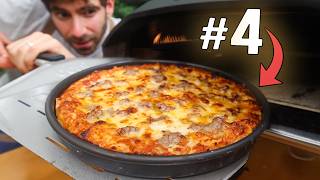

One Dough to Rule Them All: 5 Pizza Styles
55sThe promise of making five iconic pizzas from one dough challenges common pizza-making beliefs and sparks curiosity.
▶ Play Clip"Delivers exactly what the title promises: one dough, five distinct pizza styles, with clear instructions and history."
This video demonstrates how a single, versatile dough recipe at 65% hydration can be transformed into five distinct pizza styles: Neapolitan, Detroit, South Shore Bar, New York, and Turkish Lahmacun. The host explains the history and unique techniques behind each style, emphasizing that dough preparation is the foundational constant across all variations.
A well-prepared dough at the right hydration level can be used to make five popular pizza styles. The host emphasizes that this is not an exact science; every pizzaiolo has their own preferences.
The base recipe uses 1000g flour (900g white bread flour, 100g whole wheat), 5g instant yeast, 15g salt, and 650g water for 65% hydration. This hydration level is a middle ground suitable for various styles; beginners can lower to 60%.
Mix on low speed until combined, rest 5 minutes, then mix another 5 minutes. Perform stretch and folds, then bulk ferment in the fridge overnight for more flavor or at room temperature until doubled.
Each pizza style requires a different dough ball weight: Neapolitan 250g, Detroit 550-600g, South Shore Bar 200g, New York 300g, and Lahmacun 150g. After forming balls, proof in the fridge overnight.
Pizza originated in Naples, with the Margherita pizza created in 1889 for Queen Margherita. For Neapolitan, lock in the crust with fingers, then stretch from the inside out. Bake at 700-750°F for immediate oven spring.
Sauce is the biggest wild card; it's about personal preference. The host makes a simple sauce by sautéing garlic in olive oil, adding canned tomatoes, blending, and cooking down gently.
Detroit pizza traces to Sicilian immigrants in Detroit, baked in blue steel pans from auto factories. Use 550-600g dough, layer cheese (Wisconsin brick or low-moisture mozzarella with cheddar) before sauce, and bake at 500-600°F for 10-12 minutes.
A post-WWII style from Massachusetts, baked in 10-inch pans. Use 200g dough, push toppings to the edge, sauce all the way out, and bake at 500-550°F for 8-10 minutes.
Italian immigrants in New York created larger pies for slices, using low-moisture mozzarella and bakery ovens. Use 300g dough, roll out thin, top simply, and bake at 500-600°F.
Lahmacun is a flatbread with spiced meat, not technically pizza. Use 150g dough, roll super thin, press meat mixture into the dough, and bake at 600-650°F.
With one versatile dough and proper technique, you can create a wide range of pizza styles, each with its own unique character and history. The key is understanding hydration and adapting the dough ball size and baking method to the style.
What is the hydration level of the master dough?
65%
01:36
What are the ingredients and quantities for the master dough?
900g white bread flour, 100g whole wheat flour, 5g instant yeast, 15g salt, 650g water.
00:14
What dough ball weight is used for Neapolitan pizza?
250g
03:13
What is the origin of Detroit style pizza?
It traces back to Sicilian immigrants in Detroit, baked in blue steel pans from auto factories.
05:58
What cheese is traditionally used for Detroit pizza?
Wisconsin brick cheese, which can be substituted with low-moisture mozzarella.
07:03
What is the baking temperature and time for South Shore Bar pizza?
500-550°F for 8-10 minutes.
12:02
What is the dough ball weight for New York style pizza?
300g
13:36
What is Lahmacun?
A Turkish flatbread with spiced meat, often called Turkish pizza.
15:09
What is the key technique for rolling out Neapolitan dough?
Lock in the crust with fingers, then stretch from the inside out evenly.
03:26
One Dough, Five Styles
Shows that a single versatile dough can be adapted to multiple pizza styles, simplifying home pizza making.
00:14Margherita Pizza Origin
Provides historical context for the most iconic pizza style, linking it to Queen Margherita in 1889.
02:33Detroit Pizza's Industrial Roots
Explains how auto factory pans gave Detroit pizza its unique crispy edge, a great example of culinary adaptation.
05:58Lahmacun as Flatbread
Clarifies that Lahmacun is not technically pizza but a flatbread, expanding the viewer's understanding of pizza's origins.
15:09[00:01] to see how pizza has transformed over the years as it's immigrated from its homeland in Italy to different regions around the world, creating these new unique styles of pizza that are now iconic and very traditional in their own
[00:14] way. But through all of my pizza studies and all of my testing over the years, there's one main constant I found, which is that if you prepare a good dough at the right hydration level, with proper techniques, that dough can actually
[00:27] transform into five of the most popular styles of pizza that we have today. And this isn't an exact science. Nothing in pizza world should ever really be an exact science in my opinion. Every pizza shop, every pizzola, of course, is going
[00:40] to have their own recipes, their own hydration levels that they prefer. And work for this. For instance, Chicago deep dish pizza traditionally uses a higher fat dough to get that more pieike texture. So, that's not a great
[00:54] in a hydration level that really hits that perfect middle ground, making it very allpurpose for things like thin crust, deep dish, nice and fluffy open crumb structures. It really can do it all. And it's a very simple recipe based
[01:08] off 1,000 g of flour to make things very easy to calculate. I start with 900 g of a good organic white bread flour. That's the bulk of this dough. And then just 100 g of an organic whole wheat flour, mainly for additional flavor. Then all
[01:22] it needs is 5 g of instant yeast, which is fairly low and will give us the ability for a longer fermentation. And then I'll add 15 g of salt to the yeast this hydration level, which just means the percentage of water going into the
[01:36] dough, I have found that 65% is that middle ground that a lot of these you're more of a beginner pizza maker and you want an easier dough to work with, just lower to 60%. So, since we're using 1,000 g of flour, I need 650 g of
[01:52] water to get me that 65% level. I'll turn my mixer on a low speed just until shut it off and let it rest for 5 minutes. And then after it rests, I'll give it another mix on a low speed for 5 more minutes. I'll transfer the dough to
[02:05] a board and give it a few stretch and folds. Then get it in a container to This can be done in the refrigerator overnight for more flavor or at room once the dough is doubled in size, I can form my dough balls. But each pizza
[02:19] style requires a different weight of dough ball, which I'll discuss for each pizza. So, I'm going to weigh out these different sizes, form them into balls, that proofing bin in the fridge overnight for a nice long slow proofing.
[02:33] with the foundation of pizza, which is the Neapolitan style from Naples. And flatbreads have been a staple in Italy for centuries since they were simple, affordable food for the working class. But pizza as we know it now began to
[02:46] take shape in the 17th century when tomatoes arrived from South America and really transformed its flavor. Then in 1889, Queen Margarito was visiting Naples and in her honor, Pizzayola Raphael Esposito created a pizza topped
[02:59] with basil, mozzarella, and tomato sauce, representing the Italian flag. She loved the pizza and the margarita pizza was born, cementing its place in balls have proofed in the fridge overnight. They're looking really nice.
[03:13] And for a classic Neapolitan pie, I'm using a 250 g dough ball, which is pretty standard. And the key when rolling out a Neapolitan pie is to first focus on locking in that crust with your fingers. And once that crust is nice and
[03:26] locked in, you can work from the inside out evenly stretching that dough to the out evenly stretching that dough to the perfect size. which I find is the biggest wild card when it comes to pizza making. It is the
[03:39] one ingredient on a pizza that I find has very little to do with the actual style of pizza and much more to do with the actual preference of the specific pizza shop or the pizzola like the specific type of canned tomato product
[03:52] they have an allegiance to whether they like whole versus crushed tomatoes or some places like to add spices or herbs to their tomato sauce. You do you when it comes to making pizza sauce and for me a no-brainer is of course using fresh
[04:06] season. And at this point in early spring, this is just whatever I've left. So, it's a mix of different types of tomatoes from the garden. And my preparation is fairly simple. I just sauté a little bit of garlic in some
[04:19] olive oil. I add in all of those canned tomatoes. And I use an immersion blender season them with some salt and I'll cook them down on a very gentle low heat until I get my ideal perfect pizza sauce consistency. And this is the sauce I'll
[04:33] be using for every single pizza today. So, back to this Neapolitan. I'll spread on a light coating of sauce so I can still see some bare spots. I'll go in with a base of parmesan. And of course, I've got fresh mozzarella that I just
[04:46] cubed up, which gets sprinkled on. And finally, some fresh basil leaves, which don't burn in the pizza oven. And this pizza is going to bake at the highest temperature you will see today. I try to hit around 700 to 750° so you can get
[05:00] that immediate oven spring in the crust. And then I'll just watch how the top is cooking. If it's browning too quickly, I'll turn the flame down just a bit to create more of an even top down cooking of the pie. Look at this thing. That is
[05:15] one of my best Neapolitans ever, I have to say. While filming, which is not easy. The Veto Crunch. Crunchy. Listen to the crunch. This to me is pizza art at its finest. Nice light brown crust with some dark spots, which I like.
[05:30] Perfectly melted toppings with that crispy basil. bottom looks great. All of my pizza skills coming together to make this thing work. Thank you, Veto. And let me show you what that 65% hydration will do for your life. That's exactly
[05:44] will do for your life. That's exactly what it will do. today, and it's going to be hard to beat that bite. It's just so light. The flavor combinations with the basil and the fresh MS. This is the godfather of
[05:58] pizza. There's a reason it all came from this. Next up, we have Detroit style pizza, which roots trace back to Sicily, known for its thick crust Sicilian pies. immigrants came to Detroit to work in the booming auto industry. And a man
[06:13] named Buddy Rendevu had a pizzeria, and he adapted his Sicilian wife's pizza recipe, but he baked his pies in blue steel pans from the actual auto factories. Originally used to hold things like nuts and bolts, creating a
[06:25] very distinct style pizza with a light, airy interior, but a super crispy caramelized edge. And I'm using this Detroit pan from Ooni. And I've tested multiple sizes to really tune this pizza in. And I have found the perfect weight
[06:37] in. And I have found the perfect weight of dough is around 550 to 600 g for this pizza pan. So first I just slightly shape the dough ball to give it a little And then I'll just let it rest in the pan so the gluten can relax and I can
[06:50] work it to the edges. This generally takes around two to three rests in total easily. And now, traditionally for Detroit pizza, the cheese comes before the sauce. And there's a specific cheese used called Wisconsin brick cheese. And
[07:03] I ordered a few blocks online, which I paid way too much for shipping. But I really wanted to get that traditional taste. And I have to say it tastes very similar to a low moisture mozzarella. Maybe just a little fresher with a
[07:15] slightly punchier flavor. So you can sub this out for low moisture mozzarella, but I'm just shredding it up along with some cheddar cheese, which really helps get that nice lacy edge. And the key here is that you layer that cheese on
[07:28] the pizza and then stack a bit on the edges of the pan so it can melt down and crisp up. And I'm hitting my pie with a bunch of pepperoni. And this goes into a pizza oven right around 500 to 600°. And we'll cook for around 10 to 12 minutes.
[07:42] Again, once it puffs up, if the top is browning a little too fast, you can lower the temperature of the flame so it cooks a little bit more even. So, while time to talk about today's sponsor, which is Ooni, the maker of these
[07:55] amazing pizza ovens. And what I love most about Ooni is since their inception, they have just constantly innovated with the goal of making pizza more accessible, more fun, and more flexible for home cooks. And their
[08:07] latest innovation is this Kota 2 Pro, which uses G2 gas technology that has a tapered flame, delivering incredible heat distribution. And from testing countless pizza ovens over the years, uneven cooking is one of the major pain
[08:19] home. And this burner basically eliminates cold and hot spots, creating a super even cooking experience. They've also added this removable glass visor, which increases heat retention. And this oven has a massive 18-in cooking stone
[08:33] with precision temperature control from 320 to 950° F, which opens up so much make in this oven. And being able to just set this at the exact temperature, quickly and really hold that temperature well, makes outdoor cooking so much more
[08:49] lifestyle with little kids running around, but this oven gives me the single week. So, if you're interested in one of these pizza ovens, check out the over to Oon's website. And I think we're ready to pull this pizza. I think she's
[09:04] done. My god. Now we take that warm sauce, we hit it with the racing stripes. Do I have enough sauce? Oh no, I think I do. Just enough sauce. So, a little hack
[09:17] to get the pizza out of this pan is you can use one of these flat edge bench can use one of these flat edge bench scrapers like that actually works quite scrapers like that actually works quite well for an official Detroit pan spatula
[09:29] does the same thing. So, one of those is very essential. Got to break that lacy cheese crust. And then she slips And then she slips right out. Come on.
[09:42] right out. Come on. Wow. Incredible fluffy interior like a fakatcha. And look at the exterior.
[09:54] That's what you want. Crispy lacy goodness. That's where mega flavor exists. Usually, you do not go crust first with the bite, but in this case, [Music] I've become quite obsessed with Detroit
[10:08] there is a very valid reason why it's gained a lot of popularity over the last almost expect it to be heavy, just because it's thicker, but it's light as a cloud. You get so much flavor in that crust. It's such a treat. And then I
[10:23] really do love the sauce on top. It's like you have a white pizza that you're just dipping in fresh tomato sauce, which is right up my alley. Next up, we cuz there's a Southshore here on Long Island with a strong accent. So, right
[10:36] when I say Southshore, I just want to come out with the Southshore Bar Pizza. But this specific pizza first appeared after World War II, being served late night at bars around the Brockton area and other industrial Southshore towns in
[10:49] Massachusetts. And it blends elements from all different types of pizza. But what really defines it is its small personal size. Typically baked in 10-in pans that often get passed down through generations. The toppings get pushed all
[11:01] the way to the edge, which delivers a nice caramelized edge just like the Detroit style. But in this case, it is a thin crust, not an open, fluffy crumb. Now, my pan has not been passed down from generations. I ordered it on
[11:13] Amazon, but it's a 10-in non-stick personal pizza pan to give me that traditional size. And I have found that a 200 g dough ball is the perfect size to get that thin crust without having any issues of ripage of the dough. And
[11:25] just like the Detroit pizza, I'm just going to let this sit and rest until I can press it all the way into the edges. And the key is to push the center out nice and thin. And when you get to the edges, you can slightly push the dough
[11:37] up onto the sides of the pan, forming a nice little crust. I hit it with a layer of sauce, which again goes all the way out to the edges so that tomato sauce can actually caramelize on the pan. And the cheese is that distinct flavor
[11:49] profile from shredded low moisture mozzarella plus the additional of shredded cheddar cheese. And these pies are very customizable with ingredients. you can have a lot of fun with it. I'm just going to keep it really simple with
[12:02] some sausage. And I like to bake it at 500 to 550° F, which takes around 8 to 500 to 550° F, which takes around 8 to 10 minutes total.
[12:16] All right. I think that is perfect. What I love about this pizza is if you let it sit for a few minutes, it actually releases right from the pan. And then you can just pop that. Look at that grease running off. I mean, that is just
[12:30] you look at it and it screams bar pizza. That's exactly what this is. Nice browning on the bottom. This is a late night personal pizza. It's just so perfect for it. And even though I'm many miles south of the birthplace of this
[12:43] pizza, it reminds me a lot of childhood pizza that I grew up with. It's like a gourmet birthday party pizza. I don't know if anyone else relates, but oh my god, it's thin crust, but you still get a beautiful rise and it's just
[12:58] ooey and gooey and greasy and perfect. Oh my god. And then you can't forget like Detroit, you get that charred tomato sauce and that crispy cheese edge. Very important to this pizza. Next up, we have New York style pizza, which
[13:10] traces back, of course, to when Italians immigrated over to New York, which triggered a lot of changes in pizza. We have much larger pies for convenience. They could be reheated and served by the slice. They also, of course, swapped
[13:22] moisture mozzarella, which was much more available. And instead of woodfired ovens, they use bakery ovens that don't get quite as hot, which creates a much crispier and slightly drier crust. And for my New York style pizzas, I'm using
[13:36] a slightly bigger dough ball than the Neapolitan cuz it's a bigger pizza. So, I'm going with 300 g, which I roll out as big as my pizza peel can possibly fit. Maintaining a nice outer crust with a pretty thin inner crust. I go on with
[13:49] a layer of tomato sauce, followed by a layer of fresh parmesan, and of course, that shredded low moisture mozzarella. And that's it. I tend to keep my New York pies fairly simple, just like you'd be getting at a slice shop in the city.
[14:01] be getting at a slice shop in the city. And I bake them around 500 to 600° F, which is a nice temperature where I can still get some spring in that crust, but I can also bake it long enough so it gets nice and crispy and that cheese
[14:13] really bakes in and those oils start to separate. All right, look at that thing. That's a beauty. So, you can see it's stretched a little bit as it released into the oven. I would have liked it more round than oval. My
[14:28] biggest critique on this is I needed a bigger peel. The oven can handle a just a slightly thinner crust. The New York pizza is generally bigger than support it. You've got that classic grease layer from the cheese cooking a
[14:43] little bit longer in the oven. Little bit of cheese pull there. A nice airy crumb and a pretty crispy bottom. Obviously, the bottom gets crispier if you reheat it like they do in New York. You can hit it with basil, of course.
[14:55] Wow. Definitely giving me New York vibes. making New York pizza at home because it is so good to just reheat. You throw crispy. It's the parmesan with the low moisture mozzarella. It's a very
[15:09] distinctive New York flavor profile and I love it. Excellent. Excellent shot. So for this last pizza, I am making something called lockin, which is actually not a pizza at all. But we are kind of going full circle here because
[15:24] if we look at the history books, pizza originally came from flatbreads topped with ingredients which had been happening in Middle Eastern cuisine for translates into meat with dough and it spread across the entire Ottoman Empire
[15:37] and then was eventually adapted to local ingredients in southeastern Turkey. But it wasn't actually until the 1970s that Turkish immigrants took the dish over to Germany and the Netherlands where it was westernized and dubbed the Turkish
[15:50] meat mixture. And there's a ton of different recipes you can use. I'm going to process up some red pepper, onion, garlic, fresh parsley, tomato paste. I've got a little Turkish spice mix here I'm going to dump in and some
[16:05] fairly fine. And then I'll throw in my ground lamb and give that a few more blends until everything comes together. And since this pizza is a very thin flatbread, I'm using the smallest dough ball of the day at 150 g. And I'll be
[16:18] using a rolling pin to get it super thin. And I'm making sure to use plenty stuck to the board because the meat mixture actually gets pressed out in an even layer right into the dough almost so the dough and meat become one. And I
[16:32] like to cook these at a pretty high heat around 600 to 650° F. So you can get that really nice oven spring with some charring around the edges. And then that top flame is going to broil the lamb, making it super crispy and juicy. All
[16:49] right, that thing's done. Smells amazing. And this is traditionally served with some onion, some fresh parsley, some lemon juice. I'm going to hit it with just a little bit of salt. We actually, believe it or not, roll it
[17:02] up. Slice that in half. It's like you got a action. So, I would say more of a flatbread than a pizza, but people do flatbread than a pizza, but people do call it the Turkish pizza.
[17:20] completely different flavor profiles. This is a pure culinary invention right here. The crust is so thin that when you wrap it up, it tastes like a classic gyro or kebab style wrap, but all of the ingredients get evenly distributed,
[17:33] including the crust because of the wrapping. So, every bite is perfect. It's not like bursting out with certain ingredients. That is unbelievable. One making that a lot. And there you go. This was not some TV magic trick. That
[17:46] is one dough that's 65% hydration divided into different size doughs to make an array of pizzas that all came together through unique techniques and together through unique techniques and additional unique ingredients.


⚡ Saved you 0h 18m reading this? Transcribe any YouTube video for free — no signup needed.