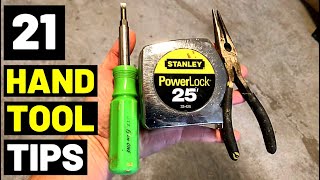

Tape Measure Tab Secret Revealed!
45sThis segment debunks a common misconception about tape measures, offering a surprising and useful tip that will make viewers feel smarter and more capable.
▶ Play Clip"Title accurately describes the content — 21 specific hand tool secrets are delivered without exaggeration."
The video reveals 21 practical secrets and tips for common hand tools like tape measures, screwdrivers, and hammers. Aimed at new DIYers and homeowners, it explains often-overlooked functions that can improve efficiency and solve everyday problems.
Many people overlook the fundamental functions of basic tools like hammers, screwdrivers, and tape measures.
The video presents 21 handy tool tips, tricks, and secrets for new DIYers and homeowners.
The wiggling tab on a tape measure is intentional (tab travel) to account for its thickness when pushing vs. pulling, ensuring accurate measurements.
The tab can be used as a scribe to make marks or indentations without a pencil, especially on board edges.
Besides the four bit options, the empty hex sockets can drive 1/4-inch and 5/16-inch nuts, making them nut drivers.
Removable screwdriver bits can be chucked into a drill in a pinch, but remember to return them afterward.
Without a countersink bit, you can create a divot for a screw head by rotating a Phillips screwdriver aggressively in the pilot hole, works well in softwoods.
Pinch the nail with pliers to avoid hitting fingers, start the nail, then back the pliers off.
Most needle nose pliers include wire cutters at the base for cutting wire quickly.
For angled nailing, start the nail perpendicular, then push it to the desired angle and finish driving.
A scrap piece of wood under the hammer provides leverage and protects the surface when prying nails.
Prying nails sideways offers aggressive leverage and removes stubborn nails faster, though the nail will come out bent.
The turn knob on combo squares can be unscrewed and used as a scribing tool for marking layouts.
The offset head on crescent wrenches allows flipping to increase leverage and swing arc in tight spaces.
Tap a nail set on the mark to create a divot that prevents drill bit wandering; a trim nail works similarly.
Use a speed square's 90-degree leg as a guide for a circular saw or jigsaw for straight cuts; also works for angled cuts by aligning the edge.
The speed square's rail protects fingers while guiding a utility knife for clean cuts, especially with larger buzzard wing squares.
Knives make sharper lines and score the wood surface, reducing saw blowouts, ideal for cross-grain cuts on plywood and hardwoods.
The slip joint on pliers widens jaws to grab thicker bolts or materials; if not enough, switch to channel locks.
Pinch beneath the screw head with pliers and lift while backing out to help the threads bite and remove the screw.
Feed a longer screwdriver through the eye hole and swivel for leverage, especially useful for large eye bolts.
Use the flat face of a large screwdriver to drive nails in tight spaces by striking the bar with a hammer.
Mini hacksaws use full-size blades and can cut fasteners in confined areas; needles nose pliers can then break the partially cut fastener.
Mastering these 21 hand tool secrets can significantly boost efficiency and problem-solving for DIYers and homeowners. The presenter promises future videos on even more tips, reinforcing the value of knowing your tools.
Why does a tape measure tab wiggle?
To account for its thickness when pushing vs. pulling for accurate measurements (tab travel).
00:52
How can a tape measure tab be used for quick marking?
By holding the measurement and pressing the tab into the material to create an indentation.
01:18
What is the hidden function of a tangible screwdriver's empty hex sockets?
They can drive 1/4-inch and 5/16-inch nuts.
01:45
How can you countersink a screw without a countersink bit?
Use a Phillips screwdriver: rotate it aggressively in the pilot hole to create a divot.
02:39
Why start a nail at 90 degrees even if you want it at an angle?
To prevent the nail point from skipping and to ensure it bites into the wood.
03:43
What is the angle of the offset on a crescent wrench head?
22.5 degrees.
04:50
How can a speed square be used as a saw guide?
Set the rail against the board edge and use the 90-degree leg as a circular saw guide.
05:46
Why is a utility knife better than a pencil for marking cross cuts?
It makes sharper lines and scores the surface to reduce saw blowouts.
06:44
How can pliers slip joints help?
They widen the jaws to grab thicker materials or larger bolts.
07:12
How to remove a spinning screw using needle nose pliers?
Pinch beneath the screw head and lift upward while backing out.
07:49
How can a screwdriver help turn an eye bolt?
Feed the screwdriver through the eye hole and swivel the handle for leverage.
08:02
Tape measure tab travel
Reveals a common misconception about a wiggly tab being broken, showcasing an intentional design feature.
00:52Tangible screwdriver's hidden nut drivers
Demonstrates a multi-function tool feature that many users overlook.
01:45Rough countersinking with a screwdriver
Provides a practical, improvised solution for woodworking without specialized bits.
02:39Combination square secret scribe
Highlights a built-in marking tool that eliminates the need for a pencil.
04:38Speed square as a saw guide
Explains a versatile use of a simple square for precise power tool cuts without a miter saw.
05:46Utility knife for cleaner cuts
Reveals a carpentry secret that reduces blowouts and improves finish quality.
06:44Backing out a spinning screw
Offers a clever, practical fix for a frustrating screw issue using common pliers.
07:49Large screwdriver for offset nailing
Shows an unconventional but effective method for driving nails in hard-to-reach spots.
08:28[00:00] So I'm often amazed at how much people don't know about some of the common hand tools that we all use. I'm talking about hammers, screwdrivers, tape measures, the stuff that everybody has in a drawer or a toolbox somewhere. People frequently overlook the fundamental functions of these tools.
[00:14] So in honor of a fresh start in 2021, I'm going to run down 21 of these little handy tool tips, tricks, and secrets. Now, if you're a professional tradesperson or an experienced DIYer, you probably already know most of these.
[00:26] But this is the stuff that new DIYers and homeowners often miss altogether. They're going to come at you fast, so keep your eyes peeled. And remember, I'll link these tools down in the description below, so if you need anything after the video, just check down there.
[00:38] Alright, here you go. 21 Hand Tool Secrets coming up next on the Honest Carpenter Show. Number 1. Tape measure tabs are supposed to wiggle. Everyone always thinks that their tape measure is broken when this tab moves.
[00:52] It's not. It's supposed to move. This is because the tab itself has an actual thickness. When you push it against something to make a measurement, the tab adds itself to that measurement. When you pull it on something, it subtracts itself from the measurement.
[01:05] It's moving to keep your numbers accurate. This is called tab travel and it's calculated in during manufacturing. Number two, tape measure tabs can also be used for quick marking. If you're pulling measurements, you'll often draw the tape out and make a dash with a pencil.
[01:18] But in some cases, you can just hold the measurement you need at one point, push the tab in, and use the tab as described. make a little mark or indentation on its own. You can even do this on the edge of a board. Just brace the tape with your finger at the number you want and scribe with pressure.
[01:33] You can lay out a bunch of numbers really fast this way, and it's often easier than using a pencil. There are so many tape measure secrets, I'll do a whole video on it someday, but we'll leave it there for now. Number three, these tangible screwdrivers have six
[01:45] functions, not four. Everyone knows that you can pull the bits out and flip them between number one and number two Phillips and flatheads, but few people realize that if you take the bits out altogether, you have nut drivers. These empty hex sockets can drive quarter-inch nuts on
[01:58] one end and five-sixteenths-inch nuts on the other. I've used them many times for pinning gutter screws or turning machine screws. Don't overlook these extra sockets. Also, number four, removable screwdriver bits can be used in drills in a pinch. If you just don't have the Phillips or
[02:13] flattened bit you need, you can pop out one of your screwdriver bits and chuck it into the drill. Tighten it just behind the ball bearing, and it'll work like any other bit. This has saved me on a Just remember to take the bit out and put it back in your screwdriver when you're done
[02:27] or you got another future headache coming And number five you can countersink roughly with just a screwdriver Countersinking drill bits make a tonic of depression for a screw to fit in This really makes driving screws easier and cleaner
[02:39] But if you don't have a countersink bit, you can get the job done with just a Phillips screwdriver. Again, this is rough, but if you need it, just put the bit into your pilot hole and rotate it aggressively. Roll it around.
[02:51] It'll shape out a divot for a screw head to fit in, especially in softwoods like pine or poplar. This is another thing I've been saying numerous times. Number six, use needle nose pliers to hammer in small nails.
[03:03] Trying to hold small nails at your fingers is just a good way to get your fingers pounded. Instead, pinch the nail with your needle nose pliers. Now you can start the nail with your fingers out of the way. With the nail partly driven, just back the pliers off. No fuss.
[03:16] Also, number seven, needle nose pliers almost always have wire cutters on them. Nearly every setup I've ever owned has wire cutters right down here at the base. These are really handy, and they're one of the reasons I always keep needle nose pliers with me.
[03:29] I don't do much electrical, but this is a tool I reach for to cut dead wire fast. Number eight, always hammer nails at 90 degrees to start. If you want to drive a nail at an angle, like a toenailing pattern, make your job easier by starting at 90 degrees.
[03:43] Stand the nail up and drive it just enough to get it set. Then, use pressure from your fingers to push the nail up and keep it steady while you drive it the rest of the way, eventually pulling back your fingers. This will keep the nail point from skipping over the surface before it bites in.
[03:57] Number nine, use a board to pry nails. If you need to back a nail out, use a standing flat piece of wood as a prying surface. This serves two purposes. Number one, it provides more leverage for the prying angle.
[04:09] Number two, it protects the surface you're prying against. You can just keep a little scrap lock about a half inch thick and a few inches square. That should do the trick. Number ten, remember that you can hammer pry sideways. DIY is often overlooked here, but if your surface quality doesn't matter,
[04:24] you can get even more aggressive leverage by prying sideways. Some carpenters don't like this, but it will get stubborn nails out faster. Just alternate trying sides. The nail will come out in a squiggly shape. Number eleven, combination squares have a secret marker.
[04:38] This little turn knob on the handle of combo squares is actually a scribing tool. It's always where you need it. Just unscrew the knob and use the scribe to mark your layouts with little scratches. You don't even need a pencil. It's built in.
[04:50] Number twelve, wrenches are helpfully angled at 22.5 degrees. All Crescent wrenches, and many other wrenches, have this offset angle at the head. This makes turning bolts and nuts easier. If you reaching into a weird space and don have room to maneuver the wrench just flip it over The offset head creates a better angle instantly increasing your leverage and the swing arc of the handle letting you work in a more comfortable position Number 13 use a sharp nail fit as a drill bit punch Drilling is always easier if you
[05:19] punch a little hole for the drill bit to knock into. I do this with a sharp nail fit because I always have one in my tool belt. Just put the point of your nail fit on your drilling mark and give it a quick tap with your hammer. Now your drill bit tip can sit in this hole and it won't
[05:32] wander as you start drilling. If you don't have a nail set, you can do this with a trim nail, but I highly suggest keeping a few nail sets on hand. They're just indispensable. Number 14, your speed square can act as a saw guide. If you need to cross cut a really straight line and don't
[05:46] have a miter saw, just use your speed square. Set the rail against the edge of your board and use the 90 degree leg as a guide for the edge of your circular saw or jigsaw. I just brace the far end with my thumb, pulling forward. You can also use a clamp if that feels better for you. And when you
[06:01] you cut even shallower angles. Just line up the angle you need with the lower edge of your board, plant the square, and once again use the edge of the guide. I just experiment by eye to line up where the speed square should sit. I use this method frequently for fast trim cuts. Number 15,
[06:16] the speed square also makes a great straight edge for knives. If I need to make a short, clean cut on something, I use the speed square as a guide for my utility knife. Just push the rail down on your cut line, set the blade against the rail, and draw across it. This is even better
[06:30] than using flat rollers because it's easier to slip and cut your hand with those. Here, the rail protects your hand because you can get your fingers behind it, and you can scale up with a 12-inch speed square, which we call a buzzard wing. And speaking of utility knives, number 16, they're
[06:44] better than pencils for making cross cuts. Many woodworkers use utility knives to mark their cuts. They do this for two reasons. Number one, it makes sharper lines than a pencil. And number two, it scores the top layer of wood, thereby reducing blowouts in the saw. With this top layer already
[07:00] severed, saw blades tend to make cleaner cuts. This works really well on cuts across the grain, plywood, and hardwoods. Number seventeen, most pliers have a helpful slit joint. Pliers are
[07:12] great for holding materials and turning or twisting them. I always have a pair in my pouch, but sometimes they can't comfortably grab something that's too thick. That's what this It spreads the jaws wider so you can grab thicker materials or larger bolts and nuts.
[07:26] If this extra space still isn't enough, then you'll have to bump up the channel locks. But I always carry slip joint pliers in my pouch because they're small and really handy for rough work. Number 18 Use needle nose pliers to help back out a screw Longer screws will sometimes get stuck in wood and just spin around This is because they have this threadless area beneath the head When this area is embedded in wood there nothing there to create traction
[07:49] If you have a screw that's just spinning, pinch beneath the head lightly with needlenose pliers and lift upward. Do this while backing out the screw. The thread will soon bite and the screw will come right out. Number 19. Screwdriver can help turn eye bolts.
[08:02] Turning eye bolts and eye screws by hand is a chore. To speed it up, take any longer screwdriver and feed the neck through the eye hole. Then, just swivel the handle around. This gives you all the leverage you need and you often have screwdrivers on hand.
[08:15] This is really helpful with large screwdrivers and bigger eye holes where you need a lot of force. And speaking of large screwdrivers, number 20, use a large screwdriver for offset nailing. I talked about this in an earlier video, which didn't get watched very much.
[08:28] But, you can use these larger screwdrivers to drive down nails that your hammer can't reach. If a nail head is poking out somewhere and needs to be tapped in, lay the flat face of the big screwdriver on it. Now, carefully strike the bar of the screwdriver with the hammer.
[08:42] You can generate enough force to sink it. This actually has hundreds of demolition applications as well. These large screwdrivers are indestructible, and they can reach into areas where other tools can't. One of the greatest demo tools ever made.
[08:54] And, number 21, use mini hacksaws for tight spaces. This is another criminally overlooked hand tool. Mini hacksaws use full-size blades and lockable handles. Often the blade projects from the end of the tool, so if you need to cut a fastener that a big frame hacksaw can't get at,
[09:09] you can carefully saw it or notch it with the open end of your mini hack. Then, needle nose pliers can often be used to help break a partially cut fastener. Mini hacksaws, something to always keep around. So that's it, 21 hand tool tips and secrets.
[09:22] There are, of course, thousands of hand tool secrets, and I'll probably do other videos like this in the future, but these were 21 of the most important ones I felt for newcomers to carpentry and DIY. What do you think? Learned anything new? Have anything to add or a different way of doing what I showed?
[09:37] Let me hear about it down in the comments. As I said, these hand tools and others are going to be linked down in the description. Feel free to browse them and remember that when you shop through these links, we receive a small commission at no extra charge to you. It helps us keep making videos and we greatly appreciate the support.
[09:52] As always, thanks for watching. Be sure to check back in for more videos coming up soon and please consider subscribing and hitting that little bell button to turn on notifications. That way you'll know the moment we post something. I'm Ethan Gaines
[10:04] with thehonestcarpenter.com. Thanks for watching everybody and Happy New Year.
⚡ Saved you 0h 10m reading this? Transcribe any YouTube video for free — no signup needed.