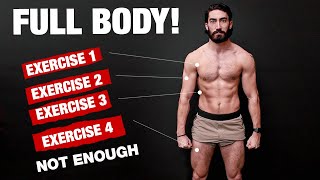

10 Essential Movements for Beginners
45sClear educational hook promising a complete beginner plan that builds anticipation.
▶ Play Clip"Delivers a detailed, structured 3-month plan as promised—solid content with clear progression."
This video presents a structured three-month full-body workout plan for beginners, focusing on mastering 10 essential movement patterns. The plan is divided into three progressive levels, each with specific exercises, sets, and rep ranges to build a solid foundation, then strength, and finally advanced power.
The beginner must master 10 movement patterns: horizontal push, vertical push, horizontal pull, vertical pull, hinge, squat, static lunge, dynamic lunge, core flexion, and carry. Each pattern has three levels of progression.
Level 1: push-up. Level 2: dumbbell bench press. Level 3: barbell bench press. The progression increases complexity and load, starting with scapular control and moving to bilateral stability.
Level 1: one-arm dumbbell press. Level 2: two-arm dumbbell press. Level 3: barbell overhead press. Focus on shoulder and triceps strength, with increasing core demand.
Level 1: chest supported row. Level 2: tripod row. Level 3: barbell row. Progresses from no low-back demand to full posterior chain engagement.
Level 1: pull-down (or banded pull-down). Level 2: band-assisted pull-up. Level 3: unassisted pull-up. Aims to build pulling strength and eventually bodyweight mastery.
Level 1: pull-through. Level 2: Romanian deadlift (RDL). Level 3: deadlift. Teaches hip hinge and powerful hip extension.
Level 1: dumbbell drop squat. Level 2: goblet squat. Level 3: back squat. Starts with a self-correcting movement to build proper squat mechanics.
Level 1: bodyweight split squat. Level 2: dumbbell split squat. Level 3: dumbbell Bulgarian split squat. Builds unilateral leg strength and stability.
Level 1: reverse lunge. Level 2: suitcase reverse lunge (single dumbbell). Level 3: dumbbell reverse lunge (two dumbbells). Adds movement and frontal plane stability.
Level 1: roll-up. Level 2: jackknife. Level 3: hanging knee raise. Teaches segmental spinal control and advanced ab engagement.
Level 1: suitcase carry. Level 2: farmer's carry. Level 3: overhead carry. Builds grip strength, hamstring engagement, and core stability under load.
Workouts A, B, C done 6 times per week (A/B alternating Mon/Wed/Fri, C Tue/Thu). Exercises: squat, vertical push, horizontal pull, static lunge (A); hinge, dynamic lunge, horizontal push, vertical pull (B); core flexion and carry (C). Sets: 3x12-15 to form failure.
Workouts D, E, F with same pattern. Exercises upgrade to level 2 variations. Sets: 3-4x8-12 to failure with good form.
Workouts G, H, I with barbell exercises. Sets: 3x5 or 3x8. Progressive overload: add 5 lbs per workout if all sets completed; repeat or reduce weight if failed.
This three-month program provides a clear, progressive path for beginners to master fundamental movement patterns and build a strong foundation for future training goals.
What are the 10 essential movement patterns for beginners?
Horizontal push, vertical push, horizontal pull, vertical pull, hinge, squat, static lunge, dynamic lunge, core flexion, and carry.
00:29
Which exercise is Level 1 for the horizontal push pattern?
Push-up.
00:54
What is the progression for the vertical pull pattern?
Level 1: pull-down (or banded pull-down). Level 2: band-assisted pull-up. Level 3: unassisted pull-up.
02:57
What is the gold standard exercise for the hinge pattern?
Deadlift (Level 3).
04:20
Why is the dumbbell drop squat useful for beginners?
It teaches proper squat positioning because the dumbbell drops through the center of gravity, guiding the body into the correct position.
04:32
In Month 1, what are the rep ranges and sets for all exercises?
3 sets of 12 to 15 repetitions, performed to form failure (or to form failure on bodyweight exercises).
09:13
What is the progressive overload rule for Month 3 barbell exercises?
Add 5 pounds to each lift per workout if you successfully complete all 3 sets of 5 reps; repeat weight if you fail; drop by 5 pounds if you fail again.
11:28
10 Essential Movement Patterns
Provides a comprehensive framework for beginner training that covers all major movement categories.
00:29Dumbbell Drop Squat Self-Correction
A clever exercise that uses gravity to teach proper squat mechanics without needing a coach.
04:32Lunge is Overlooked but Beneficial
Emphasizes the importance of unilateral leg work which is often neglected in beginner programs.
05:12Three-Month Progressive Plan
The structure of three distinct monthly phases (foundation, strength building, power) is key for long-term progress.
08:08Simple Progressive Overload Rule
Clear, actionable guideline for adding weight based on performance—easy for beginners to follow.
11:28[00:00] What's up guys, it's Cavaliere at ATHLEANX.com. Today we continue our perfect workout series and this one's all about the beginners. I have a perfect full body workout for you that's going to take you
[00:16] through step by step. I'm going to give you exactly what you have to do, not actually just for a couple weeks, but for three months. I want to make sure that you get this right. So that being said guys, let's start breaking down 10 essential movement patterns that every beginner must master.
[00:29] Okay, so it's not only important to understand that there's these 10 movement patterns that you have to master, but within the movement patterns, there's some exercise variation that we want to build upon. We're going to take them from level 1 to 2 to 3,
[00:42] and the difference between these levels is either the complexity of the exercise or the amount of weight that you can use to load on the exercise. It's going to be important to make sure you're pushing yourself forward in both of those cases.
[00:54] So what does it look like? Well, the first movement pattern is something we call the horizontal push. This is where we use the shoulders, the chest, and the triceps to do a movement like, let's say, the push-up at the most basic level. And I like the push-up as a level one variation because it demands that you build some scapular control with your hands placed firmly on the ground.
[01:12] We move from there, though, to a dumbbell bench press. We take away the ground as something that can assist us to building that stability, and we now have to have that stability ourselves. The good thing about using dumbbells is that because they can float freely, if you have any stark imbalances between the right and left sides, you're going to see it here.
[01:27] Because when we move to level three, we perform the barbell bench press. If you have those imbalances there, they can kind of be hidden because both hands are placed on a fixed bar. We move on to the next movement pattern, and this is the vertical push.
[01:40] Here we're talking mostly about the shoulders and the triceps, overhead pushing activities. We start with a one-armed dumbbell press. And it's easier to move one arm at a time because, again, you can look for those imbalances between the right and left sides, and there's less core control that's demanded of you by using this one dumbbell at a time.
[01:55] But when we step it up to level two, we now have to push both of them together. Again, additional weight being moved over your head requires more core stability and control, but we're going to get to that if we progress the right way. And we move to level three here, and that's once again where we incorporate the barbell overhead press.
[02:11] You have to now move your body around the bar as opposed to the dumbbells around your body, which increases the complexity, but you also can load this exercise even heavier. We then move to the next pattern, the horizontal pull. So now we're talking about biceps and back.
[02:24] and we start with something called the chest supported row. When we get in this position, we don't have any demands on our low back strength to be able to do the row. We can focus on our ability to get stronger and develop those pulling muscles. We can take away that support, though, and move in level two to a tripod position.
[02:40] And here you still have a little bit of support. You're not having to support your entire body in space with your low back, but you have minimized that level of support and increased the demand and the weight used here on your pulling muscles. And then of course we can move freely at level three to the barbell row where now you do have to have that support and
[02:57] strength of the low back to keep your body in the right posture and position to be able to pull in this case heavier weights. We then move to the fourth position here and it is the vertical pull. And we know that the base level here guys we're talking about something like a pull down.
[03:09] If you have access to a pull down machine you can obviously weight this to a degree that able to be done by even a very ranked beginner with light weights being used Or if you don have access to that you can simply use a band over a pull bar and do a banded version of a pull
[03:24] When we take it to the next level, we're obviously trying to get ourselves to be able to do pull-ups. So now we use a band, though, in an assisted pull-up situation. This band is going to unweight your body by anywhere from 50 to up to 80 pounds depending upon the resistance of the band that you're using.
[03:38] And of course, our goal is to ultimately get in level 3 to your ability to do pull-ups themselves without any assistance at all. Which brings us to our fifth movement pattern, and that is the hinge. And it's not about pulling with your upper body at this point,
[03:50] but learning how to pull with your posterior chain and hips. Because they're some of the most powerful pullers in the entire body if you learn how to do it right. So what we do is we start with something here called a pull through at level one, where we're simply focusing on hinging back at the hips
[04:03] and then using powerful hip extension to drive yourself back to a vertical position. And we take it to level two here with an RDL, Not having to take it fully off the ground as we will in a deadlift, but simply learning how to use those hips in an abbreviated range of motion to get through that powerful hip extension.
[04:20] And of course, as I mentioned already, level three takes you to the floor through one of the best exercises you can do. And it's the deadlift, the gold standard of posterior chain strength and development. Which brings us to the next movement pattern, and it's the squat.
[04:32] And here, guys, we're talking about your ability to move your body up and down in space. And of course, we're going to start with a variation of a squat. It's a dumbbell drop squat. The thing I like about this more than any other is that it actually will teach any beginner
[04:45] the exact place their body should be in space when they perform the squat because the dumbbell will drop right down through the center of gravity and take your body into the right position. But we simply can't load that heavy enough to progress forever so we have to now learn
[04:58] how to bring that dumbbell up in level two to a goblet position. It's a bit more challenging but you have to be able to control that up there as well which is a perfect transition to level three and it's the classic back squat. Here of course we're going to be able to use the most amount of weight while still staying
[05:12] true to the mechanics we use on perfecting the squat with the lighter weights. Now the seventh and eighth movement patterns are actually related. They're a variation on the lunge. As an athletic strength coach guys, I can tell you right now the lunge is one of the
[05:24] most overlooked but beneficial movement patterns that you need to master. We start with a static variation where we're just going to move our body up and down in space similar to a squat but with one leg out in front of the other. We start with a simple bodyweight split squat.
[05:37] unweighted. Remember the complexity or the weighting of the exercise determines which level we're at. To take it to level two we actually now add weights in the same dumbbell split squat position working each side obviously but going
[05:50] straight up and down and building the strength in our quads. Then we take it one step further to one of my favorite exercises of all time. It's the dumbbell Bulgarian split squat. Again working one side but certainly we can increase the load that we use here and the challenge on the front leg as well.
[06:04] And then we want to add some movement to it and that's where the dynamic lunge variation comes in. At level one you're looking at again a biret situation where performing a reverse lunge. I like the reverse lunge because it's more forgiving on the knees if you have any current
[06:16] knee issues. We then take it to level two where we add a single dumbbell to the situation here. We do a single sided or a suitcase reverse lunge. This is good because it's going to demand increased stability of your hips in the frontal
[06:28] plane while you still perform that sagittal plane motion. Of course we can add one more dumbbell to the equation in level three to perform the heaviest variation and it simply the dumbbell reverse lunge We move on to the ninth movement pattern here guys and it a core flexion move
[06:43] Realizing that the flexion of the spine and the rotation of the pelvis are crucial to learning how to contract your abs properly, we're going to start with something very simple in level one with a roll-up. This is a Pilates movement that teaches you not only how to get up off the ground,
[06:56] but to control that segment by segment as you lower yourself back down to the ground, Which brings us to level two where we now can perform something called the jackknife and with the legs now checked off the ground We have some additional weight challenge because the legs themselves are going to provide that and at level three
[07:11] We have something even more difficult Which is the hanging knee raise which now demands that your body can be controlled while hanging from the bar We're trying to curl the pelvis and not just simply use the hip flexors and lift the knees up And then finally we have the carry which is another one of those overlooked movement patterns
[07:26] But no less important guys you got to learn how to build your grip and hamstring and be able to dynamically move it in space. We start with a suitcase carry at level one where we have a single dumbbell at one side. Of course, you're going to be working both sides.
[07:39] We move to a farmer's carry where we have a dumbbell in each hand now, which is going to obviously increase the amount of load that you're carrying around. And then we move to the third and most challenging of these, and that is the overhead carry. Once you get those arms up overhead, like I alluded to back at the press,
[07:53] there's a lot more core demand and space on your body. How do we work our way through these levels and these movement patterns so that you have the exact plan that you need to follow? Well, we start with our first month of training here, and it's divided into three workouts, an A, a B, and a C.
[08:08] The A and B workouts are your total body workouts that are performed in alternating fashion on Monday, Wednesday, and Friday. So you go in week one, A, B, and A, and in week two, B, A, and B, and you repeat that through weeks three and four.
[08:22] The C workout will fall in the days in between on Tuesdays and Thursdays throughout the entire month. So now with those 10 movement patterns, how do we split them up over the course of A, B, and C? Well, we start with A. And in A here, we start with the squat movement pattern, followed by the vertical push, the horizontal pull, and then the lunge, in this case, the static lunge variation.
[08:44] And in the B workout, we have the hinge, the lunge, this time done dynamically, the horizontal push, and then the vertical pull. In the C workout, we actually pair together those last two that I mentioned,
[08:58] the core flexion movement pattern and the carry movement pattern. All right, so what does that mean now for Lung 1 specifically? What are you going to actually follow? Well, we have those movement patterns, again, broken down into those three workouts, and the exercises that we drop in here are those level one exercises.
[09:13] Each of these exercises is going to be performed for three sets to 12 to 15 repetitions to form failure. Or to form failure alone on the bodyweight only exercise. Now the goal here, guys, is to build up your ability to perform and master these movements.
[09:28] It's not about loading the weight yet. That's why the rep range is higher. And you might say to yourself, but I already do bench press. We're taking a step back here, guys. We're only talking about six workouts over the course of this month. I want to ensure that you learn how to build that foundation once again from the ground up to master these movements to set you up for nothing but success down the line.
[09:47] So each of the workouts shown here can do exactly that for you and prepare you for the next month which brings us to that month two And in month two now we increase the level as well to the level two exercises The structure is going to stay the same We still have the same grouping of the movement patterns
[10:02] except this time with the change in exercises, we have new workouts. So now we have D, E, and F, with D and E being those total body workouts done in alternating fashion on Monday, Wednesday, and Friday. And then we have those core and carry workouts done on Tuesdays and Thursdays.
[10:17] With the level two exercises now in place here, guys, You can see as I drop them in, the goal has changed a little bit, transitioning away from just building that foundation to now actually trying to build strength upon that foundation.
[10:29] And the reps and sets will change as well. So reps are going to drop down to the 8 to 12 range, picking the weight that you fail within that rep range, but still to complete every single repetition you do in good form. Also giving you the option to add an additional set here to build upon that volume as you continue to build your experience in these movement patterns.
[10:47] which then sets us up for that success as I said at level three. So now in month three guys you actually can do this for longer than a month. Talk about a video that keeps on giving here guys. I wanted to make sure that our beginners out there had something to follow where they can make the
[11:01] best gains and experience the most success possible. We've built that foundation up and now we're going to break it down again one more time with the H, the G, and the I workout still broken down with the same grouping of movement patterns but now we introduce those level three exercises. And where
[11:15] you're left with in these level three exercises are the traditional barbell exercises that you can perform for strength in three sets of five or three by eight fashion with the idea being to build that foundation of strength now on that really stable foundation that you've taken the
[11:28] time to rebuild from the ground up. As you perform these exercises guys if you can do the three sets of five you want to make sure that you continue to add weight. Progressively overload these movements. You would do that by adding five pounds to each workout on each lift if you were able to
[11:42] successfully achieve the three sets of five in the previous workout. If for some reason you didn't get all three sets of five, then you would repeat the weight that you used the previous workout. If once again you failed, you maybe overshot the weight that you chose, you drop that down by five
[11:55] pounds and repeat until you can master all three sets of five. In terms of the weight you're going to use here guys, to start you're going to pick a weight that you know you can perform the five reps for, but it's still going to challenge you. You're always going to be able to adapt them as
[12:07] we go based upon the success or failure I just mentioned. And with that guys, you've got a step by step game plan. As always, I'm leaving the screenshots here for you to take and make sure that you can follow this plan step by step. And where would you go from here? It really is up to
[12:20] you guys. If you want to continue to build out that strength, you can certainly stick in that third phase here in that level three and continue to add weight and do that. If you want to shift your goal entirely, you want to just focus on building muscle, whatever it is, guys, I've
[12:32] actually got step by step plans that include nutritional game plans as well, all over at athleanx.com. Guys, if you found the video helpful, make sure you leave your comments. Whoa, whoa, whoa. Why are we, you're late. This is a beginner video. I'm not a beginner anymore.
[12:44] Oh, you're not? No. Take a look at these muscles. Why do you always show your biceps when we're talking about beginner stuff? Because they look good. Okay. Guys, if you found the video helpful and you want to see others in this series, make sure to leave your thumbs and thumbs up below. Let me know what I can cover.
[12:56] I'll do my best to do that for you. If you haven't already done so, make sure you click subscribe and turn on your notifications so you never miss a new video when we put one out. And what is this? Throwing a plug. You said different muscles. Guys, I'll see you later. It look good

⚡ Saved you 0h 13m reading this? Transcribe any YouTube video for free — no signup needed.