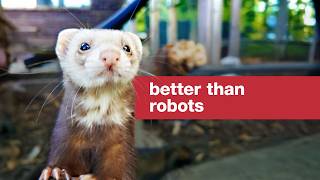

Ferret Bite Victim: The Richard Whiteley Story
44sThe shocking and humorous story of a news anchor being bitten by a ferret, with a twist, creates a memorable and shareable moment.
▶ Play Clip"The title is mostly accurate—ferrets are shown outperforming robots in specific tasks like cable pulling, though the claim is slightly exaggerated for effect."
This video explores the National Ferret School in Derbyshire, where ferrets are trained for practical tasks like hunting rabbits and pulling cables through pipes. The host learns about ferret behavior, handling, and their surprising utility over industrial robots.
The host claims ferrets outperform industrial robots in certain tasks, such as navigating narrow pipes.
The school is both for people to learn ferret care and for training ferrets, highlighting their historical use for hunting rabbits.
Ferrets are domesticated European polecats (mustelids). Males are hobs, females are jills, and juveniles are kits.
A 1977 clip shows Richard Whiteley being bitten by a ferret, leading to a hospital visit, but the ferret recovered.
Ferrets are naturally nosy, which is utilized in training. They learn by following older ferrets and through Pavlovian conditioning with food rewards.
Ferrets are used to flush rabbits from warrens and pull cables through underground pipes, a real application for events like Charles and Diana's wedding.
Ferrets are mentioned in Leviticus 11:30 (King James Bible), but this is likely a mistranslation of a lizard. It shows ferrets were well-known in 17th-century England.
A collar with a transmitter (Ferret Finder) allows tracking ferrets underground, beeping faster as they get closer.
A ferret in a harness pulls a string through a pipe, which can then be used to pull larger cables. The demonstration shows the ferret's effectiveness despite obstacles.
Ferrets remain valuable for tasks like cable pulling and pest control, often outperforming robots due to their agility and problem-solving skills.
What is the scientific name for ferrets?
Mustela putorius furo
3:49
What does 'Mustela putorius furo' translate to?
Thieving smelly weasel
4:02
What is a group of ferrets called?
A business
4:38
What are male, female, and juvenile ferrets called?
Hobs (males), jills (females), kits (juveniles)
5:28
How can you tell a male ferret from a female?
Males have a bigger, broader head; females have a slender head.
5:34
What is the Ferret Finder used for?
To track ferrets underground via a collar with a transmitter.
14:55
What treat is used to reward ferrets during training?
Salmon oil
17:26
What is the noise ferrets make when excited called?
Dooking
10:26
What historical event used ferrets to pull cables?
The wedding of Charles and Diana (TV coverage)
19:39
What does the King James Bible say about ferrets?
They are listed as unclean animals in Leviticus 11:30.
12:09
Ferrets outperform robots
Highlights the practical superiority of biological solutions over technology in specific contexts.
Ferret curiosity as a tool
Explains how natural ferret behavior is harnessed for training and work.
4:21Ferrets in the Bible
Reveals historical and cultural significance of ferrets, including a translation error.
11:52Ferret Finder telemetry
Demonstrates a simple yet effective tracking technology for working ferrets.
14:55Cable pulling with ferrets
Shows a real-world application where ferrets are used instead of robots, with historical precedent.
18:32[00:00] I met some ferrets that do a better job
[00:04] The road trip took me back
[00:06] to the county of Derbyshire,
[00:07] and I parked up at a small rural farm
[00:09] that’s the home
[00:12] Which does need some explanation.
[00:18] The first question is:
[00:19] is the National Ferret School
[00:23] or a school for ferrets?
[00:24] Also, what is a ferret?
[00:26] So, this is where we keep our ferrets.
[00:29] This is the traditional way
[00:31] We believe the Romans carried ferrets
[00:34] because they spread the rabbit,
[00:35] and the only way to get a rabbit,
[00:37] or the best way to get a rabbit
[00:39] is to have something chase it out,
[00:40] ergo the ferret.
[00:42] And so people respected them,
[00:44] and they kept them in large enclosures
[00:48] And that’s exactly what we do now.
[00:50] Correct.
[00:51] So we should see a Pavlovian reflex now...
[00:53] Because when I come to feed them, I go...
[00:59] Oh hello!
[01:02] Those are ferrets.
[01:03] And James, who runs the ferret school,
[01:06] Uh, literally, this is his book.
[01:08] And so the school is both for people:
[01:10] to learn ferret handling and care
[01:13] and also to train ferrets.
[01:15] Because it turns out they can be
[01:18] and not just for hunting rabbits.
[01:20] So, ferrets are...
[01:22] I’m going to get my terminology
[01:25] They are indeed.
[01:26] And ferrets are domesticated
[01:29] Right.
[01:30] So many domesticated ferrets have been
[01:34] -Oh, that they’ve cross-bred?
[01:36] -Right.
[01:39] And the more I see of wild polecats,
[01:42] the more certain I am that these are them.
[01:44] -Did that one just sneeze?
[01:46] (laughs)
[01:47] My apologies, I was not able
[01:51] I don’t know how queasy your viewers are,
[01:55] Right okay.
[01:56] So at whatever stage in the day,
[01:58] and then you’ll see furry locusts descend
[02:02] And you see,
[02:04] Awh.
[02:05] Don’t worry, I’m not going to show
[02:08] But I did have one concern
[02:11] and to explain why
[02:14] I need to make a callback to 1977.
[02:17] Ow. Ow. Ow!
[02:19] I’m sorry. Ow!
[02:21] Richard Whiteley, legendary
[02:24] host of game show Countdown
[02:27] joked that when he died,
[02:29] his obituary would read:
[02:30] “Ferret man dies!”
[02:32] The clip of him being bitten by a ferret
[02:35] got played around the world,
[02:36] often with a big audience laugh
[02:39] And it seems like a bit of harmless fun,
[02:41] but despite the laughter of the crew,
[02:43] the man’s clearly in a lot of pain.
[02:45] It’s alright, let it go.
[02:49] It is hurting me.
[02:50] It was rushed out.
[02:52] Emergency centre.
[02:53] Complete blood transfusion.
[02:55] Intravenous antibiotics
[02:58] But thank God
[03:01] (laughs)
[03:03] Oh, I fell for that completely!
[03:06] I’m assured that the ferret was fine,
[03:09] but not wanting to end up
[03:12] I let James handle the ferrets.
[03:14] In you come.
[03:16] Oop.
[03:17] Hello.
[03:19] Whoops.
[03:20] -You want to come in?
[03:23] I imagine they’re smart enough
[03:25] -Nope.
[03:26] They’ll go under your feet to see what
[03:29] (laughs)
[03:32] Hello.
[03:33] Oh hi!
[03:34] I would think you would pick up the aroma.
[03:36] Yes, a little bit.
[03:38] Okay.
[03:39] But there are 20 ferrets in here.
[03:41] There’s going to be a bit of laughter
[03:43] because there were ferrets
[03:47] Thankfully, only the outside
[03:49] The specific name for these
[03:52] -Uh-huh.
[03:55] Yes.
[03:56] “Putorius” is where we get the word
[03:59] Oh okay.
[04:00] -And “furo” is a thief.
[04:02] So these guys are technically called
[04:06] Incredible. And that, I presume,
[04:10] -That’s the nest box, yes.
[04:12] I’m smiling a lot here, but also,
[04:14] they are trying to climb up my leg.
[04:17] Yes.
[04:18] Well, the thing about ferrets,
[04:21] is that they are nosy.
[04:23] So when you were doing
[04:25] you were ferreting out the information.
[04:27] Yes, I was!
[04:28] Ferrets always want to know:
[04:30] What is up there, what is through there?
[04:31] What’s around that corner?
[04:33] That’s what they do.
[04:34] So, 20 ferrets, if I had 20 sheep,
[04:37] 20 cows, a herd,
[04:38] 20 ferrets, it’s a business.
[04:40] Because as soon as you put a couple
[04:43] doing their business.
[04:44] Right! Oh. Yes, hello.
[04:47] They’ve...they have
[04:49] I’m working on the assumption
[04:51] and in the same way that a farmer
[04:55] you do not name individual ferrets here.
[04:57] No, but what we do do is we implant a chip
[05:01] and we can scan that,
[05:05] So are you breeding them?
[05:06] They do that on their own.
[05:08] (laughs)
[05:09] We supervise it.
[05:10] Yes.
[05:11] Sorry...
[05:13] someone is very, very interested
[05:16] Hello.
[05:18] Yes. Hi.
[05:19] A vet once described ferrets
[05:23] -Yeah. I can believe that.
[05:25] A juvenile ferret,
[05:28] is called a kit.
[05:30] The males are hobs,
[05:31] and the females, jills.
[05:32] How to tell those apart...
[05:34] The easiest way to tell
[05:37] The jills, the females,
[05:41] But if you look at that guy,
[05:45] -Yep.
[05:46] And the hobs can be twice the size
[05:49] So at some point,
[05:51] and you’ll have to separate them out?
[05:52] Well, these are just this year’s, these
[05:57] By this time next year,
[06:00] except when they’re doing their duties.
[06:02] Aside from the obvious, though,
[06:04] those ferrets have other duties,
[06:05] one of which is to chase out rabbits
[06:08] by diving down into the rabbit-holes.
[06:10] Rabbits are considered
[06:13] and unpleasant as it might be,
[06:17] almost all landowners are required to kill
[06:23] In practice, that’s not happening
[06:26] but certainly, farmers would appreciate
[06:30] when other options are available.
[06:34] But that’s not the job
[06:36] There are other reasons
[06:39] And training them
[06:42] What I will do, when we start using them
[06:46] is take an adult out
[06:50] and then it follows through,
[06:54] in the same way that most animals do.
[06:56] It’s how they train foxhounds.
[06:58] They couple them together.
[07:00] So, they literally learn the ropes.
[07:02] But other than that,
[07:07] Because one of the first questions
[07:11] is do they bite?
[07:12] They have teeth. They are capable.
[07:14] -Yep.
[07:16] And my doctor’s warned me about it.
[07:19] -Yes!
[07:20] Yeah, no, same, same, I’ve got that.
[07:22] -So I avoid that.
[07:23] So, we start handling them at four weeks.
[07:25] Their eyes start to open
[07:27] There is this big pink thing
[07:30] and they learn quickly
[07:32] Quite the opposite.
[07:33] Then they don’t bite.
[07:34] And then we start doing the Pavlovian bit
[07:38] of conditioning them
[07:41] Food.
[07:42] One of those is really trying to get
[07:45] Yes, I get through a lot of boots
[07:47] They love climbing.
[07:49] And all we try to do in here,
[07:51] this, if you like,
[07:53] So, we’ve got pipes,
[07:55] we’ve got branches,
[07:56] we’ve got all this substrate here
[08:00] and they just learn
[08:03] It keeps them fit and healthy,
[08:05] and no matter how hot or cold it is,
[08:08] somewhere in here
[08:11] So, in the cold,
[08:15] In the winter,
[08:18] If there’s too much, they drag it out.
[08:20] If it looks like it’s getting colder,
[08:23] and they will take it in.
[08:25] There’s a lot of rattling
[08:28] And I assume at some point...
[08:30] Careful with the feet...
[08:32] Oh, he’s coming back down, okay.
[08:33] My camera was jumping around there,
[08:35] because the ferret was turning round,
[08:36] back and forth, inside a piece of tubing
[08:41] which seems like it shouldn’t be possible
[08:44] They have articulated vertebrae,
[08:47] So, we all think that we’re fit
[08:50] -Yeah.
[08:52] and they can sit with their chin
[08:55] (laughs)
[08:55] But what none of us can do is put
[08:59] Oh!
[08:59] Or our right ear on our right ankle,
[09:02] And if that was hurting her at all,
[09:05] That’s a very unbothered ferret there.
[09:06] There you go. And over the years,
[09:11] but also most of this comes
[09:13] who taught me a lot.
[09:14] And so he always said, if you pick up
[09:18] maybe it’s just come out of a warren
[09:22] or something down there,
[09:24] then all you do is hold it like thus,
[09:26] and then swing it
[09:31] and you can see just how relaxed it goes,
[09:35] To be clear, the ferret
[09:37] Well, as you can see, look,
[09:41] (laughs)
[09:42] And some will stay like this for five
[09:46] and if the wind’s blowing,
[09:49] But it just works,
[09:50] and I’ve never ever
[09:54] Wow. Yeah,
[09:56] (laughter)
[09:58] -But now, look, she’s up and off again.
[10:01] I don’t know if your microphone’s
[10:03] There’s some noise, certainly.
[10:08] (cheeping)
[10:10] What’s that noise?
[10:11] -That’s the noise that they make.
[10:14] It’s uh yeah...
[10:17] They make that when they’re interested...
[10:21] ....when they’re unsure,
[10:24] But when they’re excited,
[10:27] and they bounce around on all fours
[10:30] and their head goes backwards
[10:33] and a lot of people seeing that
[10:36] and rip you to pieces or something.
[10:37] It’s just having a whale of a time.
[10:39] Here you go, climbing.
[10:41] Oh yeah, happily...
[10:44] ...happily six feet up.
[10:48] Oh, she’s taking the civilised way down.
[10:53] Yep.
[10:54] They bounce very well.
[10:56] And at the moment we’ve got this...
[10:58] Oh! And you were right.
[11:00] There goes...thank you. Thank you.
[11:02] I’m just being very careful with my feet.
[11:04] I’m going to go and recover...
[11:06] my camera.
[11:07] The trouble is, there is now a ferret
[11:11] There we go. Woah. Ha!
[11:13] I’m going to just remove myself
[11:17] -(laughs)
[11:19] The next question is
[11:21] What can you do with ferrets,
[11:24] Well, one thing about humans is
[11:28] narrow pipes that carry cables or stuff.
[11:30] Which is all well and good
[11:32] until there’s a problem somewhere inside
[11:35] and you need to dig all of it up
[11:38] It’d be really useful if you could locate
[11:43] Although, while we were going to set
[11:46] James told me something
[11:49] and it’s fascinating,
[11:52] If you turn to the Old Testament,
[11:54] that’s where God lists things
[11:58] And there is a list of animals
[12:01] ferrets are featured on them,
[12:03] James is right.
[12:04] Ferrets are mentioned
[12:09] “and the ferret, and the chameleon,
[12:11] “and the mole, those are unclean to you.”
[12:14] But that’s the King James Bible,
[12:16] a staple of the Church of England
[12:19] And I’m not a theologian, but,
[12:22] “ferret” in there
[12:25] The original word is “anaqah”,
[12:27] and modern translators are pretty sure
[12:31] which would have been a really common
[12:34] But that’s not certain,
[12:36] it’s in Biblical Hebrew.
[12:38] And I tried to find an English analogy
[12:41] because even Old English wouldn’t exist
[12:46] So, when the King James Bible
[12:48] in England in the 17th century,
[12:50] those scholars, who were mostly
[12:53] and who’d never
[12:56] let alone seen one, they picked “ferret”.
[12:59] Which doesn’t tell us much about
[13:03] but it does tell us something about
[13:07] It means they were so well known
[13:08] that they were used
[13:11] in the English version of the Bible.
[13:13] You couldn’t eat them, so the only reason
[13:18] And so they hunt with them
[13:20] Anyway, James and I....
[13:22] okay, mostly James,
[13:24] but James and I set up a course
[13:26] Oh, do you want a hand with that?
[13:28] Yes, if you grab that
[13:30] I see it.
[13:31] Problem with this stuff is it’s a pain
[13:37] That’s a huge amount of corrugated pipe.
[13:40] -It’s like fighting an octopus.
[13:43] That’s a tiny square pipe.
[13:45] They’ll go through that?
[13:47] Yeah yeah yeah.
[13:48] That’s a recipe for escape that, isn’t it?
[13:52] Don’t worry.
[13:54] They might just clamber around it.
[13:56] That’s what I was thinking.
[13:58] No, that should work.
[13:59] -That’ll do it?
[14:02] And then catch them at the other end.
[14:05] Oh, wait, I’m sorry. A ferret...
[14:07] a ferret is in this pipe already.
[14:09] Yes. Someone’s just poked
[14:12] (laughter)
[14:16] Hello!
[14:18] What are you doing, girly? Hey?
[14:21] Come on, then.
[14:23] Come on.
[14:24] She’s going to be
[14:27] Yes, she is. I’ll hold very still.
[14:30] Come on.
[14:31] Come on.
[14:32] Ah, you little devil.
[14:34] Just a bit further.
[14:36] Thank you.
[14:37] And it’s not like you could shake the pipe
[14:40] -No.
[14:42] Just keep your eye on it in case...
[14:43] In case there’s another one in there!
[14:45] We had a pipe
[14:47] And that ferret’s first job
[14:50] and if so, where.
[14:51] But if the ferret’s deep underground,
[14:55] This is the telemetry.
[14:57] -Right.
[15:01] This is shaped so it fits under the chin.
[15:04] And you’re not catching anything,
[15:06] This has various controls on,
[15:09] (beeping)
[15:12] And you should be able to see
[15:13] It’s called the Ferret Finder!
[15:15] The Ferret Finder version 3, as well.
[15:17] And if I move it away...
[15:18] (beeping rises and falls
[15:25] Name that tune.
[15:27] I think that might be
[15:29] that’s happened on this road trip so far.
[15:30] No matter how often they have these on,
[15:32] they love to make it
[15:34] (laughs)
[15:35] So, we put it round,
[15:39] -Oh!
[15:41] “That’s tight enough.”
[15:42] Immediately, if you let go,
[15:44] -Right.
[15:46] That looks really tight,
[15:48] -It is indeed.
[15:50] So, there we go!
[15:52] Oh, yes, good point.
[15:54] Let me turn that...
[15:56] (beeping lowers)
[15:58] Oh, you’ve got sensitivity calculation
[16:00] There you go. So you should hear it
[16:04] So, we’ve got all the way up there
[16:08] How fast is a ferret?
[16:10] Turns out very fast,
[16:11] as long as there isn’t a big
[16:14] that looks like a predator
[16:16] You ready?
[16:19] (scurrying)
[16:23] (chuckles)
[16:26] (ferret finder beeps)
[16:28] So, she’s past that.
[16:29] -Oh, that was fast! Hello!
[16:30] And she’s here, look.
[16:33] This will be interesting
[16:35] and she’s not used to doing this.
[16:38] Nope, doesn’t like it. Oh!
[16:43] You’re right, she doesn’t like that.
[16:44] The ferret looked at me,
[16:47] and then promptly went back to the start,
[16:49] something we only knew
[16:52] -She’s gone back.
[16:56] (chuckles)
[16:57] Decided did not like the clear pipe there,
[17:03] Let’s try her again.
[17:04] I’ll stay behind this time
[17:08] (ferret finder beeps)
[17:10] So fast!
[17:15] It was, it was me standing there.
[17:19] And then a tiny pipe.
[17:20] That’s a tiny...
[17:22] I’ve got no idea where...
[17:24] Now you’ve got
[17:26] This is salmon oil.
[17:27] This is their treat.
[17:29] They’d trade their granny for this.
[17:31] (makes kissing noises)
[17:36] Hello?
[17:39] (makes kissing noises)
[17:42] Good girl. Come on then.
[17:44] Good girl, what’s this?
[17:46] Awh.
[17:48] Mm-mm-mm.
[17:51] So clicking...
[17:53] Yep.
[17:54] ...that just tells her you’ve done well,
[17:58] We don’t give them lots of it,
[18:02] But I think she’s done a really good job
[18:04] -With a completely new layout...
[18:07] ...with clear bits in it and some idiot
[18:11] Yeah, that’s a pretty good job, that is.
[18:12] And she’s never run through
[18:14] So, the pipe is not blocked.
[18:16] But there is a second use for ferrets
[18:19] Sure, there are robots you can send in
[18:22] you could send a snaking camera down there
[18:25] but as I’ll show you in a bit,
[18:29] And it’s also probably better
[18:32] What if you already have
[18:35] and you want to put a new piece
[18:37] -High-vis vest.
[18:39] It’s a high-vis vest for a ferret!
[18:41] There you go.
[18:43] And again, probably tries to make it
[18:46] because that’s what they do.
[18:49] You’ve had some experience with that,
[18:55] Round there, fasten it up
[18:57] And again, you have to remember
[18:59] that these guys can breathe in,
[19:03] although you may think
[19:06] I can guarantee
[19:09] So, she has a line on the end.
[19:10] This is a Heath Robinson device
[19:13] that feeds it out without it tangling.
[19:16] We made the run a bit simpler for this,
[19:17] because the corrugated pipe wasn’t
[19:21] And so the plan is:
[19:24] we attach the string to the camera,
[19:26] we send the camera back down for
[19:30] Oh, she’s moving!
[19:31] Because that’s how cable-pulling works:
[19:33] the ferret can’t carry a camera,
[19:36] And this is a real thing that happens
[19:39] including, famously, for the TV coverage
[19:43] Hello!
[19:47] Nope.
[19:48] Didn’t like the, uh...
[19:50] I think didn’t like me there.
[19:52] That might have been me.
[19:54] There she goes.
[19:54] Yep. I need to learn
[19:56] That string,
[19:57] once it’s through, can be used to pull
[20:01] and so on, and so on, and so on,
[20:02] until the cable you want
[20:04] And there she is. Hello!
[20:07] Why not just use a robot?
[20:09] Or a simple machine?
[20:10] Well, granted, my camera on a stick
[20:14] but if you want a perfect demonstration
[20:18] let’s just say running the camera through
[20:22] So, ferret ran the cable.
[20:25] Cable attached to stick.
[20:28] Stick attached to camera.
[20:30] Ferret’s-eye view whenever you’re ready.
[20:32] Okay.
[20:33] Go!
[20:51] Go on.
[20:54] It was a valiant effort.
[20:56] Hang on.
[20:58] Try that.
[21:01] Turns out there are many things
[21:03] might still be the best way to do it.
[21:05] Well, it wasn’t one smooth run,
[21:08] Yeah. I’m amazed it did.
[21:09] -Thank you very much, sir.
[21:12] Next time, or right now
[21:14] an ancient ritual
[21:17] where I end up
[21:20] That’s not clickbait,



⚡ Saved you 0h 21m reading this? Transcribe any YouTube video for free — no signup needed.