
AI Summary
This video provides a comprehensive overview of AI Agents, explaining their core concepts, how they differ from traditional software, and the various architectures used to build them. It covers the spectrum of agent autonomy, the importance of persistent memory, and the role of LLMs as reasoning engines, concluding with practical architectural patterns for implementation.
Chapters
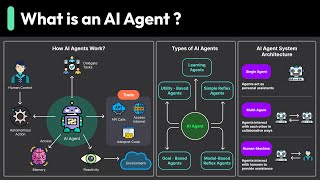
An AI agent is a software assistant that monitors its environment, makes decisions, and takes actions to achieve set goals, fundamentally differing from traditional programs that follow predetermined paths.
AI agents represent a shift from imperative programming (telling software exactly what to do) to declarative goal setting (defining objectives and letting the agent determine how to achieve them).
Agents operate across a spectrum of autonomy, from systems that recommend actions for human approval to fully autonomous agents that execute decisions independently. Calibrating this autonomy with guardrails is a key engineering challenge.
Unlike stateless API endpoints, agents maintain persistent memory across interactions, storing conversation history in vector databases, state data, and action results, enabling coherent multi-step workflows.
Most modern AI agents use large language models as their reasoning engines, providing natural language understanding and problem-solving, but the agent architecture provides the framework for action.
Agents can integrate with existing systems by executing code, calling external APIs, interacting with databases, and orchestrating multiple tools to complete complex workflows.
Common types include simple reflex agents (if-then rules), model-based agents (track world states), goal-based agents (pathfinding), learning agents (reinforcement), and utility-based agents (calculate outcome values).
Architectures include single agent (focused applications), multiple agents (coordinated specialists with communication protocols), and human-machine collaborative (agents augment human expertise).
AI agents represent a fundamental evolution in software development, moving beyond traditional paradigms to systems that reason, learn, and adapt. Understanding these patterns enables building powerful new capabilities that can dramatically accelerate work.
Mentioned in this Video
Study Flashcards (5)
What is the fundamental difference between AI agents and traditional software?
easy
Click to reveal answer
What is the fundamental difference between AI agents and traditional software?
Traditional software follows predetermined execution paths, while agents actively monitor their environment, make decisions, and take actions to achieve goals.
00:28
What paradigm shift do AI agents represent?
medium
Click to reveal answer
What paradigm shift do AI agents represent?
A shift from imperative programming (telling software exactly what to do) to declarative goal setting (defining objectives and letting the agent determine how to achieve them).
00:49
Name three types of AI agents mentioned in the video.
easy
Click to reveal answer
Name three types of AI agents mentioned in the video.
Simple reflex agents, model-based agents, goal-based agents, learning agents, and utility-based agents.
03:03
What is the role of an LLM in an AI agent?
medium
Click to reveal answer
What is the role of an LLM in an AI agent?
The LLM powers the reasoning, while the agent architecture creates a framework for action.
02:18
What are the three architectural options for building AI agent systems?
medium
Click to reveal answer
What are the three architectural options for building AI agent systems?
Single agent, multiple agents, and human-machine collaborative architecture.
03:45
💡 Key Takeaways
Paradigm Shift
Clearly articulates the fundamental change in programming philosophy that agents introduce.
00:49Persistent Memory
Explains a key technical differentiator from stateless APIs, enabling complex workflows.
01:33Agent Types
Provides a useful taxonomy of agent types, aiding in design decisions.
03:03Architectural Options
Outlines practical architecture patterns, including human-machine collaboration.
03:45Full Transcript
[00:00] Today, we're exploring AI Agents, a transformative approach to building systems that's reshaping how we think about software. We'll break down what they are, how they work under the hood, and how we can leverage them in our own projects.
[00:14] So what exactly is an AI Agent? It's a helpful software assistant that can monitor what's happening around it, make smart decisions, and take actions to accomplish goals we set for it. But what makes them fundamentally different from traditional software?
[00:28] While conventional programs follow predetermined execution paths, agents actively monitor their environment through inputs and sensors, process information through reasoning engines, make decisions based on goals and available actions, take actions that modify their environment, and learn from feedback to improve performance.
[00:49] This represents a paradigm shift from imperative programming, where we tell software exactly what to do, to declarative goal setting, where we define objectives and let the agent determine how to achieve them.
[01:03] Modern AI agents have built on several foundational capabilities that give them their power. First, agent operates across a spectrum of autonomy, from systems that merely recommend actions for human approval to fully autonomous agents
[01:17] that make and execute decisions independently The engineering challenge lies in calibrating this autonomy for specific use cases implementing proper guardrails and building appropriate oversight mechanisms Unlike saleless API endpoints
[01:33] that process each request in isolation, agents maintain persistent memory across interactions. This enables the handling of complex multi-step tasks by storing storing conversation history in vector databases, maintaining state data in structure storage,
[01:50] tracking action results and environmental changes, and passing contextual information between reasoning steps. When we provide this stored context with each interaction, the agent builds upon previous
[02:02] steps rather than starting from scratch, enabling coherent, extended workflows. Most modern AI agents use large language models as their reasoning engines. provides a natural language understanding, problem-solving capabilities, and knowledge
[02:18] representation needed to function effectively. But an AI agent isn't just an LLM. The model powers the reasoning, while the agent architecture creates a framework for action. What makes agents
[02:31] particularly useful is their ability to integrate with existing systems. They can execute code, call external APIs, interact with databases, and orchestrate multiple tools to complete complex workflows When designing these systems we focus on creating clean interfaces between the agent and its tools
[02:51] making each component modular and maintainable. There are several common types of AI agents worth exploring. Simple reflex agents map inputs directly to actions, use if-then rules without memory.
[03:04] They are perfect for validation checks and monitoring alerts where immediate response matters most. Model-based agents track world states with internal variables, allowing them to adapt to changing environments.
[03:18] Goal-based agents use pathfinding algorithms to chart action sequences that reach defined targets. Learning agents improve through reinforcement techniques, constantly adjusting their models based on performance feedback.
[03:33] Utility-based agents calculate outcome values using formulas and select the action with the highest expected payoff. This lets them weigh multiple factors when making decisions.
[03:45] When building AI agent systems, we have several architectural options. A single agent architecture deploys one agent as a personal assistant or specialized service. This works well for focused applications, but might struggle with complex challenges that span multiple domains.
[04:02] Multiple agent architectures coordinate specialized agents working together within a shared environment Research agents gather information planning agents develop strategies and execution agents
[04:15] implement solutions. The technical challenge here is designing effective communication protocols between these agents. We might use shared memory spaces or message passing systems to orchestrate their interactions.
[04:29] Even the most practical approach is a human-machine collaborative architecture that integrates aging capabilities with human expertise. The agents provide analysis and handle routine execution, while humans make critical decisions
[04:43] and provide creative direction. We see this today in pair programming assistance that suggests co-alongside developers, augmenting rather than replacing human capabilities. AI agents represent a fundamental evolution in how we build software systems.
[05:00] By understanding these patterns, we can move beyond traditional programming paradigms to a systems that reason, learn, and adapt to changing conditions. These approaches provide powerful new capabilities that can dramatically accelerate our work.
[05:14] If you like our videos, you might like our System Design Newsletter as well. It covers topics and trends in long-scale system design, trusted by 1 million readers.