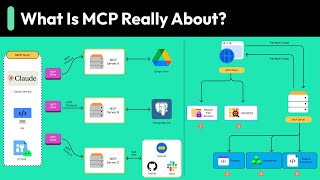

What is MCP? The Game-Changing AI Standard
45sOpens with a bold claim about a major AI advancement, immediately hooking viewers interested in AI trends.
▶ Play Clip"Delivers a solid technical overview, but the title's promise of 'deep dive' is slightly oversold given the 5-minute runtime."
This video explains the Model Context Protocol (MCP), an open standard introduced by Anthropic in late 2024 that enables seamless integration between AI models and external data sources or tools. It covers the architecture, core primitives, and the N-by-N problem it solves, along with a practical example using Claude and Postgres.
MCP is an open standard for integrating AI models with external data sources and tools, addressing the limitation of custom integrations.
Before MCP, connecting models to new data sources required custom implementations, which was expensive. MCP provides a universal standard.
MCP uses a client-server model with three components: hosts (LLM apps like Claude Desktop), clients (components within hosts), and servers (processes providing context, tools, and prompts).
Servers support prompts (instructions), resources (structured data), and tools (executable functions). Clients support roots (secure file access) and sampling (server requests LLM help).
MCP reduces N-by-N integrations to a single protocol, simplifying the integration landscape for tool builders and LLM vendors.
Using Claude with a Postgres MCP server allows querying the database without custom integration, maintaining security and context.
Integrations exist for Google Drive, Slack, GitHub, Git, and Postgres, with SDKs in TypeScript and Python.
MCP is positioned to become a foundational technology for building sophisticated AI applications, with its open-source nature and growing ecosystem making it accessible to developers.
What is the Model Context Protocol (MCP)?
An open standard for integrating AI models with external data sources and tools.
00:14
What are the three components of MCP's client-server model?
Hosts, clients, and servers.
00:58
What are the five core primitives of MCP?
Prompts, resources, tools (server-side) and roots, sampling (client-side).
01:36
What problem does MCP solve regarding integrations?
It reduces N-by-N integrations to a single protocol.
03:09
What is the 'root' primitive in MCP?
A secure channel for file access, allowing the AI to work with local files without unrestricted access.
02:19
Universal standard for AI integration
Explains the core value proposition of MCP in a single sentence.
00:14N-by-N problem solved
Quantifies the simplification MCP brings to the integration landscape.
03:09Practical example with Postgres
Demonstrates real-world application, making the concept tangible.
03:37Growing ecosystem
Shows momentum and adoption, reinforcing MCP's relevance.
04:07[00:00] Today, we're diving into the Model Context Protocol, or MCP, one of the most significant advancements in LLM integration released by Anthropic in late 2024. So what exactly is MCP?
[00:14] At its core, the Model Context Protocol is an open standard that enables seamless integration between AI models like cloud and external data sources or tools. It is addressing a fundamental limitation that has held back AI assistants
[00:29] from reaching their potential. Before MCP, connecting models to each new data source required custom implementations, which can get expensive. MCP solves this by providing a universal, open standard
[00:43] for connecting AI systems with data sources, replacing fragmented integrations with a single protocol. This means we can give AI systems access to databases, file systems, APIs, and other tools in a standardized way.
[00:58] Let's break down the architecture. MCP follows a client-server model with three key components, hosts, clients, and servers. Hosts are LLM applications like Cloud Desktop that provide an environment for connections Clients are components within the host that establish and maintain one connections with external servers
[01:21] Servers are separate processes that provide context, tools, and prompts to these clients, exposing specific capabilities through the standardized protocol. Let's dive deeper into the five core primitives that power MCP.
[01:36] These primitives are the building blocks that enable standardized communication between AI models and external systems. Servers support three primitives. First, prompts. These are instructions or templates that can be injected into the LLM context.
[01:53] They guide how the model should approach certain tasks or data. Second, resources. Structured data objects that can be included in the LLM's context window. They allow the model to reference external information.
[02:07] Third, tools. Executable functions that the LLM can call to retrieve information or perform actions outside its context, like querying a database or modifying a file.
[02:19] On the client side, there are two primitives that are equally important. First, the root primitive. Think of it as creating a secure channel for file access It allows the AI application to safely work with files on your local system like opening documents reading code or analyzing data files
[02:39] without giving unrestricted access to your entire file system. Second, the sampling primitive. This enables a server to request the LLM's help when needed. For example, if an MCP server is analyzing your database schema
[02:54] and needs to generate a relevant query, it can ask the LLM to help formulate that query through the sampling primitive. This creates a two-way interaction, where both the AI and the external tools can initiate requests to each other,
[03:09] making the whole system more flexible and powerful. Now the real power of MCP becomes clear when we consider the N-by-N problem it solves. Previously, integrating N different LLMs with N different tools
[03:23] required N-by-N different integrations. With MCP, tool builders implement one protocol and LLM vendors at Anthropic implement the same protocol, dramatically simplifying the integration landscape.
[03:37] Let's look at a practical example using cloud. When we need cloud to analyze data from our Postgres database we don need to build a custom integration Instead we can use an MCP server for Postgres that exposes database connections through the protocol primitives
[03:54] Cloud, through an MCP client, can then query the database via MCP server, process the results, and incorporate an insight into its responses, all while maintaining security and context.
[04:07] The ecosystem is growing rapidly. Developers have already created many integrations using MCP for systems like Google Drive, Slack, GitHub, Git, and Postgres. There are SDKs available in multiple languages, including TypeScript and Python,
[04:24] making it easier to implement in various environments. Looking ahead, MCP is positioned to become a foundational technology in the AI landscape, particularly for building sophisticated AI applications
[04:36] that interact with diverse data sources and tools. The open-source nature and growing ecosystem make it accessible to developers of all sizes. If you like our videos, you might like our system design newsletter as well.
[04:51] It covers topics and trends in large-scale system design, trusted by 1 million readers.

⚡ Saved you 0h 05m reading this? Transcribe any YouTube video for free — no signup needed.