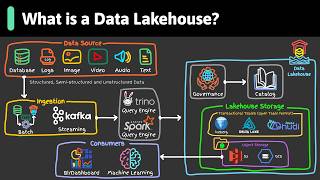

Data Lakehouse vs Warehouse vs Lake
45sThe clear, quick comparison at the start hooks viewers who are confused about data architecture terms.
▶ Play Clip"Delivers a clear, structured explanation of data lakehouses, though the sponsor segment adds some fluff."
This video explains the concept of a data lakehouse, a modern data architecture that combines the reliability of a data warehouse with the scale and flexibility of a data lake. It breaks down the core components—open table formats, shared catalogs, and governance layers—and provides a practical comparison to help viewers choose the right architecture for their needs.
A data warehouse stores curated, analytics-ready data with ACID transactions and fast SQL queries. A data lake stores raw, semi-structured, and unstructured data at massive scale on cheap object storage.
In a typical setup, raw files go to a data lake and curated tables go to a warehouse. As the platform grows, schema changes touch two ingestion paths, quality checks, and access models, causing engineers to spend time synchronizing systems.
A data lakehouse is a modern architecture that keeps one shared data layer while preserving the reliability of a data warehouse and the scale of a data lake.
The lakehouse design starts with a single object storage layer where both raw and curated data live. This removes repeated data copies between separate systems.
Open table formats like Apache Iceberg, Delta Lake, and Apache Hudi enforce database-like rules on files, providing metadata, snapshots, and commit history to ensure consistent reads and writes.
A catalog maps table names to metadata and current versions. Tools like Spark and Trino consult the same catalog, enabling a single source of truth.
Governance tools like AWS Lake Formation or Databricks Unity Catalog manage data sets, lineage, and access control, ensuring data is safe and compliant.
With format, catalog, and governance in place, all workloads (batch, ML, streaming) read from the same tables, eliminating expensive data copies.
A lakehouse is not fully managed; teams must handle file compaction and schema evolution. A bad schema update can break multiple pipelines simultaneously.
Choose a warehouse for fast analytics with minimal infrastructure management, a lake for cheap raw storage, and a lakehouse when you need both scale and reliability.
The data lakehouse offers a compelling middle ground, but it requires dedicated engineering effort. The key is to match your architecture choice to your team's size and workload requirements.
What is a data warehouse?
A system that stores curated, analytics-ready data, supports ACID transactions, and is optimized for fast SQL queries.
00:02
What is a data lake?
A system that stores raw, semi-structured, and unstructured data at massive scale using cheap object storage.
00:16
What is a data lakehouse?
A modern architecture that keeps one shared data layer while preserving the reliability of a data warehouse and the scale of a data lake.
01:14
Name three open table formats mentioned in the video.
Apache Iceberg, Delta Lake, and Apache Hudi.
03:03
What is the role of a shared catalog in a lakehouse?
It maps table names to metadata, schema, and current version, providing a single source of truth for all tools.
03:31
What is a key operational trade-off of a lakehouse?
It is not fully managed; teams must handle file compaction and schema evolution, and a bad schema update can break multiple pipelines.
05:28
Definition of a Data Lakehouse
Provides a clear, concise definition that frames the entire video.
01:14Open Table Formats
Introduces the key technology (Iceberg, Delta, Hudi) that makes lakehouses possible.
02:50Shared Catalog as Single Source of Truth
Explains how a catalog enables multiple engines to work on the same data consistently.
03:31Operational Trade-offs
Highlights the hidden costs of a lakehouse, which is crucial for decision-making.
05:28Choosing the Right Architecture
Provides actionable guidance on when to use warehouse, lake, or lakehouse.
06:13[00:02] different from a data lake or a data warehouse? Let's take a look. lakehouse, we need to understand the two systems it tries to replace. First is a data warehouse. It stores curated and analytics-ready data.
[00:16] Typically, it supports ACID transactions and is optimized for fast SQL queries. A finance team, for example, uses it to pull accurate daily revenue reports. Second is the data lake. It stores raw, semi-structured, and unstructured data
[00:31] at massive scale using cheap object storage. A data science team, for example, uses it to store millions of clickstream logs to train machine Let's take a look at a concrete example of how they interact. Our busy
[00:45] e-commerce platform generates a massive amount of valuable information: raw order events, payment records, and support logs. Typically, the raw file land in object storage to form the data lake. Meanwhile, curated analytics
[01:00] tables sit in a separate data warehouse. This works early on, but as the platform grows, each schema change touches two ingestion paths, two quality checks, and two access models. Data engineers can end up spending much of their time
[01:14] keeping these separate systems synchronized instead of building new data products. A data lakehouse is a modern architecture that tries to keep one shared data layer while preserving the reliability of a data warehouse and
[01:28] the scale of a data lake. Today's video is sponsored by Snowflake. If your data lives in five different systems, your pipeline keep breaking, and your team spend more time fixing infrastructure than building product,
[01:40] this is for you. Snowflake's AI data cloud brings everything together in one unified platform. You can work across data, apps, and teams, spin up workspaces and notebooks, and build AI-powered solution out of the box. And
[01:54] with native support for Apache Iceberg, there's no vendor lock-in. That's why thousands of enterprises trust Snowflake to move faster with their data. Start building a data lakehouse on Apache Iceberg in minutes. Get Snowflake's free
[02:06] 30-day trial using the link in the description. Let's build a design from the ground up. It all starts with a single storage layer. For our e-commerce team, raw order events and curated analytics
[02:19] tables now both live on one object storage layer. We process the raw data and save the polished results back into the object storage as optimized files, This removes repeated data copies between separate systems. Object storage
[02:35] is highly available, durable, and scales cheaply. But it just hold raw files. It does not know what a database table is. Because of this, if a job fails halfway through writing, readers may see an incomplete or inconsistent view of the
[02:50] table. If someone reads while another writes, they may observe only part of the update. We need a way to enforce database-like rules directly on top of these files. To get these rules, we need an open
[03:03] table format like Apache Iceberg, Delta Lake, or Apache Hudi. Instead of exposing raw files, these formats maintain table metadata, snapshots, and commit history. This guarantees that every write either
[03:16] succeeds or fails. Readers always get a consistent view, even during concurrent They also handle many schema changes as metadata operations. If you rename a column, you often just update a table definition. You can evolve tables over
[03:31] time without rewriting massive directories of historical data. Now we have reliable tables, but how do different tools actually find them? This requires a shared catalog. A catalog maps a table name, like orders, to its
[03:45] metadata, schema, and current version. When any tool wants to read or write, it first asks the catalog where the latest version is. This creates a single source You might use heavy-duty engine like Apache Spark to ingest millions of new
[04:01] orders, while a fast query engine like Trino powers a dashboard. Because both consult the same catalog, Trino can see the new records Spark just committed. Now we have shared metadata. The next issue is governance at team scale.
[04:16] As the platform grows, governance answers critical operational questions. What data set exist? Where did they come from? And exactly who can read sensitive data like payment fields? Tools like AWS Lake Formation or Databricks Unity
[04:30] Catalog provide a central place to manage these rules and lock down If the table format makes sure the data is correct, the governance layer makes sure it is safe. To enforce this, many teams use cloud security to lock down
[04:45] the underlying object storage. Many teams require every human and application to go through the central governance catalog. Without it, access unclear. So, what do all these enable?
[04:58] With the format, catalog, and governance in place, we unlock the main goal. Everyone reads from the exact same tables. We run batch jobs for historical payments, and heavy machine learning models, all against the same data layer.
[05:14] We no longer make expensive, repeated copies of data just to satisfy different tools. There is a trade-off, however. Different query engines may interpret data types differently. You must establish strict standards and test your
[05:28] core data types across engines before letting teams build on top of them. all our workloads, but how do we actually operate it? A lakehouse reduces duplication, but is not a fully managed database. You are taking on new platform
[05:44] responsibilities. As new orders stream in, object storage fills up with thousands of tiny files, making queries painfully slow. In a warehouse, the system optimizes this automatically. In a lakehouse, your team must schedule
[05:58] background jobs to periodically merge tiny files into larger, more efficient Also, because the system is deeply shared, a bad schema update can break finance dashboards and machine learning pipelines simultaneously. You get
[06:13] flexibility and scale, but you pay for it with platform engineering time. So, which architecture should you actually build? Choose a data warehouse to serve analytics quickly. You pay a premium, but your team focuses purely on
[06:27] writing SQL instead of managing infrastructure. Choose a data lake if you only need cheap storage for raw data and machine learning without strict database rules. Choose a data lakehouse if you need
[06:39] both. Massive scale and reliable tables for diverse workloads like streaming and analytics. It can scale very far, but requires dedicated engineering to maintain. Architecture is about trade-offs. Match your choice to your
[06:54] team size and actual workloads before locking into a design.

⚡ Saved you 0h 06m reading this? Transcribe any YouTube video for free — no signup needed.