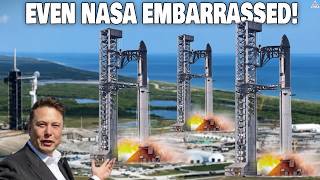

SpaceX's Shocking Move: Texas to Florida?
45sThe dramatic claim that Texas could be forgotten in 3 years sparks curiosity and debate among space enthusiasts.
▶ Play Clip"Delivers solid analysis of SpaceX's Florida expansion, but the title's '1,000 Starship' is an exaggeration not supported by the content."
This video analyzes SpaceX's strategic shift of its Starship launch operations from Starbase, Texas, to Florida's Cape Canaveral. It compares the infrastructure, regulatory approvals, and geographic advantages of both locations, concluding that Florida is set to become the primary launch site for Starship missions, including Artemis and potential national security payloads.
SpaceX is investing heavily in Florida's launch infrastructure, while Texas (Starbase) may be relegated to a testing role. The video highlights the massive gap in development pace and scale between the two states.
Elon Musk wants Starship launching almost every hour within 4-5 years, a goal that necessitates a fleet of launch pads, which is driving the expansion in Florida.
Starbase annexed 7,133 acres in February 2026 for housing and infrastructure, not launch pads. In contrast, Florida has no empty land, forcing SpaceX to lease and repurpose existing complexes.
The short answer for the Florida focus is location: prime, irreplaceable real estate that offers superior launch trajectories and access to key missions.
Starbase has two Starship pads: Pad 1 is being overhauled for Starship V3, with completion expected late Q1 2027; Pad 2 has been handling test flights since Flight 12.
LC39A at Kennedy Space Center is being upgraded with a new launch mount, quick disconnect arms, flame trench, and chopstick arms. It is nearly complete and likely months from being ready.
SpaceX is building two Starship pads at SLC 37 (former Delta IV site). 37A's tower is nearly at full height, and 37B's foundation piles are being sunk. A gigabay factory with 24 work cells is also under construction.
Florida's open Atlantic allows a wide range of orbital inclinations (28.5° to 57°), while Texas is constrained to a narrow corridor (~26°), limiting mission flexibility.
Artemis requires close coordination between SLS and Starship pads, which are neighbors at LC39A. National security launches will also fly from the Cape, as Texas is not in consideration.
Starbase is limited to 25 launches per year, while Florida already has approvals for over 120 launches annually (44 at LC39A, 76 at SLC 37), signaling where the program's future lies.
SpaceX aims for a launch before end of 2026, but the analyst predicts March-April 2027. The first Florida Starship will likely be Booster 24 and Ship 44, built in Texas and barged to Florida.
Florida is poised to become the primary launch site for Starship, driven by its geographic advantages, regulatory approvals, and mission requirements. The next chapter of human spaceflight will likely begin at the Cape, not in Texas.
What is Elon Musk's goal for Starship launch frequency in 4-5 years?
Almost every hour.
00:33
How many acres did Starbase annex in February 2026?
7,133 acres.
01:00
What is the orbital inclination limit for launches from Starbase?
Around 26 degrees.
06:36
What is the range of orbital inclinations possible from Cape Canaveral?
From about 28.5 degrees up to 57 degrees.
06:49
How many launches per year is Starbase licensed for?
25 launches per year.
08:43
How many launches per year are approved for LC39A and SLC 37 combined?
Over 120 launches per year (44 at LC39A, 76 at SLC 37).
08:55
What is the predicted first Florida Starship booster and ship pair?
Booster 24 and Ship 44.
10:35
Location is Key
The core reason for Florida's dominance is its irreplaceable geographic advantage for launch trajectories.
01:43Texas's Narrow Corridor
Starbase is limited to a single orbital inclination, severely restricting mission flexibility.
06:36Regulatory Approvals Favor Florida
Florida already has approvals for over 120 launches per year, dwarfing Texas's 25, signaling where the future lies.
08:29Artemis Tied to Florida
The complexity of Artemis requires close pad proximity, making Florida the only viable option.
07:18[00:02] into Starbase only to turn it into a practice field for Starship. But the pads that will actually get humanity off this planet, orbital refueling, the Starship HLS landing NASA astronauts on the moon and one day ships bound for
[00:17] Mars. Every single one of them sits in Florida. And that eastern coast, SpaceX is pushing so hard, so fast that within 3 years, Texas could be all but forgotten. So why why is there such a massive gap between these two states?
[00:33] Let's find out. Musk has said that in four or 5 years he wants Starship four or 5 years he wants Starship launching almost every hour. Yes, every hour, not every month like they do right now. And a goal that insane rewrites the
[00:47] rules of everything. You physically cannot fly that often from one or two pads. You need a fleet of them. And where SpaceX is choosing to build that fleet is stranger than it sounds. Back in February 2026, the city of Starbase
[01:00] in February 2026, the city of Starbase moved to annex another 7,133 acres in Cameron County, swelling its footprint almost 9-fold from around 927 acres to roughly 8,60. That's a staggering amount of land, more
[01:14] than enough to build several more launch pads. But that's not what it was for. It was framed around housing and infrastructure. Now compare that to Florida. There's no empty land to annex at Cape Canaveral. Every square mile is
[01:27] already spoken for. NASA, the Space Force, ULA, Blue Origin, all packed onto one strip of coast. SpaceX had to lease, negotiate, and tear down a retired rocket complex just to make room. So, they own wide open space in Texas and
[01:43] choose to fight for scraps in Florida. That tells you something. The short answer is location. Prime irreplaceable real estate. But before we dig into that, we need to get to know all five of these launchpads first. Because once you
[01:56] can picture them, the whole analysis clicks into place. By the way, my grandma just lost her dentures. So, if you could support her by subscribing to the channel, I might be able to buy her a new set. All right, let's start with
[02:08] what we know. Starbase. It has two Starship pads. Pad one, the launchpad we watched, carry every flight from flight 1 through flight 11. And now it's getting a complete overhaul to handle Starship V3. And the pace not exactly
[02:24] blistering. As of right now, they still haven't finished installing the new box shaped OM, let alone integrated the water deluge system or the BQD. in action until late in the first quarter of 2027. Pad 2, the refined
[02:40] second draft with its flame trench and upgraded deluge and so on. The one that's been shouldering the test flight duty in pad 1's place ever since flight 12. Now let's turn to Florida where the pace of work has been nothing short of
[02:53] lightning fast. First stop, the most famous launchpad on Earth, LC39A at Kennedy Space Center, Florida. This is hallowed ground. Apollo 11 left for the moon from here. The space shuttle flew from here for 30 years. When SpaceX
[03:09] announced they were building a Starship pad on this exact spot, Musk put it pad on this exact spot, Musk put it simply. 39A is hallowed spaceflight ground. No place more deserving of a Starship launch pad. The tower there has
[03:21] actually been standing since 2022, but for years it was an empty shell, a for years it was an empty shell, a skeleton. Then in February 2025, crews came back and started giving it organs. A brand new launch mount, the same
[03:34] modern design as Starbase's pad 2, quick disconnect arms to feed the rocket propellant, a flame trench carved into the Florida soil, and the famous chopstick arms are now fully rigged. They can ride up and down the tower. As
[03:47] of right now, the pad already looks pretty much complete. SpaceX actually released images of it during the countdown for Starship flight 13 before that flight got scrubbed the first time. And the launchpad and the SQD looked
[04:01] like a work of art. Something built by pure technology and engineering. The flame trench looked nearly finished, too. And the water deluge system has the pumps and the high-press gas systems through their paces. When a pad starts
[04:15] testing its flood lights before opening night. Game day is close. LC39A is likely just months away from being ready. 5 miles south sits stop number
[04:27] ready. 5 miles south sits stop number two, Space Launch Complex 37. This used to be the home of the old Delta IV rocket. SpaceX flattened it. And in its place, they're not building one Starship pad. They're building two side by side.
[04:41] At 37A, one of the most powerful crawler cranes on the planet, the LR13000, is stacking the launch tower module by module. As of the second half of July, it's already placed eight of the nine modules. The tower is nearly at its full
[04:55] height, and these modules are special. Each one gets loaded with plumbing, cabling, and hardware on the ground before it's ever lifted, far more than any previous tower. Meanwhile, at 37B, drilling rigs are already sinking
[05:09] foundation piles for the second tower. And of course, beyond the launch pads, they've got to build a factory to actually produce starships there, too. That's the gigabay at Robert's Road, a building with 24 work cells inside. Each
[05:22] one a station where a Starship or booster gets assembled and serviced. For Starbase, the buildings that have produced every Starship ever flown, hold six work cells combined. The gigabay is four times that. And as of mid 2026, its
[05:38] steel skeleton is finished. The cladding and roof are nearly done. And the only doors where finished rockets will roll out. They built this monster in about a year and a half. Okay, so Florida is building a lot of stuff fast, but why is
[05:56] it on such a bigger scale than Starbase? I mean, SpaceX bought up plenty of wide open land in Texas, too. So, why pour all this into Florida? For that, you need a map. Stand at Starbase and look out at the water. The Gulf is in front
[06:09] of you, but Mexico's coastline is right there on your left. And further east, blocking your path to the open ocean, sits a wall of land. Cuba, the Bahamas, sits a wall of land. Cuba, the Bahamas, Florida itself. A rocket leaving Bokhica
[06:22] can only thread one narrow corridor, east and slightly southeast, squeezing between coastlines. Starbase is an airport stuck in an alley, and the numbers prove it. Flights from Texas top out around 26° of orbital inclination.
[06:36] And when one breaks apart along that corridor, the debris rains down near the Turks and Caos. That's the price of the alley. Now stand at Cape Canaveral. There is no alley, just the open Atlantic for thousands of miles. That
[06:49] geography unlocks a whole fan of trajectories from about 28 1/2° all the way up to 57. And in space flight, direction is everything. The space station lives at one inclination. Starlink shells live at others. From
[07:03] Texas, you're locked into one lane. From Florida, you get the whole highway. Now, analyst hat for a second because geography is only the entry ticket. The real story is what kind of missions each site is allowed to fly and how often.
[07:18] Start with Artemis because people miss how tightly it's chained to Florida. actually requires. The astronauts ride an SLS rocket from pad 39b. Their lander is a starship which has to launch separately, park in orbit, and get
[07:32] starships before the crew ever leaves Earth. Two rockets, one interlock schedule, zero margin, and the cruise pad and the lander pad at LC39A are nextdoor neighbors. The same range, the same weather, the same NASA teams able
[07:48] to drive between them in minutes. NASA is not going to choreograph the most complex mission since Apollo around a test site in Texas with a onelane trajectory and a 25 flight ceiling. When the next astronauts leave for the moon,
[08:02] their lander will have left Earth from Florida. Structurally, it almost can't be any other way. And it's not just NASA. SLC 37 sits inside Cape Canaveral Space Force Station, the home field of American national security launches. If
[08:16] Starship ever carries Pentagon payloads and SpaceX has signaled it, wants those contracts, those missions fly from the Cape. Texas was never even in that conversation. So, the important missions concentrate in Florida, but so does the
[08:29] raw permission to fly. And this, honestly, is the stat that made me sit up. Starbase, the Finnish site, the one with two pads and 13 flights of history, spent years fighting through environmental reviews just to raise its
[08:43] license from five launches a year to 25. 25 total. Now look at Florida. It hasn't launched a single Starship yet, and it already holds approvals for more than
[08:55] already holds approvals for more than 120 a year. 44 launches and 44 landings 120 a year. 44 launches and 44 landings at LC 39A, plus 76 launches and 152 landings at SLC 37. Stack every site together and the program is cleared for
[09:09] about 145 flights annually, which means the site that built Starship gets barely a sixth of the pie. The regulators have in effect already voted on where this program's future lives. So, do you think Starbase gets left behind as just a test
[09:23] site, or does Texas claw its way back? Tell me in the comments. I'm curious where you land on this. So, when does Florida actually fly? Let me give it to you straight. SpaceX publicly wants a launch before the end of 2026.
[09:37] I'd call that a stretch goal. Finishing a tower is not finishing a pad. After the big steel goes up, there's a gauntlet. Cryogenic testing of the tank farm. Flowing propellant through every valve. Rolling a booster out for fit
[09:51] valve. Rolling a booster out for fit checks. A static fire. a full wet dress rehearsal and the final launch license. Each step can slip weeks. And unlike Texas, Florida is a crowded neighborhood. SpaceX shares the Cape
[10:05] with NASA, ULA, and Blue Origin. So, you can't just close the beach and test whenever you want. My honest bet, the first Florida Starship flies around March or April of 2027. And which vehicle? Follow the production line.
[10:20] Flight 13 flew booster 20 and ship 40. If Texas keeps its rhythm, the pairs through booster 23 will be spent expanding the V3 envelope at Starbase. The first pair with room to be set aside for Florida lands right around booster
[10:35] for Florida lands right around booster 24 and ship 44 built in Texas, barged around the Gulf and through the Florida Straits to Port Canaveral, a proven V3 configuration because you never debut a brand new rocket variant on a brand new
[10:48] brand new rocket variant on a brand new pad. One new variable at a time. And the real tell won't be the tower topping out. Watch the road to Port Brownsville. The moment a booster and ship skip the test site and head for the docks. That's
[11:01] the day we learn the names of Florida's first crew. At the end of the day, the future of Starship in Florida is going to be wild. A launch every few days, then every few hours from the same coast that send Apollo to the moon. So keep
[11:14] your eyes on the cape because the next chapter of humanity in space doesn't start in Texas. It starts right here. Thanks for watching.
⚡ Saved you 0h 11m reading this? Transcribe any YouTube video for free — no signup needed.