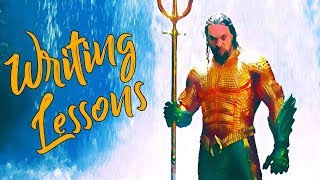

Why Aquaman's Writing is a Mess
53sThe opening hook immediately critiques the movie's writing with a humorous 'Michael Scott' reference, grabbing attention and setting up a controversial take.
▶ Play Clip"The title promises a writing analysis and delivers, but the sponsor segment and some tangents dilute the value."
This video analyzes the writing flaws in the 2018 film Aquaman, arguing that its overuse of sudden action scenes stems from excessive exposition and a fragmented plot structure. The creator, a writer, uses the film as a case study to explore pacing, character agency, and the influence of director James Wan's style.
Aquaman frequently interrupts scenes with sudden action, such as soldiers bursting in or explosions, which the creator compares to jump scares used to maintain audience attention.
Director James Wan's horror and action background is evident in Aquaman, with reused shots from Furious 7 and a tendency toward slow-motion and guitar riffs for dramatic moments.
The creator references Raymond Chandler's quote about having a man come through a door with a gun, explaining it was a cheap trick for pulp deadlines, not a storytelling ideal.
Aquaman contains a large amount of exposition about Atlantean history, politics, and character backstories, which is not used to set up action scenes but rather to worldbuild for later events.
The Mission Impossible franchise uses a talk-suspense-action structure, giving characters agency. Aquaman lacks this, instead alternating between talking and action without meaningful connection.
Aquaman's protagonist and antagonist have different goals, requiring double the exposition. The creator suggests alternative plots where everyone seeks the Trident or Aquaman learns diplomacy.
Despite visual spectacle, the story's foundation is flawed, leading to a lack of character agency and tension in the final battle.
The video concludes that Aquaman's reliance on sudden action scenes masks a structurally weak story, but acknowledges that spectacle and humor can partially compensate. The creator recommends a Skillshare course on humor writing.
Chandler's Advice
Explains the origin of a common writing trope and its misuse.
03:33Mission Impossible Structure
Provides a clear contrast to show how action scenes can be better integrated.
05:34Two Movies in One
Identifies a structural flaw that explains many of the film's issues.
06:34[00:00] There are several moments during Aquaman where I thought to myself, did Michael Scott write this movie?
[00:14] A curiously large number of scenes in Aquaman are interrupted by a sudden outburst of action. Soldiers burst into the Curry family home to arrest Queen Atlanta. Soldiers burst into the shipwreck to arrest Aquaman.
[00:27] An explosion interrupts King Orm Mid-Senton. An explosion interrupts Aquaman and Yura mid-flirtation. Think about this. What is the most exciting thing that can happen on TV or in movies or in real life?
[00:39] Somebody's a gun. That's why I always start with a gun, because you can't cop it. You just can't. I've been on to you and your little friends for weeks. Boo! Boo! Boo!
[00:53] Boo! I'm not even a thingy! Boo! Boo! Boo! They're not stopped! Taken on its own, this proclivity for suddenly throwing the viewer into an action scene isn't that big a deal.
[01:08] But in trying to figure out why this movie is written the way it is, a lot of the other problems in the story came to light. This isn't a movie that is terrible by any stretch, but it is one whose shortcomings I find useful.
[01:20] So let's, um, dive in, I guess? Really? A pun? Man, who wrote my script, Mr. Freeze? Aquaman was directed by James Wan, known for a long career in horror films, having directed Saw, Insidious, and The Conjuring, as well as one action film, the seventh-fastest series movie.
[01:42] And Aquaman is very much a James Wan movie. Even though the films have different cinematographers, there are a ton of notable shots in Aquaman that were also used in Furious 7. You've got these flowing, surreal transitions early in the movie, linking together settings that are not physically connected.
[01:57] In Furious 7, the camera tilts up away from a hospital in London, and then we're on a desert road. In Aquaman, we dive underwater and then arrive inside an aquarium. Then it's back to the aquarium, and here's a submarine.
[02:12] He also reuses this shot where we track the movement of a character getting body slammed. A montage in Furious 7 has the camera circling around characters in different scenes, intercutting it into one smooth motion.
[02:24] and in Aquaman, the same technique is used for a flashback. And when something is the most cool a thing can possibly be in a James Wan movie then there only one way to film it Slow motion with a guitar riff
[02:43] So, James Wan's style is all over this movie, and his style, at least in his action movies so far, is not subtle. It demands engagement. And with his long background in horror movies,
[02:55] I think it's worthwhile to think of the way these action beats start as jump scares. But jump scares work best when they happen within a spent scene.
[03:07] If you just throw them anywhere, they're a bit cheap, and it suggests the filmmakers are a little worried the audience is falling asleep. It's a way to temporarily jerk the audience into attentiveness. And I look at how these action scenes start the same way,
[03:21] which means what we really have to talk about is exposition and pacing. My, my, my, such a lot of guns around town, it's a few brains.
[03:33] One of the greatest writers of hard-boiled detective fiction, Raymond Chandler, once said, When in doubt, have a man come through a door with a gun in his hand. Now, while that quote certainly sounds like a piece of advice, Chandler actually said this in the 50s,
[03:47] reflecting on his career as a writer for pulp magazines in the 20s and 30s, where he had to write on a deadline and the emphasis was on content action. Having a man with a gun enter a scene without any previous setup
[03:59] was a cheap trick that he could get away with for that specific audience whenever he was short on time or didn't know how to develop the story organically. Superhero stories also originated in the Pulps,
[04:11] and the audiences of modern blockbusters are just as thirsty for action scenes as the readers of 1920s Pulp Fiction. And as a giant tentpole superhero action movie, Aquaman is practically obligated to deliver an action set piece every 20 minutes.
[04:26] The problem is that there is a lot of exposition in this movie. Like, a lot a lot. We have to learn about the rise and fall of Atlantean civilization, the forging and loss of the Trident, the Deathmatch, the giant squid monster, the politics of the Seven Kingdoms, and what happened to Arthur's mother.
[04:41] Now, normally, in an action movie, you only want to dole out as much exposition as the audience needs to understand the next action scene. Recently, the editor of Mission Impossible Fallout shared this graphic, which charts every movie in the franchise minute by minute, sorting each into three types of scenes.
[04:58] Talking scenes, suspense scenes, and action scenes. In an interview, he said that in these movies, the characters talk about what's supposed to happen, setting up the rules of the upcoming sequence. Then you watch that scene play out as suspense usually with minimal dialogue Then things don quite go to plan
[05:20] And that culminates in a large action set piece. In fairness, this is exactly how War on Sirius 7 is written.
[05:34] The benefit of doing it this way is that it gives the characters more agency in the story. They are choosing to fight and coming up with their own plans, rather than having fights thrown at them. If we made one of these charts for Aquaman, we'd only have talking scenes and action scenes.
[05:49] Now, that's fine in and of itself. Aquaman isn't a spy thriller and doesn't have to play by the same conventions as the Mission Impossible movies. But what I'm getting at is that the scenes of exposition are not utilized as a way to set up the action scenes.
[06:03] They're used as ways to worldbuild for stuff that's important much later in the movie, and when those scenes get boring, action scenes are used to resuscitate the pacing of the movie. Like, this scene where Aquaman gets captured didn't need to be a whole action scene.
[06:17] It could have just been one shot where a guy knocks him unconscious. But we just had to listen to five minutes of Atlantean history, so the audience needs a break. Send in the soldiers. So, really, the question is, why does this movie about two guys fighting with giant forks need so much exposition?
[06:34] And it's because Aquaman is actually two movies thrown into one. The protagonist and the antagonist of this film have completely different goals in the story and are rarely in the same scene together.
[06:49] Now, yes, they're both trying to be kings, but they're doing it in completely different ways that are not in competition with one another. Aquaman is trying to find a magic trident, Orm is trying to unite allies to his cause. And on top of that there is a secondary antagonist in Black Manta who has a different goal as well,
[07:05] killing Aquaman. This structure doubles or triples the amount of exposition the film requires than if they had all had the same goal. I mean, let's consider two alternative versions of this movie. In one, Orm is also trying to find the trident, or maybe Black Manta is trying to
[07:20] find it on Orm's behalf, or he's trying to get it for himself because he thinks it's the only way to kill Aquaman. In any case, everyone wants the Trident. Then Aquaman could battle with them throughout the story in a sort of Indiana Jones style hunt for a MacGuffin. They could
[07:33] fight, team up, hold each other hostage, all that good stuff. The movie wouldn't feel quite as episodic as it does now and would make Black Manta a threat for more than a single scene down the stretch Also the final fight could end with Arthur claiming the Trident rather than having the fight start after he already done so To me that a helpful change because despite the bajillion razors on screen the final battle has very little tension since the trident has been built up to be all
[07:59] Or, in our other alternative version of the movie, we can have Aquaman approaching the heads of the other kingdoms, trying to persuade them to join him. Of the two, this is, to me, more interesting, because somewhere in the back of my brain, I remember that I once saw this character fall
[08:13] through an entire building, so I'm never that worried about him losing a physical fight. But sign me up for the movie where this surfer dude has to learn diplomacy. Give him a fight that he can't punch his way out of, sort of like Ned Stark circa
[08:26] season one of Game of Thrones. So, in short, the disparate plot goals necessitate a ton of exposition for what could have been a relatively simple story. And because of that exposition, superfluous and sudden action scenes are inserted to rescue
[08:40] the pacing of the film. As a result, Aquaman doesn't really have that much agency in his own story, and he is instead either having something explained to him, or punching whoever got the jump on him.
[08:52] Spectacle can make up for a lot. Don't get me wrong, I too am a sucker for the eye-popping colors, the grand landscapes, the drum-playing octopus, and the giant squid voiced by Mary Poppins. And it's all filmed with clarity and gusto.
[09:06] But no amount of spectacle can save a story that has flaws at its foundation. Wait, do those sharks really have frickin' laser beams attached to their heads? You know, I have one simple request.
[09:19] And that is to have sharks with frickin' laser beams attached to their heads. Okay, never mind. All forgiven. Alright, so despite my criticisms, Aquaman was still a pretty funny movie.
[09:35] And I find writing comedy to be maybe the most difficult part of any kind of writing. which is why sometimes my videos don't even have jokes. But that's why I was happy to discover Mike Rocker's course on Skillshare called
[09:47] Humor Writing, Write Funny for the Internet, which you'll find useful if you're writing for the internet. It's right there in the title. So this episode was sponsored by Skillshare, which, if you don't know, is an online learning community with over 20,000 classes to choose from,
[10:02] many of which are about writing. If you want to give it a shot, the first 500 people to use the link in the description of this video will get a two-month free trial. A premium membership will also give you unlimited access to all of their classes. Thanks for watching, everyone, and a big
[10:17] thank you to all of my patrons for supporting this channel. Keep writing, everyone.
⚡ Saved you 0h 10m reading this? Transcribe any YouTube video for free — no signup needed.