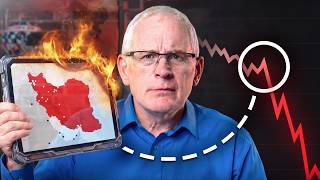

The biggest lie about the economy
47sExposes media deception about easing economic situation, creating urgency and curiosity.
▶ Play Clip"The title accurately reflects the video's core message that the economic threat from the gulf is serious and worsening, and the content delivers on its promise to explain the situation and its impacts."
The video argues that the economic consequences of the Iran conflict are more severe than mainstream news reports, focusing on six key impacts that will affect personal finances, jobs, and daily life. The speaker provides a breakdown of the situation, from oil price shocks to the risk of stagflation, and offers practical advice for viewers to protect themselves financially.
The speaker has identified six main impacts the Iran war will have on personal finances, starting with the need to understand the background of the conflict.
On February 28th, the US and Israel launched 'Operation Epic Fury', a coordinated strike on Iran targeting military sites, nuclear facilities, and senior leadership. Iran retaliated with missiles and drones.
Iran's closure of the Strait of Hormuz, a chokepoint for 20% of the world's oil, caused oil prices to nearly double from ~$61 a barrel to over $118 by the end of March.
Trump announced a two-week ceasefire, causing oil prices to drop and markets to rally, but the situation remains uncertain. The US Navy still warns vessels to avoid the waterway due to sea mine threats.
The first impact is rising energy bills, food prices, and transport costs. Oil is an 'invisible ingredient' in almost everything. The speaker advises against making big financial commitments based on assumptions that prices will drop.
Businesses face rising costs and reduced consumer spending, leading to cuts in overtime, hiring freezes, and layoffs. The hiring rate is similar to the 2008 financial crisis. Advice includes becoming harder to replace and starting an online side hustle.
Central banks cannot easily cut interest rates due to rising inflation, and printing money is risky given the national debt ($39 trillion). The speaker advises not to wait for government intervention as the playbook has changed.
Stagflation (high prices + weak economy) is a textbook setup. Moody's AI model predicts a recession with near certainty. The speaker suggests diversifying away from cash and growth stocks into real assets.
The US is trapped between three harmful options: raising interest rates (crashes stocks), printing money (fuels inflation), or stepping back from Iran (questions dollar dominance). Foreign central banks are reducing holdings of US Treasuries and buying more gold.
Low-income households spend nearly 33% of income on food vs 13% for middle-income. Government subsidies often end up as profits for large corporations rather than helping consumers. The speaker emphasizes taking personal responsibility for income.
The video warns that the economic impacts of the Iran conflict are ongoing and severe, urging viewers to prepare for a recessionary environment with rising prices, job insecurity, and limited government support. The key is to take personal financial responsibility, diversify assets, and develop in-demand skills.
What percentage of the world's oil passes through the Strait of Hormuz every day?
20%
1:53
What was the name of the US-Israel coordinated strike on Iran?
Operation Epic Fury
1:23
How much did oil prices rise from the start of the year to the end of March?
From around $61 a barrel to over $118, nearly doubling.
2:13
What is stagflation?
Stagflation is an economic situation where prices are high (inflation) while the economy is weak (slow growth or recession), making it difficult to use typical tools to fix either problem.
11:56
What is the Moody's AI model prediction regarding a recession?
The Moody's model is sitting at 49% probability of a recession, just one percentage point below a threshold that has correctly predicted every recession within 12 months.
13:51
What percentage of their income do low-income households spend on food, compared to middle-income households?
Low-income households spend almost 33% of their income on food, while middle-income households spend about 13%.
19:16
What is the current US national debt, and how much is the monthly interest payment?
The US national debt is $39 trillion, and the monthly interest payment is approximately $88 billion.
10:24
Iran closed Strait of Hormuz
This single action triggered a massive oil price spike and is the key economic shock discussed throughout the video.
1:46Oil is the invisible ingredient in everything
This is a crucial insight explaining why an oil spike affects nearly all consumer prices, not just petrol.
3:39Stagflation is the new threat
This redefines the economic problem from a simple recession to a more complex stagflation scenario, which has different solutions.
11:56Moody's AI model near recession threshold
Provides a data-driven, quantitative reason for concern, making the prediction more than just opinion.
13:51How economic crises widen inequality
Highlights a systemic, often overlooked consequence: crises disproportionately harm low-income households and corporate subsidies can be ineffective.
18:30[00:00] Believe it or not,
[00:00] the next economic shock
[00:03] and the news isn't telling
[00:05] I'm talking about the Iran war
[00:07] and the economic chain reaction
[00:10] because even if the situation
[00:13] the real financial consequences
[00:15] haven't hit the average person yet.
[00:17] This is gonna hit your finances hard
[00:19] and most people won't see it
[00:22] That's why today I thought
[00:24] what's actually going on,
[00:26] break down the direct impacts on you,
[00:28] and give you my thoughts on
[00:31] from the storm.
[00:32] I'm prioritizing getting
[00:34] so don't expect the editing
[00:37] It's far more important
[00:38] for you to hear all
[00:40] rather than later
[00:41] so you can take action quickly.
[00:43] Trust me, if you watch one video today,
[00:46] make it this one.
[00:47] Right, so I've identified six main impacts
[00:50] the Iran war will have on your finances,
[00:52] but for those to make sense,
[00:57] Have you ever noticed that
[00:59] seems to contradict the last one?
[01:01] It's almost like the mainstream media
[01:03] is purposely trying to
[01:06] so that we don't connect
[01:08] that actually matters.
[01:09] That's why I'm gonna give you a rundown
[01:11] of everything you need to
[01:13] in the shortest time possible
[01:15] before we get into the direct impacts
[01:17] on you and your finances.
[01:18] So on February 28th,
[01:19] the US and Israel launched
[01:23] code-named operation Epic Fury,
[01:26] firing nearly 900
[01:29] targeting military sites,
[01:32] and senior leadership.
[01:33] And as you can probably imagine,
[01:34] Iran didn't just sit there and take it,
[01:37] they fired back immediately,
[01:38] sending missiles and
[01:41] and allies across the Middle East.
[01:43] But the move that really
[01:46] came on March 2nd
[01:47] when Iran closed the Strait of Hormuz.
[01:49] Now, if you don't know what
[01:52] picture it like this.
[01:53] Imagine there's a single
[01:56] that 20% of the world's
[01:59] every single day with no alternative
[02:02] and someone just parked a
[02:04] Well, in this analogy, Iran is the lorry
[02:07] and the effects on everyday
[02:10] than most people realize.
[02:11] Within weeks, oil went
[02:14] at the start of the year to
[02:18] that's nearly doubling just three months
[02:20] and the biggest rise in nearly 40 years.
[02:23] And then just as everyone
[02:25] Trump announced a two-week ceasefire.
[02:28] Oil prices dropped, markets rallied,
[02:30] and people breathed a huge sigh of relief.
[02:33] It felt like the reset button
[02:36] except nobody can agree if it actually was
[02:38] because even now the
[02:42] Both sides have declared the strait open,
[02:44] but they can't even
[02:46] who is really in control,
[02:48] or how long it lasts.
[02:50] And even the US Navy is
[02:52] to avoid the waterway entirely
[02:54] because the sea mine threat
[02:57] So, is it open?
[02:59] Technically maybe
[03:02] but practically, the world isn't sure.
[03:04] And that uncertainty alone
[03:06] is enough to keep the damage going,
[03:08] because no matter what happens next,
[03:10] the shockwave is already on its way.
[03:12] The damage has been done,
[03:14] and that's what I wanna
[03:17] not the politics or the military tactics,
[03:19] I'm really not interested in that,
[03:21] what I'm interested in is
[03:24] for your money, your job,
[03:26] and your day-to-day life
[03:29] Because there are six
[03:32] that I think every single
[03:36] Let's get into them.
[03:37] (lively music)
[03:39] The biggest lie people
[03:41] is that the situation is cooling off
[03:43] when financially it's
[03:46] Yes, the fighting might be calming down,
[03:48] but that doesn't mean your
[03:51] and transport costs will also go down,
[03:53] that's not how this kind of shock works.
[03:55] Think of it like food poisoning.
[03:57] The moment you stop eating a dodgy prawn,
[03:59] it doesn't mean you suddenly feel fine,
[04:01] the poison is already in your system
[04:03] and it takes time to work its way through
[04:05] before you feel the full effects.
[04:07] That's exactly what's
[04:09] But Mark, aren't you
[04:12] This is just about oil prices, right?
[04:14] Well, yes, it's about oil prices,
[04:17] but no, I'm not being over the top
[04:19] because oil affects so much
[04:22] it's the invisible ingredient
[04:26] Think about your last grocery shop.
[04:28] Every single item on
[04:31] processed, packaged, and
[04:34] and every step of that
[04:37] And the moment oil gets more expensive,
[04:39] the steps get more expensive too
[04:41] until it finally lands on your receipt.
[04:43] Energy prices have already
[04:46] and I'm genuinely concerned
[04:49] over the next three to six months
[04:51] as a shock works its
[04:54] That means higher energy
[04:57] and pricier transport
[05:00] So what can you actually do about it?
[05:02] Well, the most important
[05:04] is be very careful about making
[05:07] based on the assumption
[05:08] that things are about to get cheaper,
[05:10] because realistically,
[05:12] your monthly expenses are
[05:15] before they come down.
[05:16] If you are thinking about
[05:19] taking on debt, or making a big purchase,
[05:22] just pause for a moment and
[05:25] to give yourself some breathing room.
[05:27] That's also why it's
[05:30] because a lot of what's
[05:33] fast moving, and easy to misunderstand,
[05:36] which means most people
[05:38] The ones who take the
[05:41] will definitely make better
[05:43] And that's exactly why I started
[05:45] a new YouTube channel recently
[05:46] called Mark Tilbury Economics
[05:48] where I break down the biggest things
[05:50] happening in the economy
[05:51] and explain what they actually
[05:54] So definitely consider subscribing
[05:57] with the stuff that actually matters.
[05:59] I'll leave a link in the description
[06:00] for those that are serious
[06:03] I actually think this is
[06:05] which is exactly why the second
[06:09] because it hits your paycheck.
[06:11] (lively music)
[06:13] If you are not where you
[06:15] this next part is gonna be hard to hear
[06:18] because your income might not
[06:21] You see, when your bills go up
[06:23] and spending goes down,
[06:24] naturally, something in
[06:27] which could result in you losing your job
[06:30] right at the worst possible moment.
[06:31] And if you think your job is secure,
[06:33] let me tell you why it might
[06:36] You see, when energy prices
[06:39] businesses get hit from
[06:42] On one side, their costs go up,
[06:43] like transport,
[06:46] things like that,
[06:47] and on the other side,
[06:49] because their bills are going up too.
[06:51] It's like a sandwich being squeezed
[06:53] from both sides at the same time,
[06:55] and when this happens,
[06:56] businesses have to make decisions fast.
[06:58] It usually starts small
[07:00] and freezing hiring,
[07:02] but as the crisis continues,
[07:04] it'll almost certainly lead to layoffs.
[07:06] And look, I'm not saying
[07:08] I'm saying this because the
[07:10] before the oil shock even hit.
[07:12] Job growth has been slowing down,
[07:14] companies have been quietly pulling back,
[07:16] and the last time the hiring rate
[07:18] was sustained at this level
[07:19] was during the financial
[07:23] If you have a job right now,
[07:25] you're probably safe,
[07:26] at least for the meantime,
[07:28] but my concern is that when you layer
[07:30] an energy shock like this
[07:31] on top of an already struggling market,
[07:33] everything accelerates.
[07:35] Historically, when
[07:37] energy spikes, businesses get squeezed,
[07:40] hiring slows, and people get fired,
[07:42] it's like a chain reaction.
[07:44] It's pretty worrying stuff,
[07:46] but luckily there are
[07:48] to protect yourself.
[07:49] First, don't assume your
[07:52] Even if your job feels solid right now,
[07:55] this is the kind of environment
[07:56] where things can change quickly.
[07:58] Second, if you're employed,
[08:00] focus on becoming harder to replace.
[08:02] That can mean picking
[08:05] improving your skill set,
[08:06] or just making sure you are
[08:09] not just someone they have.
[08:11] Third, start an online side
[08:14] to make you at least $10,000 per month.
[08:16] I know this might sound
[08:19] especially if you're
[08:21] However, you can learn an online skill
[08:23] in 20 hours of focused work
[08:26] and be better than 90% of
[08:29] I'm running a free online
[08:32] where I talk you through
[08:34] how to package it as a service
[08:36] and send it to businesses so
[08:40] If you wanna join me,
[08:41] I'll leave a link in the
[08:43] And fourth, don't sit around
[08:45] waiting for the government to step in,
[08:47] which leads me to the third impact.
[08:49] (dramatic music)
[08:51] If you don't wanna be like everyone else,
[08:54] then you've gotta assuming someone
[08:56] or something is gonna fix this for you.
[08:58] You see, if you've been through
[09:01] whether it was 2008 or the pandemic,
[09:04] you probably remember
[09:06] okay, this is bad,
[09:08] but surely the government
[09:10] and they did.
[09:11] Interest rates got cut, money was printed,
[09:14] stimulus checks got sent,
[09:15] and things stabilized fairly quickly.
[09:18] It wasn't pretty, but
[09:20] and most importantly, it held strong.
[09:23] But this time around,
[09:24] I'm worried that that safety
[09:27] You see, in a normal crisis,
[09:29] the first thing central banks usually do
[09:31] is cut interest rates.
[09:32] If you don't know what that means,
[09:34] a simple way to think about it
[09:35] is the price of borrowing money.
[09:37] When rates are low,
[09:40] so businesses take out
[09:43] people apply for mortgages,
[09:47] and the economy keeps going.
[09:48] So when something goes wrong,
[09:50] central banks cut rates to
[09:53] which gets the economy moving again.
[09:55] It's actually the most
[09:57] and it normally works a treat.
[09:59] But the problem right now is
[10:02] when inflation is rising
[10:04] because cutting rates pumps
[10:07] and more money chasing
[10:10] pushes prices up even further.
[10:12] And because oil just had its biggest spike
[10:14] in nearly 40 years,
[10:15] inflation is rising.
[10:17] So if you can't cut rates,
[10:18] why not just print more money
[10:21] Well, the US is currently
[10:25] in national debt,
[10:27] and the interest payments alone
[10:28] come to about $88 billion a month.
[10:31] That's roughly a trillion
[10:35] not funding hospitals,
[10:38] just interest.
[10:39] To put that into context
[10:40] because I know throwing
[10:43] can feel a bit alien,
[10:44] for every dollar the
[10:47] 19 cents of it now goes straight
[10:50] Think of it like someone who's maxed out
[10:52] every credit card they own
[10:55] to make the minimum payments every month.
[10:57] Would you tell that person
[11:00] Of course you wouldn't,
[11:01] and that's the position
[11:04] Every option they have to fix the crisis
[11:06] could cause a domino
[11:08] So what does this mean for you?
[11:10] Well, I suggest not waiting around
[11:12] for the government to make things easier.
[11:14] This isn't 2008 or the pandemic
[11:16] and the playbook has completely changed.
[11:19] To clarify, I'm not saying it's impossible
[11:21] for the government to step in and help,
[11:23] but the usual interventions
[11:24] just don't make as much
[11:26] Now, when you put all three
[11:29] rising prices, a weakening job market,
[11:32] and a government with limited tools,
[11:34] you start to get a scenario
[11:36] that economists actually have a name for,
[11:38] and that leads me to impact four.
[11:40] (lively music)
[11:43] Imagine it's a random Tuesday morning
[11:46] and you've just found out
[11:48] Then on the same day,
[11:50] an energy bill comes through your door
[11:51] and it's gone up by 30%.
[11:53] That's not just bad
[11:56] and it's one of the
[11:59] a country can find itself in,
[12:01] when prices are high,
[12:04] because the tools that fix one problem
[12:06] directly make the other one worse.
[12:08] Most people have heard
[12:10] being thrown around,
[12:11] but I don't think many fully
[12:14] so let's break it down.
[12:16] This might get a bit complicated,
[12:17] but I promise it'll all make sense soon,
[12:20] so just stick with me.
[12:21] In a normal recession,
[12:23] which has happened loads
[12:25] the economy shrinks, people lose jobs,
[12:27] and spending jobs,
[12:29] but at the same time,
[12:30] prices tend to come down too
[12:32] as a result of the decrease in spending.
[12:35] Stagflation, on the other
[12:38] the economy slows down
[12:40] and prices keep rising at the same time.
[12:42] So your income is under threat,
[12:44] but the cost of living
[12:46] Now, the tools that fix inflation,
[12:48] which is typically raising interest rates,
[12:51] make the recession worse.
[12:53] And the tools that fix a recession,
[12:55] typically cutting rates
[12:57] make inflation worse.
[12:59] It's kind of like being
[13:01] the more you struggle,
[13:03] It's pretty crazy, right?
[13:05] But let me bring it back to
[13:08] US inflation just jumped to 3.3% up
[13:11] from 2.4% the month before.
[13:13] And Goldman Sachs has cut
[13:16] down to 2.1.
[13:18] So put simply,
[13:19] prices are rising while
[13:22] which is a textbook setup
[13:25] Don't get me wrong,
[13:26] I'm not saying this
[13:28] but there's some interesting
[13:30] that I'd like to share with you.
[13:32] There's a company called Moody's
[13:34] and they've built an AI model
[13:35] that's been tested against
[13:39] to predict recessions.
[13:40] Every single time this model has crossed
[13:42] the 50% probability threshold,
[13:45] a recession has followed within 12 months,
[13:47] not just a few times,
[13:49] every single time.
[13:51] And right now that
[13:54] one percentage point away from a threshold
[13:57] that's never been wrong.
[13:59] And the worst part,
[14:00] that 49% reading was calculated
[14:02] before the Iran war even started.
[14:04] The last time the world
[14:07] was the 1970s
[14:09] and it lasted an entire decade.
[14:12] That's 10 years of high
[14:15] and shrinking standards of
[14:18] So how do you position yourself here?
[14:20] Well, the key thing to understand
[14:22] is that during stagflation,
[14:23] cash loses value
[14:25] because inflation is eaten away at it,
[14:28] but risky growth investments can also fall
[14:30] because the economy is shrinking.
[14:32] The people who survived the
[14:35] who own things that held
[14:38] basically, real assets that people need
[14:40] regardless of what the economy is doing.
[14:42] I'm not saying to go out and
[14:46] but if your entire financial
[14:49] or growth stocks,
[14:51] this might be the moment to
[14:54] rather than just riding it out.
[14:55] Now, one of the ways governments
[14:57] typically try to escape stagflation
[14:59] is by weakening their own currency,
[15:01] and that brings us to an impact
[15:03] that could affect every single
[15:08] Right now, every dollar
[15:11] every pension payment you are expecting,
[15:13] and every investment you
[15:16] as a system holding it up,
[15:17] and as things stand,
[15:20] are starting to question that system.
[15:22] The US dollar is what's known
[15:24] as the world's reserve currency,
[15:26] which sounds complicated,
[15:27] but all it basically means
[15:29] is when countries around the
[15:32] they mostly use dollars,
[15:33] and when governments want
[15:36] they do it in dollars.
[15:37] Think of USD like the
[15:41] Every country speaks their
[15:44] but when they need to do
[15:46] they all speak the same language,
[15:48] and that language is the dollar,
[15:50] which is incredibly powerful for America,
[15:53] but also very important
[15:56] And due to the war in Iran
[15:59] the US is trapped between three options
[16:02] and none of them are good for the dollar.
[16:04] Option one is to keep
[16:06] to control inflation,
[16:07] which would eventually bring prices down,
[16:10] but in the process, likely
[16:13] make borrowing more expensive,
[16:15] and push the economy
[16:18] Option two is to print
[16:21] but printing money into an
[16:24] could send inflation into double digits,
[16:26] which would eat away at
[16:29] Option three is to declare
[16:32] and step back from the Iran situation.
[16:34] But if the US can't reopen a
[16:38] that the world's oil depends on,
[16:39] other countries will start asking
[16:41] a very uncomfortable question.
[16:43] Is the US as strong as it used to be?
[16:45] And do we even need the dollar anymore?
[16:48] And that question is already being asked.
[16:50] You see, countries don't
[16:53] and instead they store
[16:55] in something called US Treasuries.
[16:57] If you've never heard that word before,
[16:59] think of it like this.
[17:00] It's basically a country
[17:03] into a special American bank account,
[17:05] and the US government then uses that money
[17:07] and pays them interest on it.
[17:09] For decades, it's been seen
[17:10] as one of the safest places
[17:13] but that seems like it might be changing
[17:16] because some countries
[17:18] their savings out.
[17:19] Foreign central bank
[17:21] just hit their lowest level since 2012.
[17:24] And instead of putting the money back in,
[17:26] they're moving it somewhere else, gold.
[17:29] And this is where it
[17:31] because gold now makes up 24%
[17:33] of central bank reserves worldwide,
[17:36] while US Treasuries only make up 21%.
[17:39] That's a complete reversal of
[17:43] when treasuries were 33%
[17:47] Now, I'm not saying the
[17:50] but it is worth asking,
[17:52] if the smartest
[17:53] and most powerful money
[17:55] are reducing their dollar exposure,
[17:57] should you at least be
[17:59] I'm not talking about panic selling
[18:01] or making any dramatic moves,
[18:03] but just asking whether your savings
[18:05] and investments are too
[18:08] or one type of asset,
[18:09] because every single one
[18:12] available to the US weakens the dollar
[18:14] in one way or another.
[18:16] And a weaker dollar means
[18:18] wherever you are in the world,
[18:20] which is why people often use the term,
[18:22] when America sneezes,
[18:25] And that brings me on to the final impact.
[18:28] (dramatic music)
[18:30] Let me ask you something,
[18:32] when your grocery bill went up recently,
[18:34] how did it feel?
[18:35] For some people watching this,
[18:37] it was annoying,
[18:38] maybe a bit jarring,
[18:39] but overall, just something
[18:42] And for others, it raised questions like,
[18:45] can we still take the
[18:47] That gap between annoying
[18:50] is exactly what I wanna talk about,
[18:53] because an economic crisis
[18:56] for everyone,
[18:57] in fact, it's not even close.
[18:59] I wanna be upfront here,
[19:00] this isn't a political point,
[19:02] and I'm not approaching this
[19:03] from any particular ideological angle,
[19:05] I just wanna walk you through the numbers
[19:07] because the story they
[19:09] If you are on a lower income,
[19:11] energy and food don't just take up
[19:13] a bigger chunk of your budget,
[19:14] they completely dominate it.
[19:16] Research shows that low-income households
[19:19] spend almost 33% of their
[19:22] compared to about 13% for
[19:26] So when oil doubles and food prices jump,
[19:28] someone earning a high
[19:31] but someone on a lower
[19:33] that changes their daily life.
[19:36] It's the difference
[19:36] between checking the price
[19:39] and wondering if you can
[19:41] Now, the obvious response is
[19:44] with subsidies and price
[19:47] but here's what actually
[19:49] During the Ukraine energy crisis,
[19:51] 95 of the world's biggest
[19:54] made $306 billion in unexpected
[20:00] and 84% of that went
[20:03] Think about what's
[20:05] The government takes money from taxes
[20:07] and uses it to cap what
[20:11] Meanwhile, the energy companies
[20:13] to the government and
[20:16] The money meant to protect ordinary people
[20:18] ends up flowing to the people
[20:21] It's like filling a bucket
[20:22] with a massive hole in the bottom.
[20:24] You're pouring as much in as you can,
[20:26] but the water's going somewhere
[20:29] It's the same pattern over and over.
[20:31] During the recovery of the
[20:34] the top 1% of US earners
[20:40] during that period.
[20:41] The reality is the middle class
[20:43] are being squeezed out of existence
[20:45] and nobody is coming to save you,
[20:47] that's why you need to take responsibility
[20:49] for your own income,
[20:52] So please take advantage
[20:53] of all the videos I've got on my channel
[20:55] because those that level
[20:57] and financial knowledge
[21:00] stronger and richer than ever before.
[21:02] If you wanna know why I'm changing
[21:03] how I invest my money because of AI,
[21:05] then I'm gonna leave that
[21:07] But don't click on it just yet,
[21:09] make sure to subscribe if you
[21:12] I'll see you over there.



⚡ Saved you 0h 21m reading this? Transcribe any YouTube video for free — no signup needed.