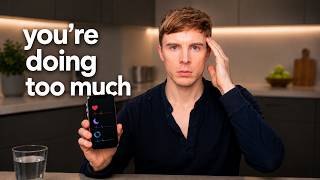

The Health Obsession Paradox
55sChallenges the common belief that more health effort always equals better health, sparking curiosity and debate.
▶ Play Clip"Title accurately reflects content; delivers valuable insights without exaggeration."
This video explains the counterintuitive phenomenon where an obsessive focus on health can actually harm well-being. It delves into the physiological and psychological mechanisms, including stress perception, the nocebo effect, and hormesis, to show how excessive health anxiety can backfire.
Orthosomnia (sleep anxiety), orthorexia (clean eating obsession), exercise obsession, and nocebo effects from expecting negative outcomes can all harm health despite good intentions.
A 2012 study found that believing stress is harmful increases mortality risk by 43%, while high stress without that belief shows no significant increase.
Expectation of benefit or harm changes brain physiology. Placebo reduces pain via brain's pain systems; nocebo increases it. Both are well-documented.
Small amounts of stress (exercise, cold, heat) make organisms more resilient. Eliminating all stress weakens health, as seen in NASA bed rest study losing 10% aerobic fitness in 70 days.
Studies show electromagnetic hypersensitivity symptoms occur even with fake EMF exposure. Up to 73 clinical trials demonstrate nocebo side effects from placebo pills.
Avoid becoming obsessed with minor health 'boogeymen' (microplastics, seed oils). The resulting stress and anxiety can be more harmful than the substances themselves.
Balance is key. Be health-conscious but not neurotic. Don't adopt others' nocebo effects. Free your mind from undue fear.
The video emphasizes that a balanced, less neurotic approach to health is more beneficial than extreme optimization. Recognizing the power of perception and hormesis can help avoid self-sabotage.
What is orthosomnia?
Sleep anxiety caused by trying too hard to fall asleep or worrying about not sleeping.
00:16
According to a 2012 study, what percentage increase in premature death is associated with high stress combined with the belief that stress is harmful?
43% higher risk of premature death.
01:24
What is the nocebo effect?
Negative effects from expecting harm, even when no active ingredient is present.
06:08
How many days did the NASA bed rest study last, and what percentage of aerobic fitness did participants lose?
70 days; 10% loss of aerobic fitness.
05:14
What was the finding of a 2010 review of 46 double-blind provocation studies on electromagnetic hypersensitivity?
People report symptoms even when exposed to fake EMF, indicating the nocebo effect.
07:28
Stress Belief Affects Mortality
Reveals that perception of stress is a stronger predictor of health outcomes than stress itself.
01:24Hormesis: Stress as a Strengthener
Introduces a paradigm shift: small stressors build resilience, challenging the idea that all stress is bad.
03:58Nocebo in EMF Sensitivity
Demonstrates how expectation alone can cause physical symptoms, highlighting the power of mindset.
07:28Avoiding Minor Health Boogeymen
Practical advice to reduce unnecessary anxiety over trivial risks, which can be more harmful than the risks themselves.
08:36[00:01] can make is becoming obsessed with health itself. Sometimes the people ones damaging their health the most. There is a point where trying to be less healthy. Here are some great examples of this. Orthosomnia or sleep
[00:16] anxiety. If you're trying really hard to fall asleep or you're anxious about not going to fall asleep or at least it'll take you many hours to do so. Orthorexia or obsession with clean eating. You get anxious and stressed about eating
[00:30] something that's not on your list of approved foods. The placebo and nocebo positive or negative effects from consuming or doing something, you're going to manifest those same expectations. Exercise obsession. You
[00:43] can end up doing hours and hours of exercise to either burn off calories or simulating how to get errors or something. In all of these examples, you're trying to make the healthier decision, but because you're so strict
[00:56] your health. So, I wanted to make this video to ex- plain the physiology and psychology behind this phenomenon. Why being too neurotic and too obsessed with your health can actually make you unhealthier. Let's start with stress
[01:09] stress. But stress may be harmful for your health only if you believe that it's harmful. A 2012 study looked at US adults and found that your perception of whether it harms your health and increases your mortality risk. People
[01:24] who experienced high stress, but also believed that stress affected their health negatively, saw a 43% higher risk of premature death. High stressed out harming their health didn't show a statistically significant increase in
[01:37] weren't statistically significant either. And the way you internalize stress may determine how harmful it becomes. Among older adults, the strongest psychosocial predictor of memory decline over 5 years was stress
[01:51] internalization. Perceiving to be more stressed out, feeling more hopelessness, and being less conscientious. This is quite a profound and important finding. By believing that stress is harmful for you, you create this placebo effect in
[02:03] your head. Your body and physiology expects the stress to be harmful for you, and therefore you manifest it in your nervous system. The placebo phenomenon is very well established in scientific research, and it applies to
[02:15] many different domains. MRI scans of people getting placebo treatment show that placebo treatment can turn down the brain's pain systems. In other words, believing you're being helped can actually make the pain feel weaker, even
[02:27] told you're getting something that will is fake. That expectation can lead your brain to turn down pain signaling before same happens when you're expected to be harmed. The expectation that it's
[02:42] harmful will change your nervous system to meet that expectation. It's basically preparing you to be stressed out and becoming harmed. What's the difference having sex with your partner? Both situations will elevate your heart rate.
[02:55] Both are physically exertion, both will raise adrenaline, and both will make you sweat. The difference is that you think the lion is going to kill you, and you perceive it as dangerous and harmful. Even if it's a pet lion at a zoo or
[03:07] these safaris, the lion who's dosed up on tranquilizers will still elevate your stressed out. Because what if the tranquilizer wears off and the lion's going to jump on you? If you had your own pet lion at home who you took care
[03:19] of since they were a cub, you fed and played with them for years, and the lion doesn't show any aggression towards you, you will treat it like a house cat. response by standing next to a wild lion or a random lion at the zoo compared to
[03:33] your home pet lion. The difference in these situations is your perception. You you've taken care of for many years since it was a cub, you perceive it to be not dangerous because it's your pet lion, right? But the wild lion isn't
[03:46] your friend in a sense. It's a wild lion, and it can be dangerous, which is why you perceive it as a potential threat even if you're not a safari. So, the way you look at things fundamentally changes how your nervous system
[03:58] responds. A much better way to look at stress is to adopt a mental hormesis model. Hormesis is a biological phenomenon seen in humans, animals, and even plants. Basically, a small amount of stress makes the organism stronger
[04:10] and more resilient. Hormesis has been seen to be responsible for the life animal research. Some of the longest living mammals in the world, like Greenland sharks and bowhead whales, who can live over 200 years, they live in
[04:22] very cold waters and scientists have identified a specific cold shock protein that gets activated in the cold to increase their DNA repair and explain people who don't exercise are at a higher risk of heart disease,
[04:35] Alzheimer's, cancer, and all cause mortality. There's also a ton of data high-temperature conditioning that strengthens your immune system, reduces disease, and dementia. Think about it. If you live inside a bubble, you live in
[04:48] constant room temperature, you're isolated from outside threats, outside bacteria, you're basically getting fed and kept in safety in a bubble. resilience, as well as your immune system, will get weaker over time
[05:01] anything that is even slightly uncomfortable or slightly stressful. Compare that to like a Navy SEAL who can handle 48 hours of sleep deprivation, 48 physical exertion. They can tolerate it
[05:14] is the NASA bed rest study where healthy people were told to lay in bed for 70 days. They couldn't sit, walk, or even go to the bathroom. After 70 days, the participants had lost 10% of their aerobic fitness, 23% of their soleus
[05:28] muscle size, and up to 20% of their muscle strength. All because their body fitness anymore, even if it's just from standing and walking. Those are extreme examples of hormesis. If you eliminate even the hormesis of gravity, your body
[05:42] space, they're not exposed to gravity that much, their bones become brittle, they lose their muscle mass, and they're unhealthy when they come back. The same applies to some other forms of stress down here on the earth. By adopting the
[05:55] harmful effects of stress because you know that it's not harmful for you. You healthier. There's also one critical component we need to talk about, and that's the nocebo effect, the opposite of placebo. Basically, you're told that
[06:08] this treatment, this supplement, or this food is going to have negative side effects, and therefore you expect those negative side effects. Even if the documented in scientific research, as shown by this review of 73 clinical
[06:21] patients are told about possible side effects of their medicine, even those in the placebo groups who received the fake pill with no active ingredient often report symptoms that match the side effects of the drug being tested.
[06:34] getting causes side effects like nausea or cramps, but it's a fake pill, there's still experience those same side effects, even if it's a fake pill. In this experiment, healthy volunteers received identical heat pain stimuli.
[06:48] One condition was told that it's going to reduce pain, and the other was told though the objective pain stimulus was degrees or volts, the nocebo condition experienced subjective increases in pain
[07:02] week. That's why you have to be very careful with what you and who you listen to online. A lot of people might share their own subjective experience by taking some treatments or using some foods or supplements, and other people
[07:15] will start to believe it. They start believing it because it's the nocebo effect. A good example of this is electromagnetic hypersensitivity, which they have. They get headaches or they feel stressed, they can't sleep, and
[07:28] they feel agitated when they're around Wi-Fi and cell towers. Well, a 2010 review of 46 double-blind provocation studies on over 1,100 people who hypersensitivity found that people report symptoms of EMF sensitivity even
[07:42] if they're getting exposed to fake EMF. Basically, the scientists tell these people, "You're getting exposed to these EMFs, like there's a Wi-Fi router in the room. It's emanating 5G or whatever it is." They start feeling the side effects
[07:54] of EMF sensitivity, such as they feel stressed, they feel agitated, they even Wi-Fi router and they think they're getting exposed to 5G, but in reality, there's no 5G, there's no Wi-Fi. They're in an isolated environment where there
[08:08] is no EMFs. But they still start feeling those same symptoms of EMF sensitivity if the doctors say that there is a Wi-Fi router. Likewise, in these other blinded experiments, when no one knows what's going on, no one knows if there is EMF,
[08:22] if they don't know whether or not there is EMFs around them. So, this is the nocebo effect. You know there are certain side effects from whatever thing it is, let's say vegetables, EMF, air pollution, microplastics, whatever it
[08:36] effects, but even if there is no active ingredient in those, you start I'm not saying there aren't any legitimate cases of EMF sensitivity, I'm cases of mold sensitivity, food intolerances, etc. But in a lot of
[08:51] cases, it's a nocebo effect. People are just expecting to get those negative because the body wants to meet those expectations. So, what's the practical takeaway from this video? It means that if you go really down the rabbit hole of
[09:04] trying to be the healthiest person you can be, you can end up harming your health by creating this nocebo effect, by becoming stressed and anxious about everything, and becoming less resilient to things that don't actually harm your
[09:17] social media, there's every different normal person has to be afraid of. There's microplastics, artificial sweeteners, seed oils, sugar, EMF, air pollution, mold, plant toxins, etc. Some
[09:30] of these boogeymen are legitimate health hazards, such as secondhand smoking, smoking. Microplastics, you know, I would certainly try to minimize my plastic exposure, don't microwave plastic Tupperware, buy glass bottles
[09:43] airport and you drink a plastic bottle water, it's not that big of a deal if don't act as they start to sabotage your own health by believing that it's harming you because that's going to cause more stress and more anxiety. And
[09:57] you will start to experience more symptoms of these negative side effects. health hazards that will harm your health. Like you live next to a nuclear radiation or you live next to some sort of a industrial factory and it pollutes
[10:11] is. Those are legitimate health hazards and they can harm your health and shorten your lifespan, but that's not what's happening on social media. On social media, you have relatively harmless boogeymen that in the grand
[10:23] health and longevity significantly. But because you might start believing that diligent and you try to optimize every more harm. So, the overall message of this video is yes, you should try to
[10:37] it to a reasonable degree, but don't become obsessed with it so much that you become anxious and stressed out by every potential boogeyman around because that's going to cause more harm to your health. And you shouldn't believe other
[10:50] people's nocebo effect. If someone says that they get a stomach ache by eating this food or taking this supplement, then don't automatically believe it because you will adopt their nocebo effect. Because as Morpheus from The
[11:03] Matrix said, you need to free your mind. >> Your mind. health span without spending hours at the gym, without spending thousands on
[11:16] supplements, and get yourself to top 1% of health without obsessing about it, then check out my online community Youth & Society. It's where you can learn more detailed programs and protocols from me. Link in the description.
⚡ Saved you 0h 11m reading this? Transcribe any YouTube video for free — no signup needed.