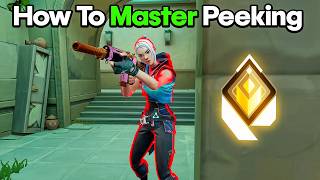

Why You Suck at Peeking
40sOpens with a relatable frustration and a blunt, controversial claim that peeking is easy, hooking viewers who struggle with it.
▶ Play Clip"Delivers solid, actionable advice on peeking, but includes a lengthy coaching plug that dilutes the value."
This video from IRP coaching explains why players struggle with peeking in Valorant and how to improve. It emphasizes that mechanical execution is less important than micro-decision-making and game sense, and provides specific techniques like the T-rule, pre-aiming, and context-based peeking.
Most players suck at peeking because they lack game sense and micro-decision-making, not mechanical skill. High-level players have encountered hundreds of peeking situations, allowing them to choose the right peek almost unconsciously.
The further you are from an angle, the harder it is for the enemy to see you first. Closer peeks are easier for the enemy to spot, but can be advantageous with close-range weapons.
With close-range weapons (shotgun, SMG, etc.), peek closer to throw off crosshair placement. With rifles, you need more distance to maintain accuracy and movement.
When facing multiple enemies, peek from further back to isolate one angle at a time, using the 'slicing the pie' technique. This prevents being overwhelmed by multiple opponents.
The most effective peek is often the one the enemy doesn't expect. Using unusual peeks like crouch peeks or jump spotting can give you more time to land the kill.
To improve game sense, ask yourself context-based questions during play (e.g., weapon, enemy positions, expectations) to build unconscious habits over time.
Visualize a line from the enemy's POV to the angle they hold. Peek perpendicularly to that line, forming a 'T'. Avoid diagonal W-key movement; use A and D to strafe.
Diagonal movement appears slower on the enemy's screen, makes you an easier target, and makes it harder to stop accurately. A/D strafing allows better dead-zone shots and easier cover reset.
Always imagine potential enemies in every angle, especially when you have no information. Better players clear angles slowly to isolate fights, increasing focus.
A great peek is useless without proper crosshair placement. Practice pre-aiming by clearing angles offline or in DMs. Game sense helps you know where to pre-aim based on round context.
The perfect pre-aim peek involves placing your crosshair at head level, strafing laterally with one or two steps, and shooting with minimal adjustment.
Top players like Premy, Demon1, and aspas use movement as the catalyst for their peeks, including crouch peeking and stopping on a dime. Practice with a Sage wall drill in the range.
Dry swinging isn't inherently bad; it depends on context. Good dry swings use information and timing, while bad ones ignore enemy positions and utility.
Peeking is confidence-based. The best players play with flair and try creative peeks, which often lead to memorable plays. Don't be afraid to experiment.
Improving your peeking in Valorant requires more than mechanical skill; it demands game sense, context-based decision-making, and confidence. By applying techniques like the T-rule, pre-aiming, and situational awareness, you can significantly enhance your peeking effectiveness.
What is the T-rule in peeking?
Peek perpendicularly to the line from the enemy's POV to the angle they hold, forming a T shape.
04:25
Why should you avoid W-key peeking?
Diagonal movement appears slower on the enemy's screen, makes you an easier target, and makes it harder to stop accurately.
05:18
What is the perfect pre-aim peek?
Place crosshair at head level, strafe laterally with one or two steps, and shoot with minimal adjustment.
08:39
What drill is recommended for practicing peeking?
The Sage wall drill: place a wall in the range, peek to see one bot at a time, and add crouches at the end.
09:05
What is the key factor in Oxy's successful dry swing?
He used information from teammate and radar to know enemy positions and timing, making the dry swing a high-percentage play.
10:22
Distance and Angle Advantage
Explains a fundamental principle that many players overlook: distance from the angle affects visibility.
01:21The T-Rule
Provides a clear visual framework for peeking perpendicularly, a core technique.
04:25Dry Swinging Context
Shows that dry swinging is not inherently bad, but depends on context and game sense.
09:43Confidence in Peeking
Highlights the psychological aspect of peeking, often ignored in mechanical guides.
12:48[00:01] before. You know exactly where the enemy is. You swing the corner ready to click their head. All of a sudden, bang, one tapped. You had zero chance to win. And sometimes you don't even see the player before the rifle shot pops. So, what do
[00:14] situations? The reality that I've realized from coaching over the years is that most of these students suck at peeking without even realizing it. And experiencing the same issue, I'll go over why your peeking sucks and how the
[00:27] effortless. Let's start with a controversial but blunt truth. Peeking properly, in all its forms, is pretty easy in the long run to learn and do. In fact, executing most movement ideas in Valorant isn't hard as long as you
[00:41] practice consistently over time. The real ceiling that players can't break is actually their micro-based decision-making with peeking and the To not suck at peeking, you need to be more than just mechanically executing
[00:55] the ideas. You need game sense. And what makes high-level players so good at choosing the right peak and executing it almost perfectly is that they've been in every kind of peeking situation hundreds upon hundreds of times. Is the secret
[01:08] sauce of peeking then spamming a bunch of games to get to that level? Well, the best method. Before we get into different methods, let's get a baseline or may not know. Let's start with something that you might already know.
[01:21] The further you are from an angle, the harder it is for an enemy to see you first in a fight. The closer you are to an angle, the easier it is for an enemy knowledge when you're peeking, right? But here's where game sense comes to
[01:33] play. We now have to decide when to peek closer or further based on a few context-based in-game decisions or in a more broad sense, your micro-decision-making. First, do you have a long-range or close-range weapon?
[01:46] If you have a close-range weapon like a shotgun, an SMG, or maybe a Bandit, we obviously want to peek closer to the angle more often than not. And part of that is because when you peek closer with these types of weapons, you can get
[01:59] more of an advantage by throwing their crosshair placement off in a way they aren't expecting because your movement can be maintained more often with these potentially facing multiple enemies? Meaning in the sense of do you have to
[02:12] multiple angles? If we need to isolate angles, we should peek from further back just enough to see one enemy at a time as we slice the pie. Otherwise, when you have those rifles and you try to peek
[02:24] earlier like on those closer angles, you're not going to be able to move as much or as dynamically with those other weapons we mentioned because your movement and accuracy is going to be way more punishing. Third, but not least,
[02:36] expecting? Sometimes, you do want to peek close with the rifles that normally you're in a one-v-one and they're not expecting you to swing in a weird crouched peek or jump spotting before the peek happens and then swinging wide.
[02:52] The least expected peek is the best peek for most scenarios. That's because the crosshair for where you're going, potentially tracking you in those moments, and giving us more time to land the kill and adjust our own shot. From
[03:05] questions when playing so that you can speed up the learning process and apply all of these different ideas into your game sense decision-making around level where you can feel these scenarios without thinking about them directly,
[03:19] which is why the context of how or when you peek is important to learn before you get to this unconscious habit building. Keeping this in mind, if you peaking, everything we've talked about
[03:31] enough to improve your peaks. But before we get into this next peaking idea, I about whether your peaks actually suck? Do you struggle to know exactly what is wrong with your gameplay in general? Here at IRP, our team of radiant and VCT
[03:44] level coaches can give you personalized feedback inside our premium 10-week Immortal Roadmap program. We'll address exactly what you need with over 80% of our students gaining 500 RR in 6 weeks, and the reviews are incredibly positive.
[03:58] We offer over 100 plus hours of personalized coaching, including one-on-ones, mechanics drills, and private scrims right there with the rest our coaching that if you don't rank up 500 RR in those 10 weeks, we'll either
[04:11] give you a full refund or coach you longer at no additional cost. We have program, so use the link in the description to book a call where we'll review your tracker to see if you'd be a good fit for us. Now, back to the video.
[04:25] I mentioned this earlier with slicing the pie, but visualizing the peak is to do. The best way I found when visualizing that angle advantage and how to approach a duel is by applying the slicing the pie into a different
[04:38] context, the T rule. I prefer using the T because it's way easier to show you guys the visual and what it looks like when you're approaching different about a normal fight from one angle to the next. And to apply this, we're going
[04:52] to show you exactly what I mean. Imagine a line from the enemy's POV to the angle they're holding. That is the line you need to peek perpendicularly to have an rule is that you'll be forming a literal T when executing your peek correctly.
[05:05] That means that no diagonal W key led movement is allowed when properly executing this T rule. You should almost always peek using A and D to avoid using W when swinging to the new angles because of a few different reasons.
[05:18] First, the diagonal movement appears slower on the enemy's screen. Therefore, you will always be an easier kill. Second, you're using more movement keys keyboard hand will be suffering as a result of the amount of inputs you are
[05:32] struggle to stop in time to be accurate when taking your shot, and that's a huge part of being accurate with any weapon in Valorant is the ability to dead zone your shots. Third, you don't give yourself a chance to reset when holding
[05:45] W. A and D strafing allows you to go in and out of cover much easier when approaching awkward angles or corners. Compare that to your W key where you have to awkwardly press S and some combo of A and D to get back into cover in the
[05:57] to get into cover in general, so make it very simple reason why your peaks look so sloppy is that you're constantly caught off guard or zoning out when approaching these new angles. A simple
[06:10] tip to work on this is to literally imagine enemy players in every potential have no information, it doesn't make sense to rush into a space that you have no idea where players are. In fact, if you look at better players, you'll often
[06:23] see them clear angles extremely slow to isolate fights, making their pace overall slower, but their focus increases to its maximum effort in order previously mentioned. I bet some of you are asking now how to apply all of these
[06:36] mentioned so far. So, let's get into it. First, a great peak is useless if your crosshair isn't in the right spot. I know, it's crosshair placement. A but if you don't get this down, it doesn't matter how good your movement
[06:50] is. This means for you, you have to learn to pre-aim and therefore improve that very first mechanic surrounding the fundamentals of peaking. There's some improve your crosshair placement like going through the map in offline and
[07:03] clearing those angles one by one or repetition through DMs. But, crosshair more prominent that a lot of people miss when they're practicing, and that's game sense. Game sense in this case is what lets you memorize every angle and know
[07:17] pre-aim and clear the angle in one step. But, it's not limited to just this pre-aim idea. Part of what game sense allows you to do is you can use context of the round to see where your crosshair needs to go or the context of previous
[07:32] going to get the most value. Example of this is that pros do this naturally because they put thousands of hours to not just learn the physical aspects of a placement for their character models, but the in-game sense on when to pre-aim
[07:46] for certain angles depending on the time in the round or the context of what has you might see the average player doing these same type of pre-aims, they'll end they aren't familiar with each spot on the map or when those spots are
[08:00] different ideas that could come through. For example, you might be clearing this very distinct player off of the B main line on Fracture, but because they're Chamber, they can go and peek out wide and not get punished like you might
[08:13] expect from another type of player. In fact, when you re-approach B main in the next round, the Chamber chooses a slightly different angle around B main, not expecting it because you're not familiar with the fact that Chamber can
[08:26] TP away from these off angles. So, this makes it easy for you to get caught off of agents. Or maybe your pre-aim in general wasn't perfect for the common angles, and you're not expecting a Killjoy to peek even though a Killjoy
[08:39] times from that same position, and you are not punishing it properly because you don't keep tabs on those agents. So, let's talk about the perfect pre-aim peek before we move on. Perfect pre-aim peek looks like this. You place your
[08:52] laterally with one or two steps, and then you shoot. You rarely should need to adjust your crosshair outside of a micro-adjustment. If you're doing this we've talked about. The next fundamental part of how we approach these peaks is
[09:05] your movement. It's no surprise if you look at players like Premy, Demon1, or aspas that their movement is the catalyst for their peaks. Not only do crouching as a part of their peeking style, players like him are also able to
[09:17] stop on a dime and isolate even the smallest of angles. To get to this level, you can try this Sage wall drill in the range. Pick Sage and place a wall the wall to practice peeking just enough to see one bot at a time. You can also
[09:30] add in crouches at the end of your peek to practice a Premy style of crouch peeking. This is especially a useful drill because it teaches you slicing the pie and isolating corners like you would in game without the pressure of fighting
[09:43] we've talked about this before, but we'll give a more clear example of starting about the context of how the in-game rounds play into your imagination. As an example of this, I guarantee most of you watching this
[09:57] video have dry swung before and gotten punished for going for your swing. Does that make dry swinging itself a bad kind of peek? No, not at all. In fact, dry swinging can be the best option depending on the context. So, let's look
[10:10] at some good and bad context scenarios for dry swings and how your imagination tracking and understanding can help you decide on when to do something like dry swinging. For a good dry swing scenario, we have a quick one-two punch from Oxy,
[10:22] C9's signature duelist. First, Oxy knows there is a minimum two grass from the spam on doors for this Haven round. Next, his teammate walking down B gives information on exactly where one of the player's grass is.
[10:35] Grass one on the box, across window. Helping him visualize where they are the angle. Finally, as he swings off of the radar and goes for the dry swing distracted, this will lead Oxy to then win the round with three in total to
[10:49] Oxy's name. But the key factor in this round was how Oxy used dry swinging to his advantage. This wasn't an instant barrier peek to dry swing into three. This wasn't a fight with his full neon kit. This was a fight of pure timings.
[11:02] The game sense factor here that gives him the edge is he knows the enemy won't is creating all that presence mid so he has that timing to make a risky play were to do it on his own. Now, in the same game, Oxy is in a way different
[11:17] hiding behind the barrier looking for a place to rotate and fight with a weaker buy. His goal this round is to use his old on the flood to help his team. Inherently, not dry swinging because he is using his ultimate utility. However,
[11:30] planned. His team does well without him needing to old. So he adjust in his mind popping his old to trade his teammates. Now here's the issue. He has a very weak
[11:42] teammate who just died garage. Because of where they popped up on the radar, he the silver to trade with his shorty. This isn't the highest percentage play and this is partially what loses his team the round. The slight difference in
[11:56] despite the similarities in the round themselves show the dry swinging nuance and how the context and game sense play into a good versus a bad fight. He original plan to trade but because of that small change in his plan, the round
[12:10] is lost. In both examples, there are some other tools Oxy used that you should use yourself when approaching how and when to swing based on the context radar to pre-aim and help his crosser placement on trades, he uses his
[12:23] to take the fight in the defense setups. This gives him a higher chance to win these rounds on defense. Now, attack might look different for him since he team would take over the role he had on defense of playing trades. These
[12:36] different context based things that affect your decision making on how or when to peek matter and you should be knowledgeable on what your role is in the round or in your team's comp in order to make those decisions. One final
[12:48] observation that you need to implement that the best of the best do is to be aren't the perfect peaks. Peaks themselves are extremely confidence based. a math equation that can be solved. You need to play with flair and
[13:01] of the cool memorable peaks you know, such as a pop and swing or jiggle one tap peaks, come from a player being extremely confident and trying to get have some fun and try some of these new kinds of peaks or new approaches to
[13:15] peaking. And if you're still interested in learning more from us, check out our video with the ultimate aim guide for 2026. Otherwise, I'll see you in the 2026. Otherwise, I'll see you in the next one.
⚡ Saved you 0h 13m reading this? Transcribe any YouTube video for free — no signup needed.