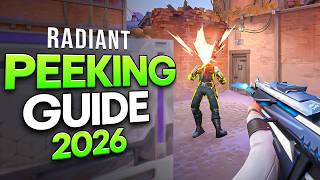

The #1 Peeking Mistake in Valorant
60sExplains a fundamental concept (distance from angle) that changes how players understand peeking, with clear visual reasoning.
▶ Play Clip"Delivers a solid, updated guide on peeking with practical techniques, though it includes a lengthy sponsor segment."
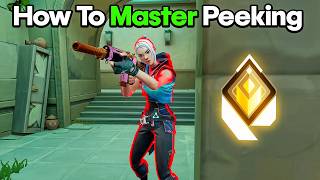
This video provides a comprehensive guide to peeking in Valorant, updated for 2026. It covers fundamental techniques like standard, wide, and jiggle peeks, then advances to expectation-manipulation tactics such as crouch peeks and pop swings, and finally addresses situational peeks against operators, shotguns, and in team scenarios. The guide emphasizes using A and D keys, maintaining distance from angles, and adapting to enemy expectations to gain a competitive edge.
Your point of view is centered in your head, so hugging a wall limits visibility. The player further from the angle sees the enemy first, so hugging the back wall exposes you less and gives the enemy less time to react.
The traditional peek involves always hugging the back wall and swinging each angle one by one. This minimizes exposure and is the standard approach.
Wide peeking (lateral swing) makes you appear faster on the enemy's screen due to proximity, making you harder to hit. It's used when committing to a peek, especially with close-range or fast-moving weapons.
A jiggle peek involves swinging minimally to gather info or bait shots, then returning to cover. Use it with your knife out for faster movement and safety when just gathering info.
Only use strafing keys A and D when peeking. Avoid combining A/D with W to maintain maximum speed on the enemy's screen and avoid giving them an easy target.
Crouch peeking is effective at higher ranks where enemies hold head height. Tap the crouch key as you swing to make your head follow a parabolic path, allowing you to strafe between shots.
The pop swing is an exaggerated wide swing that catches enemies off guard because they expect a normal peek. It works best at close range and can be combined with firing early to induce panic.
Vary your peeks to keep enemies guessing. If you jiggle peek, they'll hold tighter; then swing wide to fly past their crosshair. Never swing the same way twice.
Against an operator, use utility or shoulder jiggle peeks to bait out the shot. Hug the wall for max horizontal speed and jiggle to expose only your shoulder.
Against shotguns, fully commit to the swing to avoid giving them time to close distance. If forced, maximize distance by hugging the back wall and pre-fire.
When entrying, wide swing to create space for teammates to trade. Jump peeking can also be used to drag enemy crosshair and allow teammates to clean up.
When supporting a teammate, hug the wall to limit the time the enemy has to kill your teammate and readjust to you. This leaves fewer angles for the enemy.
Use sound cues, dual peeks, wide peeks, standard peeks, and crouch peeks to isolate each enemy and face them with the best peek possible, as demonstrated by Forsaken's clutch.
Info peeks are done with knife out to gather information. The air strafe jump peek is common, but silent jump peeks (crouch then uncrouch mid-air) are safer at higher ranks.
Mastering peeking is fundamental to climbing in Valorant. Start with the fundamentals, then layer in advanced techniques to manipulate enemy expectations and adapt to different situations. Practice consistently to improve your peeking and overall gameplay.
Why does the player further from the angle see the enemy first?
Because they are further away, they see more of the enemy sticking out, giving them a visual advantage.
01:05
What is the traditional peek?
Hugging the back wall and swinging each angle one by one to minimize exposure.
01:18
Why does a wide peek make you appear faster on the enemy's screen?
Because you are closer to the enemy, so your movement covers more of their screen, making you seem faster.
01:43
What keys should you use when peeking?
Only A and D (strafing keys), avoiding W to maintain speed.
02:36
How do you execute a crouch peek effectively?
Tap the crouch key as you swing, making your head follow a parabolic path and allowing strafing between shots.
04:45
What is a pop swing?
An exaggerated wide swing that catches enemies off guard because they expect a normal peek.
05:13
How should you peek against an operator?
Use utility or shoulder jiggle peeks to bait out the shot, then close distance or hold the re-peek.
06:56
What is the recommended peek against shotguns?
Fully commit to the swing to avoid giving them time to close distance.
07:34
What is the purpose of a jump peek in team play?
To drag the enemy's crosshair and allow teammates to trade you easily.
08:25
How do you perform a silent jump peek?
Start the peek while crouched and uncrouch mid-air to make no noise.
10:20
Distance Advantage
Explains a core geometric principle that determines who sees whom first, fundamental to all peeking.
01:05Wide Peek Speed Illusion
Reveals why close enemies seem faster, a key insight for aggressive plays.
01:43Crouch Peek at High Ranks
Shows how to exploit common crosshair placement habits, a high-level tactic.
03:04Pop Swing Effectiveness
Demonstrates a counterintuitive but powerful technique that works because of predictable enemy behavior.
05:13Isolating 1v1s
Highlights the importance of using varied peeks to isolate enemies, as shown by a pro clutch.
09:16[00:02] down to either an enemy peeking at you or you peeking at an enemy. Therefore, mastering the art of peeking is a fundamental skill in Valorant, one that could definitely help you climb in 2026. And luckily for you, I've studied the
[00:14] pros and hit radiant myself, so I'm going to break down exactly what peak to use, why it's the best choice, and how to execute it in ranked. I'll also go into some advanced peaks for specific in-game scenarios, so stick around till
[00:26] the end, and welcome to the 2026 updated Valorant peeking guide. To begin, we must first understand the fundamentals of peeking. Your eyes, and in Valorant's case, your point of view, is placed in the center of your head. So, this means
[00:39] that if we hug the edge of a wall, putting our head in the middle, we can't see anything. Let's say you and an enemy are both hugging the edge of a wall at both won't be able to see anything. However, if you simply walk backwards
[00:52] into B main, you start to see more and more of the enemy. If he does the same, he'll also start to see more and more of you sticking out. However, you can go a lot further back than you can, all the way to back site. You'll notice that the
[01:05] player standing further from the angle will see more of the enemy. Therefore, the player that's further away from the angle will see the enemy first. [music] With this in mind, by constantly trying to hug the back wall as far away from
[01:18] the angle as we can, we will stick out less. And this exposes us to fewer angles at a time and gives the other player less time to react when we swing. The traditional peak involves always hugging the back wall and swinging each
[01:30] angle one by one. So, given this, you would think that we should never swing close to an angle. But how come you often see pros do precisely that? Well, the closer we are to the wall, the closer we are to the enemy, and the
[01:43] faster we'll move on the enemy's screen. Of course, our movement speed is not actually higher, but imagine an enemy running at full speed from a close distance compared to an enemy running further away. Who looks faster? Well,
[01:55] I'm sure you'll agree that close enemies seem to move faster and are even harder to hit when they're at full speed. This is why the wide peek or the wide swing is mainly used. Wide peeking simply means peeking laterally while running
[02:07] than a standard peek. Wide peeks are a strong tool when we want to commit to a peek, especially with a close-range or a fast-moving speed weapon. And another fundamental peek you'll often see is the jiggle peek. A jiggle peek is when you
[02:21] swing as little as possible to peek out, then instantly moving back behind cover shoot prefires between directional changes, or you can just use it to check should jiggle peek with your knife out if you're just trying to get info,
[02:36] just faster and safer. So, whether it's a standard peek, a wide peek, or a jiggle peek, you should only use your strafing keys A and D. You want to avoid strafing key [music] and W key at the same time. If you do this, it'll slow
[02:51] down your speed of movement on the enemy's screen and can even give them an moving closer to the corner. The goal is while minimizing the frames your
[03:04] the chance of getting hit. So, when you peek, focus on using your crosshair and your A and D keys with zero forward or backward movement. Next, we'll cover peeks that manipulate enemy expectations. And these require both you
[03:18] and your opponent to have solid game sense. So, at lower ranks, I'd almost that we just discussed earlier. But before we do that, if you think that your peeks aren't holding you back, but you're still stuck in the same rank, my
[03:31] team of Radiant and VCT coaches can give you feedback inside our premium 10-week Immortal Roadmap program. Our average student gains 500 RR in just 10 weeks, our students have to say about us. We offer a 100-plus hours of personalized
[03:46] mechanic drills, and even coach-facilitated private scrims. coaching that if you don't rank up at least 500 RR in 10 weeks, we'll give you a full refund. So, use the link down below to book a free call with me or one
[04:01] tracker together, go over your goals, and see if we'd be a good fit. Now, back how to play with enemy expectations [music] is to begin with the crouch peak. You've probably been told a hundred times not to crouch in fights,
[04:16] Prxmi, he does it in almost every single gun fight. The crouch peak is extremely effective at higher ranks since everyone will be holding their crosshair at head height. Therefore, if we assume that our enemy is holding at head height, we can
[04:30] abuse a crouch peak and force them to have to adjust their crosshair [music] low ranks, we can't safely assume that the enemy will be holding at proper head ranks, people might assume you're going to crouch peak and hold right below head
[04:45] level. Hence, we'll notice this meta of always trying to predict how your enemy peaks that work against it. But, how do we even pull off a clean and proper crouch peak? To pull off an effective crouch peak, we want to simply tap, not
[05:00] hold, the crouch key as we swing into the angle. This will make our head follow a parabolic path rather than going straight down. It also allows us to still be able to strafe between our shots if we don't hit our initial one.
[05:13] Now, the most exaggerated and obvious example of playing with expectations is the pop and swing. What seems ridiculous on paper actually works incredibly well because enemies have fixed crosshair placement as a result of expecting a
[05:26] normal peak. But, the pop and swing is when you swing super [music] wide out of completely off guard. When you swing wider than your enemy's crosshair placement, you force them to correct in an unnatural way, which often makes them
[05:39] tense up and whiff. But, there's a problem. If the other players expect you to swing wide, then you would be an easy target giving them so much time to react to your swing. So, to pull off this peak, you want to hug the wall just like
[05:51] when we do a wide swing and peak as wide as required to pass over the crosshair possible. This works way better at closer ranges due to moving more distance on the player screen as opposed to if you were standing further back.
[06:05] You can also shoot a couple of bullets at the start of your swing to make your enemy panic and by the time you actually stop, your recoil will have recovered. Another way to manipulate your enemy's expectations is to force them to expect
[06:18] the wrong peak. If you jiggle peak the enemy, they'll naturally hold the angle tighter to try to punish your next jiggle. And this exact moment is the swing, which allows you to fly past their crosshair and catching them off
[06:31] guard. So, using this logic, it's important that we never swing the same way twice. If you peak an enemy and then fall back, the next peak needs to be different. So, we can vary it by adding a crush peak, a wide swing, or changing
[06:43] how close or far we are from the wall to alter their perceived horizontal [music] speed. And once you understand how to anticipate enemy expectations, you can create your own variation of peaks and adapt in real time. Now, everything I've
[06:56] talked about so far assumes that your enemy has a rifle and it's a one-on-one. But, that's rarely the case. Different situations need different kinds of operator. When you're playing against an op, you should almost always use
[07:10] utility. The disadvantage at medium to long range is too big to ever recommend dry peaking. With that said, sometimes you are forced to peak and in those situations, I'd recommend a shoulder jiggle peak. This is where you hug the
[07:22] wall for maximum horizontal speed and jiggle to stick your shoulder out without even seeing the enemy. And the goal here is to bait out the shot. If the operator fires, you've created an opening and that gives you time to close
[07:34] the distance or hold the re-peak. And another weapon that's dangerous to peak into is a shotgun at close range. But, unlike an operator, a standard shoulder peek here will usually end in disaster. So, against shotguns, you want to fully
[07:47] commit to the swing. Dual peeking gives them time to close the distance on you. peeking shotguns if you can avoid it. But, if you're forced to, maximize your distance by hugging the back wall and make sure to pre-fire your shots as
[08:00] close to them as possible. And now, let's add multiple players into the equation. How should you swing if you're the first player scaling an angle? You traditional peek. Your job is to create space so that your teammates can trade
[08:13] you. And that means wide swinging from a close angle, which leaves room for your second or third player to come in with a normal peek to secure the trade. Wide swinging is the best option here so that we also don't block our teammates
[08:25] movement or line of sight. And if you're feeling extra selfless, you can even jump peek the angle. And this makes it almost impossible for your teammates not to trade you, and it's especially useful when there are a lot of angles to clear.
[08:37] You'll jump in, drag the enemy's crosshair, and let your teammates clean the player [music] in front of you is already clearing with the traditional blaming your teammates, you can actually adapt and do the opposite by getting
[08:51] close to the wall. There's still a risk of lining up with your teammate, but repeating the same peek when the enemy's crosshair is already set up is far more your teammates contact, whether on defense or in a post plant, you want to
[09:04] hug the wall as much as possible. This limits the time the enemy has to kill your teammate and having to readjust their crosshair back onto you. It allows you to peek out to and see more angles, which leaves the enemy fewer ways to
[09:16] teammates, what if you're going up against multiple enemies? This is where the classic advice of isolating 1v1s look at this famous clutch from Paperax's Forsaken to see this in
[09:29] action. I broke down this example in previous videos, but just pay close attention to how Forsaken [music] uses sound cues, dual peeks, wide peeks, standard peaks, and crouch peaks all to isolate each enemy and face them with
[09:41] the best peak possible. It's a great example of using the right peak for the peak we need to cover for this video are info peaks. These are usually done with your knife out and with no intention to kill. Your goal is purely to gather
[09:54] information. The most common method used is the air strafe jump peak. You jump diagonally with W and A or W and D just enough to see the enemy, then you strafe back into cover mid-air by holding the S key and the opposite movement key. That
[10:08] said, jump peaking isn't always ideal, especially at higher ranks. You give away sound cues that let enemies either punish you with utility or to pre-aim you perfectly the next time you try to jump peak again. A safer alternative is
[10:20] doing this silently. It's the same concept, but you start the peak while you're crouched and you uncrouch mid-air to make no noise when you're jumping. This takes a bit of practice, but it'll keep you safer while still allowing you
[10:32] to normal jiggle peaks with your knife out. In rare cases, you can jump spot behind boxes silently, but make sure that the box isn't spammable. If they advantage of jump spotting. Now, you should understand how to peak properly
[10:46] perfecting your peaks to a pro level. Make sure that you start with the fundamentals and only add complexity once you feel comfortable. And once you can speak with us completely for free using the link in the description.
[10:58] free using the link in the description. [music] Thanks for watching.
⚡ Saved you 0h 11m reading this? Transcribe any YouTube video for free — no signup needed.