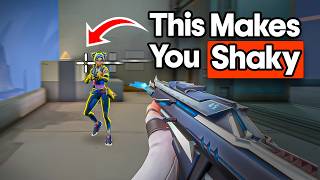

Your Aim Looks Like This?
45sImmediately relatable hook showing common aim struggles, drawing in viewers who want to improve.
▶ Play Clip"The title accurately promises five specific mistakes, and the video delivers them with detailed explanations and fixes."
This video identifies five common aim mistakes in Valorant that players often overlook, such as poor micro adjustments, stiff crosshair placement, hand tension, over-reliance on sprays, and bad posture. The coach provides practical drills and habit changes to fix these issues for more consistent aim.
Shaky, rushed micro adjustments after initial flicks cause missed shots. Players often rush or focus too much on flicks. Fix: practice micro adjustment drills like 'ect Latin American king' in aim trainers, focusing on slow, accurate adjustments.
Three reasons: crosshair placement not close enough to enemy head, incorrect peeking (shift peeking, crouch peeking, diagonal peeking), and slow initial micro adjustment transition.
Crosshair remains fixed on common spots instead of adapting to angles. Fix: practice 'painting walls' by brushing corners and common angles. Use custom games with a friend to practice keeping crosshair ready for multiple positions.
Gripping mouse too tightly causes shaky aim, overshooting/undershooting, and slower reaction time. Fix: regularly check grip, shake hands between rounds, and relax grip during warm-ups.
Spraying beyond 3-4 bullets at long range is inaccurate. Fix: practice bursting 1-3 bullets with aim reset, use strafing bots at max distance, and practice in deathmatch or custom games.
Slouching causes muscle tension leading to shaky aim and potential injury. Fix: use a chair with lumbar support, ensure desk height allows natural arm/shoulder position, take breaks, and measure setup for consistency.
Fixing these five subtle aim mistakes—micro adjustments, crosshair placement, hand tension, spray control, and posture—can significantly improve consistency in Valorant. The coach emphasizes practical drills and habit changes over raw practice volume.
What are the three reasons for getting instantly one-tapped in Valorant?
Crosshair placement not close enough to enemy head, incorrect peeking (shift/crouch/diagonal), and slow initial micro adjustment transition.
01:26
What is the recommended accuracy target for micro adjustment drills?
90 to 95% accuracy.
02:47
What does 'painting the walls' mean in crosshair placement?
Constantly moving your aim to brush corners and common angles with your crosshair to be ready for enemy peaks.
04:27
How does gripping the mouse too tightly affect aim?
It causes shaky aim, overshooting/undershooting, slower reaction time, and disrupts tiny adjustments.
05:49
What is the maximum number of bullets recommended for long-range bursts?
One to three bullets.
08:10
What personal injury did the coach experience due to poor posture?
Repetitive strain injury from a desk height that was too high, causing shoulder pain that worsened over time.
09:37
What is the purpose of shaking hands between rounds?
To reset grip and stay fresh, reducing hand tension.
06:30
Micro Adjustments Are Key
Explains that tiny corrections after initial flicks separate clean aimers from inconsistent ones.
00:37Three Reasons for One-Taps
Provides a clear framework for why players get instantly killed, addressing a common frustration.
01:26Paint the Walls Technique
Introduces a memorable metaphor for fluid crosshair placement that adapts to multiple angles.
04:27Hand Tension Destroys Aim
Highlights an often-overlooked physical factor that affects consistency and reaction time.
05:49Posture Injury Story
Personal anecdote underscores the long-term consequences of ignoring posture, adding credibility.
09:37[00:00] Does your aim look like this?
[00:04] >> But also looks like this.
[00:07] [Music]
[00:09] >> One enemy remaining.
[00:11] >> You're practicing with aim trainers,
[00:13] playing well in DMs, but somehow you're
[00:15] inconsistent and still losing a good
[00:17] amount of gunfights in ranked. What I've
[00:18] noticed after years of coaching players
[00:20] to immortal and radiant is that there
[00:21] are some small aim mistakes that hold
[00:23] you back without you even realizing it.
[00:25] So, if you're tired of missing shots and
[00:26] want to finally get a consistent aim,
[00:28] you need to fix these five aim mistakes
[00:30] you might not realize that you're
[00:32] making. I'll also show you some
[00:33] practical fixes. So, make sure to watch
[00:35] until the end for the best results. The
[00:37] first aim mistake you don't realize
[00:38] you're making is poor and shaky micro
[00:40] adjustments. At higher ranks, what
[00:42] separates clean aimrs from inconsistent
[00:44] ones isn't just flicks or crosshair
[00:46] placement. It's a tiny quick corrections
[00:47] you make after your initial flick. Bad
[00:49] micro adjustments look like shaky,
[00:51] rushed movements, and they lead you to
[00:53] miss a shot by barely dragging past the
[00:55] enemy's head. But why does this happen
[00:57] so often? The reason why you're missing
[00:59] those seemingly easy kills is that
[01:00] you're either rushing your shots or
[01:02] you're focusing too much of your
[01:03] practice on hitting your initial flicks.
[01:05] If you're the type of person who boots
[01:06] up the practice range, goes for hard
[01:08] mode bots, and tries to flick and tap
[01:10] all the bots without micro adjusting,
[01:11] you're simply wasting your time. Now, I
[01:13] know you might be thinking, "Come, I
[01:15] don't have time to calmly micro adjust
[01:16] on the enemy's head because I instantly
[01:18] get one tapped." And I know everyone
[01:20] mentions that, and yes, that can be
[01:22] true. So, I want to briefly explain why
[01:24] that happens before moving on.
[01:26] Otherwise, everything else that I
[01:27] explained will be useless. There are
[01:29] three reasons for getting instantly one
[01:30] tapped. First, your cross placement is
[01:32] not close enough to the enemy's head
[01:34] when you run into them. And in this
[01:35] case, you need to train your cross
[01:37] placement in custom games and DMs so
[01:38] that you don't have to make crazy
[01:40] adjustments in the moment someone pops
[01:41] up on your screen. The second reason is
[01:43] that you're probably peaking incorrectly
[01:45] or the enemy expects your movement.
[01:47] You're either shift peeking, crouch
[01:48] peeking incorrectly, or peaking
[01:50] diagonally, which makes you move slower
[01:51] on the enemy screen and makes you an
[01:53] easier target. Alternatively, your peing
[01:55] can be way too predictable. Your enemies
[01:57] already know what peak you're about to
[01:59] do and you're dead the moment that you
[02:00] swing out. And the third reason can be
[02:02] that just your initial micro adjustment
[02:03] is just too slow. I know everyone says
[02:05] you have to take your time, but you also
[02:07] need to work on becoming faster at
[02:09] transitioning from the first initial
[02:11] flick to your actual mic adjustment, and
[02:13] that takes practice. Now, there's a
[02:15] problem. The way you fix this bad habit
[02:16] is by doing exactly what most players
[02:19] try to avoid, which is practicing using
[02:21] specific scenarios in aim trainers or in
[02:23] the practice range. But if you want to
[02:24] hit clips like these without spamming
[02:26] thousands of death matches, you'd better
[02:27] follow what I'm about to say. Start by
[02:29] adding micro adjustment drills to every
[02:30] warm-up and aim routine that you do. In
[02:32] aimabs, try a scenario called ect, Latin
[02:35] American king, and avoid spamming
[02:37] flicks. Focus on slow, accurate
[02:39] adjustments after you land your first
[02:40] flick near the target, really dialing in
[02:42] that small movement. And as you get
[02:44] better, try speeding up. But if you
[02:45] notice that your accuracy drops, try
[02:47] lowering the speed until you achieve 90
[02:49] to 95% accuracy. And if you're really
[02:52] tired of having inconsistent aim, you
[02:54] can also clip your gunfights and watch
[02:55] your clips back, especially any whiffed
[02:58] 1v ones or weird deaths. After the game
[03:00] is over, you can even just use a replay
[03:02] system and watch the gunfights at 0.25
[03:04] or 0.5 times speed and check out where
[03:07] you're lacking in your adjustments. Now,
[03:09] I understand that even with these tips,
[03:11] grinding aim trainers and watching
[03:13] guides can feel pointless and unclear,
[03:15] especially if you're struggling to
[03:16] pinpoint which exact tip directly
[03:19] pertains to your current struggles of
[03:21] ranking up. So, if you're feeling lost
[03:22] trying to guess what you need to work on
[03:24] and you want to finally hit your dream
[03:26] rank like our thousands of students that
[03:28] I've worked with, the Mortal Road
[03:29] program is built exactly for you. Inside
[03:31] our 10-week premium coaching program,
[03:33] you'll get over 100 hours of
[03:35] personalized hands-on help from Radiant
[03:38] and BCT coaches. And we're so confident
[03:40] in getting you results that if you don't
[03:42] rank up at least 500 RR in 10 weeks,
[03:44] we'll give you a full refund. You can
[03:46] use the link down below to book a free
[03:48] call with me or one of our coaches to
[03:50] see if we'd be a good fit. Now, we've
[03:51] talked about how micro adjustments are
[03:53] key, but you won't be able to solely
[03:55] rely on micro adjustments if your
[03:57] crosser placement is stiff. And that's
[03:59] the second mistake that you might not
[04:00] realize. You've heard cross placement is
[04:02] important, but most people still get it
[04:04] wrong. Often times, when I look at
[04:06] student FOD reviews, their crosser
[04:07] remains stiff, not adapting to every
[04:09] angle as they move. This means that
[04:11] their crosser stays fixed and static on
[04:13] common spots the enemies can peak from,
[04:14] rather than adjusting their crosshair as
[04:16] they move throughout the map. When your
[04:18] crosser remains stiff, you're not
[04:19] preparing for off angle peaks,
[04:22] which makes you vulnerable in close
[04:24] fights or unexpected angles. Good fluid
[04:26] crosser placement is about constantly
[04:27] moving your aim to paint the walls. In
[04:30] other words, brushing the corners and
[04:31] common angles with your crosshair so
[04:33] you're always ready to react if needed.
[04:35] An example of this happening can look
[04:36] like this. If you're pushing out of a
[04:38] main onde, many players will instantly
[04:40] move their focus towards link or elbow.
[04:42] But you need to realize that there are
[04:44] three or even sometimes four different
[04:46] angles that the enemies can come from. A
[04:48] great way to prevent stiff crosser
[04:49] placement is by joining a friend in a
[04:51] custom game on your favorite map. Pick
[04:53] an area of the map, for example, like
[04:55] ascent to a site and have your friend
[04:57] stand in random spots within that area.
[04:59] Move around and practice keeping your
[05:00] crosshair ready for each position that
[05:02] they might peak you from or be standing
[05:04] at. And try running this a few times.
[05:06] then jump into a deathmatch to put that
[05:08] practice into action. Instead of letting
[05:10] your crosshair drift aimlessly or stay
[05:12] fixed in one position, this habit helps
[05:14] you anticipate enemies better so you can
[05:16] react faster and more smoothly. In
[05:18] Valerant, there's good and bad habits.
[05:20] And ensuring that you're ready for the
[05:21] enemies is a vital habit you need to
[05:24] work on into your gameplay. And speaking
[05:25] of another key habit to develop,
[05:27] controlling your attention not only
[05:29] helps you land more shots and win games,
[05:31] but also keeps you feeling fresh and
[05:33] able to play longer. And let me explain
[05:35] how. Do you ever notice that your aim
[05:37] just falls apart in the middle of a
[05:38] fight? For example, you flick on a
[05:40] target but struggle so much to smoothly
[05:43] micro adjust to the enemy's head. Your
[05:44] micro adjustments feels really rigid and
[05:47] abrupt. And one of the biggest reasons,
[05:49] often unnoticed by most players, is how
[05:51] tense that your hand gets. Gripping your
[05:53] mouse too tightly can destroy your aim
[05:55] and cause you tons of gunfights. When
[05:57] your hand is too stiff, your muscles in
[05:59] your hand suffer dramatically. This
[06:01] tension makes it difficult to track
[06:02] moving enemies smoothly. And this causes
[06:04] your crosser to shake or move
[06:06] unpredictably. And your flick shots will
[06:08] also become shaky and inconsistent,
[06:10] often overshooting or undershooting
[06:12] enemies. And the tiny adjustments that
[06:13] your hand needs to make get disrupted by
[06:15] the rigid grip. Even during slower paced
[06:18] peaks where you're trying to keep your
[06:19] aim steady and react precisely, a tense
[06:22] hand slows down your reaction time
[06:24] compared to playing with a relaxed grip.
[06:26] Pop players understand why it's
[06:27] important to keep their hands loose,
[06:28] which is why you often see some pros
[06:30] flick their hands out between rounds to
[06:33] reset their grip and stay fresh. The
[06:35] reason you want to fix this as soon as
[06:36] possible is that gripping your mouse
[06:38] with the correct tension will make your
[06:40] aim much more consistent and reliable.
[06:42] And this helps you hit more shots and
[06:43] top rack more often. The way forward to
[06:45] alleviate tension is to make tension
[06:47] awareness a regular part of your
[06:49] warm-ups and games. Start each session
[06:51] by checking your grip and relaxing it if
[06:54] it's too tight. Make it a habit to
[06:55] regularly check how tight you're
[06:57] gripping your mouse while playing. If
[06:58] you feel that you're tensing too much or
[07:00] your hands are becoming cramped, try
[07:01] shaking your hands or doing some
[07:03] stretches if needed. And over time, you
[07:05] won't need to check yourself as much.
[07:06] And once you get into a rhythm, you'll
[07:08] feel the effect of it on both your aim
[07:09] and gameplay. Now, even if you fix your
[07:11] tension, control, and grip, your aim can
[07:14] still suffer if your gunplay habits
[07:16] don't change. And that's why the fourth
[07:17] aim mistake that you might not be
[07:18] realizing that you're making, which is
[07:20] poor spray control, is critical to
[07:22] address if you want to keep improving.
[07:23] One aim mistake you don't realize you're
[07:25] making is relying on sprays at long
[07:27] range. Spraying feels natural under
[07:29] pressure, but at long distances, it
[07:31] ruins your accuracy and cost you fights
[07:33] you could have won with quick controlled
[07:34] bursts. The truth is, even with the
[07:37] recent buffs, sprays become wildly
[07:38] inaccurate the moment you go beyond the
[07:41] first few bullets. And those initial
[07:42] shots are your most precise with minimal
[07:44] recoil and bullet spread. Yet, when you
[07:46] spray beyond the first three to four
[07:48] bullets, you're essentially turning a
[07:50] potentially easy headshot into a spray
[07:52] and prey scenario that heavily favors
[07:54] the opponent. This becomes even more
[07:55] important at longer range angles as
[07:57] spraying considerably makes your shots
[07:59] spread out more. Not only are your shots
[08:01] whiffing, but you're also a target
[08:02] that's standing still. If you find
[08:04] yourself losing a lot more long-range
[08:06] duels than you should be, it's time to
[08:07] reassess how you approach them. Rather
[08:09] than relying on sprays, practice
[08:10] bursting one to three bullets at a time
[08:13] max while resetting your aim in between.
[08:15] Next, head into the range and turn on
[08:17] the strafing bots. Move as far away as
[08:18] possible and practice shooting only one
[08:20] to three bullets at a time. And once you
[08:22] get a hang of it, add some lateral
[08:23] strafes with A and D in between. And
[08:25] once you feel fully comfortable, try
[08:27] doing some death matches to practice
[08:28] this against real players. You can even
[08:30] hop on a custom game with some friends
[08:32] and take long-range fights in maps like
[08:34] Pearl, Breeze, and Ice Box. Now, we've
[08:36] covered using the right shooting
[08:37] techniques, but improving your posture
[08:39] as well can boost your aim in ways many
[08:42] players overlook. Which brings me to the
[08:44] fifth aim mistake that you might not
[08:45] realize you're making, and it's about
[08:47] posture. Many players don't realize that
[08:49] poor posture silently causes aim issues
[08:52] like shakiness and inconsistency.
[08:53] Sitting with a straight, supported back
[08:55] reduces stress on your muscles and
[08:57] joints, and this allows you to maintain
[08:59] steady arm and wrist positions. This
[09:00] stability is actually what helps keep
[09:02] your crosser consistent, which makes
[09:04] aiming feel more natural. Even top pros
[09:06] focus on posture to sustain peak
[09:08] performance. Most teams even have
[09:09] performance coaches who specialize in
[09:11] everything outside of the game,
[09:13] including posture, mentality, and
[09:14] nutrition, which shows that it's a key
[09:16] factor in reaching the top of the game.
[09:18] On the flip side, slouching or leaning
[09:19] forward, even subtly, shifts muscle
[09:21] tension to places like your neck,
[09:23] shoulders, and upper back. And this
[09:25] leads to shakier aim because tension
[09:26] from those areas often transfers to your
[09:29] hand and wrist movements. And this makes
[09:30] your aim sloppy and uncontrolled. And if
[09:32] you don't address bad posture, it can
[09:35] even lead to repetitive strain injuries.
[09:37] personal story of mine. Because my desk
[09:39] height was too high, it forced my
[09:41] shoulder to lean more forward towards
[09:43] the monitor. And at first, I noticed
[09:45] some stiffness and pain towards the end
[09:47] of my play sessions. But I didn't want
[09:48] to change my posture because I was
[09:50] aiming really well. And the pain would
[09:52] go away after a good night's sleep. But
[09:54] over time, the pain that I would feel
[09:56] after playing for 8 hours would come
[09:58] back after 4 hours, then 2 hours, and it
[10:00] just kept getting worse to the point I
[10:02] couldn't play the game properly for over
[10:04] 2 years. So, to avoid this from
[10:06] happening, prioritize a chair that
[10:07] offers good lumbar support. If that's
[10:09] not possible, placing a cushion or
[10:11] pillow behind your lower back can help
[10:13] you keep your posture in check. And with
[10:15] your desk, make sure that it's at a good
[10:16] height where your entire arm and
[10:18] shoulder can rest naturally. It helps to
[10:20] have an adjustable chair and desk where
[10:22] you can change their heights. But if you
[10:24] don't have an adjustable desk, you can
[10:25] change the height of your chair to find
[10:27] a sweet spot. And if you need to raise
[10:29] your chair height and it feels
[10:30] uncomfortable on your legs, you can even
[10:32] use a little stool to prop your legs up.
[10:34] And as you continue to play with better
[10:37] posture, regularly checking your posture
[10:39] during games and resetting yourself
[10:41] whenever you catch yourself slouching is
[10:42] very useful. And also never
[10:44] underestimate the importance of breaks
[10:46] in between games while you're in Q or in
[10:48] agent select. Stand up and walk around
[10:50] for a few minutes. It'll help you relax
[10:52] your muscles and reduce the tension
[10:53] while also refreshing your focus. Dude,
[10:55] after a loss, I I need to take a walk
[10:58] and like refresh cuz that was that was
[11:01] something.
[11:02] >> And if you want to take this to the
[11:03] extreme, whenever you find a posture
[11:05] that feels comfortable and helps you
[11:07] play better, you can even measure
[11:08] roughly how far you're away from the
[11:10] table, how high the monitor is from the
[11:12] table, where the mouse pad is placed,
[11:14] and how your mouse grip feels. This is
[11:16] what some pros do to keep consistency
[11:18] even when playing on different setups
[11:20] during tournaments. That's all for now.
[11:21] Be sure to like and subscribe and check
[11:23] out our other videos that we made about
[11:25] movement. Thanks for watching.
⚡ Saved you 0h 11m reading this? Transcribe any YouTube video for free — no signup needed.