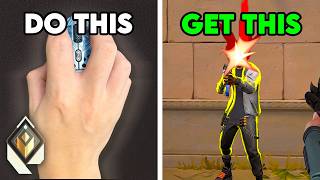

Why Your Aim Sucks (It's Not Crosshair Placement)
45sChallenges common advice by blaming mouse control, not crosshair placement, which resonates with frustrated players.
▶ Play Clip"Title promises instant fix; video delivers actionable tips but improvement requires practice."
The video presents five tips to improve aim in Valorant, addressing common issues like inconsistent aim, shaky aim, and lack of confidence. The creator shares personal experience and techniques used by pros to help viewers fix their aim instantly.
Most players don't know how to physically move their mouse using arm, wrist, and fingers in sync. High sensitivity leads to jittery wrist/finger aim; low sensitivity makes arm aim slow. Fix by choosing a sensitivity that uses all three systems, e.g., average pro eDPI 267 (800 DPI at 0.33 in-game).
If micro adjustments are twitchy, raise sensitivity temporarily by 50-100% and practice precise adjustments on bots or Aimlab static clicking. If crosshair placement and flicks are off, lower sensitivity and practice clean horizontal flicks with arm in deathmatch. Changing sensitivity temporarily helps develop new aim muscles.
Three main grips: palm (stable but limited finger control), claw (balance of stability and precision, preferred by many Valorant pros), fingertip (great tracking and micro adjustments but less stable). Find your natural grip by closing your eyes and placing hand on mouse. Ensure mouse shape matches your grip using tools like Rocket Jump Ninja or Eloshapes.
Shaky aim stems from nervousness, tension, or incorrect technique. Solution: palm aim (stop before shooting, shoot only when crosshair lines up). Control tension by holding mouse gently like an egg. Practice the Bardos method: train slowly first, then build speed. Drill: go to range, pick bots, take time to line up shot, restart if miss in first 5 seconds or after 3-4 misses.
Spraying is useful in tight situations against multiple enemies. Spray transfer: after killing first enemy, continue spray onto second. Train by aiming at first bot's head, start spraying, then flick to second bot within half a second. Practice in deathmatch in chaotic spots.
Confidence impacts aim significantly. In ranked, pressure causes hesitation and tension. Fix by letting go of whiffs and swinging every angle like you're going to win. Consistent confident swings lead to winning more fights.
Improving aim in Valorant requires proper mouse control, targeted training, correct grip, calm aim technique, spray transfer skills, and confidence. Applying these tips consistently will lead to noticeable improvement.
What is the average eDPI used by pro Valorant players?
267 eDPI, which is around 800 DPI at 0.33 in-game sensitivity.
01:40
What are the three main mouse grip types?
Palm grip, claw grip, and fingertip grip.
05:09
What is the Bardos method for training aim?
Train your aim like an instrument: master it slowly first, then build up speed over time.
08:30
What is spray transferring?
After killing the first enemy with a spray, continue the spray onto a second enemy by flicking to them.
09:54
How can you find your natural mouse grip?
Close your eyes and place your hand on your mouse naturally; that's your default grip.
06:04
What is the recommended way to hold the mouse to avoid shaky aim?
Hold your mouse gently, like holding an egg, to allow smoother tracking and precise flicks.
07:50
What is the drill to fix shaky aim?
Go to the range, select bots (easy for silver and below, medium/hard for gold+), take time to line up the shot, then shoot. Restart if you miss in the first 5 seconds or after 3-4 misses.
08:13
Why is changing sensitivity temporarily beneficial?
It helps develop new aim muscles and improves overall aim; muscle memory is a myth.
03:18
Mouse Control Basics
Explains the often overlooked importance of using arm, wrist, and fingers in sync for aim.
00:39Muscle Memory Myth
Debunks common belief that changing sensitivity ruins muscle memory, encouraging varied training.
03:18Mouse Grip Importance
Highlights how grip affects comfort, speed, and accuracy, and how to find the right one.
04:48Calm Aim Technique
Provides a clear method to fix shaky aim through tension control and deliberate practice.
06:52Spray Transfer Utility
Emphasizes the value of spraying in multi-enemy situations, countering the headshot-only trend.
09:30Confidence in Aim
Stresses that mental state directly impacts mechanical performance, a key insight for competitive play.
11:08[00:00] Have you ever watched a pro hit some
[00:02] insane shots and think, "Dang, next game
[00:04] I'm going to pop off, too." So, you
[00:06] queue up, but what do you know? You end
[00:08] up whiffing every single shot. Or maybe
[00:10] your aim looks great in death matches,
[00:12] but in ranked, it looks more like this.
[00:16] Why are you heading? Well, before
[00:18] hitting Radiant, I was exactly like you.
[00:20] My aim felt inconsistent, and I didn't
[00:22] know how to fix it. Most guides at the
[00:24] time were just repeating the same
[00:26] information, and real improvement felt
[00:28] impossible. However, after learning the
[00:31] tips I'm about to show you, everything
[00:32] changed. So, that's why in this video,
[00:34] I'll go over five tips that you can use
[00:36] to fix your aim instantly. For the first
[00:39] tip, it's something that a lot of people
[00:41] don't talk about enough. Most coaches
[00:43] say your aim sucks because your
[00:45] crosshair placement is off or you're not
[00:47] aiming at heads, but no one tells you
[00:49] this. You just don't know how to control
[00:51] your mouse correctly. I'm talking about
[00:53] the way you physically move your mouse
[00:55] with your arm, your wrist, and your
[00:56] fingers. If any of those are out of
[00:58] sync, you'll keep whiffing no matter how
[01:00] many death matches you try to grind. Let
[01:02] me explain. If your sensitivity is too
[01:04] high, you're probably flicking and micro
[01:06] adjusting using just your wrist and
[01:08] fingers. That's why your aim feels
[01:10] jittery. You've basically cut your arm
[01:12] out of the equation. And if your
[01:14] sensitivity is too low, you're probably
[01:16] overrelying on your arm to aim. That
[01:18] slow sense makes your flicks feel slow.
[01:21] And turning 180° to dodge flashes
[01:23] requires a dinner tablesized mouse pad.
[01:26] So, first fix your setup. You need
[01:28] enough desk space and a mouse pad that
[01:30] lets you move freely. Then, pick a
[01:32] sensitivity that lets you use all three
[01:34] aiming systems, your arm, wrist, and
[01:37] fingers. The average eDPI that pros use
[01:40] is 267, which is around 800 DPI at 33
[01:44] in-game sensitivity. You don't have to
[01:46] copy that, but if your sensitivity makes
[01:48] you do a 720 when you move an inch,
[01:51] yeah, you're trolling. Once you've
[01:53] figured out a comfortable sensitivity,
[01:54] we move to the next step, training your
[01:56] weaknesses. And this is where most
[01:58] people mess up. If your micro
[01:59] adjustments feel twitchy or
[02:01] inconsistent, that might be because
[02:03] you're struggling to make finer, precise
[02:05] adjustments with your wrist and fingers.
[02:07] To fix this issue, raise your
[02:08] sensitivity temporarily by 50% or maybe
[02:11] even 100% and run some bots in the
[02:13] range, even at medium difficulty. Don't
[02:16] rush. Focus on steady, precise micro
[02:18] adjustments. You can also try Aimlab's
[02:20] static clicking scenarios. They'll force
[02:22] you to snap with your wrist and fingers
[02:24] only. It'll feel weird at first, but
[02:26] that's the point. You're isolating and
[02:28] training fine motor control in order to
[02:29] improve your precision. If you prefer
[02:31] Kovac, I also have a free playlist that
[02:34] you can use inside my Discord server.
[02:36] Link for that is in the description.
[02:37] Now, on the flip side, let's say you're
[02:40] struggling with crosshair placement and
[02:41] general flicks towards the target being
[02:43] completely off. In that case, it might
[02:45] be that you have poor control over the
[02:47] use of your arm while aiming. To fix
[02:49] this, lower your sense, go to the range,
[02:52] and select eliminate 50 bots. Stand in
[02:54] the center, and each time a bot spawns,
[02:56] flick cleanly to it. No overflicking by
[02:58] miles or aiming too high or too low.
[03:01] Just clean horizontal flicks with your
[03:03] arm. Then go into deathmatch and play in
[03:05] high action spots like mid ascent.
[03:08] Enemies will come from every angle and
[03:10] you'll be forced to flick side to side
[03:12] using your arm. Remember, you're not
[03:14] changing your sensitivity to play
[03:15] better, but you're changing it to train.
[03:18] That's what aim pros do. But compi,
[03:20] changing your sensitivity ruins your
[03:22] muscle memory. That's not true. Muscle
[03:24] memory is a myth that has been debunked.
[03:26] In fact, changing your sense helps you
[03:28] develop new aim muscles. And aim pros
[03:30] often change it daily for different
[03:32] scenarios that they practice on. And
[03:34] don't worry, once you finish training,
[03:36] you can switch back to your normal
[03:38] sensitivity or even adjust it slightly
[03:40] to what feels better. Now, your aim
[03:42] won't be ruined, and you'll be able to
[03:44] adapt to it quickly with a more
[03:46] well-rounded aim. And this kind of
[03:47] improvement doesn't come easy. It takes
[03:49] effort. And sometimes your rank might
[03:51] actually drop a bit before it rises
[03:53] since you're undoing bad habits you
[03:55] might have picked up and learning new
[03:57] good habits. But if you actually want to
[03:59] rank up fast, like our students who
[04:01] climbed from being hardstuck in diamond
[04:03] to hitting immortal in just a few weeks,
[04:05] our team of radiant and VCT coaches,
[04:07] including rank one players like Jawa and
[04:09] former XL player Maru, is here to help.
[04:12] We offer coaching options for every
[04:14] budget, including our flagship 10-week
[04:16] immortal roadmap program with a 500 RR
[04:19] in 10 weeks guarantee or your money
[04:22] back. We just opened up 50 new spots for
[04:24] the upcoming summer season. So, if you'd
[04:26] like to see if you'd be a good fit for,
[04:29] book your free assessment call using the
[04:30] link below. During the call, we'll break
[04:32] down your tracker, find your biggest
[04:34] bottlenecks, and give suggestions on how
[04:36] we can help. Now, we fixed our
[04:38] sensitivity and started to aim properly.
[04:40] But even if you actually improve your
[04:42] physical aim, there's one more element
[04:44] that if overlooked can make all that
[04:46] progress feel pointless, and that's your
[04:48] mouse grip. Too many players overthink
[04:51] mouse grips. They copy tens or force
[04:53] themselves into uncomfortable hand
[04:55] positions. And what they end up with is
[04:57] an incorrect grip that causes stiffness,
[04:59] inconsistent aim, and frustration. Your
[05:01] grip affects your comfort, your speed,
[05:03] and your accuracy. The right grip will
[05:05] boost your control, and the wrong grip
[05:07] will wreck your mechanics. So, here are
[05:09] three main grip types. There's a palm
[05:11] grip, claw grip, and the fingertip grip.
[05:13] For the palm grip, your entire hand
[05:15] rests on the mouse, providing stability,
[05:17] but limiting fine control of your
[05:19] fingers. It's a stable grip, but micro
[05:21] adjustments can feel clunky since your
[05:23] fingers can't move all that freely. With
[05:25] a claw grip, your palm slightly touches
[05:28] the back of the mouse while your fingers
[05:30] arch, offering a balance between
[05:31] stability and precision. Many Valiant
[05:34] pros prefer this grip style because it
[05:36] allows for consistent and stable flex
[05:38] while also allowing for more control of
[05:40] your micro adjustments. And lastly, for
[05:42] the fingertip grip, this is when only
[05:44] your fingers touch the mouse. This grip
[05:46] usually requires bigger hands or a
[05:48] smaller mouse, and it allows for great
[05:50] tracking and precise micro adjustments.
[05:52] Some pros like Scream use this grip, but
[05:54] this grip might feel less consistent and
[05:56] stable for most people that play
[05:58] Valerant. So then, what grip should we
[06:00] use and how can you find the right one
[06:02] for you? A simple method is just to
[06:04] close your eyes and place your hand on
[06:06] your mouse naturally. That's your
[06:07] default grip. Don't overthink it and
[06:09] don't force anything unnatural. If your
[06:11] grip always feels weird, it might
[06:12] actually be that your mouse shape is not
[06:14] made for your type of grip. Even a $200
[06:17] final mouse can feel awful if it's not
[06:19] shaped for you. If your expensive mouse
[06:21] is made for palm grips and you use a
[06:23] claw grip, you'll likely feel
[06:24] uncomfortable. So, what matters most in
[06:26] a mouse is a shape. To find the right
[06:28] mouse to use, I suggest you look into
[06:30] tools like Rocket Jump Ninja's site to
[06:33] find mice that match your grip and hand
[06:35] size. You can also use the website
[06:37] Eloshapes to compare your current mouse
[06:39] shape to different mice. So, in short,
[06:41] stop chasing the hype around new mice
[06:43] and focus on what fits. Now that you
[06:46] found the right grip and mouse, you're
[06:48] off to a solid start. But that alone
[06:50] doesn't solve everything. If you ever
[06:52] struggle with shaking aim, this next tip
[06:54] is going to help you fix it. Shaky aim
[06:56] is one of the most frustrating problems
[06:58] in Valerant. You line up a shot, but at
[07:00] the last second, your crosshair jitters,
[07:02] causing you to miss. Instead of fluid,
[07:04] controlled aiming, your aim feels
[07:06] erratic and inconsistent. And shaky aim
[07:08] usually stems from a combination of
[07:10] nervousness, tension control, or
[07:12] incorrect technique. If ignored, it'll
[07:15] sabotage your ability to land critical
[07:17] shots and win duels. The solution: palm
[07:19] aim. To quickly break it down for those
[07:21] of you who don't know what this is, palm
[07:23] aim simply means two things. Number one,
[07:25] you stop completely before shooting. And
[07:27] number two, you shoot your first bullet
[07:29] only when the crosshair lines up with
[07:31] your target. Mastering this technique
[07:33] helps you stay composed in high pressure
[07:35] situations and help you land shots like
[07:37] this.
[07:39] What
[07:41] is the first step to fix shaky aim is
[07:44] tension control. Many players grip their
[07:46] mouse too tightly, causing micro jitters
[07:48] that ruin tracking and flicks. Instead,
[07:50] hold your mouse gently so it's secure
[07:52] but relaxed, like holding an egg. This
[07:54] allows for smoother tracking, more
[07:56] precise flicks, and micro adjustments
[07:57] for those clean, crisp shots. Another
[08:00] reason you don't have calm aim is
[08:01] because you're rushing your shots
[08:03] instead of taking your time to micro
[08:04] adjust onto the targets head. This
[08:06] sounds obvious, but most players panic
[08:08] shoot way too early. They start firing
[08:10] before their crosshairs lined up and
[08:12] whiff their shots. So, here's a drill to
[08:13] fix that. Go to the range and select
[08:15] bots. Easy for players that are silver
[08:17] and below, and medium or hard for
[08:19] players that are gold and above. Next,
[08:20] play to the bot as fast as you can
[08:22] without losing control. And third, take
[08:24] your time to line up the shot, then
[08:26] shoot. This might sound easy, but hear
[08:28] me out. What we're doing is practicing
[08:30] with the Bardos method, which simply
[08:32] says that you need to train your aim
[08:34] like an instrument, mastering it slowly
[08:36] at first, then building up speed over
[08:38] time. But we're not done here. There's
[08:40] two rules you need to follow when doing
[08:41] this drill. Restart the bots if you miss
[08:44] in the first 5 seconds, and restart
[08:46] after three misses on easy bots or four
[08:48] misses for medium bots. This will force
[08:51] you to be intentional. You're building
[08:52] smooth flicks into micro adjustments,
[08:54] not rushing the shot. What we're also
[08:56] practicing with this drill is training
[08:58] the smoothness of your flicks and micro
[09:00] adjustments. This is because if you rely
[09:01] on your first flick to shoot instantly,
[09:03] you're going to be inaccurate a lot of
[09:05] the time. And if you're taking too much
[09:07] time to micro adjust and shoot, you're
[09:08] going to lose most gunfights before even
[09:10] shooting a bullet. So, what we're doing
[09:12] here with this drill is we're starting
[09:13] slow to make the flick to micro
[09:15] adjustment transition feel automatic and
[09:18] faster over time. Now, as much as calm
[09:21] aim is super helpful in a lot of
[09:22] scenarios, if you've watched my
[09:24] unscripted calm aim video, you'll know
[09:26] that calm aim isn't the solution for
[09:28] every type of gunfight. In fact,
[09:30] sometimes you actually need to do the
[09:32] quite opposite. Let's be real, everyone
[09:33] wants to hit those crisp head shots to
[09:35] post on TikTok. But what if you're
[09:37] actually not spraying enough? Spraying
[09:39] gets a bad rep, but the truth is, in
[09:41] tight situations against multiple
[09:43] enemies, spraying can save you rounds.
[09:45] Picture this. You're near a smoke, two
[09:47] enemies swing out, you headshot the one
[09:49] facing you, then you have to flick and
[09:51] pray to quickly one-shot the second guy.
[09:54] But if you just sprayed down the first
[09:56] target and continued your spray and
[09:58] flicked towards the next enemy, you've
[10:00] got a way better odds of killing both or
[10:02] at least doing big damage. That's what
[10:04] spray transferring is. Another great
[10:06] situation where you should spray
[10:07] transfer is if you kill an enemy and
[10:09] expect another one to swing and trade
[10:11] their teammate. In that scenario, you'll
[10:13] kill the first enemy and spray transfer
[10:15] towards the angle or smoke where the
[10:17] next enemy might peak. You'll be
[10:19] surprised with how many free kills this
[10:20] can give you. But compi, the recoil is
[10:22] random after like five bullets. Yes, but
[10:25] landing any damage can win rounds. If
[10:28] the second enemy is one shot, your
[10:29] teammies will have an easier time. The
[10:31] point is, spray transfers can save you
[10:33] rounds. And here's how to train it. In
[10:35] the range, go over the practice spots
[10:37] and aim at the first spot's head and
[10:39] begin spraying. While shooting, flick
[10:41] and transfer to another bot. Don't worry
[10:43] about headshots here. Your main goal is
[10:45] to eliminate the second bot within half
[10:47] a second of transferring. If you need
[10:48] more time than that, you're going to
[10:50] likely die in a real scenario. So, focus
[10:52] on fast, confident switches. You can
[10:54] practice this in deathmatch, too,
[10:56] especially in chaotic spots where
[10:57] enemies stack. You can try spraying on
[10:59] the first enemy that you see and
[11:01] continue your spray onto the second
[11:02] enemy that pops up. With this training,
[11:04] you'll turn panic sprays into clutch
[11:06] double kills. Now, with that fourth tip,
[11:08] you're almost there. But the final
[11:10] piece, the thing that ties everything
[11:12] together is confidence. And without it,
[11:14] even a mechanically gifted player can
[11:16] crumble. Have you ever felt like prime
[11:18] 10's in a deathmatch? You're peeking
[11:20] with confidence, hitting every shot. The
[11:22] second you load into ranked, it's like
[11:23] your aim just disappears. It's not that
[11:26] your mechanics changed, but it's your
[11:28] confidence. If you're smurfing or you're
[11:31] just playing deathmatch, there's no
[11:32] pressure. You're able to play loose,
[11:34] take fights without hesitation, and
[11:36] trust your aim. But in ranked, your RR
[11:39] is on the line, but you end up
[11:40] second-guessing your positioning. You
[11:42] end up playing scared, and you start
[11:44] missing shots that you normally hit.
[11:46] What most players don't understand is
[11:48] how much confidence impacts your aim.
[11:50] Without it, your insane mechanics are
[11:52] going to be wasted. When you overthink,
[11:54] your aim starts to slow down. And that's
[11:56] because you start to get tense. you get
[11:58] stuck in your head and you start running
[11:59] through every possible outcome instead
[12:02] of just reacting. And in Valerant, that
[12:04] moment of hesitation is a free kill for
[12:07] the enemy. So, how do you fix it? It's
[12:09] simple. First, let go of the whiffs.
[12:11] Everyone misses. It's not the end of the
[12:13] world. One bad round doesn't define your
[12:15] aim unless you let it. And second, swing
[12:18] every angle like you're going to win.
[12:19] Even if it's a 40 60 fight, peak like
[12:22] you already know that the kill is yours.
[12:24] If you consistently swing with
[12:25] confidence, you'll win more fights than
[12:27] you lose. If you want to learn more
[12:29] about improving your mechanics, check
[12:30] out these videos here.
⚡ Saved you 0h 12m reading this? Transcribe any YouTube video for free — no signup needed.