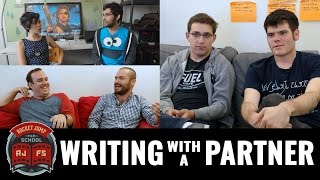

How to Ask Someone to Be Your Writing Partner
60sRelatable and humorous advice on initiating a writing partnership, framed as 'asking someone out on a date,' which is engaging for creators.
▶ Play Clip"The title promises a discussion on writing partnerships, and the transcript delivers exactly that—a candid, insightful conversation with no fluff."
In this video, the writers and directors of RocketJump, known for Video Game High School, discuss the dynamics of successful writing partnerships. They share personal experiences, the importance of trust and ego management, and a unique theory of creative centers. The conversation offers practical advice for anyone interested in collaborative writing.
The team introduces themselves, highlighting their roles at RocketJump and their long history of working together.
They compare a writing partnership to a marriage, emphasizing trust and the ability to let go of ego.
The 'tennis' metaphor is introduced, where ideas are volleyed back and forth without being precious about them.
One writer shares how he initially disliked a future partner, but learned to appreciate his input and embrace criticism.
The 'dick, brain, and heart' theory is explained, describing three creative centers that contribute to storytelling.
They recommend using note cards to visualize long scripts and stay aligned with a partner.
The final takeaway is to serve the story, not your ego, and to avoid being a 'dick' in the creative sense.
Trust is key
Highlights the core principle that trust in a partner's instincts is essential for creative collaboration.
01:59Creative centers theory
Offers a memorable framework for understanding different creative impulses and balancing them in a team.
06:30Use note cards
Provides a practical, actionable tip for managing long scripts and improving collaboration.
08:37Serve the story, not yourself
Emphasizes the importance of humility and focusing on the collective work rather than personal validation.
09:01[00:00] My name's Jake, and I'm a writer at RocketJump. I'm John, and I direct at RocketJump. Let's do a go-through, I guess. I'm Matt Arnold.
[00:13] I don't know, I'm a founder of RocketJump, and one of the writers on Video Game High School, and a director. And Will. And I'm Will Campos. I'm here, okay. Hi, I'm...
[00:25] Oh, it's Anthony first. Anthony, go first. How about you start first? I'm John. I like to direct and sometimes write. I'm Ashley Burch. I am an actor, writer, and director at Rocket Jump.
[00:38] I've been here since last November, and I've been working with Anthony. He's still trying to think about it. I'm Will Campos, and I am one of the co-writers and co-creators of Video Game High School. I started working at Rocket Jump back in 2009 with Hellstorm, and then we moved very quickly on to BGHS.
[00:56] I'm Anthony. I'm Anthony Birch. I'm a writer at RocketJump. I was a head writer at RocketJump. The show. And... I'm Jake, and I
[01:09] write at RocketJump. I don't even know how you approach somebody to be a writing partner just naturally. It sounds like you're just asking somebody. Yeah, literally it's like asking someone out on a date or something. Yeah, I don't do that. We've been working together for over ten years now.
[01:23] Yeah. 10 wonderful years it's hard work you know yeah we're like a an old married couple at this point sounds weird
[01:35] because we're siblings but there's like a weird like I'm not going to say marriage but it's it's a very it's like an intimate partnership that like you have to feel comfortable being we're going to lose our team no no the team the team's all game of thrones it's fine yeah
[01:47] you can't you're a fool it's weird it sounds like the term of it the marriage is like the best example of what it is. And again, like a marriage, a lot of it comes down to trust. I've been in writing situations where you just get
[01:59] deadlocked on something. You're like, this is f***ing stupid. The other person's like, no, this is genius. Then you can spend an hour going back and forth, but a lot of times, being in a good partnership comes down to being able to trust someone and trust their instincts and be like,
[02:11] okay, I'm going to let go of what I thought and we're going to try it this way. I like to think of it like tennis, you know? One of the serves, you know? And then the other one hits it back
[02:24] back and forth you know we're not really precious with our ideas but I think if either of us has an instinct that something isn working it generally because there a good reason for it yeah the only reason people the reason people get precious with their ideas but I think if either of us has an instinct that something isn working it generally because there a good reason for it Yeah the only reason people the reason people get precious with their ideas is because they
[02:38] in a partnership or a writing situation where they feel like they need to prove themselves, I think. I don't think you liked me. I definitely did not like you when I first met you. Yeah, you definitely did not like me. Chris and I came up with this movie about acid rain.
[02:50] Yeah, Frank was talking to his friend Matt Arnold, and Matt says it should be a hail movie now, so now we're doing a hail movie. I was like, who the f*** is this Matt Arnold f***? Like, who the f*** is with my f***? Well, you want to write with people who are like-minded people,
[03:06] who, you know, you're kind of on the same page about what you're trying to do. And then the first time I met you, it was like, Tony Zinn was just like, hey, Matt, you should come to this meeting, this writer's meeting, to talk about it. And then I just see you and Chris there, and then I already had a sense of like,
[03:19] you're just seeing you as these vocal people. But he just brought me in, and I'm just sitting here telling them things I would fix. with their experience and I was like man the world must absolutely hate me and you know but you were right you were right it was better
[03:31] once you're really comfortable with somebody that mentality of no I have to always be right and I have to always be helpful once that goes away you can be a lot freer to have real discussions about what is
[03:43] working and what is not and how to change it and how to fix that without ego coming into it which is really really really useful once you can get there but it can be hard to get there but at least one guy has been related no there's no ego with it because we know each other for so long.
[03:55] So, yeah, I think the best part about it is the ability to chis down each other's ideas. Yeah, and, like, over time, like, learning to just embrace criticism, because that was something that I had a hard time
[04:07] to deal with back in the past. Like, it's so disheartening to get, like, honest feedback, but now I've come to, like, love it and cherish honest feedback because, like, it really just makes you better. So I appreciate it, wouldn't you?
[04:20] You sh** myself. A good writing partner will tell you he said it's through someone else or not said acid rain is a f***ing idea and you should go and kill her and he went up in circumstances where you make it work and we made it work and we can make that
[04:32] set piece and still remember it five years later yeah there's some cool moments in both those scripts yeah we've always rimmed together yeah outline into
[04:44] you know the episode outline into the like scenes and then even like deep within the scene we'll kind of just keep getting in and like feel that everything feels right and in the perfect world if like all that stuff was working, when you actually get to write a scene,
[04:57] it's really easy. You know, it's like, it feels good because you kind of know everything going to be there Once you going to go through it you think it sucks the next day but it easy to write other times it every single moment of that scene she comes to discussion and even then
[05:10] you'll kind of write like the scene and then you might even you know we'll do play horror dialogue at times because we're not even at the point of dialogue usually one of us goes off and just does a I don't know I don't think we ever like write it
[05:22] like with each other right but we talk it out then you can just feel enough trust to let someone go off on their own and do what I would pass on it, you know?
[05:34] Yeah, I've personally never really enjoyed having someone, like, over your shoulder while you're writing, you know? But certain people can do that. Like Will. Will can do that. The thing that we're getting better at, like, we're good at,
[05:48] but we're getting better at it is turning off that switch in your brain that says don't say that, that's stupid. You have to do that. Yeah. If you're writing with anyone. Yeah. I mean, we just have a super similar sense of humor. So we ended up just making each other laugh a lot when we write. to me our writing partnership works because we basically have almost identical views in what is funny,
[06:06] even if we get there in different ways. You know what I mean? Yeah. That's all I have to say. I mean, ball pit was really hard. I remember we had, like, we thought, we practiced, like, ready.
[06:18] And then I just showed, we showed just Will, and Will was just like, no. You still aren't ready. Well, you have a theory, which I don't know if it's your theory, as long as we can keep saying it's going to be
[06:30] the dick brain and heart. Yeah, that's my theory. It boils down to this, that there are three creative centers to the body from which ideas and inspiration can spring. There's the brain, which is cerebral and intellectual
[06:42] and theoretical. And then there's the heart, which is emotional and sentimental and passionate. And then there's the dick, vagina, whatever. You can use a better word for whatever that is. But it's the part of your brain that likes seeing shit blow up.
[06:55] It's the part of your brain that'll come up with a really funny idea, but also still really important in the mix. In terms of video game high school, we always would say that I was the brain, you were the heart, and Brian Francis was the dick. So the idea then being
[07:07] that people tend to operate more out of one of these places than the other two means you and Brian, we each brought, like, different heat to the equation, but I think we all had an understanding of what we wanted the show to be. But then, again,
[07:19] it creates this good cycle of kind of everybody kind of checks and balances and kind of understanding each other because, like, okay, that's a crazy idea, but then it's like, but is it the right idea? And then they'll be like, okay, and does it work with the emotions
[07:32] we want the characters to do in the moment And then when all those things you know come together you know you make you get you know Captain Greenlight You get Captain Greenlight That pretty cool Have the good fortune to have a teacher that allows you to do video projects
[07:44] I would highly recommend that as a way to cut your teeth on writing, especially within groups, especially for writing partnerships and all that kind of stuff. I think it's probably also part of the difficulty is that, like, you might get into a writing partnership that doesn't work and it's knowing your limitations.
[07:58] Like, that's happened to me before where I've, like, started writing with people and I'm like, oh, God, we just don't mesh. Well, I mean, that's like... It's kind of what it is. I think it's like some projects work those because it's like, it's a very short time. It's like, work with these people, and then you find out, like, oh, I don't like any of these people, so just in case, maybe don't need to do that.
[08:11] I would say to the people who aren't working with a partner, I would consider it heavily, and I would consider bringing another voice in. Is the... A film is an inherently collaborative media,
[08:24] and the... It's good practice to get used to this. If I had been insisting on writing everything myself, I would have never gotten anywhere. So I think that it's a good experience to have.
[08:37] If you're writing a longer script, you should definitely step out of line with no cards. So both you and your partner are on the same page and you can see it all right in front of you. It's kind of tough.
[08:49] Even when you make a step out of line on final draft, it's still hard. You can't really see the whole thing at once. You're just scrolling through, and that can be daunting. and it's just hard to wrap your head around.
[09:01] So note cards, just put note cards on a wall if you're writing a longer script. As you're writing, you should be serving whatever story you're creating, not yourself. So if you're writing something and you're treating it as a way of validating yourself
[09:17] and putting your name out there and making it something that's all about you, then a writing partnership isn't going to work very well because it has to be about creating something together and having not, not just being something that's flushed your ego.
[09:29] So, big takeaway, don't be a, don't be a dick. Unless you're the dick or vagina. But only when you're creative sense. Yeah. Yeah, I'm saying, you know, I don't think everyone needs to use no cards
[09:42] or write it. No, no, yeah, but for writing woes. Oh yeah, some people are flows. They're like, you know, like f***ing no cards. But that's like Werner Herzog, you know? Yeah, sometimes Werner Herzog makes bad movies, you know? Maybe he's not
[09:54] the right guy. I don't know.
⚡ Saved you 0h 10m reading this? Transcribe any YouTube video for free — no signup needed.