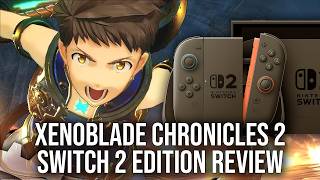

Switch 2 Edition: 4K 60?
45sThe promise of 4K 60 on a classic RPG sparks immediate curiosity and debate among gamers.
▶ Play Clip"Delivers a thorough technical analysis that matches the title's promise, though the 'substantial' claim is somewhat subjective."
Digital Foundry analyzes the Switch 2 Edition of Xenoblade Chronicles 2, a game known for its technical issues on the original Switch. The video examines whether the new edition delivers on its promises of 4K/60 docked and 1080p/60 handheld, focusing on image quality, performance, and other visual tweaks.
Xenoblade Chronicles 2 was one of the most technically controversial early Switch 1 games, with low frame rates and poor image quality.
Monolith Soft released a Switch 2 Edition claiming 4K 60 gameplay in docked mode and 1080p 60 gameplay in handheld mode.
The Switch 2 Edition delivers better edge detail, edge stability, and texture details compared to the original, with a 720p internal resolution.
The game likely uses temporal upsampling to a higher resolution, possibly DLSS, and may also use smart spatial upscaling to achieve a 4K-like image.
Grass appears higher resolution and more liberally placed, depth of field is deeper with less blur, lighting differs, bloom is lessened, and ambient occlusion is more localized.
Pre-rendered video sequences run with a higher bitrate, with rain properly defined and droplet-like compared to coarse aliased noise on Switch 1.
Playing the Switch 1 version on Switch 2 looks just about identical to the Switch 1 version, with only minor enhanced sharpness.
Switch 2 mostly delivers 60 FPS with some dips during traversal and alpha-heavy moments, using a double buffer Vsync setup that drops to 33ms frame delivery when over budget.
Switch 2 delivers a good-looking 1080p-like image in handheld mode, with internal resolution around 468p, using temporal and spatial upscaling.
A distorted line-like pattern was visible in one field when moving the camera, potentially unique to handheld mode.
Handheld mode delivers a pretty good 60 FPS with few dips, possibly using VRR or the panel's slow pixel response to obscure drops.
Xenoblade Chronicles 2 is a pretty good Switch 2 Edition with greatly improved image quality and smoother performance, but the 4K/1080p marketing is a bit of a stretch.
The Switch 2 Edition of Xenoblade Chronicles 2 is a substantial upgrade over the original, with significantly improved image quality and performance, though it doesn't quite hit the native 4K/1080p claims. It's a safe buy for fans, but expectations should be tempered.
What was the internal resolution of Xenoblade Chronicles 2 on Switch 1 in docked mode?
720p
00:46
What upscaling techniques does the Switch 2 Edition likely use?
Temporal upsampling (possibly DLSS) and smart spatial upscaling.
02:09
What is the internal resolution in handheld mode on Switch 2?
About 468p
06:56
What is the frame rate target for the Switch 2 Edition in docked mode?
60 FPS
05:27
What visual tweaks are present in the Switch 2 Edition?
Higher resolution grass, deeper depth of field, altered lighting, lessened bloom, more localized ambient occlusion.
03:46
How does the Switch 2 Edition handle frame drops in docked mode?
Uses double buffer Vsync, dropping to 33ms frame delivery when over budget.
05:55
Marketing Claims
Sets up the central question of whether the Switch 2 Edition meets its 4K/60 and 1080p/60 promises.
00:20Upscaling Analysis
Reveals the likely technical approach behind the image quality improvements, showing deep analysis.
02:09Performance Improvements
Demonstrates the significant performance leap from 30 FPS with dips to mostly 60 FPS.
05:27Verdict on Marketing
Provides a critical take on Nintendo's marketing, tempering expectations.
08:16[00:05] most technically controversial early Switch 1 games. Monolith Soft's open world epic clearly strained the hybrid system, delivering low frame rates and poor image quality. These issues have never really been addressed until now.
[00:20] That's because Monolith has just dropped a Switch 2 edition of this classic RPG, claiming 4K 60 gameplay in docked mode and 1080p 60 gameplay handheld. So, does
[00:32] this latest Switch 2 edition live up to those standards?
[00:46] Xenoblade Chronicles 2 lies in image quality. The base game looked fine enough in its original Switch 1 outing, at least in docked mode. You could expect a 720p image here in docked play, treated with TAA, which produced
[00:59] acceptable results, especially for early Switch 1 title. It was a bit messy though, and you'd really want much better image quality for a Switch 2 game. Thankfully, the Xenoblade Chronicles 2 Switch 2 edition delivers,
[01:12] mostly. In any given shot, we find much more pleasing image quality characteristics than the original version. This shot is a good example. Notice the increased detail in the grass and the decreased edge artifacting as it
[01:26] sways back and forth. Distant elements resolve with greater clarity and well-defined edges. As Pyra's cloak moves from side to side, notice how its edges remain clear and stable. Also, notice how more of the texture detail on
[01:39] the trees is resolving. In other shots, we spot similar patterns. We're hitting three key benchmarks here. Better edge detail, better edge stability, and better texture details. In general, I think XC2 is delivering genuinely good
[01:55] image quality for Switch 2 game. Pixel count suggests the game is running at the same 720p internal resolution of its predecessor, which would normally suggest DLSS given that we are looking at a switch two game.
[02:09] But it may be a little bit more complicated. Now, I do think we are looking at some form of temporal upsampling here. In cutscenes when the camera cuts, the game takes a few frames to cohere and form a higher resolution
[02:22] image, suggesting some kind of temporal upsampler is in play. The original TAA, in contrast, settles more gracefully. But there's a sense that the edges are resolving more modest in surface details, despite little apparent edge
[02:39] ringing, which makes me think of smart spatial upscalers like lossless scaling's LS1. Xenoblade Chronicles X appeared to use a similar spatial upscaler, so this could be a solution Monolith likes for switch
[02:51] two games generally. It's hard to precisely peg what's going on here, but I believe we're looking at temporal upsampling to a higher resolution, which could be using DLSS or another solution. On top of that, there may be some smart
[03:05] spatial upscaling to achieve a more 4K-like final image. You could imagine, for example, the game being rendered at 720p, then being upscaled using a temporal upscaler to an intermediate resolution, and then being upscaled from
[03:20] there with a smart spatial algorithm to 4K. That would explain the general uplift in image quality over the base game, along with some of the quirks we find when we look at the image closely. Alternatively, the game may simply be
[03:33] using an upscaler that we haven't seen before. Something of Monolith Soft's invention, perhaps, that follows in the footsteps from their work on Xenoblade Chronicles 3. Without a direct confirmation from the developer, it's
[03:46] I believe a similar solution is probably used in the Xenoblade Chronicles 1 switch two Edition, which has somewhat similar image quality characteristics. Beyond image quality, there are a few other tweaks. Grass appears higher
[03:59] resolution and is more liberally placed in the Switch 2 Edition. Depth of field can appear deeper with less blur. Lighting also differs across scenes. Bloom appears lessened on Switch 2 and ambient occlusion tends to be more
[04:14] localized. On top of that, one shot seems to be substantially re-lit in my comparisons with tweaked lighting setups and perhaps some altered materials as well. Texture details do resolve more crisply in the Switch 2 Edition, but I
[04:28] think this mostly comes down to image quality improvements and perhaps better texture filtering. Up close, I couldn't find clear evidence that any particular texture had an obviously higher resolution source. Pre-rendered video
[04:42] sequences do seem to run with a higher bitrate, however, as we can observe in the game's opening shot. The rain is properly defined here and droplet-like, while Switch 1 peppers the screen with coarse aliased noise that much more
[04:57] poorly represents that rain. I've been comparing the Switch 1 version to the Switch 2 Edition so far, but you can play the Switch 1 version of XC2 on Switch 2 as well. Outside of some minor enhanced sharpness when playing on
[05:12] Switch 2, the two versions of the game look just about identical, so my visual finding should broadly apply to that game configuration as well. On Switch 1, Xenoblade Chronicles 2 runs at 30 FPS with dips. You can expect some
[05:27] little periodic one-off frame drops alongside extended lulls in the 20s, especially during traversal. Cutscenes also dipped at times. It was fine enough performance for an early Switch 1 open-world game, but obviously
[05:41] expectations have evolved for Switch 2. Thankfully, Switch 2 mostly delivers 60 FPS with a much higher performance level. But there are some dips in the mix with a peppering of drop frames during typical traversal and some dips
[05:55] during alpha heavy moments and cutscenes. It does look like the game is using a double buffer Vsync setup here. So if frames go over budget, the game drops to 33 millisecond frame delivery until the additional load is relieved.
[06:10] This is just early game content and performance may differ elsewhere, but I suspect this is a pretty representative environment to test out the game's frame rate issues. >> [music]
[06:27] despite its faults, was more or less fine for the original Switch, but portable mode was much more concerning. The game ran at very low resolutions in portable play, dipping as low as about 360p, which looked pretty awful. Plus
[06:42] the game used an aggressive sharpening pass to enhance detail in the image, which just exacerbated its image quality flaws. Thankfully, Switch 2 alleviates these issues. Switch 2 delivers a good-looking 1080p-like image in
[06:56] contrast with good image treatment and stable edges. Internally, the game renders at about 468p or so, at least based on the counts I was able to generate. Again, if I had to guess, I
[07:09] think there may be a temporal upscaling component and then perhaps a smart spatial upscaling component to give the edges that final high resolution look. If we compare the Switch 2 edition in handheld mode to the Switch 1 version in
[07:22] docked mode, which is kind of a proxy for the Switch 1 version running with handheld boost on Switch 2, because we can't really capture that directly on Switch 2, I think the Switch 2 edition still looks
[07:35] better. Edges are cleaner, sharpening is less obvious, and textures resolve with more detail. I did notice one odd image quality fault in my time playing though. In this field, a distorted line-like pattern was
[07:50] visible when I moved the camera. This may be an issue elsewhere in the game, but I just wanted to flag it as a potential concern that may be unique to handheld mode. In handheld play, Switch 2 delivers a pretty good 60 FPS update
[08:04] with few dips. I noticed drops in similar spots as the docked mode, but much. It's possible Switch 2 is using VRR here to smooth out drops, or perhaps
[08:16] the panel's slow pixel response is just obscuring some of these dips. In any case, portable performance seems fine. Xenoblade Chronicles 2 is a pretty good Switch 2 edition. Image quality is greatly improved from its Switch 1
[08:30] counterpart, and performance is much smoother as well. Judged relative to that version of the game, there's little to complain about. But Nintendo's marketing suggests a 1080p title portable, and a 4K title docked. I'd
[08:45] suggest that's a bit of a stretch. It's true that the game presents crisp native res UI, and I suspect there's some fancy upscaling tech going on here to enhance the 3D content. But the game doesn't really deliver a perfectly sharp
[09:00] native res image at the end of the day. That's not a bad thing necessarily, and I think Monolith's approach here reasonably balances image stability and clarity, but it's important to temper expectations. At the same time though,
[09:14] artifact-ridden Xenoblade Chronicles X Switch 2 edition, delivering a much higher quality image. So, Xenoblade Chronicles 2 is a very safe Switch 2 buy, even if some flaws remain. If you enjoyed this video, please like,
[09:30] YouTube notifications. Check out the Patreon at patreon.com/digitalfoundry for exclusive and early access content and to get in touch use social media.

⚡ Saved you 0h 09m reading this? Transcribe any YouTube video for free — no signup needed.