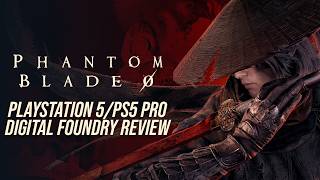

Why Phantom Blade Zero's Foliage is Next-Gen
60sShows off impressive interactive foliage physics that stand out from typical UE5 games, sparking visual awe.
▶ Play Clip"Delivers a thorough tech review as promised, though the title is generic and the content is dense with technical detail."
Snapshot 2026-10-31
Every observation TubeSum recorded, plotted as measured.
Based on 4 observations · last observed Oct 31, 2026 · straight lines connect consecutive observations — TubeSum does not measure the days between them.
Exact daily observations; gaps mean no observation was taken that day.
| Date | Views | Avg views / hour | Channel median |
|---|---|---|---|
| 2026-10-31 | 392,202 | 5,447.3 | 114,461 |
| 2026-10-30 | 375,224 | 7,817.2 | 114,461 |
| 2026-10-29 | 331,205 | 13,800.2 | 114,461 |
| 2026-10-28 | 26,017 | 13,008.5 | — |
This Digital Foundry tech review examines Phantom Blade Zero, an Unreal Engine 5 action game, focusing on its visual presentation and performance across PS5 and PS5 Pro. The review highlights the game's standout interactive foliage and acrobatic combat, while also analyzing the differences between its performance, balanced, and graphics modes, including the PS5 Pro's ray tracing toggle.
Phantom Blade Zero is a Chinese-developed AAA melee action title using Unreal Engine 5, delivering convincing Chinese martial arts stylings. It stands out from typical UE5 games due to its sense of animation in motion and highly interactive foliage that reacts to player movement and sword slices.
The combat is acrobatic and owes more to Devil May Cry than Bloodborne, featuring high action density and less emphasis on evasion. Secondary animation in hair and clothes underscores the flow of action, and bosses have unique moves and imposing introduction sequences.
The game uses standard UE5 features like software Lumen for indirect lighting and Nanite models. Lighting is generally attractive with pleasing occlusion and bounce light, though there are occasional missteps with light sources and shadow maps that fail to portray lighting accurately beyond a limited tracing distance.
The game has a semi-openworld structure familiar to fans of Souls games or God of War, but in the sampled slice, it seems more restrained in scope, with grand views but more boxed-in playable environments. Branching paths and exploration are key.
PS5 offers three modes: performance (60fps), balanced (40fps), and graphics (30fps). The biggest visual difference between performance and graphics modes is shadow quality, with graphics mode having higher fidelity shadows. Other differences are largely iterative, with Lumen GI and reflections retained in performance mode.
Graphics mode runs at around 1440p internal resolution, performance mode hovers around 900p-1080p, and balanced mode sits between but closer to performance. The game uses DRS, so resolution varies. The upscaler (TSR) does a good job presenting a clean, sharp image across all modes.
Performance mode reaches and holds 60fps for the most part with stable frame rates, though there are momentary dips. Graphics mode has some bouts where the frame rate cap lifts, causing visible judder. Balanced mode runs at a consistent 40fps but has totally busted frame pacing throughout, making it hard to recommend.
PS5 Pro has the same three modes plus a new ray tracing toggle for shadows, reflections, and global illumination. With the toggle off, PS5 and Pro look similar. The biggest divergence is image quality, with Pro using PSSR and having higher sharpness in motion.
The RT toggle is likely hardware Lumen. Reflections change from blobby to polygonal forms, and there are subtle GI improvements. However, shadow presentation looks similar with the toggle on and off, and image quality and resolution are similar. The toggle doesn't seem to justify its existence on PS5 Pro.
PS5 Pro frame rates are in line with the base console: consistent 60fps in performance mode, stable 30fps in graphics mode, and broken frame pacing in balanced mode. The RT toggle doesn't affect performance. The reviewer recommends performance mode on both consoles due to no feature level excisions and the faster update being helpful for an action title.
Phantom Blade Zero is a visually sound game that differentiates itself through stunning animations and dynamic environments, delivering familiar UE5 technology with good performance on consoles. The balanced mode's broken frame pacing is a notable issue, but action fans should give the game a shot, especially in performance mode.
Interactive Foliage
Highlights a key differentiator from typical UE5 games, showing dynamic environments that react to player actions.
00:36Combat Style
Clarifies that the game is not a Soulslike, but more akin to Devil May Cry, which is crucial for player expectations.
01:21Balanced Mode Frame Pacing
Identifies a significant technical flaw that makes the balanced mode unplayable for some, a key purchasing consideration.
06:42RT Toggle is Hardware Lumen
Provides a technical insight into what the PS5 Pro's ray tracing toggle actually does, which is not obvious to players.
08:35Performance Mode Recommendation
Offers a clear, actionable recommendation for players, emphasizing the value of 60fps in action games.
11:09[00:05] Wukong, another Unreal Engine 5 Chinese developed AAA melee action title is hitting digital storefronts. The upcoming Phantom Blade Zero delivers Chinese martial arts stylings convincingly, and it has been well
[00:20] reviewed. But how does the game fare in visual terms in its console outings? And visual terms in its console outings? And what's the PS5 Pro advantage?
[00:36] from the typical UE5 fair we see these days with its sense of animation in motion. Most of the game's foliage is interactive on some level and it sways and bends as the player intersects with it. Footsteps cause tall grass to spllay
[00:51] out wildly and sword slices shake grasses and bushes from side to side. In a lot of Unreal Engine 5 titles, we see much less interactive foliage, and often foliage in UI5 titles only animates at all at close range. Shadow map updates
[01:06] can become very expensive in Unreal with animated foliage, especially in larger, more openw world gameplay contexts. Combat is especially acrobatic as well. Expect well choreographed combo moves with wild finishers that are a lot of
[01:21] fun to watch. Phantom Blade Zero isn't a Soulslike game at all with combat that owes more to Devil May Cry than Bloodborne. So, the combat has higher action density and less emphasis on evading attacks. The combat has an
[01:34] excellent momentto- moment feel and proves visually captivating in a way few other games can match. Secondary animation in Hair and Clothes underscores the flow of the action and movement more generally. The main
[01:46] character often sports loose clothes that hang freely around his feet and shoulders, which helps create a visually interesting silhouette in motion. Bosses are another highlight. The stock enemies are fine enough, but bosses seem to have
[01:59] fairly unique moves and sport imposing introduction sequences and strong design work. Phantom Blade Zero seems to be packed with boss encounters, so the effort here substantially elevates the game's combat experience. Beyond some of
[02:12] the game's more interesting artistic touches, Phantom Blade Zero appears to be pretty standard for an Unreal Engine 5 title. The strong points of UEI5 are here, including using software lumen for indirect lighting, at least on PS5, as
[02:25] I'm showing here, and having nanite models. The game's lighting presentation is generally very attractive with pleasing occlusion and obvious bounce light. There are some occasional missteps, like the game's reliance on
[02:38] light sources. where rendering additional shadow maps from an additional light may be prohibitive in performance terms. These are an interesting visual curiosity but fail to accurately portray lighting past a
[02:51] certain limited tracing distance. For grasses and other little details that are closely relieved against the ground, they work well, but for main character model, chair, or table, they prove less effective. The game has a kind of
[03:05] semi-openworld structure that will be familiar to fans of Souls games or of titles like the Norse God of War games, but in a limited slice of the game I was able to sample, this seems a bit more restrained in scope. Expect grand views,
[03:20] but more boxed in playable environments. Not that this is necessarily a bad thing. Branching paths and exploration are the name of the game here within this is an excellent looking Unreal Engine 5 title. It's easy to take the
[03:35] does consistently produce some of the best looking titles that get released these days. And I'd say Phantom Blade slots in convincingly among the second wave of UE5 titles. Titles that have been primarily developed after some of
[03:50] UE5's teething pains were sorted out. AAA juggernauts like Gears of War Eday are ahead in ambition and in using cuttingedge engine features, but Phantom Blade looks great and works very well within its own.
[04:14] modes on PS5. A performance mode, a balanced mode, and a graphics mode, balanced mode, and a graphics mode, which do the typical 60, 40, and 30 FPS frame rate split that we're used to seeing in current generation software.
[04:26] The biggest difference that separates the performance in graphics modes lies in shadows, which are noticeably higher quality in the graphics mode and have better fidelity to their casting object. Outside of that, visual differences seem
[04:39] to be largely iterative. Newer versions of Unreal Engine 5 aim to target 60 fps on consoles with few feature level cuts. So techniques like Lumen GI and reflections are retained just fine in performance mode. Instead, users can
[04:53] expect a set of more iterative tweaks that only have subtle impacts on the final rendered frame. The game's 40fps targeting balanced mode lies somewhat closer to the graphics mode and overall visual settings with a similar shadow
[05:06] presentation to its higher frame time brethren. Outside of some occasional visual oddities like this moss presentation or this grass where balance mode differs in some unexpected ways, this seems pretty similar to the
[05:20] graphics mode presentation. These occasional differences I feel are differ between the various mode offerings. Of course, graphics mode is usually good for about a 1440p internal resolution in my counts, and performance
[05:34] resolution in my counts, and performance mode seems to hover around 900p to 1080p in my shots. Balanced mode straddles the two, but seems closer to performance mode in internal pixel count. There's a lot of DRS in the mix in this title, so
[05:47] the game's resolution in any given shot can vary substantially. The actual resolved image is fairly similar between the three modes. The game's upscaler, which appears to be Unreal's TSR, does a good job of presenting a clean and sharp
[06:00] image across all three modes. The higher quality variants may be slightly sharper and may offer a slightly cleaner resolve on certain edges in motion, but they all do a good enough job in my opinion. Performance generally seems to be quite
[06:14] good. The game 60fps performance mode reaches and holds 60 fps for the most part in the content I sampled with stable frame rates. There are some momentary dips in the mix and little dropped frames, but the game runs fine
[06:27] enough for the most part, at least during gameplay. The graphics mode is are some bouts where the game's frame rate cap no longer works properly, and periods of above 30 fps performance are possible, which produces visible
[06:42] jutdder. Balance mode runs at a pretty consistent 40fps at its 120 Hz output, but for whatever reason, it has totally busted frame pacing throughout, so it's hard to recommend. I tried forcing VRR on in the system settings, but it seems
[06:57] to have no effect on the incorrect frame pacing. I do have to temper this finding because according to other reviewers, the game does have some performance issues in mid to late game areas. I
[07:10] constraints and because of the game's difficulty and my general lack of skill in melee action games, but suffice to say that frame rates in later areas may not be as consistent as the on-screen footage in earlier areas. PS5 Pro is a
[07:26] little curious. Here we have the same three modes, performance, balanced, and graphics. But a new toggle is added to the mix which says it turns on ray tracing for shadows, reflections, and global illumination. With the toggle
[07:40] off, PS5 and Pro look pretty similar in broadstrokes with similar visual settings and software lumen for indirect lighting. In all modes, the underlying visual settings look similar between PS5 and Pro, so don't expect any major
[07:54] difference in shadows or other tweakables. The biggest divergence lies in image quality. All PS5 Pro modes have higher sharpness in motion and can exhibit a different aliasing character relative to their base PS5 counterparts.
[08:08] I think PS5 Pro uses PSSR here, while the base console makes do with TSR. In performance mode, the change is quite obvious. While in the higher resolution balanced and graphics modes, I would expect a smaller uplift. I think
[08:22] resolutions are a little higher here than on the base PS5 as well, though it's hard to tell because Sony's enhanced PSSR can be difficult to count and the game has fluctuating resolutions thanks to DRS. But what about the ray
[08:35] tracing toggle? My guess here is that this is actually a toggle for hardware lumen. The biggest tell lies in reflections, which go from blobby and misshapen forms with the toggle off to simplified but obviously polygonal forms
[08:50] with the toggle on. Phantom Blade doesn't have very many clear and stable reflective surfaces, but this change is obvious in some of the game's puddles. I'd also expect subtle improvements to GI quality, like how these boxes more
[09:03] convincingly olude the light on nearby wooden beams. The ray tracing toggle also flags improvements to shadows, which aren't really evident in my tests. With the toggle on and off, the game shadow presentation looks similar within
[09:18] each mode variation. So, I don't think the RT toggle is doing anything in possible that there are some small tweaks here, but there's no wholesale RT shadow change, like transitioning the game to UE5's Megalite system, for
[09:33] instance. Indirect diffuse shadowing should be improved by the transition to hardware lumin of course, but direct shadows seem largely unaffected. Image quality with the toggle on and off seems quite similar, and the limited number of
[09:47] pixel counts I was able to gather suggest similarish resolution as well. I wouldn't expect to see any big differences here at all. I'm not totally sure why this toggle justifies its existence on PS5 Pro at all given the
[10:00] lack of meaningful drawbacks. Perhaps a lumen toggle would make more sense on the base machine. The RT toggle doesn't improve the game's appearance that much, but it doesn't seem to particularly bother the PS5 Pro's GPU and it's
[10:13] improved RT capabilities over the base console. PS5 Pro frame rates are in line with the base console. A pretty consistent 60 fps is possible in the performance mode, at least in the early areas with few dips. The graphics mode
[10:26] is mostly good for a stable 30fps minus some bouts where the frame rate cap appears to lift briefly. And the balanced mode seems to do a good job of hitting 40 fps, but it does a very poor job of actually locking its update to 25
[10:40] milliseconds with broken frame pacing. I imagine these figures could get worse in late game areas if impressions from other outlets hold true. I tested the game with the RT toggle on and off and it didn't seem to make much difference
[10:54] at all. The headline performance targets remain the same and any dips or other issues seem substantially similar as well. Again, I'm not totally sure why the rate tracing toggle makes sense on PS5 Pro. On both PS5 and PS5 Pro, I'd
[11:09] lean towards the performance mode. There are no real feature level excisions here, and the faster update is very helpful for an action title. Unreal Engine 5 is pretty good about delivering advanced visual features at 60fps these
[11:22] days, and that seems to be the case here. Phantom Blade Zero seems to be a very good game, and it logs good visual features and performance on consoles as well. It differentiates itself from other UE5 fair through stunning
[11:35] animations and dynamic environments, and otherwise delivers some pretty familiar technology. That's not a bad thing, though, and the content I sampled seem to hum along just fine. The balance mode is the biggest exception to that rule,
[11:49] which really needs a fix. So, Phantom Blade Zero is a visually sound game. Action fans would be well advised to give this one a shot. If you enjoyed press the bell for YouTube notifications. Check out the Patreon at
[12:04] patreon.com/digitalfoundry for exclusive and early access content. for exclusive and early access content. And to get in touch, use social media.




⚡ Saved you 0h 12m reading this? Transcribe any YouTube video for free — no signup needed.