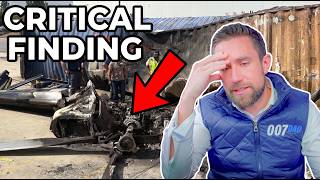

NTSB Drops Bombshell in Chopper Crash
45sThe NTSB's revelation about engine sounds and advisories in the crash video is a shocking new detail that will intrigue viewers.
▶ Play Clip"Delivers a solid breakdown of NTSB findings with useful visualizations, though some speculation is clearly labeled."
The NTSB released a press conference detailing their investigation into the NBC4 NewsChopper 4 crash in Chatsworth, California, which killed two crew members and one person on the ground. The NTSB highlighted critical evidence from the live video footage, including engine sound changes and potential advisories, and discussed the possibility of an out-of-ground-effect hover. This video breaks down the NTSB's findings, provides visualizations of potential mechanical failures, and separates facts from speculation.
The NTSB is focusing on the video footage from the live coverage, which they consider the most important evidence so far. They plan to send a pristine copy to their recorder's lab for sound spectrum analysis.
The NTSB heard sounds consistent with the engine changing speed and tones likely advisories to the pilot. This is a key clue pointing to a possible mechanical failure.
A separation at point number 4 in the drive shaft could unload the engine from the rotor blades, causing the engine to speed up (higher pitch). This could trigger an automatic fuel cut-off as a safety response.
If fuel is cut off at 500-800 feet in a hover, the helicopter enters the 'dead man zone'—too low for auto-rotation landing and without forward momentum. This could explain the crash.
The helicopter was likely in an out-of-ground effect hover (more than one rotor diameter above ground), which increases power required and stress on the engine. This was confirmed by video footage.
A vortex ring state can occur in hovers, causing a self-doom loop of sinking. However, this is unlikely here because an engine failure would destroy the vortex, and the pilot could have moved forward.
The fireball suggests fuel was present, so the crash may have been due to fuel starvation from a mechanical safety shutdown, not fuel exhaustion.
Despite the post-accident fire, physical evidence remains. The NTSB will work with airframe and engine manufacturers to analyze components. A preliminary report is expected in about 30 days.
The NTSB's investigation points to a potential mechanical failure, possibly a drive shaft separation, leading to fuel cut-off in an out-of-ground-effect hover. While speculation is early, the evidence from the video and sound analysis is crucial. A preliminary report is expected in about 30 days.
Sound Spectrum Analysis
The NTSB's focus on sound analysis is a key investigative technique that could reveal the cause.
01:49Drive Shaft Separation Hypothesis
Explains a plausible mechanical failure that matches the observed engine sound changes.
03:38Dead Man Zone
Highlights a critical safety concept in helicopter operations that explains the crash dynamics.
06:08Out-of-Ground Effect Hover
Shows how hover height increases engine stress, a contributing factor in the crash.
06:42Fuel Starvation vs. Exhaustion
The fireball evidence suggests a mechanical fuel cut-off, not fuel exhaustion, narrowing the cause.
11:10[00:00] The national transportation safety board just released a press conference indicating what they're focused on in the investigation regarding NBC4's Newschopper 4 crash yesterday at 6.57pm
[00:20] in Chatsworth, California. In this video, we're going to break down exactly what problems the NTSB just highlighted and I'm going to provide visualizations for how potentially this aircraft with this crew could end up like this.
[00:36] Because it's devastating and it's a tragedy. Especially since they were already covering tragedy with two deaths in a T-Bone Ford SUV crashing right into a Metroline bus in Los Angeles, killing two, injuring six others.
[00:51] And then, of course, the helicopter crash, killing two crew and an additional person on the ground. We're going to break down what the NTSB just said regarding the crash, and we're going to go ahead and start by playing a little bit of a clip of the NTSB
[01:06] referring specifically to the video footage of the crash that we saw yesterday. And I'm going to highlight exactly what they point out here. I want you to pay attention to what the NTSB does here with their hand.
[01:20] I think this is exactly what we pointed out yesterday as a red flag. NTSB is already on the case. Listen to it, and then we'll talk about it. We'll provide some simulations around what they could be referring to with their hand motion here.
[01:33] Listen closely. Asking you guys, you're asking about the video that was actually taken while the reporter was doing the live coverage. That video is probably the most important evidence that we have discovered so far.
[01:49] And what we're going to do is get a pristine copy of that recording and send it to our recorder's lab for a sound spectrum analysis. Because in that recording, we are clearly hearing sounds that are consistent with the engine changing its speed.
[02:06] We're also hearing tones that are being generated that are likely advisories to the pilot. This hand motion the NTSB just connected with the video that we saw yesterday here is exactly what we flagged.
[02:21] In fact, in our video yesterday, we went back and we replayed this segment right here. And I want you to listen to it because it tells us a lot about what could have possibly gone wrong here. And there are multiple simulations we're going to play in a moment.
[02:34] But let me play you that sound. Listen to what sounds like that engine getting louder and higher pitched before shutting down. Listen closely.
[02:46] Uh-oh. Okay. One more time. Uh-oh.
[03:00] Okay. Why does that matter? This is possibly. Now, we're going to speculate about this portion. When there are accidents involved, I always like to be clear about here. the facts, this is what the NTSB is saying, this is what they're signaling. They are signaling.
[03:17] That very change in sound is a key a clue to this We don know why but what we do know is that that sound would happen in a very specific mechanical failure And I can show that to you in this diagram right here
[03:38] This is essentially the drive shaft of the aircraft connected to the main rotor right here. I want you to pay specific attention to where the number 4 is right here.
[03:50] because if this component right here, for some reason, were to disconnect or become separated, what would happen is if you would have a separation at point number four,
[04:03] you would all of a sudden be unloading the engine from the rotor blades in the weight of the aircraft. So all of a sudden, an engine that's working hard, kind of like when you have a lot of stuff plugged into a generator, right?
[04:18] all of a sudden, if you unload it, it gets a little bit higher pitch. That could be consistent with the unloading of weight on this aircraft,
[04:31] which could be consistent with some form of disconnect here. Now, we are speculating on it based on that sound. Again, I'm going to always separate fact from speculation because it's so early. We won't get a preliminary report on this accident for about 30 days,
[04:46] and that's just a preliminary report. We'll talk about some other sequences that the FAA is looking into along with the NTSB. But watch this. Let's play this sequence. So this is moving like normal. We get a separation here at number four.
[05:00] The load is removed. It spins faster. Now all of a sudden, fuel gets automatically cut off because all of a sudden you're providing a lot of fuel to the system that is now unloaded.
[05:13] The sensors in the aircraft say, we're going to explode this motor if we throw this much fuel in with this kind of input command that we're getting from the pilot, which is normal because you're flying under a loaded condition.
[05:26] You don't all of a sudden expect this torque overload with the amount of fuel that's coming into here. Because helicopter engines are designed to operate at a constant RPM, and so you're just providing more fuel to maintain that level of RPM.
[05:41] I'm oversimplifying. But watch this again. A little bit, one more time. We have a normal drive system right here. That's normal. Everything's moving normally. You get a separation.
[05:53] Boom. This spins twice as fast. Oh my gosh, we're going to blow up the engine. Cut the fuel. An automatic safety response. Cut the fuel. Now, unfortunately, if you're five to 800 feet above the ground,
[06:08] you're in what we talked about yesterday, which is the dead man zone. You're at a hover. You don't have the forward momentum to really get that auto-rotation landing. You also don't have the height to catch that air resistance under your rotor to actually pull an auto-rotation land.
[06:28] Now, the next thing that the NTSB talks about is the out-of-ground effect hover. Let's listen to that portion right here. The helicopter possibly being in an out-of-ground effect hover.
[06:42] The helicopter in an out of ground effect hover is hovering a little bit more than, at least a little bit more than its rotor diameter. So we need to gather video footage witness footage to find out how high that helicopter would be to even determine if it was an OG hover It was Okay let be clear It was We could see from the video
[07:06] footage, it was clearly more than one roto blade length in diameter. So, like, imagine your hands or your arms with a roto right here. I'll kind of compress them so we're actually on video. It's like, yes, the helicopter
[07:18] was more than that above the ground. So, yes, there was an out of ground effect Tupper. Ground effect is when you're pushing wind or air, essentially, compressing air against the ground, giving you a little bit of float. This is actually how, when an aircraft
[07:33] comes to land, you can kind of see a plane float a little bit, catching that ground effect. All right, and if you have too much energy, you get more float. Why does this potentially matter? An out-of-ground effect Tupper matters because of the stress on the aircraft, on
[07:50] the actual engine, which we just saw. Take a look at this here. Here, we have power required. You can see this little blue bar right here, kind of in the middle. We're hovering above
[08:04] the ground. The ground is actually giving us some lift, because we're pushing air down, that air is hitting the floor, and you're getting this sort of resistance, equal opposite reaction, right? When you lift up and you actually start hovering higher out of ground effect,
[08:23] the level of power required, so in other words, the strain on the engine will actually grow. So near the ground, you're going to have the minimum sort of power required for a hover.
[08:37] But watch what happens as I move this slider. I'm going to move the helicopter up, see how the power required is going up, increasing, increasing, increasing, increasing. We keep going, more
[08:49] torque is needed, RPM stays the same, more torque, more torque, more torque. This is, in other words, a much more stressful situation for that motor, or that engine, right, so
[09:01] not electric motor, so this is turbine engine, just for the technical people in the bunch, yes, there is a difference between an engine and a motor. We talk about Tesla a lot on channel here, so we talk about Tesla motors, electric motors, but this is a turbine engine.
[09:15] Let's just make that clear and forgive me for sometimes when I use that interchangeably. But I do think details matter, so I'd like to clarify that. Anyway, so you can see power use is higher when you're in a hover.
[09:28] Obviously, this is reduced if you're able to fly in a forward direction. This is actually where what you're fighting, in addition to this out-of-ground effect hover, What you're fighting is the potential for a self-induced vortex, essentially.
[09:45] This is very normal. It's called a vortex ring state. It can happen. Helicopter pilots are trained to escape this simply by moving forward. But in other words, if you spend too long in one location and the conditions turn right,
[10:02] the weight moves below the aircraft. You're pulling this air down. So you play this sequence right here, that air gets pulled down, but what can happen is you can sink. So your aircraft sinks a little bit.
[10:15] Now all of a sudden you're enveloping the air around your top, air recirculates around the top and actually almost gets sucked into your vortex even more and you create this self doom loop of sinking This is not likely what happened here Last time experienced helicopter pilot was simply moved forward here and in a vortex you wouldn have an engine failure In fact an engine failure would immediately destroy the vortex that you creating
[10:38] But the point is, there's more strain on an aircraft, and there are other situations that can occur in hovers. But is it possible that an out-of-ground effect hover contributed to stress on the engine components?
[10:52] Absolutely. Is it possible that there was some form of separation and therefore some form of safety switch cut fuel? Absolutely. Because remember yesterday we saw a fireball, which would imply that there's either fuel on the ground or fuel fill in the tank,
[11:10] which suggests we wouldn't have exhausted our fuel. It means for some reason we may have been starved of fuel, like a mechanical system all of a sudden shutting down your fuel flow for a safety feature.
[11:22] We know the building close to the accident scene has security cameras, so we're working with the owners to secure those security cameras. That's useful. Securing the security cameras might give us a little bit more of an angle from lower.
[11:36] I don't think you're seeing much other than the impact, unfortunately. We're fixing out the two-core autorotation. They were also asked about autorotation. This is a very common question you're going to ask. Of course, they're going to investigate that.
[11:49] But what's more interesting is a lot of questions have come up here about, hey, like, can you actually get any debris, anything useful out of this aircraft, given that, you know, it burned? Let's play the response here.
[12:02] That's a very good question. And even if the aircraft has experienced a post-accident fire, there is a lot of physical evidence that will help us get to the point where we're analyzing our factual data and getting to a probable cause.
[12:19] and part of the success that we have is by bringing on party members, the airframe manufacturer, the engine manufacturer, who are experts in these airframes and engines.
[12:33] So even though they may be badly damaged, they know what those components look like. That's very useful context. They're essentially saying, look, we're now going to go through all those components. If we find a component that's damaged, obviously that's going to go into a preliminary report,
[12:49] We'll have that probably in about 30-ish days is the expectation. But this is devastating. This is very disappointing to see. A lot of people are disputing the heights of the helicopters, where they're flying, where they're allowed to fly.
[13:01] Technically, helicopters can fly as low as they want, so typically they're held above 400 feet. Sometimes new helicopters are brought to at least 1,000, and then police helicopters can circulate lower at 400 or 500 levels.
[13:15] A guide guessed the aircraft was closer to 800 feet. But we'll see. We'll get the actual data and we'll know a lot more in 30 days. In the meantime, this is, for what it's worth, a factual update on what the NTSB has said.
[13:30] I played those clips, providing a little bit of a factual update. We've talked about how certain system failures can contribute to exactly the sounds that we've heard. But we are being very clear here that coming to a conclusion is very crucial.
[13:43] During the whole advertisement, these things that you told us here, I feel like nobody else knows about this. We'll try a little advertising and see how it goes. Congratulations, man. You have done so much. People love you. People look up to you. Kevin Parker, F.Y. Nice to meet you.
[13:55] And you two both need Kevin or it's great to get your take.




⚡ Saved you 0h 14m reading this? Transcribe any YouTube video for free — no signup needed.