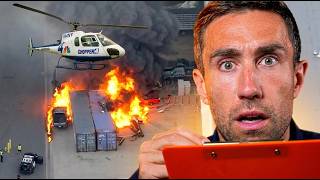

Tragic Helicopter Crash Caught on Live TV
45sThe shocking footage of a news helicopter crashing while covering a bus accident is inherently gripping and emotionally charged.
▶ Play Clip"The title promises heartbreaking footage and a breakdown, which is delivered, but the video includes some filler and speculation."
This video provides a detailed breakdown of a tragic helicopter crash that occurred while covering a bus accident in Chatsworth, California. The presenter analyzes the footage, explains the technical aspects of helicopter flight and the 'dead man's zone', and discusses the probable causes of the crash.
The video opens with heartbreaking footage of a C4 helicopter crash that occurred while covering another fatal accident, leading to additional fatalities.
At 5:03 p.m., a dark-colored SUV slammed into a Metroline 166 bus at Nordhoff Street and DeSoto Ave in Chatsworth, California, killing two and injuring six.
During coverage, NewsChopper 4 (NBC4) went down, killing both crew members and one person on the ground, and hospitalizing another. Total fatalities: five, injuries: seven.
The low RPM rotor horn is a warning sign that rotor blades are not spinning fast enough to maintain lift, indicating the need for engine failure recovery procedures.
The helicopter was in a hover at about 400 feet, which is in the 'dead man's zone' where recovery requires more than 1,000 feet of altitude.
Before the engine quit, the RPM seemed to increase, suggesting a possible mechanical governor issue rather than simple fuel starvation.
The aircraft had been flying for about two hours, with fuel capacity for 2.5-3 hours. The immediate engulfment in flames suggests fuel was still present.
In an engine failure, pilots use auto-rotation: diving to gain speed (60-80 knots) to keep blades rotating, then flaring before impact.
The slower the aircraft moves, the more height is needed for recovery. Hovering requires about 800-1,000 feet for a successful auto-rotation.
The aircraft was an AS350 (tail number N358TV), a standard for LA news helicopters, single-engine, reliable.
Potential causes include fuel starvation vs. exhaustion, compressor failure, fuel control unit failure, or fuel contamination. NTSB will investigate.
The crash was a devastating event, likely unrecoverable due to the helicopter's low altitude and hover state. The NTSB will determine the exact cause, but the situation highlights the inherent risks of low-altitude helicopter operations.
Dead Man's Zone
Explains a critical aviation safety concept that is often misunderstood.
02:38Engine RPM Anomaly
Suggests a possible mechanical issue beyond fuel starvation, adding depth to the investigation.
04:18Auto-Rotation Strategy
Provides a clear, step-by-step explanation of a life-saving technique.
06:48Possible Causes
Outlines the investigative process and potential factors, showing the complexity of crash analysis.
13:43[00:00] In this video, you are going to see heartbreaking footage of what appears to be this ending C4 helicopter crash while it is covering another fatal accident.
[00:12] And unfortunately, this video footage ends up leading to yet more fatalities. In this video segment, just briefly after the accidents occurred, we are going to break down as much information as we have as of this moment.
[00:28] Keep in mind, this is briefly after the accident, so more information is going to come out in time. Here's what we know. First, we know that at about 5.03 p.m., a dark-colored SUV slammed into a Metroline 166 bus traveling direction, Sun Valley.
[00:48] This occurred at the intersection of Nordhoff Street and DeSoto Ave in Chatsworth, California. Multiple used helicopters then launched to cover the accident because it was a fatal accident.
[01:02] ABC 7 is reporting that in that bus accident, two people died. You can see the vehicle has penetrated into the side of the bus.
[01:14] Two people were killed in this accident and six people were injured. multiple firefighters were on scene extraditing trapped victims from the bus. Helicopter crews were responding to cover this accident.
[01:30] And unfortunately, during their coverage of it, News Choppers 4, NBC 4, went down, killing both crew members, killing another on the ground,
[01:43] and hospitalizing a fourth person on the ground. That means tonight we have a total of these two accidents, five fatalities, and seven injuries. This video feed right here occurred live.
[01:56] I'm going to play it first, halfway through, because there is a latency portion at the beginning of it, where you get the pinwheel and it makes it feel like your device is broken. That's just the best recording that's available for the first half.
[02:09] But this is the second half, and I want you to listen to what is called the low RPM rotor horn. That is essentially when your rotor blades are not spinning enough for you to maintain lift,
[02:21] you are going to get a high-pitched horn sound, and that is your warning sign. This is typically when you're going to enter your engine failure recovery procedures. The problem is, when you're covering an accident, maybe, maybe 400 feet in the air,
[02:38] if that, and you are at a hover, you are in the perfect dead man's zone to where the recovery technique for this particular situation requires likely more than a thousand feet of height.
[02:53] This is why they call it the dead man's zone. Listen closely to the second segment, and then I'll play the full segment. Anything you can't pull up? It is a devastating accident. I'm now going to play it from the beginning.
[03:12] You can see the accident here. Keep in mind, the aircraft did end up crashing at about the 9151 North Mason Ave address in Chatsworth, 91311.
[03:28] I'll show that in the map in just a moment after we play the full footage. Keep in mind, the buffering is not you, it is the recording.
[03:42] Thank you It absolutely devastating
[04:03] Now, you can hear the pilot exclaim in the background some kind of shock and expletive is what it sounded like. totally reasonable at this point. Unfortunately, too low to really enter those recovery procedures.
[04:18] One thing that I think is really strange, and I want you to listen to it, is before that engine just quits, which usually in a fuel starvation, you're just going to hear an engine sputter and roto down. This one actually seems to RPM up before going down, suggesting that maybe there
[04:38] was more of a different mechanical governor issue related to this crash. Listen to that part closely. We're going to play from a little bit earlier.
[04:50] We hear it right about here. That's exactly where it is, right before the beep, beep, beep. You hear it go up, beep, beep, beep, and then you hear, essentially, the engine shutdown.
[05:04] Here we go one more time. Uh-oh.
[05:19] This ended up crashing into two containers. As I mentioned, the aircraft appeared to have immediately become engulfed in flames.
[05:36] This does suggest that even though the aircraft had been flying for, we believe, somewhere around two hours, fuel capacity for this aircraft is probably somewhere between two and a half to three hours, depending on how much weight they have for camera equipment on the actual aircraft.
[05:50] But given this immediate fire here, unless there was additional fuel on the ground, some other factor here, it seems like the aircraft still had fuel based on the severity of this burn here.
[06:04] Now there is more video footage of ground response and potentially an identification of the victims. This is at least what is circulating at this point.
[06:18] Please take this for whatever grain of salt it is. I'll just put them on screen here because we do have already some sort of footage of these people actually working in their day jobs. We'll be looking at it in just a moment.
[06:30] It's worth indicating the police had over 14,000 hours. That's what's currently reported. And I'd like to just reference briefly the dead man's zone, because a lot of people might not recognize how you would recover from an engine failure in a helicopter.
[06:48] In a helicopter, if your engine fails, you're typically going to use an auto-rotation strategy. This is where you're trying to get up to somewhere between 60 to 80 knots of speed by essentially diving forward.
[07:01] So that way you could get speed, get speed under your blades and get your blades rotating again. And then when you get that speed just simply through air, giving you just some rotation,
[07:14] you can get just enough maneuverability to essentially come straight, maybe not straight down, but more like down at a 45-degree angle, and then flare right before hitting the ground.
[07:26] and you really only have one chance to flare on a helicopter. But here an example of what the dead man zone is considered This is a graphic here It went a little kaput But basically the principle of the dead man zone Ah this is a little better
[07:42] The principle of the dead man's zone is the slower you are moving, the more height you need. So, for example, if you're hovering, you're going to need about 800 feet per this chart.
[07:55] I originally said 1,000. I think 1,000 is more realistic just for reaction time purposes. So the slower you're moving, the more height you're going to need to actually be able to pull off an auto rotation.
[08:08] If you have height, then you have time to get that speed because you can dive. Now, if you are going faster and you're lower, let's say you're going 40 or 50 or 60 knots at 400 feet,
[08:24] you'd have more of a chance. But this aircraft was clearly in a standstill hover, covering the unfortunate tragedy that happened at the intersection. This would require the highest possible height for recovery.
[08:41] Unfortunately, this may not have been a recoverable situation, and it's devastating. The aircraft, after the fact, based on images circulating online, was clearly heavily, heavily damaged.
[08:58] It will take quite a while for the NTSB to go through this. There is some B-roll of Eliana Moreno. I'd like to play that. Here we go. Chapter 4, Eliana.
[09:11] I am the NBC4 helicopter reporter and photographer out of Westman Airport. A typical day here at the airport requires an aircraft, of course.
[09:23] So you'll see us all around town covering pursuits, brush fires, shootings. And we do it all using this handy-dandy camera that you see up here. That's how we're able to record all of the footage that you see on TV.
[09:38] And while I'm operating that camera to bring you those images of a high-speed pursuit, for example, I'll also be in the back narrating what's going on. This is another potential photo of the aircraft and the victims.
[09:53] No identification of the potential victim on the ground. This is some more stressful footage of one of the reporters arriving on scene here. He was actually essentially shooed out of the area by the law enforcement that was there.
[10:09] You can see another camera person here trying to get closer. they're all getting pushed back and you can hear his concern. I'm from another, from ABC in fear and concern. We don't know where this chopper is from.
[10:22] We don't know if it even is a chopper. We don't know if it's a new chopper. We are just looking right now. What are you hearing? Okay, so me and I, my husband and I saw it. We think it's a 7. I'm not sure. I don't know.
[10:34] I think it's an Air 7. 7 was confirmed to be okay. What happened? Yeah, it came and it was for the accident that was on Desoto and it came and I think it just slammed into the building, but we don't know why.
[10:54] What's your first name? Okay, yeah, I'm sorry. Okay, it's not you. My colleagues are telling me that it is not their, that it is not from their station.
[11:07] We don't know where it's from. You know, this is the situation. and we are just giving you the information just as we have it. We are being pushed back. This is when you know in L we work together here There are people running There are my colleagues running trying to get their trucks out of the way
[11:33] Devastating. Devastating situation. So let's understand a little bit also just on location here. This is the Nordhoff and DeSoto right by the Farmer's Boys. This is approximately the accident location here.
[11:48] We could see right between these two buildings, you've got the container area here. Unfortunately, regarding the situation, it would have been very difficult to know exactly what was right under you in this panicked situation.
[12:04] I actually personally found it very impressive that the aircraft was able to be put down on what could have been a flat road. I think it was likely very difficult to see this stack up right here.
[12:18] They dodged the buildings, potentially sparing other lives. One person on the ground did die, though. We don't know. So now what we can understand is what potentially could have happened here.
[12:32] More information will come out in time. But here's the limited information that we have. We know this was an NBC4, NewsChopper 4. Tale number was November 358, Tango Victor.
[12:45] We don't have, obviously, reporting yet from the FAA or the NTSB. We do have some flight tracker information that does indicate that this aircraft seemed like it was circulating for quite a while.
[12:58] Again, usually in a fuel starvation situation, you're not going to hear that sort of rev up, and you might not necessarily see that much of an explosion. This is a single-engine aircraft, though, so that one engine goes, you really have to hope you have height,
[13:12] otherwise you are in the dead man's zone. And there's little performative that could have been done here. This was just a horrible situation. It just appeared like terrible fate that day.
[13:24] This particular aircraft was an AS350, which is a standard for LA news helicopters. Again, reliable. One engine, very normal. We saw the very own live shot, and there's no evidence here that there was any kind of mid-air collision.
[13:43] As far as probable causes or possible causes, it's so early to say. I mean, of course, we look at fuel starvation. The NTSB will be looking at that. Could this have been a compressor failure, a fuel control unit failure, fuel contamination?
[13:58] What was this fuel starvation versus fuel exhaustion? In other words, did they run out of fuel, or was there some form of mechanical failure that didn't deliver that fuel to the engine,
[14:13] even though it had fuel in the tanks. We don't know, right? Exhaustion is dry tanks. Starvation is some form of blockage, a filter blockage. I mean, it could be a fuel pump failure,
[14:26] although usually these aircraft have multiple fuel pumps. I know in the aircraft that I was typewriting, they rated in again, jet aircraft. We've had fuel pump failures. We have two fuel pump failures, or two fuel pumps, though.
[14:38] You can rely on another. You can also rely on the suction pumps that we have. But this is a totally different type of aircraft. Helicopter, obviously. So every situation is different. But this is the information that we have right now.
[14:52] And we'll be looking for updates. This is a terrible situation. The heart goes out to everybody involved. I'm not advertising these things that you told us here. I see that nobody else knows about this. We'll try a little advertising and see how it goes. Congratulations, man.
[15:04] You've done so much. People love you. People look up to you. This is Kevin Passapath, their financial analyst and YouTuber. Meet Kevin. Always great to get your take.




⚡ Saved you 0h 15m reading this? Transcribe any YouTube video for free — no signup needed.