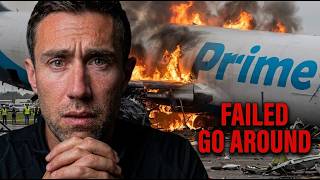

Shocking NTSB Reveal: Amazon Crash Details
45sThe video opens with a dramatic revelation of new NTSB findings, immediately grabbing attention with the promise of shocking details.
▶ Play Clip"The title promises shocking new information, and the video delivers specific NTSB findings and analysis, though it includes some promotional content."
The video discusses newly released NTSB information about the Amazon cargo aircraft crash operated by 21 Air. Key findings include a failed go-around attempt, a hard landing, and the captain's limited experience. The creator analyzes the timeline, the go-around decision, and the lack of thrust reversers, emphasizing the challenges of jet operations.
The NTSB provided new information about the crash, including a failed go-around attempt and the captain's type rating only four months prior.
The nose and right landing gear touched down 30 seconds before the accident, with rapidly shifting tailwinds from headwind to variable to tailwind.
The go-around attempt was canceled, likely due to insufficient time for thrust spool-up, which takes 7-9 seconds in a jet.
Neither reverse thrusters nor spoilers were applied during the final roll, possibly due to the late decision to cancel the go-around.
The aircraft crashed at 65 knots, resulting in five fatalities. Key issues include captain experience, landing hot, tailwind, and lack of speed brakes.
Captain's Experience
Reveals the captain had only four months of type rating, a key factor in the investigation.
00:21Missing Thrust Reversers
The NTSB revealed that neither reverse thrusters nor spoilers were applied, a critical finding.
07:44Go-Around Timing
Demonstrates the actual time required for a go-around in a jet, highlighting the challenge pilots face.
10:12Crash Speed
The aircraft crashed at 65 knots, resulting in five fatalities.
08:39[00:00] 1, 2, 3, Holy smokes, we just got shocking new information on the Amazon cargo aircraft crash operated by 21 Air, including a failed go-around attempt, a hard landing, and a captain who was type-rated in his plane four months ago
[00:21] with apparently no evidence that the reverse thrusters were activated. In this video, we're going to break down the shocking new information that the NTSB just provided for us.
[00:34] I'm going to go through the timestamps first, and then we'll get into a little bit more of that pilot experience. First, on this breakdown of timing, I'm going to give you the facts that the NTSB provided, and then we're going to compare that to what we said in our initial reaction, mostly,
[00:50] because there's a massive learning lesson in here that I talked about in my very first lesson. A lot of people talk about, just go around. They try to. And in my very first reaction, I nailed what the problem with a go-around in a jet is.
[01:07] And I'll explain that in just a moment. And this isn't to pat myself on the back or whatever. It's to educate. Because it's very different from a piston aircraft. Here's the time framing. 30 seconds before the accident. The nose and right landing gear touch down.
[01:22] We know we're kind of diving in here as we're coming in for that landing. We got that dive, trying to get two reds, two whites, trying to get onto the glide slope, get that three-degree descent, trying to get to our landing markers.
[01:34] But we've got rapidly shifting tailwinds, right? We went from a headwind an hour ago, we went to variable winds 20 minutes before landing, and we went to a tailwind the very minute of landing,
[01:47] which means the METAR data was probably given as they were landing, which would have essentially made it impossible for them to know that. Anyway, facts. 30 seconds before, that's when the nose landing gear and the right main touched down.
[02:01] And when I say before, that's 30 seconds before the actual accident by crashing into the vehicle. So that would have been roughly around here. It's a relatively flat landing. Now, at about 20, the landing speed.
[02:16] Landing speed was 158 knots. Typical landing speed for this aircraft is probably going to be somewhere closer to about 140 knots,
[02:28] and that's with the wind factor already in it. A lot of pilots are looking at a typical dry runway, headwind, landing speed of about 120 to 130, so I'm already adding a crosswind factor into this because we know we've got crosswind issues here,
[02:45] and for controllability, you're going to add a little bit more energy. 23 seconds before impact breaks were applied which would be somewhere probably when they felt they got that left gear down so that way they wouldn have differential braking You
[03:01] might wonder why delay seven seconds? If you want to make sure you got all those wheels down, if you hit the brakes on just one side, you might end up getting off the side of the runway. Every aircraft is different. This is an experience question
[03:17] when it comes to controllability of the aircraft with just half of your braking power on. Now remember, these aircraft pivot if you provide differential braking. That's actually how a lot of early pilots
[03:29] learn how to fly and turn smaller aircraft with differential braking. Anyway, this is like the definition of differential braking when only half of your gears are down. But anyway, they came in at 158 knots ground speed,
[03:42] again a little bit hot, 23 seconds before they applied the brakes at about 146, so they bled out about 12 knots before they hit the brakes. 19 seconds before, we get that left gear down, and we're at about 134 knots there. 15 seconds before,
[04:02] the brakes were released at 120 knots. They increased their throttles to go around. Now, That's at 120 knots.
[04:14] This is really important. If you're at 120, you need to only get to about 135 to take off. But you don't have a headwind. So you don't have the benefit of a headwind helping you gain lift.
[04:28] So you might need even more than that because of the tailwind. That doesn't seem like a lot. And for those of us that have spent a lot of time in piston engines, you know when you land and it's like,
[04:40] I don't like this landing, I'm going to go around. You throttle up, we're in the little Cessna, you pull the little red button out, this thing just goes whoop. It's incredible. It's like a lawnmower, or like a wave runner,
[04:52] if I like to put it, like a jet ski. It's great. What? This is what I talked about in the first video. Totally freaking different. It takes forever to spool up.
[05:05] I'm not going to show it right now, I want to get through the facts, because I think they're most important, but I'm going to show you an actual go-around that I did here. I'll show you that in just a moment. And I want you to see when we go throttle, full power here,
[05:18] how long it actually takes to get that go-around cooking. You're going to see that in a jet, a multi-engine jet aircraft, a complex aircraft. All right. So 15 seconds before, we get brakes released, go around.
[05:32] Throttles increased. Four seconds later, we get throttles. back to idle, brakes applied. And here's the crazy thing.
[05:44] They went to go around full power 15 seconds before at 120 knots Four seconds later their speed was 117 knots
[05:57] They went full power, and for four seconds, they lost three knots of speed. That is exactly what I mentioned in my first reaction to this, is that it's not that easy in a giant freaking jet that's
[06:12] way bigger than what I used to fly. It's a smaller business class. These puppies take a while to school up. If the little guys take a while to school up, these guys probably take 7 to 9 seconds
[06:24] to school up. Mine was like 4 seconds. And it's the weirdest feeling ever going from a piston aircraft because it just doesn't make sense. Piston aircraft? Power. This guy?
[06:36] Full power. Go on. Oh! Now it's mine. It's so weird. I mean, you can hear the spooling, but you just don't get the thrust. Seven to nine seconds.
[06:48] We're going to put these guys at the end of the freaking runway. So honestly, in my opinion, looking in from the outside, I could be wrong. But if they committed to that go-around, they should have, looking in from the outside,
[07:01] probably just committed to going full reverse thrusters and brakes here, right? We'll talk about that in just a moment. Monday morning quarterbacking, okay? I don't know what was going on in the cockpit, obviously. I'm just saying. they actually committed to that go-around,
[07:13] this puppy would have probably hit some equipment at the end of the runway, and this would have been one of those tumblers like the UPS aircraft that we saw, and there would have probably been a whole lot more death. So for the sake at this moment of minimizing death,
[07:28] canceling that go-around was probably the right choice. But here's the bizarre part. For some reason, as we get into this final roll here, we never get reverse thrusters or spoilers.
[07:44] The NTSB just revealed that neither were applied. Now, it's possible because by the time they stopped their go-around and applied brakes, they were four seconds away from a lateral acceleration change.
[08:00] I think that means by the time they decided to cancel the go-around, they had maybe only three and a half to four seconds before hitting the fences and the equipment at the end or running into the grass, right?
[08:13] That's not a lot of time. So would it have made a difference to apply the spoilers at that point? Probably. But they were not. And so that ended up leaving the aircraft
[08:25] seven seconds after the lateral acceleration changes, which likely means going off the end of the runway. They ended up crashing at 65 knots at zero seconds when the recorder stopped.
[08:39] That the Econoline band that was likely hit at 65 knots That where the five people died Now three big issues obviously we got here First a lot of people are going to be wondering
[08:53] captain flying, four months in type, not necessarily a bad thing. But why are they flying with somebody who's been typed for a year and five months? I don't know. What I found is
[09:06] when I was in training, especially in jet training, the goal was always put a newer pilot, me, with somebody who's been doing this for, and typed in this aircraft for five plus years.
[09:18] And it's got like 5,000 hours. That was the goal, at least. Every company's going to have different standards. Those are going to be reviewed. We got that issue. We got the issue of landing hot.
[09:31] We've got the tailwind and the changing winds that we received. We've got no time for the go-around at the time of the decision because of the spool-up time. Take-off weight for this aircraft was 252,182 pounds.
[09:44] Landing weight was 231,236 pounds. Cargo was only 32,000 pounds. Mostly contact glasses. Contact lenses. Really interesting. And then, of course, we have the no-speed brakes with thrust reversers deployed.
[09:59] So, some oddities here we're going to have to dissect and learn more from. We should be getting a cockpit voice recorder breakdown tomorrow. And now I'm going to play for you how long it takes for a go-round. And so we'll count it up.
[10:12] Maybe it's not a full second. We'll see when we actually really start getting the lift here. So we'll pay attention together, and we'll see how close my estimate was. All right, here we go. Best power up. So two, three, four.
[10:26] Okay, now we're flying. We're flying about four there, right? Kind of incredible, though. You see that? Look, I'll let you, I'll let this play a little bit longer. Coming out of the clouds, obviously, if you're in a jet, you're instrument rated.
[10:44] One, set, two, set, three, four. That's my lift. Boom, there you go. So, it's surprising, like, we say it's a jet, but it's not that freaking fast.
[11:00] You know, like, and I'm not trying to laugh about the incident that happened. That's a freaking travesty. I'm just saying, like, looking at my own video, I'm like, oh my gosh. It's just, you don't think that.
[11:14] And so when we apply that to this scenario, I'm in a panic in that cocktail without a doubt. I feel terrible about this situation. I'm saying on the advertising, these things that you told us here,
[11:26] I feel like nobody else knows about this. We'll try a little advertising and see how it goes. Congratulations, man. You've done so much. People love you. People look up to you. Kevin Pasquale, F.I. National Analyst, a YouTuber. Meet Kevin. Always great to get your take.




⚡ Saved you 0h 11m reading this? Transcribe any YouTube video for free — no signup needed.