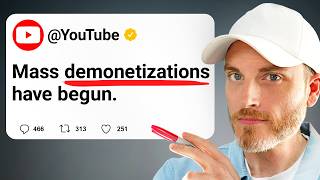

YouTube Demonetizing $30k/Month Channels
45sShocking stats about massive demonetization grab attention as creators fear losing income.
▶ Play Clip"Delivers exactly what the title promises with case studies and a clear framework, though a few minutes of promotion lower the density."
YouTube is conducting a massive demonetization enforcement, targeting low-quality AI-generated content. This has impacted channels earning substantial ad revenue, including a Bible channel making $30k/month and an exam prep channel earning $7k/month, both demonetized despite human oversight. The episode reveals YouTube's insider framework for what is allowed and what triggers demonetization, emphasizing the concept of 'interchangeability' and the importance of unique branding.
YouTube is demonetizing channels at an unprecedented scale, including those earning $30k/month and $7k/month from ad revenue. Over 4.7 billion views and 35 million subscribers have been affected, with an estimated $10 million in lost annual revenue.
A faceless Bible channel with 500k subscribers earning $30k/month was demonetized despite quality content. The channel was AI-assisted but not fully automated. YouTube cited 'inauthentic and mass-produced' as the reason, and the appeal is under review with no timeline.
An exam prep channel earning $7,500/month was demonetized. It used AI for scripts and voice, and had heavy automation in the pipeline. The content was educational and useful, but YouTube cracked down on how the content was produced and scaled.
YouTube is not anti-AI but anti-interchangeability. If a channel could be swapped with a hundred others and nobody would notice, it's a problem. Channels need to feel human and unique, not assembly-line content.
YouTube allows AI-assisted editing, human commentary and interpretation, deep research with AI, creative transformation, and limited automation with human judgment. These patterns keep content within guidelines.
Disallowed patterns include fully automated pipelines, script recycling with minor tweaks at scale, upload flooding (multiple videos per day), and mass-produced templates. These trigger demonetization or deletion.
1) Treat YouTube as distribution, not the business. 2) Break templates on purpose by varying structure. 3) Use AI as an assistant, not an engine. 4) Fewer uploads, higher distinction. 5) Build a unique brand to avoid interchangeability.
Building a unique brand is critical. Even with AI, creators should create a distinct character or avatar (like Mickey Mouse) that is recognizably unique. This applies to both face and faceless channels.
YouTube's pattern-based enforcement is here to stay, aimed at eliminating low-effort AI slop. Creators must adapt by focusing on uniqueness, quality over quantity, and diversifying income streams to survive the crackdown.
What is the key concept YouTube uses to distinguish problematic AI content?
Interchangeability: if a channel could be swapped with a hundred others and nobody would notice, it's a problem.
11:43
How many views were affected by YouTube's channel deletions?
Over 4.7 billion lifetime views were erased.
01:08
What are the five disallowed patterns that lead to demonetization?
Fully automated pipelines, script recycling, minor tweaks at scale, upload flooding, and mass-produced templates.
19:00
What is the first protection principle for creators?
Treat YouTube as distribution, not as the business itself.
22:53
Why can't YouTube be anti-AI but is anti-interchangeability?
Because AI-assisted editing, research, and limited automation are allowed; the problem is when content is indistinguishable from others.
11:43
What was the reason given for demonetizing the Bible channel?
Inauthentic and mass-produced content.
08:18
How many protection principles are shared for creators?
Five.
22:53
Interchangeability is the core issue
This concept clarifies YouTube's stance: not anti-AI, but against content that could be easily replaced.
11:43YouTube as distribution, not business
Key advice to diversify income and not rely solely on ad revenue.
22:53Build a unique brand
Emphasizes creating a distinct identity to avoid interchangeability and survive the crackdown.
33:50Content farms vs wild-caught salmon analogy
Powerful metaphor: creators should be 'wild-caught' (unique, high-effort) rather than 'farm-raised' (mass-produced).
40:37AI as assistant, not engine
Encourages using AI to enhance creativity rather than replace it entirely.
30:34[00:01] one of the most important episodes that you listen to all year. YouTube is currently conducting one of the largest scale demonetization enforcement initiatives that I've ever seen. Channel earning $30,000 a month in YouTube ad
[00:15] revenue, totally demonetized. Another one that was earning $7,000, demonetized. We actually got some insider information from YouTube, how to protect yourself. A big theme of this is AI, but all channels need to be aware of
[00:29] this information. So, we have real case studies. We've got direct language from YouTube as well. Um, and we're going to show you a clear Um, and we're going to show you a clear framework uh of what is and isn't okay
[00:41] navigate it. >> Yeah. And so, we've broken this conversation into parts. Let's start off with just some of the things that are happening. So, YouTube has deleted actually millions of channels. The big
[00:53] headline there, people have heard about AI slop channels, super low effort, super generic. Okay, but what we're talking about is there's some of the people in our community that have humans behind the channel, sometimes editors
[01:08] that are really crafting their content, yet still they were demonetized. And these stats are kind of staggering though because there was uh as far as channels being deleted, over 4.7 billion lifetime views were just erased off the
[01:22] platform. 35 million subscribers were affected and an estimated lost annual revenue across the channels was $10 million. into the first story to make this contextual. So, one of the people that
[01:38] are part of our accelerator program have a Bible channel where they're telling Bible stories, breaking down, I mean, I would say quality content. Like, these are good stories, good information, you know, well structured, well thought out.
[01:52] They were earning $30,000 a month from YouTube ad revenue. They had 500,000 subscribers. And they get an email from YouTube that just says, "Hey, you're that towards the end of the episode. They said, "This is what you could do to
[02:06] graces, >> and there's a process that you can go there's people listening, they're like, "I just want to get monetized." But month, and it just goes to zero. Now, they had a couple other income streams,
[02:20] which we'll also talk about that later, but that's that's wild. like just that, like would not take into consideration other income streams, just >> Yeah. That's absolutely insane. And I remember too like you know talking with
[02:35] working with them in our coaching program and it's just like it's crazym those things that just doesn't feel right. It doesn't feel fair. You feel all the emotions and like I just I know our whole team we're just trying to
[02:49] think about how do we rally? You know what I mean? and like what are our other up it's kind of crazy because you're up against to phrase it that way but you're you know and so I I been thinking about this Sean like how do you make sense of
[03:04] like how did that flag initially happen I think a lot of people wonder like how does who made that call is it actually someone is it AI stuff that's going on that's rolling out like how how did that flag initially happen
[03:16] flag initially happen >> so YouTube is using AI systems to scan monitor channels and that could lead to the channel being deleted or in some cases left up but demonetized >> and then humans are getting involved
[03:30] because the email that we saw is from a YouTube person effort. That's right. specific feedback to that individual creator. And when you zoom out a little bit again, $10 million in lost annual
[03:44] revenue. And one of the myths out there is, well, YouTube is just shutting off monetization for the creator, but still running ads for their own money themselves. But that's actually a myth. When they're demonetizing the channel,
[03:56] they're not running ads on it anymore. >> Why? Well, one of the things is they're kind of redefining what is quality content. And we want to sell inventory for advertisers to put their ads on. And so, we're actually taking the hit like
[04:10] type of content. Now to go a little bit deeper, the YouTube CEO has publicly acknowledged this and the big head the big points are the rise of lowquality
[04:22] >> Yeah, >> lowquality repetitive AI slop is the term and they have systems to fight basically spam and clickbait. Now, you
[04:34] know in the comments if you've heard this, if you know someone who's gotten their channel deleted or demonetized, why this hits so close to home is both of the channels in our community are not spam or clickbait,
[04:47] >> So, is there an overreach here? I think yes. But at the same time, YouTube is not banning AI. >> And even if you want to be a faceless channel, there's a way to do it, which we'll cover that later. They're not
[05:02] that's the overreach of the headline. I see it every time we do like a live shouldn't use AI at all. YouTube is anti-AII and they're banning AI." So, there's a tension there. But kind of the quick hits are if it's
[05:17] >> uh repetition, low effort, mass production. That one's interesting. Yeah. If you're just pumping out repetitive the same thing over and over and posting a ton. viewer trust and advertiser trust.
[05:31] >> So is it is it higher quality like trustworthy con even if it is AI do you still have viewer trust and would advertisers want to advertise on this? the top I still think there's an overreach here.
[05:45] something new they're going to make mistakes but uh I think both viewer I know for a fact that both viewers and advertisers were fine advertising on this content. this was quality content and yet they got demonetized as well.
[06:01] >> So I think knowing some of the changes but in a way YouTube didn't really invent new rules here but what they are is turning up the enforcement in the is turning up the enforcement in the world of AI that has gone so parabolic.
[06:13] >> And some what some people are doing is with AI they're launching like 150 new YouTube channels in a day. >> You know they they set up a a Claudebot or now a Moltbot or whatever it is. publish channels, publish lots of
[06:26] videos, and it really is a spam. So, like that sounds extreme. And so, to combat that, YouTube is setting up systems, but unfortunately, there's 100%. >> It's crazy to think through these terms
[06:40] familiar with and some of the research like in preparing for this talk. It's interesting to note how a part of the mass production piece, what stuck out to me is there's this element where YouTube is saying, okay, AI is able to create
[06:56] just like what you just said, AI AI is able to create content at such a scale and at such speed that a human would never be capable of by themselves. So, it is interesting to think about like volume seems to be at play here. it's at
[07:09] least some sort of trigger point about like the amount like the sheer velocity of content that's coming onto the platform and seeing all that come from one channel, one creator. I'm just curious like well I'm I'm still hoping
[07:22] trigger points for for folks, you know? these case studies, but I also I want to encourage listeners. They might be saying, well, I just vlog. It's always me on camera. Um and so, you know, I
[07:35] don't need this information. I actually think number one, what could be the mistake is even if you are mostly just on camera, you should be using AI. >> And you could have an an illogical fear of using AI at all or maybe you start to
[07:50] like, "Oh no, am I going to get flagged?" So, you think you just need to know the best practices because, you know, if I use AI at all, will it >> these things seeing certain things on my
[08:02] channel. If I'm using AI in thumbnails or if I'm using AI. So, a couple quick faceless Bible channel, $588,000 subscribers, three $30,000 a month in ad revenue. Um, faceless, narrative driven, AI assisted, AI assisted, but not AI
[08:18] >> Fully demonetized. And here's the reason, inauthentic, and mass-roduce >> There it is. >> Now, they they have they submitted an appeal >> under internal review, but there's no
[08:31] timeline on that review. M >> I think listening to this episode would situation >> things you should include into the >> So even how because you're only going to get one shot to submit that appeal.
[08:44] But here's I think a big quote. >> This didn't happen because of one video. It happened because of the pattern of the channel. the channel. >> So you a oneoff AI video. You know I'm
[08:57] exploring the idea. Listen, I I'm at some point here, I'm going to turn myself into an AI avatar. Yes. >> And and cover a news story, but think about that. It's a little bit different. I I'm still a personal brand.
[09:09] >> Um I'm able to provide good information. It could be my voice. Yeah. >> And it could be an AI video. Oh, is that going to get flagged? Well, is that the >> There's some other nuances there. Here's the second case study. Um so, this is an
[09:23] the second case study. Um so, this is an exam prep education channel. amazing content helping people prepare for real estate exams in specific states, >> educational, earning $7,500 a month.
[09:36] Some of that was from people that would sign up for their deeper software that will really help you prep for the exam, >> but a lot of it was from ad revenue, uh, clear user value. Now, heavy automation in the in the pipeline, though, and
[09:51] automation in the pipeline is a flag. Like is this just press a button and it makes a video? That seems to be a big flag. >> AI assisted scripts and voice. So it's all AI voice also demonetized. So this
[10:06] is a different niche, but it had the same outcome and the same um underlying pattern. And so it, you know, it's not whether or not the con content is useful. YouTube is cracking down on how is the content produced and how is the
[10:21] is the content produced and how is the content being scaled. M so this you know I'm thinking through okay so for for both of these channels this whole this let me just back up a second right like I I remember when the button first
[10:35] popped up in upload settings where you have to say yes the AI is involved in this or no it's not right so I think like YouTube has obviously been aware of what's coming and so to as these guidelines can continue to come out I'm
[10:47] thinking through like how do you if you're a faceless channel if you're an AI channel or if you're even using AI, like what is the tension? How do I how do I use AI in my content if you're scared about this happening to you? Like
[10:59] crippled up to be honest even even if like you just said uh these channels right have been using AI heavily automation in the pipeline but I see a because they just don't even know what they're allowed to do.
[11:13] >> That's true. I mean that actually a big response to this is fear or like you about starting. Do I even start? Or I'm on the sidelines. I was excited to start on camera. There's new tools to do it. Yes. Oh, do I just not do it? There's a
[11:28] way to do it. And we'll hit that in a second, but I think we should touch on YouTube. Yeah. >> And this is an interesting word, but this is the word to know. The real issue is interchangeability.
[11:43] honestly. That's why I had to look it up. So, let me read you the definition. So, what do they mean? It's basically this. YouTube is not anti- AI, they're anti-inchangeability. What does that mean? It means this. If
[11:57] YouTube can swap your channel with a hundred others and nobody would notice, that's a problem. >> So, okay, you're doing some exam prep videos, you're doing Bible stories, you're doing documentaries, mini
[12:12] documentaries about Warren Buffett and, you know, investor principles. If that video just looks exactly the same like a hundred or a thousand other videos, that's a problem. They want creators who feel human and unique, not videos that
[12:28] assembly line. >> Now, we have a principle later, but might as well hit it here. >> What's one of the best ways to do AI content is to build an actual brand. >> Meaning like think about it like Mickey
[12:43] Mouse. Mickey Mouse is not a real human, >> right? but is a notable figure and a unique piece of intellectual property. So if if you want to pivot and you're
[12:55] >> yeah, >> you create an AI avatar that is unique, that is the same, that has, you know, a voice, a look, and that's the and it's
[13:07] the person. >> Yeah. So, so I it's not that it just it has to feel human or be unique >> as opposed to oh just spam videos. So now you can have a fully AI channel but you have you've created like in a way a
[13:21] you have you've created like in a way a cartoon a unique cartoon that is unique >> because if if basically interchangeability if it could just be channel that made that it seems like the same as every other motivational stoic
[13:34] quotes list. it seems like every everything else. And so this is kind of what they explain. And people need to know these seven things. If number one, you have the same structure in every video. It's a template. Number two, it's
[13:48] the same pacing. Number three, same cadence. Number four, same emotional arc. Number five, same visuals. Number six, same voice. Number seven, same >> but it's just being pumped out. I think
[14:00] there are tools that are let you have this AI avatar this day and this AI avatar that day >> and again repetitive >> pattern as opposed to distinct brand. Yeah, that's getting cracked down on
[14:15] >> I'm thinking through even so again like the production process seems to be where a lot of these decisions are being made by people by creators that then is and everything right now. So, in the production process, I'm just wondering,
[14:29] production process, I'm just wondering, okay, you know, repetitious content, if 17 different people all had the same idea for the same kind of channel in the same niche, decided to kind of just outsource everything to AI and are
[14:42] channels that are successful. >> It's like there in the creation process, different people saying, "Hey, can you help me?" There's talking to chat or Like, here's some inspiration. I want to make videos like this one. I want to
[14:56] make whatever. And AI is wicked smart. So, it's going to be able to analyze makes that video successful. What is the framework? AI can give you a framework here's the structure and architecture that's going on. And so, I'm just
[15:10] thinking through like, man, if you're kind of if at the production process, is that if at the ideation process, here's kind of like a coach take. If it's not starting with you >> and you're just trying to recreate what
[15:22] other people are doing because you want to do this YouTube thing, I don't know, for me that falls into this category. >> Well, you know what you that just really good at spotting AI. >> Yeah.
[15:34] >> And I think the problem in this mass-produced content um you know, arena mass-produced content um you know, arena on YouTube is that um there's so there's biggest >> it's it's taught by AI faceless gurus.
[15:50] script, >> enter that script into your thing, spin >> But then just hit publish. Now, let's take this into what people have probably heard as far as like students using chatbt to write their papers.
[16:05] >> And and then what what tools have popped up? tools to audit a student's paper to up? tools to audit a student's paper to say what percentage of this is AI and it >> So think about just this tweak. I think people are in such a rush. They're in
[16:20] >> Yes. >> Paste that. Spin it a little bit. Publish that. Well, then you at some point all the LLMs are just referencing each other. Everything is h and then it hits YouTube. And so even at a they
[16:34] basically. We've already seen it. That would be a flag. So, if you're doing AI content though, but you slow down and even if you start with AI or you start with an outlier concept, >> if you sit down and let AI outline the
[16:50] work. >> Do some that's it. Do the work. the outline, but let me start writing and let me also start figuring out my going to be people that are trying to game the system, but like you might want
[17:04] to run that script through an AI >> tester to say, "Oh yeah, this is this is no percent chat GBT. It's 10% chat GBT instead of 99% ChatGBT." >> That's a power up. >> And and I mean cuz AI can spot AI.
[17:18] >> And so this next part of the video is the YouTube framework. This is literally the YouTube framework. This is literally gold. So this is what is allowed and what is not allowed on YouTube. And this might take a second to process for us,
[17:31] but here's what's allowed. So, we can all see it. The economy is shifting fast. Old strategies are just not working anymore. And if you aren't adapting right now, you are missing out on massive opportunity. That's why we
[17:44] created our Think Media Mastermind, which is a 2-day event that happens in Las Vegas. And you can check out details at think mediamastermind.com. out an application. This isn't for
[17:56] criteria to make sure that the right people are in the room. And so if you're an entrepreneur or a creator that wants to scale their online business, then go to the website and apply soon because seating is extremely limited for this
[18:11] very intimate gathering. You can check it out at think mediamind.com. AI assisted editing. Okay. So can you use AI to help you edit? For sure. Human commentary and interpretation. All right. What also if if you're you
[18:26] AI to do deep research for my history channel which is a great niche. Okay. But are you going to then interject some human commentary, some interpretation, some perspective? >> Okay. So, if you put that in there,
[18:41] creative transformation, that's a good thing. Limited automation, automate, not no automation, right? >> But limited automation and human judgment shaping outcomes. That's all allowed.
[18:54] >> Disallowed patterns. Interesting. Fully automated pipelines. And that's that. That's like from concept to completion. And and think about what AI can easily do. Study viral videos, steal their
[19:07] scripts, flip the script around, turn it into a video, create some B-roll or add some stock images, add some music. The whole the whole pipeline could be >> So, you just go, okay, I still could have automation in the pipeline, but is
[19:21] the pipeline fully automated? >> Script recycling. There's there's a >> script recycling. >> Huge. and minor tweaks at scale
[19:34] >> Huge. and minor tweaks at scale upload flooding another big red flag. So, if you're uploading, let's say long form videos. So, this could be shorts >> you know, you upload a video even daily, that's a hard thing to sustain if you're
[19:47] do it. It's not getting tired. >> If you're uploading multiple times a day, if you're uploading 20 videos a day, and some of these channels, they'll they'll take like um uh like a news story. Sometimes they'll even tell
[20:00] what can get clicks, man. >> And then they'll spin the hook. So and the hook and upload a version. Doesn't do well. Upload another version. >> So they'll upload six variations there of a video. So even this, it shows the
[20:17] like, you know, block. >> Yes. >> Trying to spot these. >> If it sees, oh, there's upload flooding. you're using AI, if you slow down, you're going at a slower pace. And then
[20:30] you're going at a slower pace. And then also mass produced templates. And how quickly is YouTube going to be able to see the template? And so if a human can't clearly point uh to uh you know someone shaping this content, YouTube
[20:44] assumes a machine made the content. And if it looks like a machine made the >> So for those that still want to do automation, >> it's not that you can't. But I think again this is a good part to rewind.
[20:57] Those were the basically five things that are allowed and the five things that are disallowed in terms of patterns. Man, I I I think as you're listening to this too, so part of me obviously is frustrated because I'm just
[21:13] coming alongside our own students who are actually trying to do good and put into what they're putting out there and this stuff is happening. On the other hand, I'm pretty pumped. Is that okay to say? Because I would think like as a
[21:27] serious creator and a shout out to like all my artists out there, you want your touch over everything. Thank goodness YouTube like is part of what I want to say which is like thank you for removing just the loweffort content that could be
[21:41] the the the kind of content out there that's just not going to contribute or you know, I mean, it's kind of like a side quest, but so many of these musicians that are out there right now, you know, like actual AI artists that
[21:56] you have like, you know, the the tensions on both sides. But I I think that what's happening right now is we are experiencing the unfortunate ripple effects of a structure that I personally believe that YouTube's putting in place
[22:11] for good, for the longevity of the platform. you is still in YouTube and I fingerprints of the actual people and actual creators. So, I think that it's this and trying to figure out, okay, like what is allowed and what's not. So,
[22:25] that if you are an AI creator or you're a creator that's like heavily relying on AI, like you you're going to have to change your approach and if you're effects of this too, I think we're about to get into like how creators can
[22:38] can do to move forward. >> Yeah. So there's five things and so how can creators protect themselves and these are principles that could apply to good just principles >> to build on on YouTube in 2026.
[22:53] >> Number one, treat YouTube as distribution, not as the business itself. >> Uh listen, I almost like was sick to my stomach when I heard that $30,000 a month was demonetized. I'm like just
[23:07] just I I literally uh Caleb post that in our Slack group and his first thing was first emotion was like rest in peace to Granny. She got hit by a bazooka. I mean
[23:19] >> kablau >> kablow kaboom like you know she's done like she got you know hit by a missile which is a niche reference of a viral >> on social media right now. But like you know treat YouTube as distribution at
[23:32] the business. This channel um is still getting reach. this channel did not get deleted. So, they're they're still getting reached. They're still getting almost a million views a month. And it's always a good question to ask
[23:44] views? So, if you treat YouTube as distribution, not as the business, you in front of people and you still have a chance to grow an email list or move traffic to a Discord group or get phone numbers or um or just get influenc.
[24:06] pitching brands? You could. It's distribution. Awareness and attention is still valuable. It's very discouraging to get demonetized, but having your own channels, they do have their own products. AdSense is a big part of their
[24:21] business. So they're going through a checklist to get back into compliance and to appeal and to re get into ad revenue. But um a general good business basket. >> Yeah.
[24:35] >> Yeah. >> Diversify and diversify before you >> So that you're just ready for anything to even carry you through the let's say >> because I mean the cool thing and we all
[24:48] wish it was faster than it is. But the cool thing is there are channels who are program. You do appeal. they may go, "Okay, it was an overreach." You know, "Okay, it was an overreach." You know, for that um uh exam prep channel, the
[25:02] thing that breaks my heart about that channel is, you know, the creator is They're using automation, but they're sitting in every video. They're tweaking it. They're fixing it. They're making sure it's good. They like even getting
[25:15] the audio right. There's this whole thing about making sure AI pronounces making sure the voices are good and then factchecking it. It's it's very >> You you don't want to just be putting out exam prep videos with like AI can
[25:30] these people get ready for exams. >> Yeah. And like things are so so like there actually was just such human and almost argue the content was almost better than a human could do
[25:43] >> because it's polished. It's perfect. It's educational. That's frustrating to me. I think it's an overreach. It's not spam. It's not uploaded flooding. yet he still got demonetized. But nevertheless, thank God he's got also another uh
[25:57] business that the channel can drive to. So, how can you increase that? Number two, break templates on purpose. This means varying things. And this word think I'm still trying to wrestle with it. Like, break templates on purpose
[26:12] >> you know, because we're all about frameworks here at Think Media. you maybe that could be a little bit of a stretch, but like thinking about, oh, frameworks for a hook, for example. We have frameworks for content, for
[26:25] example, perfect video recipe 3A, right? Like there's different things to do, but breaking templates, it's like, no, literally, if you're actually like same thing. >> Here's a template. So, I actually will
[26:40] watch uh, you know, Bible content and it'll be like uh 10 secrets of King >> And so the video will sound like kind of a dramatic old wise voice over and it'll be like King Solomon was the richest man who ever lived and he had 700 wives.
[26:57] >> But you won't believe this secret fact about him that we'll talk about in part two. But first we have to there's like a there's viral templates. >> for face and and so there's template and it's actually interesting. You start to
[27:10] feel the flow. >> King Solomon was born. and his father was this. But one little known thing was he was visited by a prophet and then it's like but make sure you keep watching until the end because the most
[27:23] watching until the end because the most crazy fact is coming later. >> Okay. And then like repeating that same thing over in Boaz was a whatever you architecture. >> Yeah. So the same architecture
[27:35] are those templates? They're a level of best practice for hacking attention. But templates on purpose. >> Do it on purpose. >> So even if you're sitting down, there's still a place. I mean, one of the most
[27:49] powerful things about YouTube is highquality mini documentaries, >> which was essentially what these are. It could be like a Kanye West iceberg where you're going down in all these facts about him. Or it could be like the real
[28:01] downfall of Wei work like the any creator your any person from their home cool content >> that could be entertainment based about musicians or facts about musicians. >> It could tell stories
[28:14] >> but the templates is I think it would come right out in terms of you know you like one or two things >> break it on purpose like write your own thing your own perspective have a different flow to it. Um, so if you're
[28:28] varying your intros, you're varying pacing, you're varying structure, you're >> Oh, that's huge. >> And so people that are going to try to probably be an AI tool that's like YouTube detection proof. But the the
[28:42] to work, bro. >> Like sit down and like uh you know, here in Nashville, you know, filming some stuff with um and speaking at an some stuff with um and speaking at an event. We're we're talking about pastors
[28:57] >> Yeah. >> And and generative AI and some people being like, you should never use AI for your sermons. And I was like, I don't should. Like, it's going to help you research faster. You don't need to get a
[29:12] like lexicon of words quick, the definition of the Hebrew and Greek. But then I was like, the the the pastors who are using it wrong are lazy. >> Because they just want to go golf. And so they're not going to sit down and
[29:26] actually like they let AI generate a sermon in one hour What does really like sitting with the invest 10 to 20 hours in your sermon. Some invest 30 hours.
[29:39] a busy schedule, but if you're just trying to get videos done in 5 minutes, that's probably going to be a template. >> Yes. If AI helps you get started and >> Yes. If AI helps you get started and save five hours, but then you still put
[29:52] and your personality, you write some stories and you fix it and you get rid >> Yeah. I >> I'm not we're not saying you shouldn't start with AI. And so that's a spirit. That's a very important role. A pastor,
[30:07] scripts. >> It's ridiculous. >> 100%. But like I also wouldn't go to the extreme of like AI is of the devil and template. >> Yes. Like like put yourself in there.
[30:20] Get some different pacing. Be you. So that's number two. talk about. Okay. Number three here using AI as an assistant, not an engine. This is what we're talking about. And I think it's learning to learning to
[30:34] when to reach for a tool and when to reach for AI. And I think this is where been trying to like withhold a little bit during this episode as we've been the nail on the head. I think a lot of this a lot of the templated stuff and
[30:50] you know adverse effects of this as we've talked about, but a lot of this is aimed at the lazy creator. I mean, why is YouTube even it's called YouTube or AI slop? Like >> that's a pretty intentional word. You
[31:03] know what I'm saying? And I think that this so that's why it pumps me up and to think through okay if you are ju you are just trying to get as much as possible with as little as possible like you want the maximum returns with like the
[31:17] minimum effort and any creator that's been on the platform for more than 02 seconds that has like some legitimate success that's been around for a while goes that's just not how it goes anywhere right like and you can't push a
[31:29] button and expect stuff to just happen and so using AI as your assistant I love I've actually been trying to do more of, Sean, is kind of force myself when just for a little bit. I'm absolutely using AI to help me brainstorm and think
[31:44] actually am challenging myself to just start with myself. because it's like that's actually the good old days, you know what I mean? I my own business, when I was like starting to learn about uh courses and
[31:59] selling courses and email funnels and landing pages and I had Kajjabi, you know, you know who had to write every word of all that stuff? This dude. I had to do every single freaking thing. There was no AI there. Like I had to actually
[32:13] revise stuff myself or send it to another human to revise it. And so all that to say, I think when it comes to using AI as your assistant, I would like start with yourself. You know, >> that's good. Number four is fewer
[32:28] uploads, higher distinction. So scale can equal risk. And uh if you're just doing flood of uploads, uh a flood of automated uploads, that's a problem that's causing a a flag. You know, I think one of the trends that is
[32:44] quality over quantity. >> Yo, >> and quantity's purpose oftentimes is practice and getting started, >> but slowing down and uploading fewer
[32:57] Caleb Rston on the podcast. You know, him and I go back like 20 years now, >> but I want to say his channel's on the way to 100,000 subscribers and he's form videos. He was >> he's slowing down and going just deeper,
[33:11] higher quality videos. >> If you're a faceless channel, again, if you slow down and just put more heart AI is an assistant, maybe the whole thing is generative, but >> AI drafts drafting the video is not the
[33:24] video. >> If the draft and the template, okay, you come back, you add some things here, and you humanize the script. It outlines it for you, but you write more. You add in some other research. Yeah.
[33:38] >> fewer uploads, >> higher distinction. But I think number five is maybe the most important and biggest ideas. Um, build a unique brand
[33:50] >> So, there's some really there's some good channels right now um that I am aware of that are completely AI avatar. They also are very much fewer uploads
[34:02] >> And what they've done is they've created a character. >> Yes. So they don't want to be on camera, but they have either digitized themsel but they have either digitized themsel or a version of themselves and they are
[34:15] it's a brand then. So now there's a recognizable avatar. You remember the Clippy, is that his name? >> Yes. Was that his name? Clippy. Clippy. love him or hate him. He's a brand, you know. He's a little guy who'd pop up and
[34:30] help you uh with your Microsoft Word document. Microsoft, why did they retire Clippy? bring him back, man. >> You know, but even if you are a cartoon or an avatar or a character, >> like it's a brand still.
[34:44] >> And so you could still use AI, but don't be generic. for everybody is number one, if you're going to go faceless, you're going to build an automated channel, you distinct brand. What did YouTube say? They said
[34:59] if your videos cannot be distinguished from anybody else's >> if it literally like anybody can just generate some images, animate them, >> There it is. >> But like what what is your unique brand?
[35:11] You know, this is a a difficult and high level of content to create. And this can work in any niches. You know, we respect people from all backgrounds and beliefs. We're talking a lot about like the Bible, but there is the Bible project.
[35:23] >> That is a voiceover animation channel. >> Illustrations, animations. I'm not seeing a person on that channel. >> So, can you still do a high now? What what the Bible project, which I believe had donors, hundreds of thousands,
[35:36] millions of dollars, has gone into that content. Anybody sitting at home right 2026, >> has the ability to get into the game of produce >> to do it for like hundreds of dollars.
[35:51] >> Because these tools still cost money. Generative AI still cost money. But we need a human. You got to be if you're behind it and what's the unique brand of >> Like what what what is your unique vibe or you your unique style? What's you
[36:04] know injecting that? And then anybody if you're just somewhat using AI and you start to incorporate more into your more AI into your content, you're still on your brand? What's unique about you? What's your uniqueness? You know, I I do
[36:19] want to let people know >> uh coming up at our Think Media >> Um in Vegas. that's happening in a couple weeks. Um, we have our brand to >> And so that's a tool that we use in the room together. Proprietary process we
[36:34] walk people through. That's not just for faceless channels, although more >> Yeah, I would agree. >> But one of the most important things in a noisy online world, period, >> AI or not, is personal brand or brand is
[36:50] the only differentiator left. >> Yeah. What what is the uniqueness that What's unique? This could go all the way from, of course, values, beliefs, style >> Yeah. >> And and so Mickey Mouse is a unique
[37:05] brand. Paw Patrol has a is a unique brand. It has got unique characters, brand. It has got unique characters, unique look to the animation. Um and so, uh dialing in your brand, if you're you're established right now, but your
[37:17] brand is kind of weak, is a good time to be working on it. you're just getting started. Having the thought of like how do I brand myself, position myself, what's my unique angle so important in 2026. And if anybody wants to check that
[37:30] out, um there's a few spots left to our mastermind. You can go to think to apply and spend two days together covering a lot of stuff about YouTube growth. But uh you know, building a
[37:42] unique brand is critical in 2026. So would you go so far as to say like say you create I'm now I'm thinking of all these random characters like the Geico gecko you like all these other you know so if you if you go this route this is
[37:56] attributing branding to this character to your channel really to to to your your channel as a whole like beliefs value systems like you said brand coloring and everything like this is just this is a
[38:08] way you can distinguish yourself from just random stuff you could have any sort of AI generate for you. I would love to learn personal finance from a >> I like you know >> there's an idea.
[38:20] animals from a gecko. >> This would just be great. >> So there's a lot of channels that you know just rand like facts about animals >> Yeah. So these are questions you could ask yourself. The voice, the audio
[38:34] branding, the video branding, the AI avatar, how it's positioned, >> you know, cloning your own voice. Um, and I think about, you know, what's fascinating is there's a there's a cool channel, Patrick CC. Yeah. He covers all
[38:48] kinds of mini documentaries. Used to do beats and hip-hop stuff, >> but he he does like banger videos, well thought out, well researched. He shows >> but it's like 3%. Yes. >> You know what I mean? Like all of a
[39:01] at the camera, encourages people to drink water and then um stay hydrated and then he keeps going. So, you know, it's not even necessarily that an AI avatar would be seen the whole time, but like you could still get he's got a
[39:15] unique brand and >> the content is high effort >> Yeah. >> Big views, distinct brand, good stories, good storytelling, good structure. So, yeah, I mean, whether AI or not, build a
[39:28] >> This is huge. So, as we land the plane here, we think about where YouTube is going, right? um because we only actually just started 2026 which is kind of crazy but so we're future casting.
[39:41] >> Here's what we know and trust that this sort of patternbased enforcement it's here to stay right like and it's hopefully only going to get better and to stay. >> Yes. Yeah. You know I think that
[39:55] creators who adapt will be fine but channels that are factories are in >> Okay. >> Automated factories. Yeah. >> You know, there's a term for this and this is part of the group that has been
[40:09] >> Yes. >> How do you feel about farmraised salmon? >> It's not good for you. >> That wild caught Atlantic.
[40:21] are you paying more for wild caught salmon? Yes. >> Yes. >> So these content farms, these content >> Yeah. I mean, that's that's a red flag. So, what what is YouTube solving for?
[40:37] And and so at a high level, you know, and and I'm we always get some critique defending YouTube. No, I I fired a few >> but also um you know, we'll talk about both sides. They're also thinking about
[40:51] >> Satisfaction. They're thinking about their own longevity. If the platform >> um farmra salmon >> or Yeah. farm raised salmon, going to die >> and so then the platform dies or it like
[41:06] you know there's just so much spam there's so much noise they have to they have to be constantly adapting >> and so you know I think uh if you continue to adapt subscribe to the channel stay connected to information
[41:18] conversation >> 100% >> you know one of the things that we have said uh I learned this from one of my said uh I learned this from one of my mentors but creators who outwork outarn
[41:30] out strategize and outlast Everyone else win. >> That's right. I'm still working hard. I'm plugging in really hard prompts, bro. Put in some
[41:42] >> Outwork. Out. Learn. Continuing to learn. Okay, there might be a tweak. How do I p Oh, that's a flag. Like those who do faceless at an elite level, they're couple of my channels got shut down, but now this is the new thing that's work.
[41:56] updated on those best practices. Outstategize. we going next? And then of course outlast. So if you got to outlast the >> yeah, >> update your content. What that channel
[42:11] did is, you know, they were working directly with Caleb and uh, you know, our team gets hard at work, starts doing all the research, sends some stuff back some of our old library. We unlisted or deleted some videos. We're changing some
[42:24] things and we're changing our workflow going forward. We're adapting. We're appealing the process. And then at the same time, we're going to diversify. income streams. And so, yeah, creators who adapt. Um, you know, YouTube success
[42:38] is a moving target. >> This is true. So, if we're just willing I'm curious your final thoughts. But I do want to also just shout out to listeners. If you've enjoyed this conversation and you're on YouTube, it
[42:51] always helps if you hit the like button and uh, you know, subscribe for more uh, tips on building a profitable YouTube channel. And if you're new to the Think Media podcast, thanks for being here. If you're on audio, definitely rate and
[43:03] review. Super grateful for being able to hang out with you in your Apple ear pods or AirPods or Bose noiseancelling uh headphones or Skull Candy. What about just goes through like a list of brands? >> Uh or or on your Bluetooth speaker as
[43:17] you're working out uh or as you're walking your dog. It's been nice to be hanging out with you. Um and then also, if you want to join us, we are hosting a two-day event in Las Vegas. It is called our Think Media YouTube Mastermind.
[43:29] Limited to 60 spots. This next one only has a few spots left. Uh think media the link in the description, fill out the application, and get in the room because YouTube success is a moving target. Besides the fact that we'll walk
[43:44] you through getting clear on your brand, the latest stuff that's working right now, the chance to network with other uh creators and entrepreneurs, the chance to connect directly with me and our coaches, um and the chance that like I
[43:58] mean we're going to be at the time of recording this in Las Vegas in 3 weeks about >> in person. And I mean probably that week what's come out, >> you know, and we break we break into
[44:12] circles with um our whole team, you know, think is a team of 30 people. So >> Yeah. >> And iron sharpens iron. So you get all those best practices. So again, if you're interested in being a part of our
[44:25] YouTube mastermind, just go to think mediamastermind.com. thoughts. you're on the front lines of this every single day working with our for us, >> man. Absolutely. Well, I just thank you
[44:37] for leading the charge by the way, like just to be an OG in the space and to continue to just to do all those things you just you encourage us to do to continue to outwork, outlast, outlearn, and to bring content here. And it's just
[44:50] conversation here because the truth is I'm still learning, man. Like, as we all know, stuff on YouTube, it was really fast. And so my encouragement would be like please stay close, stay subscribed, and hang around. We'd love to see you at
[45:04] possible. We're doing several of them throughout the year. So if it doesn't see you at one of those. But I would just want to encourage you with this. Um, this is the year to take your channel more seriously. And I know I
[45:18] you're like, man, I'm really not working hard. like whatever kind of like agitated you during this episode, I would encourage you to have like a be open-handed and be like, "Hey, that kind of got under my skin because maybe
[45:31] that's something you need to go learn more about." But this is the year that you need strategy because this time 2027, I can't even imagine what's going will have come. So, you're going to need to be able to pivot and we want to help
[45:43] you pivot as we are learning as player coaches, too. Well, hey, if you got any rate, share, review wherever you watch or listen. This is the Think Media or listen. This is the Think Media Podcast.


⚡ Saved you 0h 45m reading this? Transcribe any YouTube video for free — no signup needed.