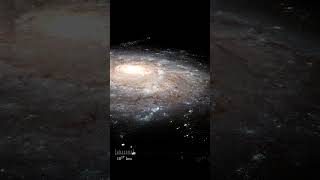

The Universe Zoom Out Paradox
43sReveals a surprising flaw in popular cosmic zoom-out videos, sparking curiosity and debate.
▶ Play Clip"The title accurately describes the content, but the video is more about the creation process than the zoom-out itself."
This video explores the creation of a 'powers of 10' zoom-out animation that visualizes the scale of the universe, from the familiar to the cosmic. The creator discusses the challenges of representing such vast distances accurately, the risk of underselling the true scale, and the use of real astronomical data to ground the visualization in scientific reality.
The video was made in collaboration with Paul Dstep as part of a pair of videos on how we know distances to various objects in the cosmos.
Powers of 10 zoom-outs can undersell the true scale of the universe because the implied camera moves faster than the speed of light, making distant galaxies feel accessible when they are not.
It would take about 2.5 million years to reach the nearest galaxy, highlighting the immense distances involved.
The creators struggled with how to end the zoom-out, wanting to remain scientifically accurate without resorting to artistic renditions of the universe.
The ending uses a point cloud representing data from the Sloan Galactic Survey, which maps distances to galaxies in many directions, showing clusters and strands of billions of galaxies.
The video emphasizes the importance of using real astronomical data to create scientifically accurate visualizations, while acknowledging the inherent challenge of conveying the true, mind-boggling scale of the universe.
What is the main risk of powers of 10 zoom-outs?
They can undersell the true scale of the universe because the implied camera moves faster than the speed of light.
00:15
How long would it take to reach the nearest galaxy?
About 2.5 million years.
00:41
What data source was used for the ending of the zoom-out?
The Sloan Galactic Survey, which maps distances to galaxies in many directions.
01:08
The Illusion of Accessibility
Highlights a key flaw in common cosmic visualizations: they make distant objects feel reachable when they are not.
00:152.5 Million Years to the Nearest Galaxy
Provides a concrete, staggering number that grounds the abstract concept of cosmic distance.
00:41Mapping the Unreachable
Emphasizes the remarkable scientific achievement of mapping galaxies that are completely beyond our physical reach.
01:08[00:02] 10 every 3 seconds it was made by my collaborator Paul dstep as part of a pair of videos on how we know the distances to various objects in the cosmos and on the one hand I think it does it very well notice for example how
[00:15] through these many seemingly blank orders of magnitude before we even see orders of magnitude before we even see the first
[00:29] kinds of powers of 10 Zoom outs can risk underselling the true Scale of the Universe if you think about it the implied camera position is moving just so so much faster than the cosmic speed limit the speed of light and it makes
[00:41] the distant objects like other galaxies feel almost accessible when in fact it would take around 2 and 1/2 million years to even reach the nearest galaxy light I'll also be honest with you we struggled a lot with how exactly to end
[00:55] this zoom out cuz we wanted to remain scientifically accurate without falling too deep into that trap of doing artists Renditions of the universe ultimately Point Cloud representing data pulled from the slone galactic survey which
[01:08] essentially Maps the distances to various galaxies at many different directions you could point in the sky I find it a mindboggling testament to the this is even possible that despite the
[01:21] millions and billions of light years away from each other that they are completely beyond our grasp we can nevertheless map them and and study patterns like the Clusters and strands that these billions of galaxies form in
[01:34] that these billions of galaxies form in the vast reaches of unfathomable space


⚡ Saved you 0h 01m reading this? Transcribe any YouTube video for free — no signup needed.