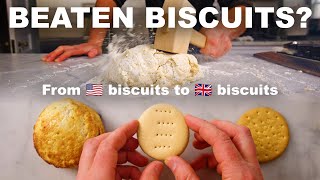

Biscuit vs. Cracker: The Great Debate
45sThis clip contrasts British and American biscuits, creating a relatable cultural shock that sparks curiosity and engagement.
▶ Play Clip"The title accurately reflects the video's content, which indeed explores a missing link between British and American biscuits."
This video explores the historical and culinary evolution of biscuits, contrasting the thin, crisp British biscuit with the soft, fluffy American biscuit. The host proposes the 'beaten biscuit,' a 19th-century African-American recipe, as a missing evolutionary link between the two. The video demonstrates both a modern American biscuit recipe and the labor-intensive beaten biscuit method, highlighting the cultural and technical differences.
In North America, a biscuit is a soft, laminated bread similar to a scone, while in the UK, it is a thin, crisp, dry cracker. The video explores the evolutionary link between these two types.
The beaten biscuit is a 19th-century African-American recipe that requires beating the dough for up to 45 minutes to create laminations. It contains no leavener, relying on physical work to tenderize.
The modern recipe uses flour, baking powder, baking soda, salt, cold butter, and buttermilk. The dough is folded to create layers, then baked at 450°F for 10-15 minutes.
The beaten biscuit uses flour, butter, lard, salt, and sweetened water. No chemical leaveners are used; the texture comes from laminations created by beating and folding.
Annie Nolles Fiser, a cook from Columbia, Missouri, popularized beaten biscuits via mail order. She invented a non-stick biscuit cutter and became a wealthy property owner, supporting her daughter's education.
The beaten biscuits are hard but lighter than expected due to laminations. They are best served with gravy. The host suggests they represent an evolutionary midpoint between British and American biscuits.
The beaten biscuit serves as a historical and culinary bridge between the British and American biscuit traditions, demonstrating how technique and ingredients evolved over time.
What is the etymology of the word 'biscuit'?
It means 'twice cooked' because dough was baked, sliced, and re-baked to dry it out for shelf stability.
00:45
What leavening agents are used in modern American biscuits?
Baking powder and baking soda.
01:13
Why does the beaten biscuit contain no chemical leavener?
Because old leaveners like pearl ash were not very tasty, and the texture comes from laminations created by beating.
03:44
What is the purpose of beating the dough for beaten biscuits?
To create laminations (thin layers) that form steam pockets during baking, tenderizing the final biscuit.
05:58
Who was Annie Nolles Fiser?
A cook from Columbia, Missouri who popularized beaten biscuits via mail order, invented a non-stick biscuit cutter, and became a wealthy property owner.
05:20
At what temperature and for how long are beaten biscuits baked?
325°F (160°C) for about an hour.
06:54
What ingredient in the beaten biscuit recipe enhances browning and extends shelf life?
Sweetened water (sugar lowers water activity).
04:40
Beaten Biscuit as Missing Link
Proposes a specific historical recipe as the evolutionary bridge between British and American biscuits.
00:31Annie Nolles Fiser's Story
Highlights the entrepreneurial success of an African-American cook who built wealth from beaten biscuits.
05:20Lamination Technique
Explains how beating creates laminations that tenderize the biscuit, a key technique.
05:58[00:03] biscuit. It came from a sleeve. In North America, we'd call it a cracker. It is thin, crisp, dry, and dense. This is a biscuit, a southern United States style biscuit. It's like a scone, but much
[00:17] softer, and it's often a little laminated, like puff pastry. Here, I propose is a possible missing evolutionary link between these two very different biscuits, and it's called a beaten biscuit. Seriously, it requires
[00:31] quite a lot of time spent hitting the dough as hard as you can. You beat it. I'm not saying the result is good, but it is historically interesting. It's a 19th century African-American recipe that I'm working off of. Etmologically
[00:45] speaking, biscuit means twice cooked because you used to bake a log of dough, slice it thin, and then re-ake the slices to dry them out, thus making them shelf stable for your long maritime voyage to the Americas, perhaps where
[00:59] biscuits morphed into something radically different. To get a basis for comparison, I will quickly show you a modern US biscuit recipe. This is from my girl Chrissy's book. two and two/3 cups allpurpose flour, four teaspoons
[01:13] baking powder, one teaspoon baking soda, and one teaspoon kosher salt. She actually has you chill the bowl with the dry ingredients for a while to help you avoid melting the whole stick of cold butter. Chrissy Tegan uses a food
[01:27] processor. I'm going to use a pastry cutter to cut the butter into tiny pieces in the flour. Basically, you cut until the butter pretty much disappears. not melted, so the mixture stays heterogeneous and crumbles apart when
[01:41] you eat it. One cup of cold Americanstyle buttermilk, which is fermented like kefir. You could use kafir. Just barely stir this until you have a shaggy mass that almost resembles a dough. Bring it together, smash it out
[01:55] flat, then fold it over on itself two or three times to make those laminated sheets. Press it out an inch thick, then cut it into rectangles if you're efficient, or circles if you're a traditionalist. Circles do bake more
[02:08] from the trim, but it won't be as tender. Work the dough as little as possible. Brush the tops with melted butter or buttermilk if you're Chrissy, and bake at 450 Fahrenheit, 280 C. While I'm waiting, I'll resume the movie that
[02:23] I'm watching on Movie, sponsor of this video. Movie is a curated streaming service dedicated to elevating great cinema from all around the globe. You can get a whole month for free at movieby.com/adamusia.
[02:36] From iconic directors to emerging aur there's always something new to discover. With movie, each and every film is hand selected. Check out their collection, Let's Eat Food and Film, featuring works, contributions, and
[02:48] insights from Jean Pierre Jane, Tron Ang Hong, Alfred Hitchcock, George Miller, Eileene Miles, and more. From cult classics to contemporary discoveries, titles include The Lunchbox, Lacosina, Flux Gourmet, The Taste of Things,
[03:02] Dessert for Constants, and many more. You can try Movie free for 30 days at movieby.com/adamreusia. That's mubi.com/adamregusia
[03:15] free. Link in the description. Thank you, movie. Anyway, modern American biscuits. A really hot oven for 10 or 15 minutes. This or something like it is what a biscuit is in most of North America today. Though in older sources,
[03:29] I've seen it referred to as biscuit bread, which I suspect means bread baked in the style of a biscuit, which is to say in small individual portions with fat. and no yeast. The beaten biscuit actually has no leavenner at all in it.
[03:44] Perhaps because old leavenners like pearl ash were not very tasty. This is a rich person's treat because it replaces the leavenner with a lot of elbow grease. A quart of flour, which is four cups. A third of a cup of butter. Salt
[03:59] half a teaspoon of kosher per cup of flour. And then this lard, rendered pig fat used to be very popular in southern baking because butter melted down here before refrigeration. A third of a cup of lard. And then I'm supposed to cut
[04:14] the fat into the flour. Per classic French pastry technique. You can just use a knife to cut fat into flour. It doesn't take that long to basically disappear. Then my 19th century recipe says to use sweetened water. Doesn't say
[04:28] how sweet, but I've seen it compared to milk. And a cup of milk would have the sugar. So that's what I'm using. One cup of sweetened water goes in. And I'll integrate it using the Italian well
[04:40] method. Just bring in a little of the walls into the water until you can't anymore. And then it's time to knead this together. The sweetened water was purported to enhance browning and extend shelf life, which I suppose makes sense.
[04:53] Sugar might lower whatever remaining water activity we'll have after baking. water activity we'll have after baking. Time now to smack that a lot. First, I tried to hammer and then I moved over to my rolling pin. Smack a little, roll a
[05:06] little, smack a little, roll a little, and constantly fold it back over on itself to create laminations. How long do you have to beat it? I've seen estimates as high as an hour and a half. I did about 45 minutes. While that's
[05:20] happening, let me tell you about the woman who wrote this recipe, Annie Nolles Fiser. She was a cook in Columbia, Missouri. Rich white folks would have paid her or enslaved her parents to do the hard physical labor of
[05:33] beating these biscuits. I'm sure Miss Annie had forearms like Popeye. And her beaten biscuits were so good that she started selling the mail order to Southerners who had moved up north or out west. And she started making them
[05:45] with a biscuit break, which is like a pasta roller. That's why I think rolling is probably a good idea in as much as you can do it. The dough is very tough, but I think the point of beating is to fold this over on itself a million times
[05:58] to create laminations that will effectively tenderize the final biscuit. How? By making steam pockets that inflate a little in the oven and also by it. They say that you're done when the dough appears lighter and you see it
[06:12] blistering. When you see evidence of those thin layers, get it half an inch thick, and then the traditional thing was to ball this up in your hands, them with a fork. That gets you a crude result. Annie Fiser used a cutter to
[06:27] visually show off those layers. I'm using a measuring cup, but she invented her own non-stick biscuit cutter. Fischer earned enough money shipping beaten biscuits to buy a lot of rental properties in downtown Colombia and she
[06:40] died a rich free woman. Divorced her no- good husband without giving him a scent and she put her daughter through college. Pretty badass. The docking bubbles from deforming the biscuit in the oven. You're supposed to bake them
[06:54] gently at 325 Fahrenheit, 160 C for about an hour. And here they are, beaten biscuits. I'm not sure if they're supposed to be this hard. They are lighter and easier to eat than the bricks that we would have gotten had we
[07:08] not formed those millions of laminations that you can see in the interior texture. I might like it better moistened with gravy, which is But there you go. If you're wondering how hard little English biscuits became
[07:22] thick, fluffy American biscuits, I'd theorize that this and things like it theorize that this and things like it represented the evolutionary midpoint.


⚡ Saved you 0h 07m reading this? Transcribe any YouTube video for free — no signup needed.