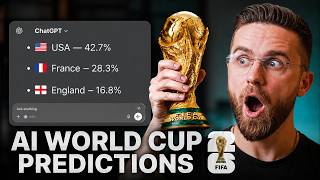

AI Predicts World Cup Winner?
60sThe opening hook directly poses a controversial question about AI's predictive power, instantly drawing viewers in with the promise of a shocking reveal.
▶ Play Clip"The title promises a shocking prediction, but the video delivers a nuanced analysis of AI behavior, which is more valuable than the clickbait suggests."
This video tests three AI models—GPT 5.5, Claude Opus 4.8, and Gemini 3.5 Flash—on their ability to predict the 2026 FIFA World Cup outcomes. The creator compares not just their predictions, but their reasoning styles, revealing each model's design philosophy: GPT commits to numbers, Claude flags uncertainty, and Gemini prioritizes speed. The video grades these predictions against real tournament results, highlighting where each model succeeds and fails.
The creator explains the test: not about right answers, but how each model answers. GPT 5.5 is trained to be useful, committing to numbers with authoritative confidence. Claude Opus 4.8 flags what it doesn't know before answering. Gemini 3.5 Flash is optimized for speed, returning shorter answers and sometimes reading live data better due to Google's index.
A crypto site Decrypt ran seven models on the winner question; four picked Spain, three picked Argentina. GPT committed to France at 22%, Claude hedged with 'I'd lean France, but under 20%', and Gemini gave no percentages or reasoning. This shows different hedging styles.
No AI model mentioned Cape Verde, a country of 527,000 people with a 40-year-old goalkeeper from the Portuguese second division. Opta's 25,000 simulations gave them 0%, yet they qualified from their group and faced Argentina in the round of 32.
Two models (GPT and Gemini) predicted Turkey advancing, but Claude put them last, citing inconsistency. Turkey finished with zero goals. Claude's initial move was to flag uncertainty and check group composition, which led to the correct call.
GPT and Gemini predicted Brazil 2-1, with Gemini providing deeper analysis (Vinicius on four goals, Cunha on three). Claude refused to give a specific scoreline, citing no probability basis for an unplayed match. The creator notes Gemini had more current data this time.
All three models predicted Norway beating Ivory Coast and then losing to Brazil in the round of 16. GPT reasoned from patterns, Claude verified facts first, and Gemini provided the most detail, including specific dates and venues. Haaland remains a dark horse.
Despite Messi leading with five goals, all three models picked Mbappé for the Golden Boot. Claude even searched live scores but still went with Mbappé, showing training data bias overrides live data. The pattern 'Mbappé wins knockout golden boot' is deeply embedded.
GPT and Claude both found the fact of Argentina vs Cape Verde on July 3rd in Miami. GPT used it as a launch pad for a full bracket path, while Claude flagged that everything beyond that date is unknown. Gemini just reported the facts and stopped, answering a different question.
GPT picked Uruguay over France, Claude picked Morocco over France, and Gemini picked USA over Spain. Two out of three targeted France as the most likely upset victim. Each model revealed its style: GPT gave one sentence, Claude flagged uncertainty and gave a tactical breakdown, Gemini gave a high-level reason.
All three models said Morocco would reach the semi-finals, despite the prompt asking for a team that reaches the semi-finals. The creator notes nobody read the brief, but the pattern of model behavior is consistent: GPT sounds confident, Claude is cautious, Gemini is fast.
When fed real new information (France's 4-1 win over Norway), GPT and Claude updated to France at 18% confidence. However, Claude called the facts fabricated, rejecting true information because it seemed too surprising. It also confused Messi's tournament goals (5) with his career total (18), concluding the premise was impossible.
When asked for a single number, GPT picked Spain vs Argentina, contradicting its earlier France pick without explanation. Claude refused, and Gemini invented France vs Brazil. The creator notes each prompt is a blank slate for GPT, highlighting a lack of memory.
Despite Messi having six goals (updated live), all three models still picked Mbappé. Claude buried a useful note: only one of the previous five Golden Boot winners started with odds under 15-to-1, suggesting an outsider like Dembélé. Gemini caught the live update to Messi's goal count, while GPT missed it.
The creator concludes that each model is genuinely useful for reasoning, writing, analysis, and code, but predicting sports outcomes is not their strength. The confidence displayed is pattern matching dressed up as certainty. Knowing each model's personality helps decide which to trust for which question.
The video demonstrates that AI models have distinct design philosophies that shape their predictions and reasoning. While none can reliably predict the World Cup, understanding these personalities helps users choose the right model for specific tasks. The final takeaway is to know the models' strengths and limitations, not to rely on them for sports predictions.
What are the three AI models tested in the video?
GPT 5.5, Claude Opus 4.8, and Gemini 3.5 Flash.
00:02
What is the design philosophy of GPT 5.5 according to the video?
Trained to be useful first, commits to numbers, sounds authoritative, and fills uncertainty gaps with generated confidence.
00:30
How does Claude Opus 4.8 differ in its approach?
It flags what it doesn't know before telling you what it does, prioritizing honesty over false precision.
00:44
What is Gemini 3.5 Flash optimized for?
Speed. It returns answers first, stays shorter, and sometimes reads live data better due to Google's index.
00:58
What did the Decrypt test of seven models on the World Cup winner show?
Four picked Spain, three picked Argentina, and none picked anyone else.
01:27
What was Cape Verde's predicted chance of winning the World Cup according to Opta?
0%.
02:37
Which model correctly predicted Turkey's group stage exit?
Claude, which put Turkey last, citing inconsistency.
03:33
What was Claude's response to predicting a specific scoreline for Japan vs Brazil?
It refused outright, stating there is no real probability basis for an unplayed match.
05:00
What did all three models predict for Norway's path?
Norway would beat Ivory Coast and then lose to Brazil in the round of 16.
05:57
Why did all three models pick Mbappé for the Golden Boot despite Messi leading in goals?
Training data bias: the pattern 'Mbappé wins knockout golden boot' is too deeply embedded to override with live numbers.
07:19
What did Claude do when presented with real tournament facts that seemed surprising?
It called the facts fabricated and rejected them, confusing Messi's tournament goals with his career total.
10:46
What was the outcome of the commitment test where models were asked for a single number?
GPT picked Spain vs Argentina (contradicting its earlier France pick), Claude refused, and Gemini invented France vs Brazil.
12:08
What useful caveat did Claude mention about the Golden Boot?
Only one of the previous five Golden Boot winners started with odds under 15-to-1, suggesting an outsider like Dembélé.
13:18
Design Philosophies
Explains the core differences between the models, setting the stage for the entire test.
00:30Cape Verde's 0%
Highlights a real-world example of AI's limitations in sports prediction.
02:21Claude's Correct Call
Demonstrates that hedging and uncertainty can lead to better predictions than confident guesses.
03:33Claude's Failure
Shows how over-caution can cause a model to reject true information, a critical flaw.
10:46Personalities, Not Bugs
Summarizes the key takeaway: understanding model personalities helps choose the right tool.
14:02[00:02] Cup 2026 champion. One of them had Turkey winning their group. Turkey didn't score a single goal in two matches. Today, we're putting GPT 5.5, matches. Today, we're putting GPT 5.5, Claude Opus 4.8, and Gemini 3.5 Flash up
[00:17] against real football. Quick frame before we go in because this matters. I'm not here to find out if these models are right. Any model can guess correctly. What I'm actually watching is how each one answers. Because that tells
[00:30] you something real about how each model is built and which one to trust on which kind of question. GPT 5.5 is trained to be useful first. It commits to numbers. It sounds authoritative and it fills uncertainty gaps with generated
[00:44] confidence. Claude Opus 4.8 is built differently. It flags what it doesn't know before it tells you what it does. Gemini 3.5 Flash is optimized for speed. It returns answers first. It stays shorter than both and it sometimes reads
[00:58] live data better because of Google's index. It's a question. Three different design philosophies. That's the test. Here's how I've split the next 15 minutes. Four blocks. Two quick receipts from what already happened, then live
[01:11] [music] predictions. Round of 32, quarters and semis, and the final. Every call gets graded before July 19. So, my first question to all three, the obvious about since the draw. While they're thanking, the external receipt. Back on
[01:27] June 8th, the crypto site Decrypt ran seven models on this exact question. Four picked Spain. Three picked Argentina. Not one picked anybody else. So, the interesting thing isn't who they pick. The interesting thing is how they
[01:41] hedge and whether the way they hedge tells you something about the model itself. GPT is the only one that actually answered. France at 22% full committed to a number and gave you a
[01:55] reason. Claude refused once, then hedged. I'd lean France, but I put any single nation under 20%. No specific number, no list, just a direction and a caveat. That's Claude optimized, to be honest. It won't manufacture false
[02:09] precision. Gemini was fastest and emptiest. Confidence level 0% for naming a definitive winner. Named three teams, gave no percentages, no ranking, no
[02:21] reasoning. Fast format, thin content. Fun fact, seven AI models got tested on World Cup predictions before the tournament by Decrypt. Not one of them mentioned Cape Verde. Opta supercomputer ran 25,000 simulations. Cape Verde got
[02:37] 0%. They qualified from the group anyway. Cape Verde is a country of 527,000 people. Their goalkeeper is 40 years old and plays in the Portuguese second division. No AI model thought they were
[02:50] worth a sentence. Their round of 32 opponent, Messi and Argentina. The team AI gave zero chance is playing the defending champions. This is what 0% looks like on the islands. Before next test, one quick thing you'll notice on
[03:04] screen. To ask three models the same question at once, you'd normally need three subscriptions and three open tabs. I'm doing this inside one window, AI Master, our platform. One compare button sends the prompt to all three
[03:18] simultaneously. That's the whole mechanic. Let me go specific. I'm going to give them one group and ask them to call it. Two out of three models in our test had Turkey advancing. GPT put them second. Gemini put them second and wrote
[03:33] three paragraphs explaining why. Claude put Turkey last, one point. His reasoning, talented but inconsistent, struggles to translate quality into results. That's a minority signal buried under the louder pre-tournament hype.
[03:49] Claude found it. GPT and Gemini didn't. Notice one more thing. Claude's first move was I don't have reliable pre-tournament information. Let me check the group composition. It flagged uncertainty before answering. Turkey
[04:02] finished with zero goals. Claude had them last. The model that hedged first got it most right. Now we go live. Round of 32 just starts. Nothing in this block has happened at the moment when I shot this. This is where the models have to
[04:16] actually reason forward, not replay what they absorbed in training. First live they absorbed in training. First live match. back and how much they mean it. Japan are here. They beat Germany and Spain in
[04:32] are here. They beat Germany and Spain in 2022. They convinced an NFL quarterback to clean the stadium after their game. These are not a team you dismiss. Two out of three gave you Brazil two minus one. Same scoreline, different
[04:45] confidence. GPT at 58, Gemini at 70. That gap matters. Gemini also went deeper. Vinicius on four goals, Cunha on three. Three nil wins in the last two. GPT gave you two sentences. Gemini wrote a scouting report. The speed model
[05:00] actually had more current data this time. [music] Claude refused outright, not a hedge, a flat refusal. That's technically correct. A specific scoreline for a match that hasn't been played is no real probability basis. GPT
[05:13] and Gemini manufactured one anyway. You find out June 29th which approach was find out June 29th which approach was worth more.
[05:27] Their fans showed up with a Viking row. I'm going to hand them a fact they watch what they do with it. This is a direct test of in-context reasoning, not training data, but real-time logic. One more setup note. Holland has four goals
[05:43] before the tournament and they just qualified by finishing second in their group. France beat them 4 to 1 in the deciding match, but Norway are still here. That's exactly the kind of signal the models didn't have when they build
[05:57] their original predictions. Three different models, same call. Norway beat Ivory Coast, then go out in the round of 16, probably to Brazil. GPT gave you a tight scout's assessment. Holland changes the ceiling. The bracket is
[06:11] manageable, then brutal. The defense conceded seven in three games. Claude mid-answer, found the real group standings, flagged that Holland was rested against France, and then still landed on the same output, but with a
[06:25] caveat. Anything past the last 16 is hope rather than forecast. Gemini gave you the most detail. Specific dates, venues, bracket paths, even noted the squad rotation against France as a positive sign for the knockouts. They
[06:39] agreed on the destination, but showed completely different working. GPT reasoned from patterns. Claude verified facts first, then reasoned. Gemini built noticed Norway before the tournament, but they qualified. France beat them 4
[06:53] to 1 on the way out of the group. Haaland's still playing. The dark horse Haaland's still playing. The dark horse story isn't over.
[07:06] anyone, a name. Let me make that explicit in the prompt. The interesting question is whether the models pick the players who are actually hot or the players their training data says are always hot. Messi leads with five goals.
[07:19] All three still picked Mbappé. Claude even searched for the live scores, found them, and went with Mbappé anyway. That's what training data bias looks like. The pattern, Mbappé wins knockout golden boot, is too deeply embedded to
[07:33] override with live numbers. Argentina built an 85-ft Messi statue to celebrate the tournament. From the front, stunning. From behind, the internet had opinions. We're five questions in. The pattern is already consistent. GPT
[07:45] commits to numbers. Claude flags what it doesn't know. Gemini answers fastest. Here's the uncomfortable question nobody wants to say out loud about the broke every record, the team built entirely around him. Now let's ask that
[08:00] question. GPT and Claude both found the same fact. Argentina versus Cape Verde, July 3rd, Miami. They did opposite things with it. GPT used it as a launch pad, quarterfinals, Portugal, Colombia as the fallback, full bracket path.
[08:14] That's as far as the facts go. Everything beyond July 3rd hasn't happened. Same data, two completely different philosophies about what you're allowed to do with it. Gemini just reported the facts and stopped. No
[08:27] prediction, no refusal. It answered a different question than the one you different question than the one you asked. matchup, a score, a reason. One team that isn't supposed to win a
[08:40] quarterfinal, but wins it anyway. No hedging allowed. Okay, I asked for one upset. I got three completely different answers, and honestly, all three make sense. GPT went with Uruguay over France. Midfield intensity, physical
[08:55] battle, steal it late. Claude picked Morocco over France. Defensive block, disrupt the transition game, counter with pace. Gemini went USA over Spain. High press, forced turnovers, home crowd at SoFi. Notice that two out of three
[09:10] targeted France. Both GPT and Claude independently identified France as the team most likely to be on the wrong end of a quarterfinal upset. That's a signal worth keeping. Also notice what each model revealed about itself. GPT gave
[09:25] you one sentence of reasoning. Claude flagged uncertainty first, then date, the venue, and a tactical breakdown. Same prompt, same instruction, three completely different levels of detail. Screenshot all three.
[09:39] These are falsifiable predictions with a date attached. We find out July 9th to 11th which model read the tournament correctly. And just to close the loop, I is talking about that reaches the semi-finals. All three said Morocco, the
[09:53] team that beat Spain and Portugal in 2022, the team everyone's been talking about for 3 years. Nobody read the brief. Seven questions, the same three patterns every time. GPT sounds most confident, fills uncertainty with
[10:07] generated numbers. Claude sounds most cautious, surfaces base rates and historical distributions the others miss. Gemini answers fastest, sometimes catches current signals the others lag behind on. Those aren't random quirks,
[10:20] those are design choices, and once you know them, you know which model to reach for first on which kind of question. Okay, the final. This is the same question as test one with one critical difference. I'm feeding them real new
[10:33] information and watching whether they update. A model that updates is reasoning. A model that doesn't update is just pattern matching. Two out of three updated to France. Same confidence, 18% each. Same reasoning,
[10:46] 4-1 over Norway, depth, knockout experience, clean update on new information. Claude called the facts fabricated, not a hedge, not a caveat. It looked at real tournament results, Turkey out with zero goals, Cape Verde
[10:59] qualifying, England's possession record. Every single one of those facts is real. All of it happened. Claude rejected true information because it seemed too surprising to trust. It also made a specific error. It said Messi couldn't
[11:13] have broken the all-time record with five goals in two matches. [music] That's a misread. The five goals are his tally in this tournament. The 18 is his career World Cup total. Claude confused the two, concluded the premise was
[11:27] impossible, and refused to engage. This is the most interesting failure in the humility, the thing that made it the most honest model in earlier tests, just made it the least useful one. It was so
[11:39] trained to reject fabricated premises that when real facts seemed surprising, it rejected those, too. Cape Verde held Spain, drew Uruguay, drew Saudi Arabia, qualified. Claude looked at those facts and said they seemed fabricated. The
[11:54] most cautious model on the planet couldn't believe it, either. One last thing, I want a number. Not a range, a number. The prompt is going to say that explicitly. GPT picked Spain versus Argentina. 10 minutes ago, in this same
[12:08] conversation, it told me France was its updated pick. No explanation, no acknowledgement, just a different answer like the previous one never happened. Each prompt is a blank slate. Claude refused, consistent at least. Gemini
[12:22] invented France versus Brazil. Nobody asked for that bracket, it just decided. The prompt said commit to a number. One model forgot its own answer. One model won't play. One model answered a different question. By the way, there is
[12:36] a site called score GPT that tracks five AI models on every single World Cup match, grades every prediction publicly, wins and losses. Their current consensus champion pick is Spain. The receipts are public. Anyone can check. And the last
[12:51] one, simple question, but watch what each model does with it. Messi now has six goals. He added one since the last question. All three models have that number in front of them. All three still picked Mbappé. At this point, it's not
[13:05] bias, it's a wall. The pattern is too strong to override, regardless of live data. But read the fine print. Claude buried something useful at the end. Only one of the previous five Golden Boot winners started with odds under 15 to
[13:18] one. This award loves an outsider. Keep an eye on Dembélé as the live long shot. That caveat didn't change Claude's pick, but it's the only sentence in all of three answers that points somewhere genuinely interesting. GPT projected a
[13:33] full top five with specific goal tallies. Mbappe eight, Messi seven, Vinicius six. Gemini went further. Mbappe nine, Messi eight. Those are real numbers with a real data attached. Screenshot them. July 19th will tell you
[13:47] which model was actually reading the tournament. One more thing from Gemini worth noting. It listed Messi at six goals, not five. He scored again between questions. Gemini caught the update. GPT missed it and still had him at five.
[14:02] Small detail, but that's exactly the gap between a model index current data and one working from what it last loaded. Every model you watch today is genuinely useful. Reasoning, writing, analysis, code, but predicting what happens next
[14:17] in a sport where one bounce changes everything, that's not what any of them are built for. The confidence wasn't expertise. It was pattern matching dressed up as certainty. GPT commits, Claude checks its assumptions, Gemini
[14:32] gets there first. Those aren't bugs, they're personalities. Know the personalities and you know which one to trust on which kind of question. That's the takeaway, not who wins the World Cup. And if Cape Verde wins the whole
[14:44] thing, I'm deleting this video and starting a podcast about goalkeepers. I ran this whole video inside the platform I use every day, AI master. Three top models in one window, one subscription instead of three. Roughly half the cost
[14:58] of paying for the flagships separately. 12,000 people are already using it. 7-day money-back guarantee if it's not for you. If you want to run your own version of this test, pick any question where the answer actually matters. Watch
[15:11] three models disagree in real time. The link is in the description. Grade me in link is in the description. Grade me in three weeks.




⚡ Saved you 0h 15m reading this? Transcribe any YouTube video for free — no signup needed.