
AI Summary
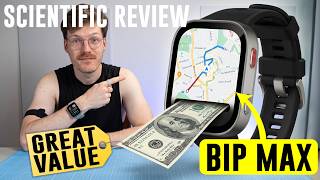
This video is a scientific review of the Amazfit Bip Max smartwatch, priced at around $100. The reviewer, a post-doctoral scientist, evaluates heart rate tracking, sleep stage tracking, and GPS performance using reference devices and detailed data analysis.
Chapters
The Amazfit Bip Max is a budget smartwatch that performs well in testing, especially for the price of around $100. It offers a good screen and form factor, but has some limitations.
During indoor cycling, the heart rate correlation with an ECG chest strap was 0.91, with one missed interval. This was the worst cardio result, but likely an exception.
Running heart rate tracking was excellent with a correlation of 0.99. There was one run with a slightly low reading for a while, but overall performance was among the best compared to competitors, including Garmin.
Outdoor cycling heart rate correlation was 0.97, with minor deviations. Performance was close to the more expensive Amaze Helio strap and Fitbit Air, making it a great budget option.
Weight lifting heart rate tracking was not great; it often detected too low heart rates and missed peaks. However, most devices struggle during weight lifting.
The overall heart rate score is 95.8, placing it in the 'great' category. It's an amazing heart rate tracker for the price, with only minor issues during spinning.
Sleep stage tracking was compared to a reference EEG headband over just two nights due to reference data issues. Deep sleep agreement was 92%, RAM sleep agreement 84%, but light sleep agreement was only 65% because it over-detected deep and RAM sleep.
The Bip Max's sleep tracking performance is close to the Amaze Vegeta 2 Pro and among the best devices. With more data, it could enter the top six brands for sleep tracking.
Despite the limited data, the sleep stage rating is 'great' with a score of 80, mainly because it over-predicts deep sleep and RAM sleep, affecting light sleep agreement.
GPS tracking was tested by repeating the same routes. Cycling to work showed some acquisition delays and deviations but was acceptable. Running near a large wall introduced significant noise, showing sensitivity to interference.
GPS tracking gets a score of 65 out of 100, described as 'okay'. Overall, given the price, the device is a really good deal, but it is bulky and the app is cluttered.
The reviewer recommends the Bip Max for budget-minded users who want a sports and smartwatch without subscriptions. There are no subscription fees, and the app, while not perfect, works adequately.
The Amazfit Bip Max is a standout budget smartwatch, offering excellent heart rate accuracy and solid sleep tracking, with GPS as its main compromise. For $100, it's a strong recommendation for anyone new to fitness tracking or who wants a no-subscription sports watch.
Mentioned in this Video
Study Flashcards (9)
What was the heart rate correlation during indoor cycling for the Amazfit Bip Max?
easy
Click to reveal answer
What was the heart rate correlation during indoor cycling for the Amazfit Bip Max?
0.91
01:15
What was the heart rate correlation during running?
easy
Click to reveal answer
What was the heart rate correlation during running?
0.99
02:51
What was the overall heart rate score out of 100?
medium
Click to reveal answer
What was the overall heart rate score out of 100?
95.8
07:10
What were the sleep stage agreement percentages for deep, RAM, and light sleep?
hard
Click to reveal answer
What were the sleep stage agreement percentages for deep, RAM, and light sleep?
Deep: 92%, RAM: 84%, Light: 65%
10:04
What was the sleep stage rating score out of 100?
medium
Click to reveal answer
What was the sleep stage rating score out of 100?
80
14:52
What was the GPS tracking score out of 100?
medium
Click to reveal answer
What was the GPS tracking score out of 100?
65
17:48
In which activity did the Bip Max perform worst for heart rate tracking?
medium
Click to reveal answer
In which activity did the Bip Max perform worst for heart rate tracking?
Indoor cycling (spinning)
01:31
In which activity did the Bip Max perform poorly for heart rate tracking?
easy
Click to reveal answer
In which activity did the Bip Max perform poorly for heart rate tracking?
Weight lifting
06:28
What reference device was used for sleep stage tracking?
easy
Click to reveal answer
What reference device was used for sleep stage tracking?
ZMAX EEG headband
08:04
💡 Key Takeaways
High Heart Rate Score
A budget watch scoring 95.8 in heart rate tracking is exceptional and challenges more expensive competitors.
07:10Sleep Stage Performance
With 92% deep sleep and 84% RAM sleep agreement, the Bip Max rivals top-tier devices despite over-detecting those stages.
10:04Top Six Potential
The sleep tracking algorithm could place Amazfit among the top six brands, a significant achievement for budget devices.
11:31GPS Limitation
The GPS score of 65 is the weakest area, but the reviewer notes it's acceptable for the price, helping buyers set expectations.
17:48No Subscription Model
The absence of subscription fees adds significant value, making it a practical recommendation for budget users.
19:57Full Transcript
[00:03] crazy. We just had the Fitbit Air release and now the Amaze Fitbit Max is performing really well in my testing as you will see. Though there are a few limitations, but for just a h 100red bucks, what can you really expect? And
[00:16] this device seems to be doing really well in a lot of categories. Now, for my name is Rob and I'm a post-doctoral scientist specializing in biological data analysis. And that's exactly what we'll focus on today. Data analysis of
[00:30] the health tracking features of the new Amazefitit Bib Max. And this device is doing really well for the price. For just $100, you're getting a pretty good just $100, you're getting a pretty good screen, a nice form factor, and pretty
[00:44] that. And let's start with the heart I want to start with the heart rate tracking performance during indoor cycling. So this is indoor cycling right here with the heart rate as measured by
[00:58] horizontal axis which is an ECG chest strap and the heart rate as measured by the amazefit bit max along the vertical axis where each point here is a single perfectly agree all points should be on or close to blue line and for the most
[01:15] part they are quite close. There is one moment of deviation right here, which means the correlation right here at 0.91 isn't quite as high as I'd hoped, but this is still pretty okay because I suspect it's just one moment of
[01:31] deviation. And specifically, it's this moment right here. So, most of my intervals were detected, but it did miss this first interval. But given the other results, I won't weigh this very highly. Now, unfortunately, for indoor cycling,
[01:44] I just have this single session. I had a problem with one of the reference measurements. So, I only had two total to start with and had to exclude one. But the other data I think is even more important. But let's first take a look
[01:56] at how this value in terms of correlation compares to the competition. And this is actually the one cardio exercise I would say where it didn't perform amazing. Probably still good enough. I do think this is likely going
[02:08] to be exception rather than the rule. Mostly based on the other data. So, we right as possible. Well, that means there's better performance. So, we're using that correlation value and the Amaze bit max is rather low in this
[02:21] overview. Close to the Ultra 2 from Amazefitit, but I would have expected more roughly in this area right here close to the T-Rex 3 Pro, the Active Max, the Cheetah 2 Pro, the Active 3 Premium. So, I suspect with more testing
[02:36] it would end up here or maybe even a bit higher given that it isn't very heavy. exercises where I have more data. And one of those is running right here. And here it did super well. So again, the reference along the horizontal axis and
[02:51] the amazed bit max along the vertical axis where most points are close to or on the blue line. So that's very good with the really high correlation at 0.99. And if we look at the individual runs, we actually have one run with some
[03:06] issues and that's this run right here. So here I detected a slightly too low heart rate for a while. So the amazing bit max is in red and the reference in blue green. Otherwise pretty good with some minor deviation here. Then this
[03:18] session really good. Nothing to complain about. And also this session almost perfect. So mostly for running it's just doing really well and also really well compared to the competition. So we have the amazefit Max right here and compared
[03:33] to the competition that's doing really well. So it is really among some of the best performers right here. So close to the Amaze Helio strap with the same sensor, but that I actually wore on my bicep. So I have several test of the
[03:47] Amaze Helio strap right here. But also the Amaze Helio strap on the wrist right here did pretty well. You cannot see it. Let me actually get rid of some stuff. So the Amaze Helio strap on the wrist was also really well and is really close
[04:01] was also really well and is really close in performance to the Amaz. So Macefitit for running is doing a really good job and really a lot better than some other devices out there. Even some brands that are known for more
[04:13] sports like Garmin for instance, though Garmin is probably also good enough, but here the Amaze Fitbit Max did really well. And we can actually zoom in a bit to just the better performing watches. So here we have the Amaze Bit Max and
[04:28] it's close to the Amaze Helio strap on the wrist. other Amaze Fit Helio strap testing and actually doing very similar to the Fitbit Air, which is in that same price category, but without a screen. So, depending on the form factor, maybe
[04:42] the Amaze Fitbit Max is a better choice for you. But let's now make things a lot more difficult and let's take a look at the results for cycling outside. So, cycling outside tends to be a lot harder because there's more tension on my wrist
[04:55] and a lot more bumpiness. But still here it's looking really good with a correlation of 0.97. So not perfect. There are minor moments of deviation, but this is really minor and this is likely good enough for sure.
[05:10] individual bike rides, it misses some of the details in my peak. So the maze bit maxim is a little bit lower than the reference. Also right here, a little bit looking pretty good. Some details here as well. This is looking really good.
[05:26] also right here. Nothing really to complain about. Some minor details missing. So, overall looking really good for cycling outside. So, if we take the Amazefit Bitmax right here, it's close to the Amaze Helio strap on my biceps,
[05:41] but also not that far from the Amazefit Helio strap on the wrist, which again has the same sensor and also not that far away from the Fitbit Air on the wrist. So, all of these devices are not expensive, around $99 and doing really
[05:57] well. So, these are really some great budget options. Yes, likely with an Apple Watch, you might get a bit better performance. Same is probably true for a Pixel Watch 4, but is it worth that extra money for you? I'm not so sure.
[06:12] And again, if we zoom in, we can really see it's among some of the best performers out there. So really just overall good performance for the Amazing and cycling outside. As I said, I had limited data for cycling indoors. I
[06:28] think it's good enough for that. So overall doing really well. The one thing it isn't doing so well for door is weight lifting. So this is weights. And this I would say is something where the Amazing.
[06:42] So we can see that quite often it texts to low heart rate and we can see that if we take a look at an example session right here. So it wasn't able to detect all the peaks in my heart rate. Some but not all. So I would say for
[06:55] weightlifting likely not the top choice but most devices aren't good enough during weightlifting. So let's give that a score. How good is the heart rate tracking of the Amaz? Well, the overall heart rate score is
[07:10] 95.8, which puts it into the category of great heart rate tracking. So, really an amazing heart rate tracker for the price. We only really saw some minor issues during spinning. I want to do
[07:23] some more testing in the future. But given the amount of devices that are releasing at the moment, I just don't have the time to do more exercises with have the time to do more exercises with the Amaz.
[07:37] the price, I'm really happy with it. But let's next take a look at this sleep stage tracking performance because that is something that Amazefitit recently updated. I'm actually testing that right now with the Amazed Helio strap with the
[07:49] new algorithm and I'm really excited to see how that compares to both the Whoop strap and the Fitbit Air right here. But today we're talking about Bitmax. So, tracking performance, which I compared against the ZMAX EEG headband, which can
[08:04] actually measure my brain waves. But before looking at those results, I because running this channel next to my full-time job as a scientist is neither easy or cheap. I pay my editor, Alex, for instance. I have a bunch of
[08:17] different camera gear right here. And I've bought most devices I've ever sent me this for testing. So, if you want to support, there's multiple ways of doing that. the most direct ways by using one of my affiliate links down
[08:30] Amazon affiliate link to make any purchase, even something as small as toilet paper or coffee beans. And any purchase you make on Amazon then bookmark it with command or control D. There's also specific affiliate links,
[08:44] There's also specific affiliate links, for instance, to the Amaz, but also to, for instance, the Helio strap, the Whoop strap, the Fitbit Air right here, or my Aleppod. And for many of these, you even get the best discount possible and get
[08:58] want to support that's really the easiest way. Don't forget to subscribe and like. But let's get back to the testing. And as I said, we're going to look at the sleep stage tracking performance. One big side note though,
[09:11] nights, but I had some issues with my reference device. And in the end, there were only two nights left where I judge the data of the reference to be of sufficient quality. So this is going to be an initial test. And if you want to
[09:24] algorithm of Amazefitit, check out my testing of the Amazefit Helio Strap out soon where I will have many more nights of data to look at. But I did want to show you my first results right here where on top we have the sleep
[09:38] stages as tracked by the reference device and on the left we have the sleep device and on the left we have the sleep stages as tracked by the BIP Max. And if they would perfectly agree, all values along the diagonal right here in yellow
[09:51] should be 100%. This is actually looking pretty good. Now, this is just for two nights of data. So, there is a big asterisk here. But as a first result, this is looking really well. So, about 92% of what was deep sleep according to
[10:04] the reference was also deep sleep according to the bit max. Light sleep agreement wasn't quite as good. It's at 65% let's say with a lot of extra deep you will see that's actually the major limitation of this device where it's
[10:19] limitation of this device where it's detecting too much deep sleep and also too much RAM sleep. But many devices tend to do that. And the RAM sleep agreement is again really good at 84%. So overall really good performance
[10:33] algorithm that they were using. If we just look at one example night, you can actually see what's going on. So on top here we have the reference device. So we sleep, light sleep, and deep sleep. And on the bottom, the same night for the
[10:47] amazefit bit max. So we actually see all of the deep sleep that was detected by the reference is also detected by the amazement bit max, but some extra deep sleep is detected. And you can see more or less the same for this second example
[11:01] night. And then for RAM sleep, we also see most of the RAM sleep as detected by the reference was also detected by the Amaz. It just detects some extra RAM sleep again. And the same here for the second night. some extra RAM sleep being
[11:16] detected. So, not perfect, but definitely an improvement. And we can to that of many other devices I've previously tested. And that's displayed in this overview right here with the average sensitivity along the horizontal
[11:31] axis and the worst out of those three sleep stages. So, deep sleep, RAM sleep, and light sleep along the vertical axis. And we have the Amazefitit Bip Max right here. So, it's doing really well. It's actually quite close in performance to
[11:45] the Amaze Vegeta 2 Pro I recently tested. And I think they should have the same sleep stage tracking. So probably the truth is somewhere in the middle, maybe here. I'm not 100% sure, but I think the Amazed Active 3 Premium might
[11:59] have used the same algorithm. So I don't know why there's so much spread. I think mostly this testing here is limited. So there's an asterisk here because I only had two nights of data. Hi, Rob from the future here. So quick note, I'm at work
[12:12] and audio quality, but I was looking at the results and I noticed that the Amaze Fit Cheetah 2 Pro was a little bit better than my initial review. And this is because I added some data. It seems that wasn't in the initial review, which
[12:25] actually made the overall results a tiny bit better. So, about 2 to 5% per sleep stage, which is why it's now in between the position of the Active 3 Premium and the Bitmax. So, for the Cheetah 2 Pro, I think I had about a week's worth of
[12:39] data, maybe 6 days or 7 days, and of course, a lot more than for the Bit Max. more testing of the Bit Max, but also the Helio Strap if both of those will also end up at that position of the G2 Pro or closer to my current testing of
[12:52] the Bit Max. Overall, they're looking really good because the best devices are here amongst the top right. And if this holds true, which you will see in my further testing of also the Helio strap, Amazefitit could make it into the top
[13:06] six brands out there. So the common brands that do really well in terms of sleep stage tracking are the Aura Ring for instance with their new Aura Ring 5, the Whoop Strap, also Google and Fitbit with their Fitbit devices and Pixel
[13:19] watches. Then there is of course the Apple Watch which is doing really well in my testing. And finally, there's the eight sleep pod, which is my favorite expensive device. It's not a wearable. Goes around your mattress. And it can
[13:32] actively cool and heat each side of the bed independently. As I said, it's my favorite sleep improvement device because I really suffer in summer. And actually sleep. And when I have a partner, she can set her side of the bed
[13:45] at an independent temperature, usually warmer than mine. That goes for both the blanket and the surface of the mattress. And in addition, it has really good way amongst the top five brands out there. But as I said, it's really
[13:57] expensive and the main reason I use it is for the cooling functionalities. Now an affiliate link down here or down here that will let you try it for a while and discount possible. But getting back to the Amaz right here with that asterisk,
[14:13] it might actually be doing really well or at least getting very close in performance to the best devices out there or it might already be there and that could be super exciting. Then we're going to have several cheaper brands
[14:25] Fitbit and also Amazit that have good sleep stage tracking and good heart rate tracking. More testing is needed though, but I did want to share you the results that I have now because I just don't have the time and opportunity to do more
[14:38] But as I said, I am testing the Amaz Helios strap again with the new algorithm and also the new cheetah model from Amaze Fit. So, the new running and the same sleep stage tracking capability. Now, if we give it a mark
[14:52] with a big asterisk included because we only have two nights, I would give it a sleep stage rating of great and a score of 80. So, I'm really happy with that performance. It just predicts a little bit too much deep sleep and RAM sleep,
[15:07] which is why the light sleep agreement isn't perfect, but overall some of the best performance out there. So, that now covers the heart rate tracking performance and sleep stage tracking performance. Both of which fall into the
[15:19] category of great. But there's one thing remaining, the GPS tracking performance. And this is where I have to say this is probably where some cheaper parts were used and you're not going to get the absolute best GPS tracking performance.
[15:33] tested the GPS tracking performance during both cycling and running. And the way we're going to test the GPS tracking performance is by cycling and running the exact same route several times. And if the signals overlap nicely, that
[15:47] likely means that the GPS tracking is very good. And if there's a big deviation, it's likely not very good. Now, I tested it four times cycling to work and four times back from work. And let's start with the first. So, cycling
[15:59] to work. And the signal wasn't quite acquired instantly. So, two times right here, it took a little bit of time for it to be acquired. And after that, we do see some deviation. So, more deviation I'd like to see right here. Still some
[16:12] deviation here. And then it's starting to look better. Not perfect, but okay, I would say. And here is actually looking quite good. So, this final part of the solid. That's something I'm happy with. But let's also take a look at the
[16:27] results for four times I cycled back from work. And here the signals were acquired very fast almost instantly with some deviation right here where there's all of a sudden a shift in my location. This wasn't actually something that
[16:39] the signal. Then there is some deviation here. Not the worst but okay. This also looks okay. Some deviation also right here. Overall not bad actually. But
[16:53] where I saw some issues or more issues was with running. So let me show you those results. I did two runs and actually ran in a circle right here in Park Belvadier. And this was the run where I saw the major issues. And on the
[17:08] left right here of this sort of rectangle that I ran in, you can see the signal quality is quite good. The signals are quite close together. But on the right right here, the sort of orangey brown color is a large wall that
[17:22] tends to interfere with the GPS tracking signal. You can indeed see that there's quite some noise introduced here. So it is a bit sensitive to interference. So this is not perfect, but okay. I actually had a second run as well. So
[17:35] let's take a look at that. That mostly shows the same phenomenons. On the left, really good. On the right, a bit of deviation. For the price, this is still quite okay, but not quite topofthe- line as you're going to get for instance with
[17:48] our top-of-the-line Cheetah models. But of course, I also gave it a score. And in terms of GPS tracking, it gets a score of 65 out of 100. So pretty good. And I would call that okay GPS tracking. So overall, if I would have to rate this
[18:04] device in total, especially given the price, this is a really good deal. Now, you do need to like the design. So it's really more of a square design, and it does feel a bit more massive than many other devices out there. It's not a
[18:19] small device. So if I compare it to for instance the Fitbit Air, you can see what a difference that is in size and it's just a bit of a bulky watch. It's also not thin. So in terms of size, you do need to have big enough wrists.
[18:32] However, overall for the price, the performance, if we just look at the data, which is of course limited because it was on me for a limited amount of days, it is still looking really good. This is something I could recommend to
[18:45] quite a few people for the price. If you're new to tracking your rides, your runs, your sleep, this could be a good first model for you to try because basically a smartwatch with all the functionalities and it appears to have
[19:00] good data quality. Now again, this is an initial test of this device, so I want might also give it to my colleague Raphael to try out for a while, but the first indications are good. Now, the one thing I hope Amazefit still improves is
[19:15] the Zap app. Here we have it. It looks quite okay, I would say, but it is quite cluttered. It doesn't give me the best overview, and I think some redesign could help here. Now, overall, they did copy quite a few points from the older
[19:31] Whoop app, but I think it generally works quite okay, but it's a bit sluggish overall with not the optimal design. So, I have some pointers there for them. Also, starting a workout sometimes, so I use the Helio Strap can
[19:43] take a while for it to stop the workout. It sometimes just doesn't feel the It sometimes just doesn't feel the smoothest, but again, for the price, it functionalities are free. There are no subscriptions. So, overall, I can
[19:57] actually recommend it to many people that just don't want to spend a lot of money and still want a sports and smart watch. Now, of course, if you spend more another device, you will get better performance. not from the app, but from
[20:10] the watch itself. But is that worth it for you? Or is this a good enough enough with this? I know, for instance, my editor Alex is already really happy with his Amaze Fit BU, I believe it is, which is even cheaper than this device.
[20:25] Now, if you do end up getting yourself an Amaze Max or a Fitbit Charge 6, a Whoop strap, an Amaze with Helio Strap, my favorite sleep improvement device, the eight sleep pot, or anything at all on Amazon for that matter, even
[20:39] something as small as toilet paper or coffee beans. You want the best discount channel, there's different affiliate links in the description below that let you try out the devices and also gives you the best discount possible. Now,
[20:52] given that you watched this video on the Amaz, I think you will like this video on the Fitbit Air or this video on the HL pod.